ILLUSTRATIVE CUSTOMER JOURNEY
Cleanroom Garment Incident Recovery
Reconstruct how a pharmaceutical production customer moves from a garment contamination alert to a verified replacement and restored operating confidence.
THE CLIENT DECISION
Which handoffs, evidence gaps and ownership boundaries should be redesigned so an affected garment can be withdrawn, replaced and accepted without avoidable production uncertainty?
The situation
A pharmaceutical manufacturer relies on reusable cleanroom garments processed and returned through an external service chain. When a garment is suspected of contamination, damage or processing failure, the customer must protect the controlled environment while determining what happened, locating the affected garment, obtaining a suitable replacement and rebuilding confidence that the incident is closed.
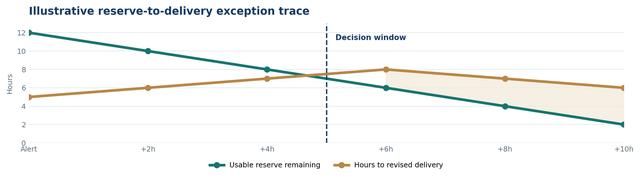
The visible delay may appear at replacement delivery, but the initiating breakdown may have occurred earlier when the incident was recorded, the garment identifier was transferred, responsibility changed or release evidence was not visible to the next decision owner.
Journey boundary
ALERT
Garment concern is identified
CONTROL
Garment is removed and isolated
REPLACE
Suitable replacement is assigned
VERIFY
Status and release evidence are checked
RESTORE
Operator returns with confidence
Illustrative scope parameters
CASE BASE
Four to six recently closed incidents across two or three facilities
PROXIMITY
On-site stock, local service route and remote processing hub compared
OUTCOMES
Same-shift recovery, delayed return, escalation and workaround cases
PARTICIPANTS
A feasible starting range of 14 to 18 interviews across all roles
EVIDENCE
Permitted incident, garment, service, dispatch and release records
TIMING
Approximately five to seven weeks after access and feasibility are confirmed
The scope is designed around closed incidents, not a broad satisfaction sample. Final case count, facilities, participants and timing depend on incident frequency, permissions, customer burden and evidence availability.
RESEARCH DESIGN
Recruit around the incident, not around job title alone
Each case is reconstructed through the people and records that directly carried the incident from alert to accepted recovery.
How cases and participants are selected
- Closed incident with a recognisable outcome. The garment was withdrawn, replaced, escalated or managed through a temporary workaround.
- Recent enough for stage recall. Participants can identify sequence, elapsed time, evidence requested and the moment responsibility changed.
- Contrasting recovery conditions. Cases vary by facility, shift, garment type, stock location, distance to the service hub and recovery outcome.
- Direct role in the pathway. Participants are selected because they observed, owned or approved a stage, not simply because they are senior.
Only approved records are used, and customer identities can be separated from cross-case reporting.
Participant architecture
CLEANROOM USER OR SHIFT LEAD
Alert, control action, interruption, workaround and return confidence
QA OR DEVIATION OWNER
Classification, evidence threshold, closure and unresolved risk
GARMENT OR SITE COORDINATOR
Identifier, quarantine, stock, replacement and handoff
SERVICE PROVIDER OPERATIONS
Notification, lifecycle trace, processing proof, dispatch and escalation
What the outreach looks like
A QA sponsor identifies eligible closed incidents without selecting only successful recoveries.
Each case generates role-based invitations to the people who handled specific stages.
Permitted timeline anchors and fields are prepared before interviews.
Different accounts are explored independently, then reconciled through records.
Evidence pack
INCIDENT
Alert, action and closure
GARMENT
Identifier, status and replacement
SERVICE
Ticket, processing and dispatch
ACCEPTANCE
Receipt, evidence and return
INTERVIEW GUIDE
Questions begin with one shared incident background
The interviewer anchors every conversation to the same closed incident while adapting the probes to the participant's actual role.
BACKGROUND READ TO PARTICIPANTS
We are reconstructing one recently closed cleanroom-garment incident from the first alert to accepted return to use. The purpose is to understand the sequence, evidence and handoffs, not to assess individual performance or reopen the technical investigation. Please answer from what you directly saw, decided or received. Where memory is uncertain, we will mark it as uncertain and compare it only with records permitted for this study.
Cleanroom user and shift lead
- What first indicated that the garment might no longer be suitable, and what made you act at that moment?
- Walk me through what you did from removing the garment to obtaining an alternative. Where did you wait, repeat information or improvise?
- Which status updates helped you understand whether the issue was controlled, and which questions remained unanswered?
- What evidence or event made you comfortable returning to the controlled area, and whose judgement mattered most?
QA, deviation owner and garment coordinator
- Using the incident timeline, when did the issue move from a suspected garment concern to an action requiring withdrawal or replacement?
- Which garment identifier, condition detail or processing record was required before the next person could act?
- At which handoff did ownership become unclear between production, QA, the garment coordinator and the service provider?
- What had to be true before the incident could be considered operationally recovered, even if the wider investigation remained open?
Service provider operations
- Starting with the first notification you received, what information allowed you to locate the garment and open the correct service action?
- How was a replacement selected, processed and linked back to the customer's incident or affected user?
- Which status could the customer see during processing and dispatch, and where did your internal status differ from what the site understood?
- What evidence accompanied the replacement, and what additional proof would have reduced follow-up or delayed acceptance?
Follow-up probes use incident-specific time anchors, screenshots, ticket fields or garment identifiers only where the participant has permission to discuss them.
CASE-TRIGGERED RECOVERY RECONSTRUCTION
Separate the visible delay from the event that created it
The analysis keeps the customer pathway, operational record and responsibility boundary visible at the same time.
Set the alert, accepted recovery and evidence boundary for each incident.
Build a provisional event line from permitted records before interviewing.
Interview each direct participant against the same event anchors and capture uncertainty.
Compare recollection, garment status, service events and QA evidence without forcing agreement.
Link the first missed evidence or ownership transfer to later waiting, workaround or escalation.
Specify the recovery owner, evidence gate, escalation trigger and customer-visible status needed at each handoff.
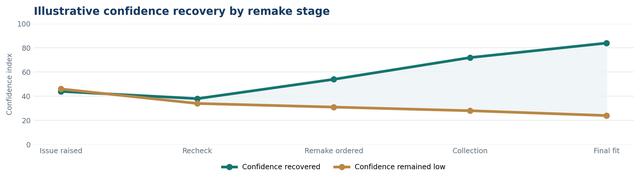
Illustrative recovery-confidence pattern
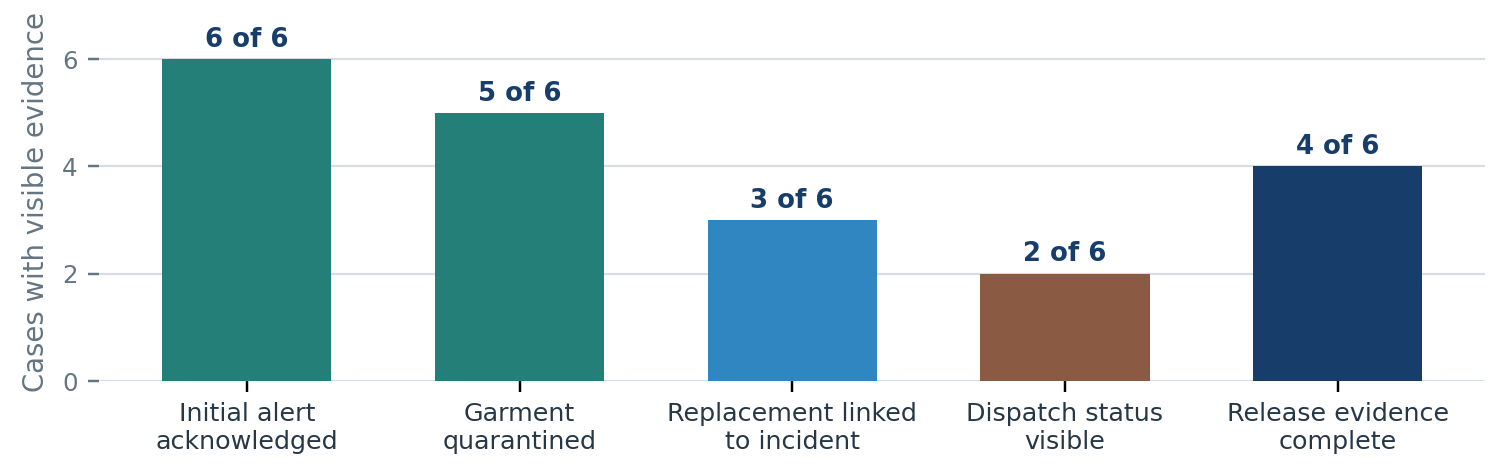
What this pattern could reveal
OBSERVED PATTERN | CUSTOMER CONSEQUENCE | DECISION IMPLICATION |
|---|---|---|
Replacement not linked to incident | QA repeats the identifier and processing request | Use one incident-linked replacement record |
Dispatch visible only to provider | Site cannot plan cleanroom re-entry or shift coverage | Expose status and escalation time to the site owner |
DECISION OUTPUT
Turn the incident journey into a controlled recovery design
The final output identifies what must be visible, who must own the next action and when escalation should begin.
Recommended recovery design
ONE CASE ID
Connect alert, garment, replacement and closure
NAMED OWNER
One person carries recovery across handoffs
STATUS WINDOW
Show acknowledgement, processing and dispatch
RELEASE PACK
Provide agreed evidence at receipt
ESCALATION
Trigger before production impact expands
What the client receives
- Incident Recovery Pathway. Customer action, service event, evidence and elapsed time by stage.
- Responsibility Boundary Map. Where production, QA, garment coordination and service operations exchange control.
- Recovery Confidence Gates. Evidence required for withdrawal, replacement, receipt and return to use.
- Exception Case Register. Initiating breakpoint, downstream consequence and evidence strength across contrasting cases.
- Intervention and Management Brief. Prioritised ownership, status, evidence and escalation changes with a decision presentation.
Delivery approach
WEEK 1
Boundary, permissions, cases and evidence fields
WEEKS 2 TO 3
Recruitment, interviews and record linkage
WEEKS 4 TO 5
Cross-case analysis and responsibility map
WEEK 6
Customer and service validation
WEEK 7
Decision workshop and final outputs
FLEX POINT
Timing follows access and response feasibility
Study boundaries
This engagement maps the customer and service recovery journey. It does not determine contamination root cause, validate processing, replace a deviation investigation or provide a GMP compliance audit.
NOTE
This example does not describe a client engagement. Facilities, cases, participant ranges, evidence, findings and timing are hypothetical and would be redesigned after feasibility, privacy and access are confirmed.
Contact Us
Discuss a journey that crosses teams or service partners
Tell us the outcome, journey boundary, facilities, participant access and available evidence. August Research will design the outreach, pathway method and decision outputs around the recovery question.