CUSTOMER JOURNEY MAPPING | LONGITUDINAL WARRANTY JOURNEY
Returning an e-bike rider to a safe, confident ride
A triggered warranty diary following the rider, support team, dealer and parts path from fault report through the first post-repair ride.
TRIGGER
Eligible warranty claim opened
OUTCOME
Rider safely returns to use
EVIDENCE
Diary pulses and service records
DECISION
Reduce inactive and uncertain days
Why a live journey is needed
A manufacturer selling through both direct and dealer channels wanted to understand why similar faults produced very different periods off the road. The warranty record showed case status, but it did not show when riders stopped trusting the process, repeated troubleshooting, searched for a willing repairer or remained hesitant after collection.
Outcome definition
DIAGNOSED
Fault and safe next step understood
SUPPORTED
Owner knows who is responsible
REPAIRED
Approved work completed
RETURNED
First ride confirms confidence
External research advantage
A neutral researcher can hear how riders interpreted safety, warranty eligibility and repair responsibility without turning the conversation into an active support case or asking a dealer to defend the process.
Illustrative study
All figures and findings are hypothetical. A practical live cohort is 6 to 8 eligible claims across 2 to 4 dealer areas, subject to claim incidence, safety exclusions, consent and repair duration.
TRIGGERED OUTREACH
Recruit at claim opening and stay with the rider
Short pulses capture uncertainty when it happens; interviews explain the critical turns after the journey closes.
Longitudinal contact plan
CLAIM
DIAGNOSIS
APPROVAL
REPAIR
FIRST RIDE
Baseline and rider reliance
Evidence requests and safety guidance
Coverage and repair route
Parts, scheduling and updates
Confidence and unresolved concerns
Who is included
RIDER
Use reliance, safety perception and workaround
SUPPORT AGENT
Triage, evidence and coverage communication
DEALER OR TECHNICIAN
Diagnosis, repair acceptance and completion
PARTS OR SERVICE OPERATIONS
Availability, routing and escalation
Cohort parameters
- Safety-critical versus mobility-limiting fault
- Daily transport reliance and access to an alternative mode
- Distance or travel time to an authorised repair option
- Local stock, regional transfer and manufacturer-order parts paths
- Direct-to-consumer versus dealer-supported purchase route
SCOPE-SPECIFIC METHOD
Fault-to-Ride Diary
Each pulse records what changed, what the rider understood and which handoff became the next dependency.
Interview background
The rider is told that the research team cannot diagnose the e-bike or provide safety advice. Active concerns remain with the manufacturer or qualified repair channel. Questions focus on communication, handoffs, waiting and confidence.
Sample questions tied to milestones
Before submitting the claim, what made you decide the bike should not be ridden, and where did you look for confirmation?
You were asked for a video and serial information. Which request moved the diagnosis forward, and which felt repetitive or unclear?
During the parts wait, what update would have changed what you planned for work, school or daily travel?
What did you check before riding again, and what made the repair feel trustworthy or incomplete?
At what point could you confidently select a repair route, and what missing evidence delayed that decision?
What information or part confirmation was needed before you could accept and schedule the job?
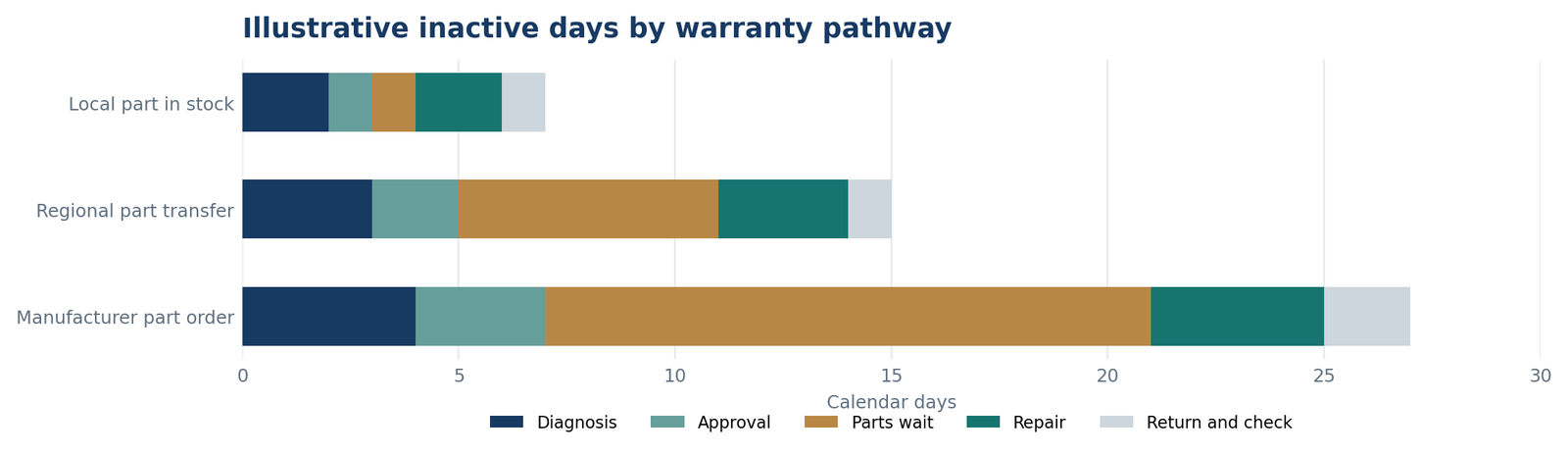
ILLUSTRATIVE WAITING-TIME COMPOSITION
Parts routing can dominate the journey even when repair work is short
The visual separates inactive time by dependency so the client can act on the right delay.
Decision implication
The journey should not use one generic case status. It should identify the current dependency, the owner of the next action, the expected update point and the safe rider action while waiting.
DIAGNOSIS
Evidence complete or still needed
ROUTE
Dealer, mobile or self-install path
PART
Availability and expected movement
RETURN
Repair check and first-ride reassurance
DECISION PACKAGE
Turn claim status into a return-to-ride system
Outputs connect rider confidence and operational time to specific warranty handoffs.
Client outputs
LONGITUDINAL JOURNEY
Rider, support, dealer and parts milestones
INACTIVE-TIME VIEW
Waiting time split by operational dependency
HANDOFF RULES
Owner, evidence and next-update definition
STATUS CONTENT
Stage-specific messages and rider actions
RECOVERY MEASURES
Return-to-use and confidence indicators
DECISION WORKSHOP
Priority fixes by channel and fault type
Indicative delivery
Approximately 6 to 8 weeks for a small live cohort, with timing dependent on claim incidence and parts pathways. Longer claims may be analysed as open journeys rather than held until every case closes.
Contact Us
Discuss your customer journey question
Tell us the warranty routes, rider markets, dealer footprint and return-to-use decision you need to improve. August Research will design the cohort around realistic claim incidence and participant safety.