CUSTOMER JOURNEY MAPPING | OPERATIONAL EXCEPTION
Keeping a remote construction site operating when a fuel delivery slips
A live exception study showing when limited reserve, changing arrival information and unclear escalation turn a delivery delay into shutdown risk.
OUTCOME
Critical equipment remains fuelled
TRIGGER
Delivery ETA no longer reliable
PRIMARY ROUTE
Event-triggered mobile outreach
DECISION
When and how to escalate
The client decision
A fuel distributor serving remote construction projects wanted to redesign the exception journey. The challenge was not the scheduled delivery itself, but the period after an ETA changed and before the site knew whether to conserve, reroute, activate reserve supply or request an emergency top-up.
Journey boundary
ALERT
Delay first becomes visible
VERIFY
Reserve and revised ETA checked
DECIDE
Site and dispatch select a response
DELIVER
Fuel reaches the controlled site
RECOVER
Operations and records stabilise
Why fieldwork matters here
An exception changes by the hour. Capturing the event while dispatchers, drivers and site teams are making decisions preserves revised estimates, informal workarounds and responsibility handoffs that a later satisfaction interview may compress or forget.
Illustrative study
All figures and findings are hypothetical. A practical starting frame is 4 to 6 closed exceptions across 2 or 3 sites, with final scope confirmed after incident availability, access and safety review.
LIVE OUTREACH DESIGN
Follow the exception, not the normal delivery
Participants are contacted through the active event, then interviewed after the outcome is known.
Event-triggered outreach
1 FLAG
2 PULSE
3 TRACE
4 REPLAY
Client identifies a qualifying delay after consent rules are agreed
Site and dispatch complete a 3-minute mobile check
Updates, calls and operational decisions are logged
Separate interviews reconstruct the closed exception
Who is heard
SITE MANAGER
Operational impact and shutdown authority
FUEL COORDINATOR
Tank level, consumption and site access
DISPATCHER
Replanning, alternatives and customer updates
DRIVER
Route, access and delivery constraints
CARRIER OPERATIONS
Capacity and escalation rules
PROJECT CONTROLS
Cost and schedule consequence where relevant
Selection parameters
- Distance and travel time from the supplying depot
- Usable reserve hours and equipment criticality at the time of the alert
- Road, weather, access-window and shift conditions
- Recovered, escalated and near-shutdown outcomes
SCOPE-SPECIFIC METHOD
Reserve-to-Recovery Trace
Each case aligns what every role knew with the reserve position and the decisions available at that moment.
Interview background
The interviewer explains that the study is not evaluating an individual dispatcher or driver. It examines one completed exception so the company can understand how information, thresholds and handoffs supported or delayed recovery.
Sample questions by role
When the revised ETA first exceeded the site's reserve window, what options were genuinely available and who could authorise each one?
At the first alert, how was usable reserve calculated, and what site condition made that estimate more or less reliable?
What did you know when you issued the first update, what was still uncertain, and what threshold would have triggered an alternative vehicle?
Which route or access condition changed the delivery plan, and when could that information realistically have reached the site?
Which exception could the standard process absorb, and which required a named escalation owner?
Operational messages, dispatch records, tank readings and delivery timestamps are included only when permission and data quality allow.
ILLUSTRATIVE JOURNEY SIGNAL
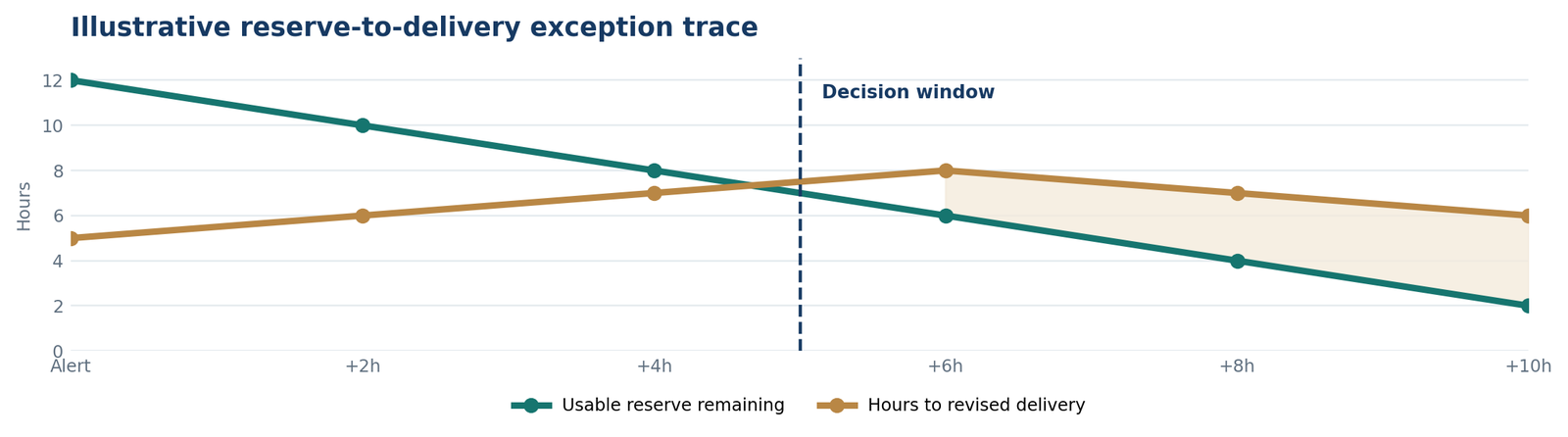
The critical point appears before reserve is exhausted
The map identifies the moment when the site still has time to choose a controlled response.
Decision implication
The journey would be redesigned around a shared reserve-to-ETA trigger. When revised delivery time approaches usable reserve, the dispatcher must name the next update time, the alternative option and the person authorised to activate it.
VISIBLE THRESHOLD
One reserve and ETA view for site and dispatch
OWNED UPDATE
A named person and next-update commitment
PRE-AUTHORISED PATH
Clear reroute, reserve or emergency rules
Indicative delivery
Approximately 5 to 7 weeks, depending on exception frequency, site access and evidence availability. Outputs include the exception trace, escalation design, role handoffs and measurement plan.
Contact Us
Discuss your customer journey question
Tell us the sites, delivery model, reserve conditions and exception decision you need to improve. August Research will design the outreach around the operating reality of those locations.