CUSTOMER JOURNEY MAPPING | CUSTOMER CONFIDENCE RECOVERY
From an eyewear remake request to a confident final fit
A paired-episode study examining why some customers regain confidence after a remake while others remain uncertain even after the product is corrected.
CUSTOMER
Recent prescription-eyewear buyer
OUTCOME
Comfortable, accepted final fit
CONTRAST
Recovered versus unresolved confidence
DECISION
Where reassurance must be rebuilt
The customer problem
An optical retailer wanted to improve the remake journey for customers reporting blur, discomfort, fit problems or difficulty adapting. A technically correct remake did not always restore trust. The client needed to know which interactions helped a customer feel understood, informed and ready to wear the final pair.
Two journeys with the same operational endpoint
CONFIDENCE RECOVERED
Customer accepted the explanation, remake and final fit
CONFIDENCE REMAINED LOW
Product collected, but doubt, avoidance or repeat contact continued
Evidence sought
What reassured the customer and confirmed progress
Evidence sought
Where uncertainty remained despite operational completion
Why independence helps
Customers may soften criticism when speaking directly to the store that tested, dispensed or remade their eyewear. A neutral interviewer can separate adaptation, communication, measurement and fit concerns without assigning blame.
Illustrative study
All figures and findings are hypothetical. A practical frame is 8 to 12 recently closed remake episodes, selected only after access, consent and the available mix of outcomes are checked.
PAIRED EPISODE DESIGN
Recruit from completed remakes, then compare recovery paths
The outreach begins after resolution so the complete journey can be reconstructed without influencing care.
Hybrid outreach
CUSTOMER INVITATION
Neutral invitation sent after the remake episode closes
STAFF MATCH
Relevant store or service staff linked to the same episode
LAB TRACE
Production or service handoff reviewed where permitted
Episode selection
REMAKE REASON
Vision, adaptation, measurement, lens, frame or fit concern
LENS CONTEXT
Single vision, progressive or other relevant lens complexity
REVISIT COUNT
One-resolution visit versus repeated visits
ELAPSED TIME
Time from issue raised to final acceptance
STORE-LAB PATH
Local, central or external production handoff
FINAL STATE
Confident wear, conditional acceptance or continuing doubt
Feasible participant mix
The starting design may include 10 to 14 customer interviews and 6 to 8 paired staff conversations. Final counts depend on the number of eligible closed episodes and should not create pressure on customers with unresolved clinical concerns.
SCOPE-SPECIFIC METHOD
Paired Remake Episode Study
A customer account is compared with the staff and service account of the same episode, then grouped by confidence outcome.
Interview background
Customers are told that the study concerns their experience of the remake process, not a clinical reassessment. The interviewer does not decide whether a prescription or lens was correct and directs active care concerns back to the appropriate professional channel.
Sample questions
When you first realised the eyewear was not working for you, what made you return rather than wait, adapt or stop wearing it?
During the recheck, what helped you believe the concern had been understood, and what still felt uncertain?
While the remake was underway, what information did you need to know that progress was being made?
At final collection, what convinced you that the pair was ready to use in everyday situations?
At the first return, how did you distinguish adaptation, fit, measurement and escalation needs?
What information arrived with the remake, and what ambiguity could cause the episode to repeat?
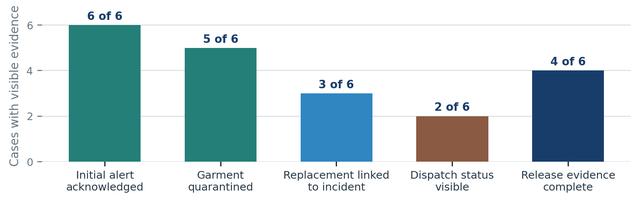
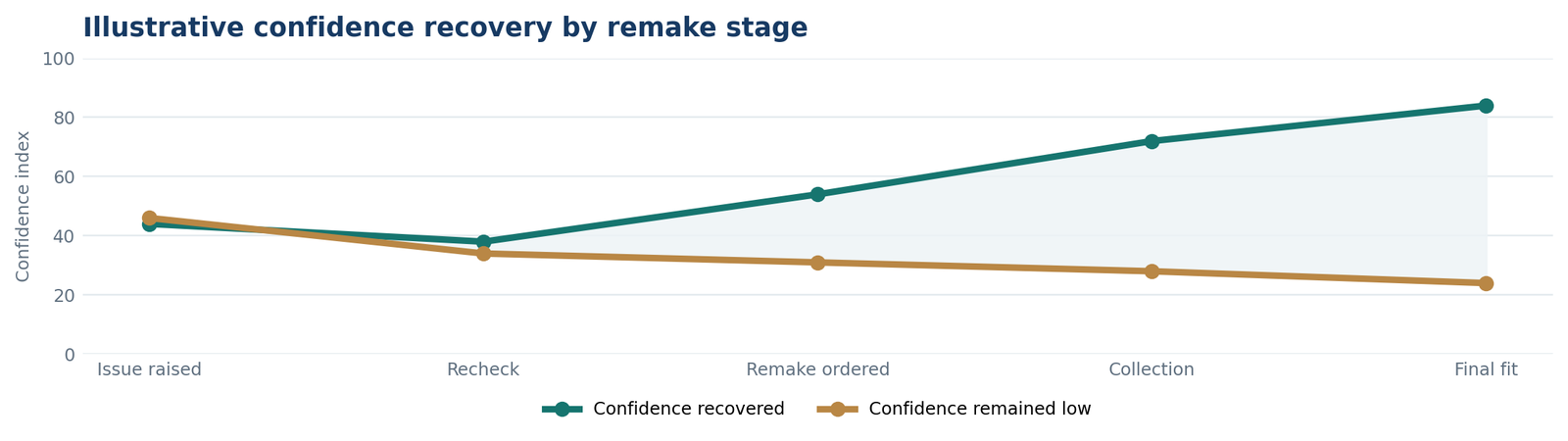
ILLUSTRATIVE CONFIDENCE PATTERN
Operational completion does not guarantee customer recovery
The useful measure is not only whether the remake closed, but whether confidence returned by the final fit.
Decision implication
The highest-value redesign would place a confidence checkpoint at recheck and final fit. The customer should leave knowing what was found, what will change, how adaptation will be judged and what to do if the expected outcome does not occur.
Client outputs
PAIRED EPISODE MAP
Customer, store and service accounts aligned by event
CONFIDENCE RECOVERY VIEW
Moments that restore or weaken acceptance
REMAKE COMMUNICATION GUIDE
Stage-specific explanations and checkpoints
MEASUREMENT PLAN
Revisit, repeat-contact and confidence indicators
Indicative delivery: approximately 5 to 6 weeks after eligible-case access and customer outreach are confirmed.
Contact Us
Discuss your customer journey question
Tell us the remake types, customer groups, store model and recovery outcome you need to understand. August Research will build the episode comparisons around the decisions your teams can change.