CUSTOMER JOURNEY MAPPING | B2B IMPLEMENTATION JOURNEY
From laboratory software migration to the first accepted report
A milestone cohort study showing how configuration, data, training, validation responsibilities and quality review combine during a regulated rollout.
SETTING
Multi-site laboratory rollout
OUTCOME
First report accepted through the new workflow
UNIT
One site-milestone cohort
DECISION
Sequence rollout dependencies
The implementation question
A laboratory software provider and its client needed to understand why some sites reached their first accepted report smoothly while others relied on shadow spreadsheets, repeated review or delayed go-live activities. The study focuses on the user and organisational journey, not on certifying the software or the client's compliance.
Outcome path
CONFIGURE
MIGRATE
EXECUTE
REVIEW
ACCEPT
Roles and workflow set
Required data available
Method completed
Quality review resolved
Report issued and trusted
Why outside research helps
Implementation teams often report progress through workstreams. Independent journey mapping follows the actual outcome across workstreams, making it easier to surface unclear responsibility, workarounds and site differences without turning the study into a vendor performance review.
Illustrative study
All figures and findings are hypothetical. A realistic starting cohort is 2 to 3 laboratories within one rollout wave, with 10 to 15 participants over 6 to 8 weeks, subject to access and information-security requirements.
MILESTONE COHORT OUTREACH
Contact each role when its dependency becomes active
Short milestone pulses are combined with observation and closing interviews rather than relying on one retrospective workshop.
Outreach architecture
SITE NOMINATION
Select sites with contrasting system and workflow conditions
ROLE ENROLMENT
Confirm decision rights and milestone involvement
MILESTONE PULSES
Capture readiness, dependency and workaround at each stage
WORKFLOW OBSERVATION
Observe selected tasks where security permits
DOCUMENT TRACE
Review approved project artifacts, not unrestricted records
CLOSING INTERVIEWS
Compare expected and experienced rollout paths
Cohort parameters
- Geography, site type and rollout wave
- Instrument and interface count relevant to the selected workflow
- Data migration and method configuration complexity
- Training readiness and prior system experience
- Local versus central quality and IT responsibilities
- Accepted, delayed and workaround-dependent milestone paths
SCOPE-SPECIFIC METHOD
First-Accepted-Report Milestone Cohort
The research follows one defined workflow and records which role, evidence and dependency controls each transition.
Interview background
Participants are told that the study is not an audit, compliance assessment or individual performance review. Questions address implementation experience, ownership and handoffs. Controlled records are included only through agreed access and redaction rules.
Sample questions by milestone
Before the first live method, which task could you complete independently and which still required a workaround or another person's help?
What did the site consider ready for use, and where did that definition differ from the rollout plan?
At the first review, which evidence supported acceptance and which issue required the workflow to return to an earlier step?
Which access, interface or environment dependency had to be stable before the laboratory could progress?
Which site assumption changed during configuration, and how was the revised responsibility agreed?
When the first report stalled, who recognised the dependency, who owned it and how was the next action communicated?
ILLUSTRATIVE DEPENDENCY VIEW
Readiness changes by milestone and role
A single overall readiness score can hide the specific dependency controlling the next transition.
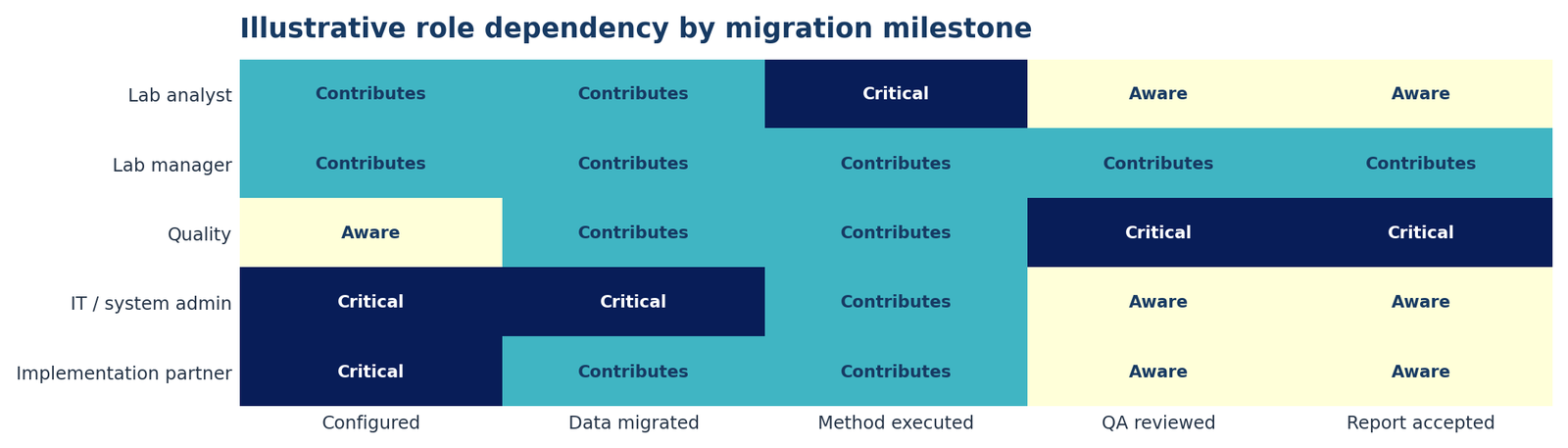
Decision implication
The rollout should use milestone-level readiness gates. Each gate names the critical role, required evidence, fallback path and acceptance owner before the next site activity begins.
DEPENDENCY
What must be complete and observable
OWNER
Who can resolve or accept the condition
FALLBACK
What happens without uncontrolled workarounds
ROLLOUT DECISION PACKAGE
A journey map built for implementation governance
The output helps the provider and client sequence support around the dependencies that control first use.
Client outputs
MILESTONE JOURNEY
Expected and experienced path by site
ROLE DEPENDENCY MAP
Critical contribution at each transition
WORKAROUND REGISTER
Reason, owner and controlled alternative
READINESS GATES
Evidence and ownership before progression
SITE COMPARISON
Parameters explaining rollout variation
GOVERNANCE BRIEFING
Decisions for rollout and support leaders
Boundaries
The engagement does not provide computer-system validation, legal advice, regulatory interpretation or compliance certification. Those responsibilities remain with the client's qualified functions and approved providers.
Indicative delivery
Approximately 6 to 8 weeks for one rollout cohort, depending on milestone timing, site access and security review.
Contact Us
Discuss your customer journey question
Tell us the laboratory workflow, rollout wave, sites and first-use outcome you need to understand. August Research will design the cohort around the actual implementation dependencies and access conditions.