R&D & INNOVATION / SECONDARY RESEARCH
Continuous Chromatography for Flexible Biologics Production
Emerging Technology Assessment | biopharma manufacturing and process development
DECISION QUESTION Does the evidence support developing a continuous downstream platform for a variable biologics portfolio, or should continuous chromatography remain limited to selected molecules and unit operations?
The situation
A biopharma process-development group is planning a flexible manufacturing platform for monoclonal antibodies and selected non-mAb proteins. The group wants to reduce resin use, pool volumes and facility footprint while handling variable upstream titre. Periodic counter-current chromatography and flow-through polishing appear promising, but the development decision affects process control, viral safety, traceability, surge capacity, equipment strategy and the comparability burden across molecules.
The regulatory pathway is clearer than it was several years ago. ICH Q13, adopted by FDA in 2023, describes scientific and regulatory considerations for continuous manufacturing and lifecycle management. Published work has also demonstrated a 24-hour integrated mAb downstream sequence using PCCC, virus inactivation and flow-through polishing across feed rates from 0.5 to 10 L/day and concentrations from 1 to 3.2 g/L, including a larger run in a GMP facility. This supports technical credibility, but it does not prove platform transfer to every molecule, resin, viral-clearance strategy or facility.
Why the question requires an application-specific assessment
- An isolated high-capacity capture result does not establish performance of the connected process train.
- Residence-time distribution, material diversion and surge logic become part of batch definition and traceability.
- A platform suitable for monoclonal antibodies may not transfer to unstable, low-titre or non-mAb proteins.
- The decision must retain regulatory, control and viral-safety dependencies alongside productivity gains.
WORKING PREMISE The assessment treats continuous chromatography as part of a controlled manufacturing system. Readiness is judged at the proposed process boundary, not by counting continuous unit operations.
ENGAGEMENT DEFINITION
A product and process boundary
The engagement defines a hypothetical portfolio and facility envelope so that public evidence can be screened against the same product, control and integration requirements.
Parameter | Working project input | Assessment significance |
|---|---|---|
Portfolio | Three IgG1 monoclonal antibodies plus one Fc-fusion protein | Tests whether the platform is molecule-specific or genuinely reusable. |
Upstream mode | Perfusion or intensified fed-batch; 1.5 to 6 g/L harvest titre | Defines feed variability and capture loading strategy. |
Annual demand | 10 to 120 kg per molecule | Shapes campaign length, equipment scale and changeover logic. |
Capture option | Two to four-column PCCC using Protein A or molecule-specific affinity step | Defines resin cycling, breakthrough control and column scheduling. |
Polishing intent | Flow-through or multi-column ion-exchange sequence | Tests whether impurity clearance can remain robust under connected flow. |
Facility constraint | Single-use flow path where practical; limited hold-vessel space | Makes surge capacity and equipment interfaces decision-critical. |
Decision horizon | Select platform-development route within 12 months | Separates development readiness from later commercial validation. |
Research boundary
The assessment covers continuous and periodic multi-column capture, flow-through polishing, connected virus inactivation and filtration interfaces, residence-time distribution, process analytical technology, diversion logic and lifecycle control. It does not treat upstream perfusion or continuous formulation as proven merely because they connect to the proposed train.
BOUNDARY RULE Evidence is considered transferable only when molecule class, feed composition, scale, column configuration, cycle count, impurity profile and connected-process boundary are clear. Batch chromatography results can provide a baseline but not continuous-process proof.
HOW THE RESEARCH IS EXECUTED
Process-chain evidence reconstruction
1. DEFINE THE CONTROL OBJECTIVE Set product-quality attributes, impurity-clearance expectations, throughput, allowable holds, diversion strategy and facility constraints.
2. SEGMENT PLATFORM VARIANTS Separate PCCC, simulated moving bed, rapid-cycling membrane adsorbers, flow-through polishing and hybrid batch-continuous trains.
3. REBUILD EACH DEMONSTRATION Capture molecule, feed titre, column volume, loading, breakthrough criterion, cycle count, recovery, purity, duration and connected operations.
4. TRACE MATERIAL AND DISTURBANCES Assess residence-time distributions, surge vessels, sampling, diversion and the propagation of feed or equipment disturbances.
5. EVALUATE REGULATORY FIT Map ICH Q13 concepts, batch definition, control strategy, validation, change management and region-specific submission considerations.
6. TEST PLATFORM TRANSFER Compare molecule attributes, resin chemistry, impurity burden, viral-safety strategy, scale and facility interfaces.
7. SET A DEVELOPMENT GATE Define whether to develop a platform, restrict it to a molecule subset, partner, monitor or retain batch processing.
Common-basis extraction fields
Evidence field | What is retained | Interpretation protected |
|---|---|---|
Binding and loading | Dynamic binding capacity, residence time, breakthrough criterion and resin age | Prevents headline capacity from hiding the operating point. |
Run continuity | Elapsed hours, cycles, pauses, cleaning, sanitisation and unplanned stops | Separates a continuous label from sustained operation. |
Product quality | Recovery, aggregates, fragments, charge variants, host-cell protein, DNA and leachables | Keeps throughput linked to the quality profile. |
Connected control | Hold volumes, RTD, sensors, diversion points and disturbance response | Shows whether isolated units form a controllable train. |
EVIDENCE INTERPRETATION AND VISUAL OUTPUT
Credible unit operations, conditional platform readiness
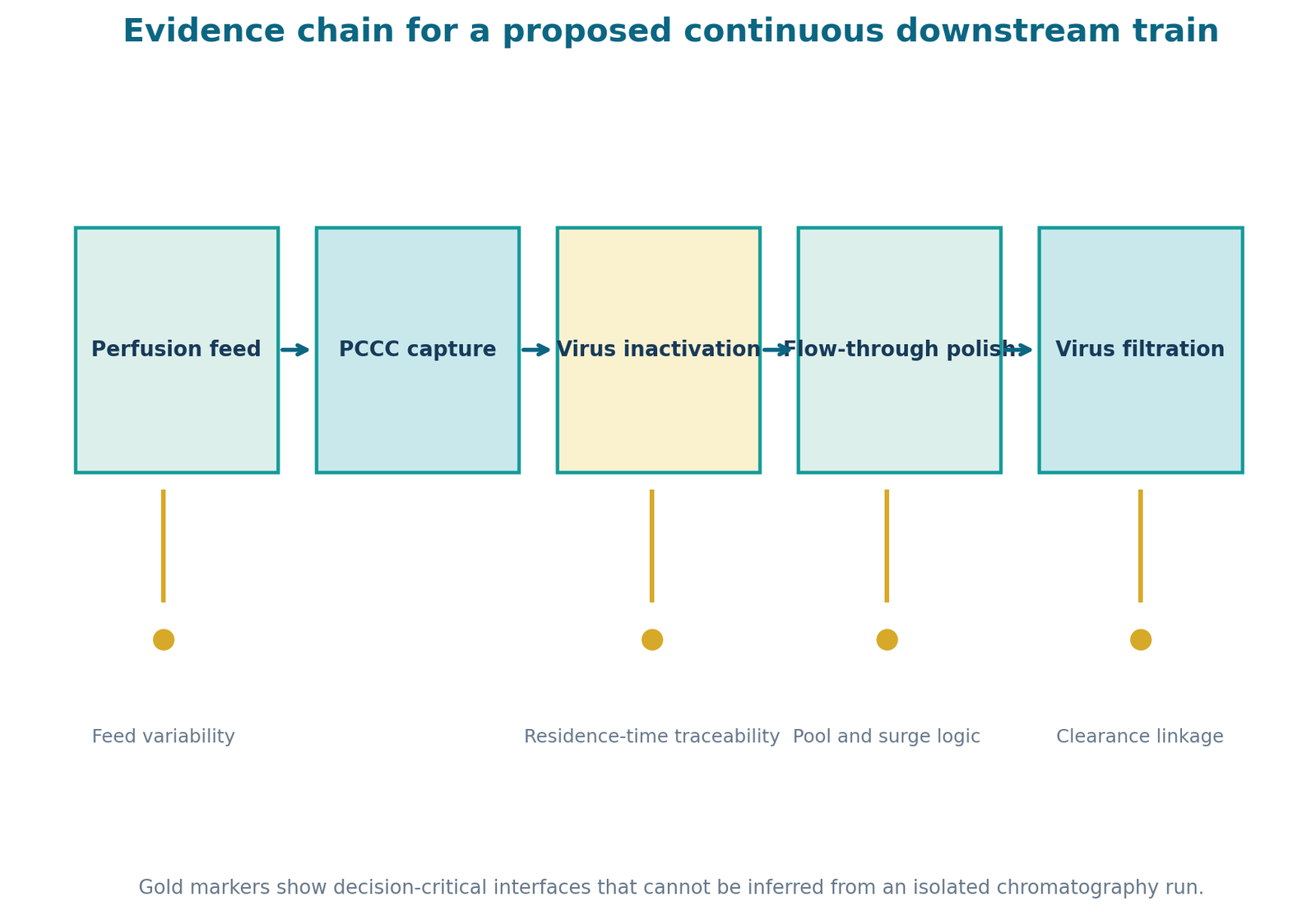
Public evidence supports multi-column capture and integrated downstream operation for selected monoclonal-antibody processes. The 2024 Konoike study is especially useful because it describes PCCC, a surge-capable virus-inactivation step, connected flow-through polishing and virus filtration under varying feed rates and concentrations. Other work on rapid-cycling membrane adsorbers and non-mAb capture shows that the technology set is expanding.
The remaining uncertainty lies at the portfolio boundary. Molecule stability during extended processing, impurity breakthrough, resin and membrane lifetime, viral-clearance linkage, changeover, material traceability and disturbance handling can alter the decision even when chromatography productivity is attractive.
Decision-relevant interpretation
- Continuous capture has the strongest evidence base for platform consideration, particularly for monoclonal antibodies.
- The connected process should not be rated ready unless material-traceability and diversion logic are defined at the full train boundary.
- A flexible portfolio may require two operating archetypes rather than one universal continuous platform.
WEBSITE PRESENTATION SUGGESTION Present a Living Process Train. Visitors open each unit operation to see demonstrated scale, molecule coverage and the interface that remains conditional. A disturbance slider can show how a titre excursion propagates through hold tanks and diversion points. On mobile, use a vertical train with expandable interface cards.
DECISION OUTPUT
Recommended action: develop a bounded platform
DECISION Proceed with a platform-development programme for the monoclonal-antibody subset, while treating the Fc-fusion product as a separate transfer case. Use a connected small-scale demonstration before committing facility architecture or filing strategy.
Draft evidence gates
Gate | Draft condition | Evidence expected |
|---|---|---|
Capture robustness | At least 100 representative column cycles across feed variability | Breakthrough, recovery, pressure, resin age and product-quality trends. |
Connected operation | Minimum 72-hour integrated run or justified campaign model | RTD, hold volumes, disturbances, diversion and mass balance. |
Quality control | Maintain agreed impurity and aggregate limits across the run | Time-resolved CQAs and in-process-control performance. |
Viral safety | Define how continuous operation interfaces with clearance validation | Scale-down rationale, worst-case conditions and linkage strategy. |
Platform transfer | Run at least two molecule representatives with predefined bracketing logic | Comparability of loading, recovery, impurity clearance and control ranges. |
Lifecycle fit | Document batch definition, change management and continued verification | Control-strategy and regulatory-assessment package aligned with ICH Q13 concepts. |
What the client receives
- A technology taxonomy and demonstration register for continuous downstream options.
- A molecule-to-platform transfer matrix and process-chain evidence map.
- A common-basis productivity, resin-use and hold-volume workbook.
- A regulatory and control dependency register structured around the proposed process boundary.
- A connected demonstration protocol and platform-bracketing questions.
- A decision brief identifying the development lane for each molecule class.
DELIVERY AND NEXT STEP
Indicative project delivery
Timing | Research activity | Primary output |
|---|---|---|
Week 1 | Portfolio, facility and decision protocol | Working product and process boundary |
Weeks 2 to 3 | Scientific, regulatory, patent and vendor evidence review | Demonstration register and technology taxonomy |
Weeks 3 to 4 | Process-chain reconstruction and common-basis comparison | Evidence-chain map and benchmark workbook |
Week 5 | Platform-transfer and regulatory dependency assessment | Molecule matrix and control questions |
Weeks 6 to 7 | Challenge review and development-gate design | Decision brief and connected demonstration protocol |
Delivery can include a PowerPoint management readout, an Excel evidence and benchmarking workbook, a Word or PDF technical assessment, and a development-gate pack for process development, quality and regulatory teams.
TIMELINE NOTE: The stated timeline is indicative. Actual timing depends on the number of technology variants, geographical coverage, availability of full technical records, source-language requirements and the depth of developer or patent analysis.
Let’s discuss your project
If your team is considering continuous downstream processing, August Research can assess the evidence at the molecule, process-train and facility boundary that matters to the development decision.
NOTE: This hypothetical engagement demonstrates the service. Regulatory and technical interpretation is grounded in public records, while portfolio composition, thresholds, timeline and recommendations are example inputs rather than client outcomes.