R&D & INNOVATION / SECONDARY RESEARCH
Enzymatic Recycling for Food-Grade PET Feedstock
Emerging Technology Assessment | FMCG, circular materials and food-contact packaging
DECISION QUESTION Does current evidence justify qualifying enzymatic PET recycling for a food-grade packaging pathway, or should the technology remain in controlled validation and partnership monitoring?
The situation
An FMCG packaging team wants a route to recycled PET that can address coloured, opaque or lower-quality feedstock while producing monomers suitable for repolymerisation. Enzymatic depolymerisation could recover terephthalic acid and ethylene glycol under milder conditions than some chemical routes. The commercial question extends beyond polymer conversion: feedstock control, pretreatment, enzyme productivity, monomer purification, repolymerised resin properties, traceability and food-contact compliance all affect readiness.
Technical progress is substantial. A 2024 Nature Communications study reported nearly complete PET depolymerisation in eight hours at 200 g/kg solids loading using an engineered hydrolase. A 2025 process study reported near-quantitative conversion in 50 hours after extrusion and quenching, more than 99% reduction in acid and base consumption, 74% lower annual operating expense from the revised neutralisation route, and 65% lower energy demand for ethylene-glycol recovery through fed-batch operation. These results improve the scale case but do not themselves establish food-contact suitability.
Why the question requires an application-specific assessment
- High depolymerisation yield does not establish monomer purity, resin quality or food-contact compliance.
- Pretreatment energy, crystallinity, solids loading and enzyme dose strongly influence process economics and environmental performance.
- Input contamination, labels, adhesives, multilayers and non-PET polymers can alter purification and traceability requirements.
- EU Regulation 2022/1616 treats decontamination and purification as central to recycled food-contact plastics, so the regulatory route must be mapped at the full process boundary.
WORKING PREMISE The assessment separates proof of PET depolymerisation from proof of a controlled food-grade material pathway. A technology can be chemically credible while still requiring qualification of purification, repolymerisation and regulatory evidence.
ENGAGEMENT DEFINITION
A food-contact qualification boundary
The research is organised around a hypothetical bottle and tray portfolio. Public evidence is screened against the entire route from feedstock to repolymerised resin, not only the enzyme reactor.
Parameter | Working project input | Assessment significance |
|---|---|---|
Target applications | Clear beverage bottle and thermoformed food tray | Creates distinct resin, colour, IV and migration requirements. |
Feedstock | Post-consumer PET bottles and trays with controlled coloured fraction | Tests whether the claimed feed flexibility is relevant. |
Contaminants | Caps, labels, adhesives, polyolefins, PVC risk and incidental contamination | Defines sorting, purification and safety burden. |
Process intent | At least 90% PET conversion at 150 to 200 g/kg solids | Sets an industrially relevant evidence threshold. |
Monomer intent | Purified TPA and EG suitable for repolymerisation | Avoids treating crude depolymerisation products as feedstock-ready. |
Resin intent | Properties comparable with the selected virgin or mechanically recycled grade | Connects monomer recovery with pack performance. |
Geography | Initial EU pathway with later US comparison | Makes regulatory and dossier requirements explicit. |
Technology boundary
The assessment covers PET hydrolases, pretreatment and amorphisation, enzyme manufacture and reuse, depolymerisation, TPA and EG separation, monomer purification, repolymerisation and resin qualification. Mechanical and chemical recycling are retained as comparison baselines where their feedstock and product boundaries are comparable.
REGULATORY BOUNDARY A recycled-content objective is not treated as evidence of food-contact acceptance. The assessment separately maps input controls, purification or decontamination, process registration or authorisation, traceability, declaration-of-compliance and intended-use requirements.
HOW THE RESEARCH IS EXECUTED
A chain-of-qualification methodology
1. DEFINE THE MATERIAL CLAIM Specify target package, recycled-content role, feedstock classes, resin properties, geography and decision horizon.
2. RECONSTRUCT THE PROCESS Map sorting, washing, size reduction, amorphisation, enzyme reaction, pH control, purification, repolymerisation and finishing.
3. NORMALISE TECHNICAL EVIDENCE Extract PET crystallinity, solids loading, enzyme dose, temperature, time, conversion, monomer yield, purity and residual contaminants.
4. TEST FEEDSTOCK TRANSFER Compare controlled flakes and films with coloured, multilayer, label-bearing and tray-rich input streams.
5. ASSESS MATERIAL CLOSURE Trace recovered monomers into resin intrinsic viscosity, colour, acetaldehyde, mechanical properties and pack performance.
6. MAP THE COMPLIANCE ROUTE Review EU food-contact recycling rules, applicable authorisation logic, input traceability, quality control and dossier evidence.
7. SET PARTNERSHIP AND VALIDATION GATES Define pursue, validate first, partner, monitor or set-aside conditions and the evidence needed for movement.
Evidence extraction fields
Field | What is retained | Interpretation protected |
|---|---|---|
Feedstock state | Polymer form, crystallinity, colour, additives, contamination and pretreatment | Prevents clean model PET from representing mixed waste. |
Reaction basis | Solids loading, enzyme loading, temperature, pH, time and conversion basis | Makes yield and productivity comparable. |
Purification | TPA and EG recovery, purity, solvent or salt use, wastewater and mass balance | Exposes what happens after depolymerisation. |
Material closure | Repolymerisation route, resin properties, article testing and migration evidence | Separates monomer recovery from food-grade qualification. |
EVIDENCE INTERPRETATION AND VISUAL OUTPUT
The reactor evidence is advancing faster than the qualification evidence
Engineered PET hydrolases now demonstrate high conversion at industrially relevant solids loading, and recent process innovations address acid and base use, ethylene-glycol recovery and pretreatment efficiency. These developments reduce several scale barriers that previously made enzymatic recycling appear laboratory-bound.
The narrower evidence base concerns variable post-consumer input, purification of unpredictable contaminants, consistent repolymerised-resin quality and the food-contact route. EU Regulation 2022/1616 explicitly includes purification within the concept of decontamination and requires control of input, process operation, traceability and compliance. A food-grade decision therefore needs evidence through the full qualification chain.
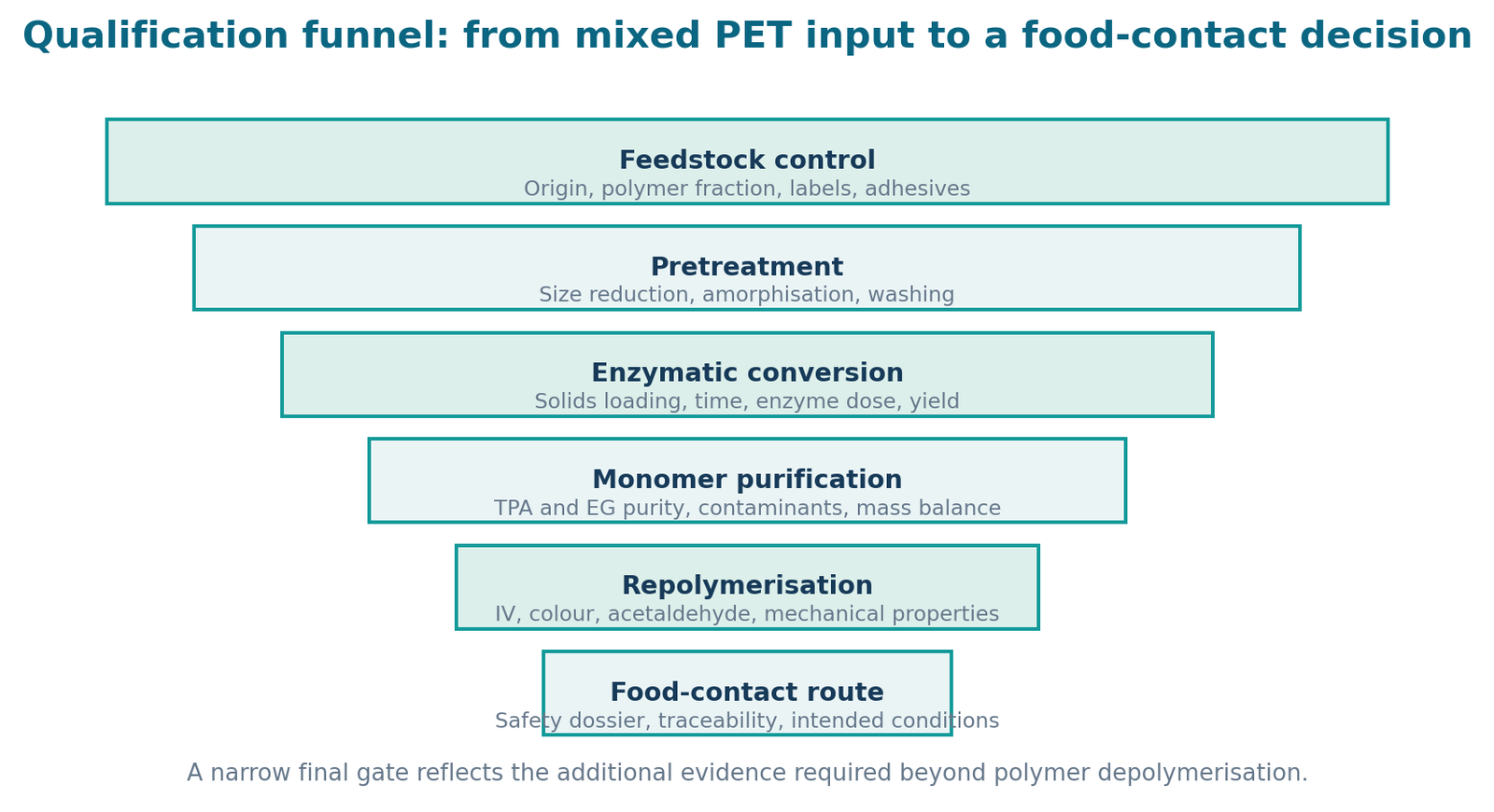
What the funnel clarifies
- A strong enzyme result can pass the conversion gate while failing to answer purification or resin-performance questions.
- Feedstock flexibility creates value only if contaminants and material losses remain controlled across the process.
- Partnership screening should distinguish enzyme capability, process integration, monomer purification and food-contact dossier ownership.
WEBSITE PRESENTATION SUGGESTION Use a clickable Qualification Funnel. Each stage opens the evidence required, the strongest current signal and the unresolved condition. A feedstock toggle can show how clear bottle flakes, coloured PET and tray-rich input change the pathway. On mobile, present the six gates as a vertical narrowing sequence.
DECISION OUTPUT
Recommended action: partnership-led validation
DECISION Retain enzymatic recycling as a qualified strategic option and begin partnership due diligence with developers that can document the process beyond depolymerisation. Do not make a food-grade claim until variable-feedstock purification, repolymerised-resin performance and the regulatory route are demonstrated.
Draft evidence gates
Gate | Draft condition | Evidence expected |
|---|---|---|
Feedstock control | Defined input specification with challenge lots for colour, trays, labels and non-PET contamination | Batch composition, sorting efficiency and contaminant fate. |
Conversion | At least 90% conversion at 150 to 200 g/kg solids on representative feed | Replicated time course, enzyme dose, mass balance and residual PET. |
Purification | Monomer purity and contaminant control suitable for the selected repolymerisation route | TPA and EG assays, impurity profile, recovery and waste streams. |
Resin closure | Repolymerised PET meets agreed IV, colour, acetaldehyde and mechanical criteria | Resin and converted-article test results against baseline. |
Food contact | Clear EU regulatory route for the technology, process and intended application | Dossier plan, traceability, quality-control and migration requirements. |
Scale and value | Credible equipment, enzyme supply, utilities and cost at target capacity | Mass and energy balance, capacity plan, sensitivity and lifecycle boundary. |
What the client receives
- A process and technology taxonomy covering enzyme, pretreatment, purification and repolymerisation options.
- A feedstock-to-evidence transfer matrix and qualification funnel.
- A common-basis conversion, monomer-recovery and resource-use workbook.
- A food-contact regulatory and traceability pathway map.
- Developer profiles separating demonstrated capability from stated scale plans.
- A partnership and validation brief with evidence gates and monitoring triggers.
DELIVERY AND NEXT STEP
Indicative project delivery
Timing | Research activity | Primary output |
|---|---|---|
Week 1 | Material claim, geography and process-boundary protocol | Working qualification framework |
Weeks 2 to 3 | Scientific, patent, developer and regulatory evidence review | Technology taxonomy and evidence register |
Week 4 | Feedstock transfer and common-basis process comparison | Qualification funnel and benchmark workbook |
Week 5 | Food-contact, traceability and scale dependency analysis | Regulatory pathway and partner criteria |
Weeks 6 to 7 | Challenge review and action-gate design | Decision brief and validation specification |
Delivery can include a PowerPoint decision readout, an Excel evidence and mass-balance workbook, a Word or PDF technical assessment, a regulatory-pathway map and a partner-validation question set.
TIMELINE NOTE: The stated timeline is indicative. Actual timing depends on the number of technology variants, geographical coverage, availability of full technical records, source-language requirements and the depth of developer or patent analysis.
Let’s discuss your project
If your team is evaluating enzymatic recycling for a packaging portfolio, August Research can assess whether the available evidence supports validation, partnership or continued monitoring at the material and regulatory boundary that matters.
NOTE: This hypothetical engagement demonstrates the service. Technical and regulatory interpretation is grounded in public records, while feedstock composition, thresholds, timeline and recommendations are examples rather than client outcomes.