INDUSTRY ADOPTION STUDY | EXAMPLE ENGAGEMENT
Closing the diagnostic shipping loop
Testing whether reusable outer shipping packs can progress from isolated trials to routine use across diagnostic routes in Southern Ontario.
The adoption question
A packaging provider had developed a reusable outer transport pack for repeat diagnostic routes. Interest was strongest among laboratories and receiving sites seeking to reduce packaging waste, but discussions focused on the pack itself while the return cycle remained uncertain.
The client needed to know which route structures could sustain reuse, where responsibility would transfer at each handoff and what operating conditions would make the loop reliable enough to scale.
CLIENT DECISION Which Southern Ontario route types should enter a controlled rollout, and what return, cleaning and ownership rules must be designed before launch?
ADOPTION THRESHOLD A route counts as adopted only when the pack completes dispatch, delivery, empty-pack logging, collection, inspection and release for repeat use within an agreed cycle.
Adoption happens across the loop
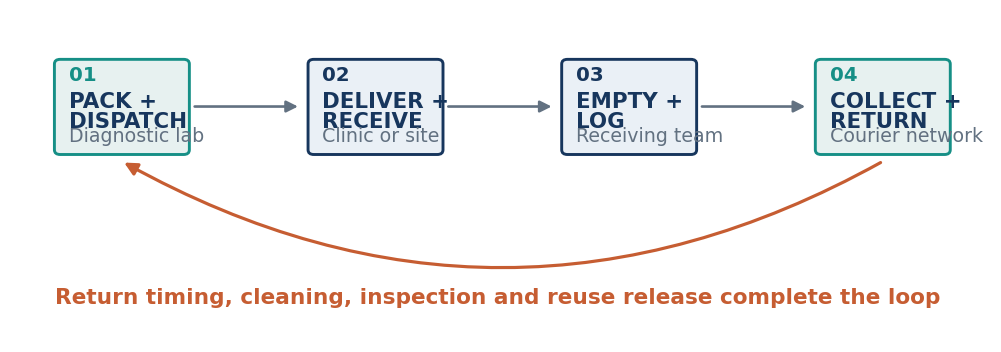
WHY GEOGRAPHY MATTERS Southern Ontario creates a useful study boundary because route density, urban and regional travel, winter operating conditions and access to courier depots can materially change return feasibility.
This example and its findings demonstrate a possible engagement structure. They do not represent a completed client project.
ROUTE-BASED FIELDWORK
Route-Loop Viability Reconstruction
The study does not ask whether participants like reusable packaging in principle. It reconstructs recent transport episodes and follows the same pack through every organisational handoff, including episodes where the return did not complete.
12
ORGANISATIONS
17
INTERVIEWS
14
ROUTE EPISODES
3
WALKTHROUGHS
Who is approached
ROLE GROUP | INTERVIEWS | DIRECT EVIDENCE SOUGHT |
|---|---|---|
Origin laboratories | 5 | Packaging, dispatch and route ownership |
Receiving clinics or sites | 4 | Unpacking, storage, logging and return readiness |
Courier and route operations | 4 | Collection feasibility, scan events and route economics |
Cleaning or pack service partners | 2 | Inspection, cleaning, damage and release |
Procurement or sustainability | 2 | Contract ownership and rollout approval |
The interviews span 12 organisations because several route episodes require evidence from more than one party. Counts are illustrative and would be adjusted after route mapping.
What the outreach looks like
ROUTE FIRST Build a route universe by origin, destination, frequency, distance, courier structure and current packaging flow.
EPISODE VERIFICATION Recruit only participants who handled a recent dispatch, receipt, return request or cleaning decision on an eligible route.
PAIRED EVIDENCE Where possible, approach the origin, receiver and courier connected to the same route rather than collecting unrelated opinions.
CONTRAST CONTROL Protect a mix of dense urban, regional and winter-sensitive routes, including completed and broken loops.
Selection parameters
Route frequency, distance, courier model, receiver type, shipment handling requirement, pack ownership, return timing, storage space, cleaning responsibility, winter exposure and evidence of direct involvement.
QUESTIONS AND EVIDENCE
Questions begin with a specific route episode
PARTICIPANT | BACKGROUND USED | SAMPLE QUESTIONS |
|---|---|---|
Origin lab | Think about the last eligible shipment sent to a repeat destination. | At dispatch, who expected the outer pack back? What return event was recorded? When did your team know the loop had failed? |
Receiving site | Use the most recent pack received during a normal operating week. | Where did the empty pack wait? Who was asked to release it? What would make that step easier during a busy shift? |
Courier team | Focus on a route where outbound delivery was routine but reverse collection was optional. | What signal creates a pickup? When does collection add a separate stop? Which routes can absorb the return without a new journey? |
Service partner | Consider a returned pack that needed inspection or cleaning before reuse. | Which conditions trigger rejection? How quickly can the pack re-enter stock? What evidence should follow the pack? |
Example route evidence
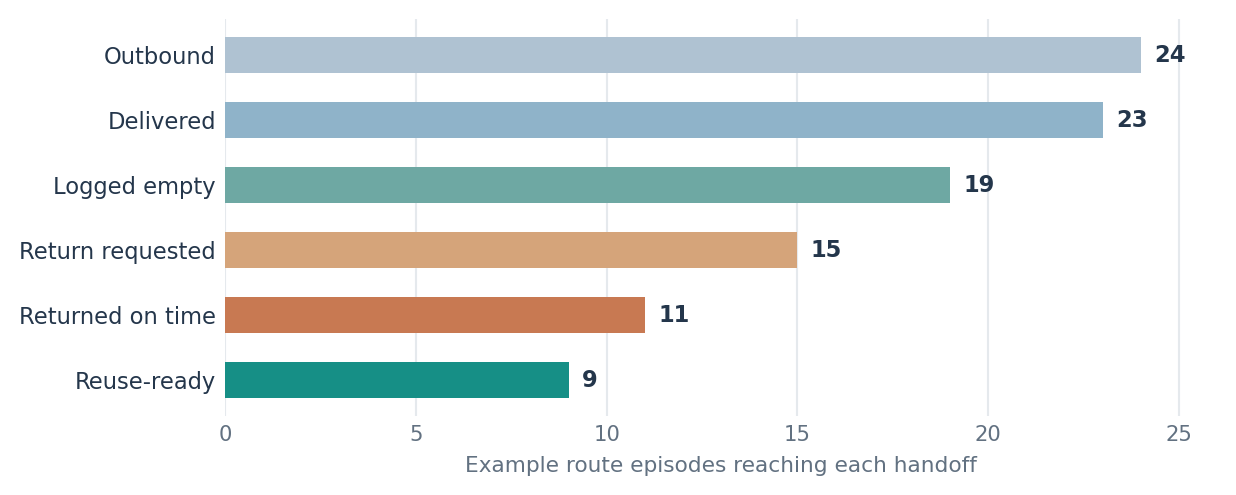
INTERPRETATION The largest loss does not occur during outbound delivery. It occurs when the empty pack lacks a visible owner, a pickup signal or a place in the courier's existing reverse route.
ROLLOUT DECISION
Prioritise closed routes before broad availability
The example conclusion is that the pack should not be launched as a general replacement for disposable outer packaging. The first rollout should target repeat routes where the same parties can agree a return trigger, cycle-time target and exception owner.
PRIORITY | ACTION | ADOPTION EFFECT |
|---|---|---|
01 | Select closed-loop routes | Prioritise repeat lanes with sufficient frequency and an existing return movement. |
02 | Assign each handoff | Name who logs, stores, requests collection, inspects and releases the pack. |
03 | Create an exception path | Define action for late, damaged, contaminated or unscanned packs. |
04 | Measure loop completion | Track full-cycle completion and turnaround time, not outbound delivery alone. |
What the client receives
- Route-loop map with ownership and evidence at each handoff
- Completed, delayed and broken-loop episode profiles
- Route eligibility rules for the controlled rollout
- Return, cleaning, inspection and exception responsibilities
- Pilot measurement plan and scale decision briefing
Indicative delivery
STAGE | TIMING | ACTIVITY |
|---|---|---|
Map | Week 1 | Define eligible routes, handoffs and route episode screen |
Reach | Weeks 2 to 4 | Paired outreach, interviews and workflow walkthroughs |
Trace | Weeks 4 to 6 | Loop completion analysis and route comparisons |
Decide | Week 7 | Rollout rules, ownership design and pilot briefing |
Timing depends on access to matched route participants, courier cooperation and the final geographic spread.
CONTACT US Tell us which transport loop you want to make repeatable and where returns appear to break. August Research will design the outreach around the real route network and adoption decision.