INDUSTRY ADOPTION STUDY | EXAMPLE ENGAGEMENT
Defining a credible path to autonomous airfield inspection
Testing what evidence Nordic regional airports would require before progressing from supervised trials to routine operational use.
The adoption decision
An autonomous inspection technology provider could demonstrate detection and route-following capability, but airport interest did not translate into a common route to operational use. Different stakeholders required evidence about adverse weather, airside integration, human oversight and contingency response.
CLIENT DECISION What bounded operating model and evidence package should the provider take into regional airport trials in Norway, Sweden and Finland?
ADOPTION THRESHOLD Adoption means routine use within a defined inspection task and operating envelope, with accepted evidence, named human decision rights, airside coordination and a tested fallback process.
Evidence must move toward clearance
WHY GEOGRAPHY MATTERS Regional airports across Norway, Sweden and Finland can face winter conditions, darkness, remote operations and lean staffing that materially change the evidence required for routine use.
This example and its findings demonstrate a possible engagement structure. They do not represent a completed client project.
TWO-ROUND ADOPTION DESIGN
Evidence-to-Clearance Assessment
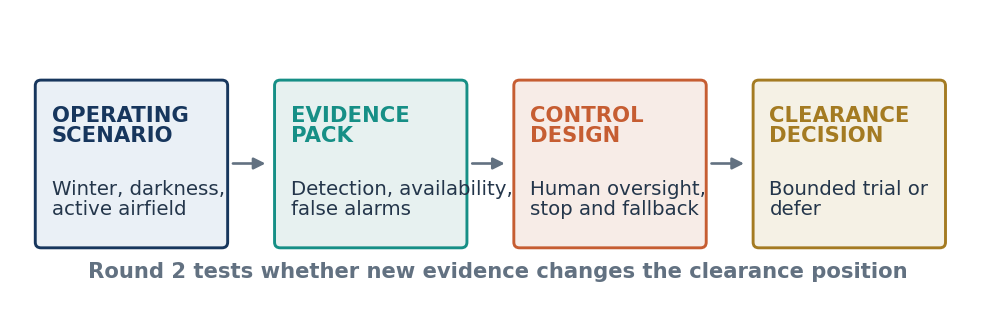
Round 1 establishes the current clearance position and the evidence gaps behind it. August Research then converts those gaps into a bounded evidence pack and operating scenario. Round 2 tests whether the proposed evidence and controls change the decision.
6
AIRPORTS
16
ROUND 1
12
ROUND 2
3
SCENARIOS
Who is approached
PARTICIPANT GROUP | ROUND 1 | DIRECT CONTRIBUTION |
|---|---|---|
Airport operations | 4 | Operating need, airside coordination and task ownership |
Safety and assurance | 3 | Evidence sufficiency, operating envelope and controls |
Airfield inspection roles | 4 | Current task, detection consequences and field judgement |
Maintenance and winter operations | 3 | Availability, recovery and adverse-condition demands |
Technology and integration specialists | 2 | System limits, data and support dependencies |
Twelve participants who completed Round 1 and can evaluate the revised evidence are invited to Round 2. Three scenario walkthroughs test representative operating conditions rather than general technology sentiment.
Outreach and selection
OUTREACH CONTROL | APPLICATION |
|---|---|
Airport cell design | Select regional airports across three countries with relevant inspection responsibilities and contrasting winter or staffing conditions. |
Role verification | Confirm direct responsibility for airside operations, inspection, safety, maintenance or technology integration. |
Round 1 neutrality | Ask what would be required for a bounded task without assuming that full autonomy is the desired outcome. |
Round 2 continuity | Return the evidence pack to participants who can judge whether the gaps have been resolved and under what limits. |
Independent research advantage
A neutral study can separate provider claims from airport evidence requirements, preserve candour about control limits and compare how different roles define an acceptable first operating envelope.
SCENARIO QUESTIONS AND CLEARANCE EVIDENCE
Each question is framed around a bounded inspection task
ROLE | SCENARIO BACKGROUND | SAMPLE QUESTIONS |
|---|---|---|
Airport operations | A low-light winter inspection before the next planned aircraft movement. | Which part of the task could be delegated? What event requires human intervention? How would the operation return to a safe state? |
Inspection role | A system-generated detection that is uncertain or inconsistent with field judgement. | What evidence would you inspect? Who decides whether action is required? Which false result creates the greater consequence? |
Safety / assurance | A proposed supervised trial inside a defined route and operating envelope. | Which controls must be demonstrated before the trial? What evidence can transfer across airports, and what must be local? |
Maintenance | A system or sensor fault during adverse weather and limited staffing. | How quickly must the issue be diagnosed? What fallback preserves the inspection task? Which support model is credible? |
Example Round 1 evidence-gate view
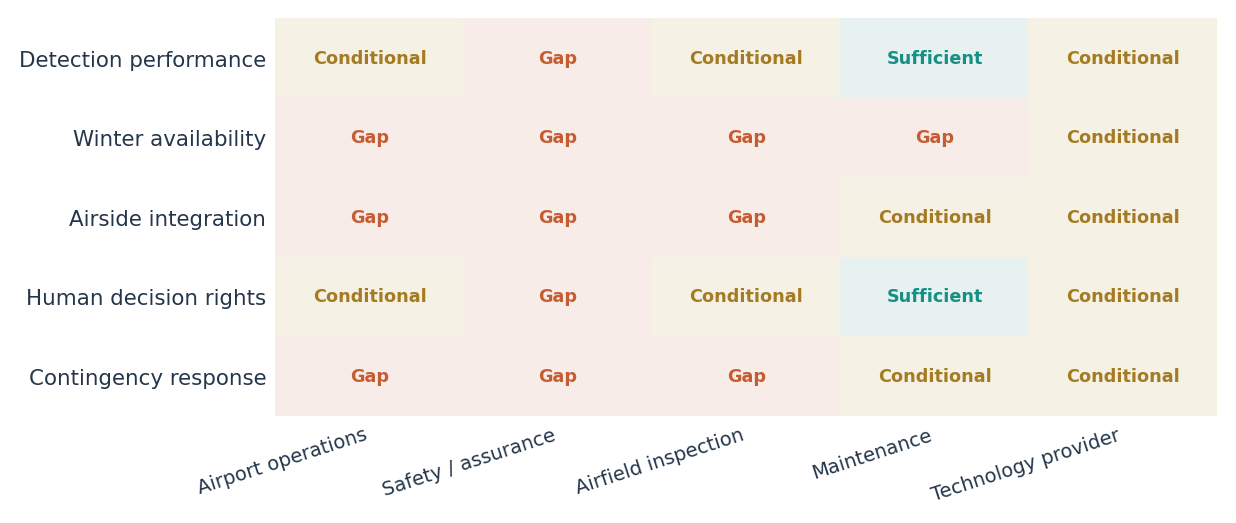
INTERPRETATION Stakeholders may accept supervised automation sooner than full autonomy. The strongest shared gaps concern winter availability, airside integration and contingency response, not the core detection demonstration alone.
ADOPTION PATHWAY
Progress through supervised operating envelopes
The example conclusion is to begin with a narrow inspection task under remote supervision and explicit human decision rights. The trial should expand only when performance, adverse-condition availability and fallback evidence meet the next clearance gate.
STAGE | OPERATING MODEL | EVIDENCE TO PROGRESS |
|---|---|---|
01 | Bounded supervised trial | Defined route, conditions, observer role and immediate manual fallback |
02 | Repeat supervised operation | Stable performance across representative winter and low-light conditions |
03 | Expanded operating envelope | Accepted integration, contingency response and support capability |
04 | Routine task ownership | Named decision rights, monitoring and change-control process |
What the client receives
- Airport and role-specific evidence-gate register
- Round 1 and Round 2 change-of-position analysis
- Human oversight, decision-right and fallback design
- Bounded trial scenario and operating-envelope requirements
- Phased adoption pathway and airport engagement briefing
Indicative delivery
STAGE | TIMING | ACTIVITY |
|---|---|---|
Define | Week 1 | Airport cells, task boundary and evidence-gate guide |
Round 1 | Weeks 2 to 4 | Outreach, interviews and initial gap analysis |
Reframe | Weeks 5 to 6 | Evidence pack and scenario walkthroughs |
Round 2 | Weeks 7 to 8 | Reassessment, pathway resolution and briefing |
Timing depends on airport access, cross-country recruitment and the level of evidence that can be shared with participants.
CONTACT US Tell us which operating task is approaching adoption and which stakeholders must accept the evidence. August Research will build the assessment around the real clearance pathway.