INDUSTRY ADOPTION STUDY | EXAMPLE ENGAGEMENT
From demonstration to line integration
Understanding why inline spectral inspection can show promise in a nut-processing trial but still fail to become routine production practice.
The situation
A provider of inline spectral inspection systems had completed several demonstrations with mid-sized nut processors. The demonstrations created interest in detecting quality defects and contamination indicators that conventional visual inspection may miss. However, commercial discussions repeatedly slowed after the trial stage.
The client needed to understand whether the issue was insufficient technical proof, production-line integration, unclear ownership, weak economics or a mismatch between the demonstration and the processor's real decision process.
CLIENT DECISION Should the company continue offering a standard demonstration, or redesign the offer around a production proof package with validation, integration and operating ownership built in?
ADOPTION THRESHOLD Adoption was defined as routine line operation with an accepted validation protocol, a documented response to flagged product and a named owner for calibration, maintenance and quality decisions.
The evidence population
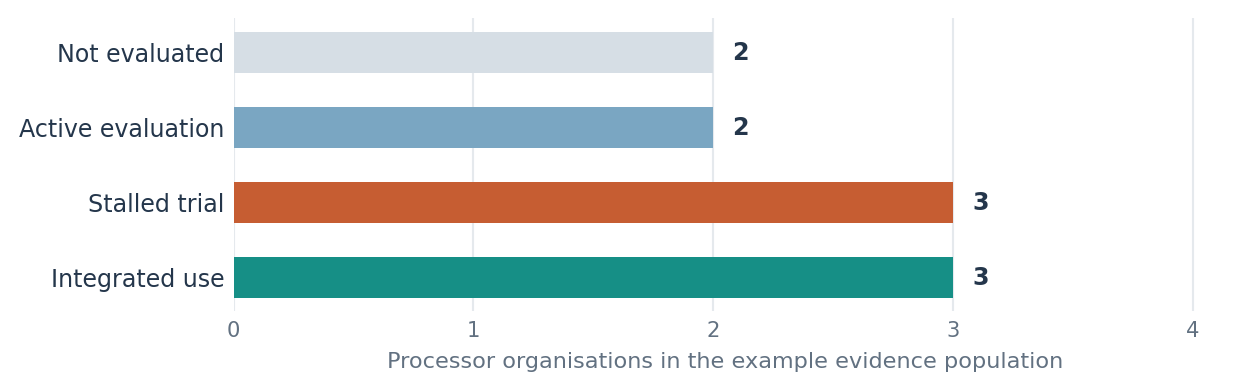
WHY OUTSIDE RESEARCH An independent interviewer can reach former trials and non-customers, protect candour about supplier limitations and compare adoption episodes without allowing the client's sales pipeline to define the market view.
This example and its findings demonstrate a possible engagement structure. They do not represent a completed client project.
RESEARCH DESIGN
Trial-to-Line Transition Reconstruction
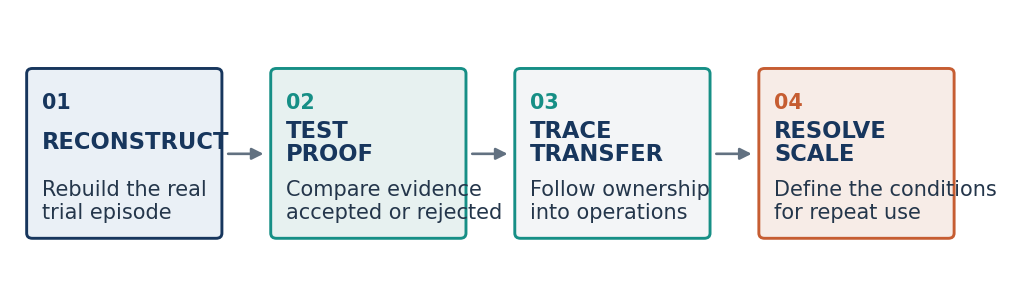
The research concentrates on one transition: the point at which a bounded trial must gain production evidence, operating ownership and permission to become routine use. This keeps the study distinct from a general opinion survey or technology readiness assessment.
Participant structure
ADOPTION STATE | ORGS | INTERVIEWS | WHY THIS COHORT MATTERS |
|---|---|---|---|
Not evaluated | 2 | 2 | Reveals what keeps a relevant need outside formal evaluation. |
Active evaluation | 2 | 3 | Shows the proof, alternatives and internal case currently being assembled. |
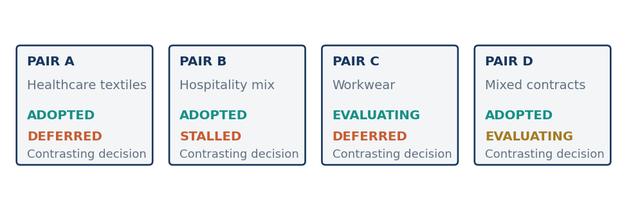
Trial stalled or abandoned | 3 | 5 | Exposes unanswered questions, ownership gaps and consequences after material effort. |
Integrated use | 3 | 5 | Identifies the conditions that enabled transfer into normal operations. |
Four additional interviews with an equipment integrator, an independent laboratory specialist, a food-safety adviser and a machine-vision practitioner test the ecosystem requirements around the processor evidence.
What the outreach looks like
1. Build a candidate universe: Identify processors and relevant roles through industry directories, professional networks, public project evidence, client-approved contacts, integrators and specialist recruitment routes.
2. Screen the adoption episode: Confirm the product and line context, adoption state, decision role, trial recency and direct involvement. General familiarity with spectral inspection is not enough.
3. Protect contrasting evidence: Monitor the evidence cells throughout recruitment so successful users or friendly accounts do not dominate. Replace candidates whose experience cannot be verified.
4. Use role-specific invitations: Approach quality, food-safety, operations, engineering and capital-approval roles with neutral wording that explains the study, confidentiality and expected time.
Selection parameters
Adoption state, product format, throughput, line age and automation, current inspection process, trial recency, decision role, validation responsibility, integration requirement and evidence of direct involvement. Geography is added only if regulation, crop conditions or infrastructure materially changes the adoption episode.
FIELDWORK AND ANALYSIS
Questions are anchored in a real adoption episode
Participants receive enough context to identify the relevant episode, but the questions do not assume that the technology should have been adopted. The guide changes with the participant's adoption state.
COHORT | BACKGROUND USED | SAMPLE QUESTIONS |
|---|---|---|
Stalled trial | The last point at which usable trial evidence existed but the integration decision stopped. | What remained unproven? Who was expected to accept the evidence? What would have reopened the decision? |
Integrated user | The period when the system moved from a protected trial into routine production. | Which result changed confidence? What process or responsibility changed before go-live? What still limits repeat deployment? |
Active evaluator | The current inspection workflow, failure exposure and alternatives under consideration. | What event would justify a trial? Which conditions must the test reproduce? What evidence would be insufficient? |
Ecosystem role | The participant's direct experience supporting validation, integration or food-safety decisions. | Where do processor trials usually become difficult? Which proof transfers across sites, and which must be recreated? |
Example evidence pattern
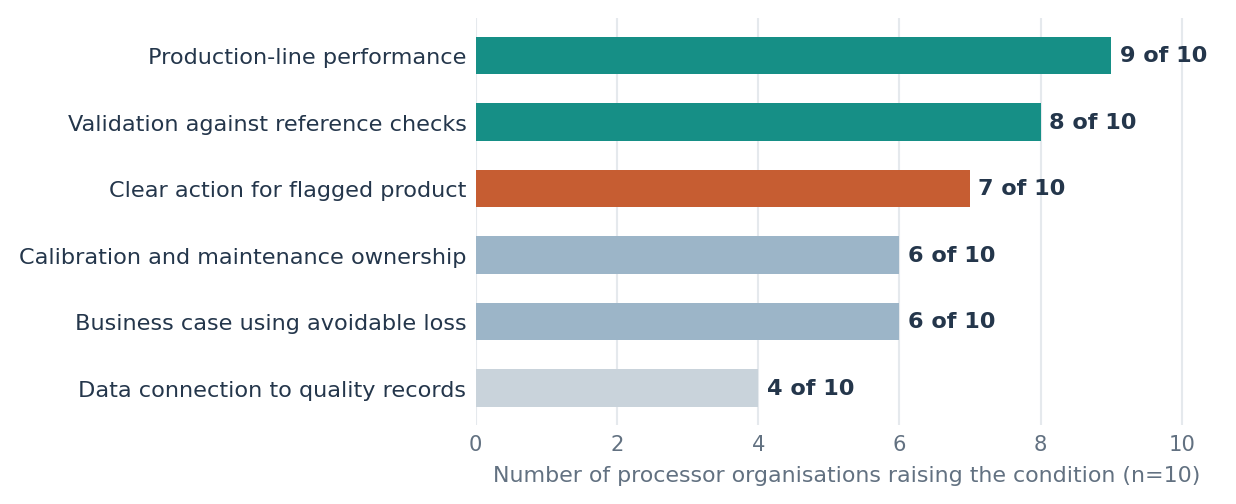
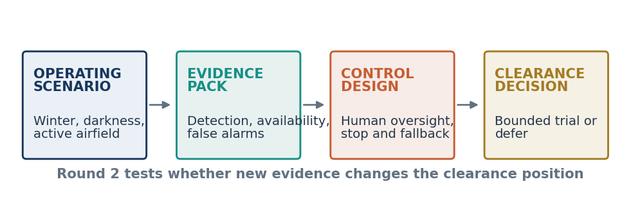
PATTERN BEHIND THE NUMBERS The strongest evidence gap appeared between a successful detection demonstration and an accepted production decision. Processors needed proof under normal line speed and product variability, plus an agreed response when the system flagged product. Without those conditions, technical promise did not transfer into operating ownership.
DECISION IMPLICATION
Redesign the offer around production proof, not demonstration access
The hypothetical conclusion is that adoption is not primarily constrained by category awareness. The transition fails when a demonstration is treated as the final proof, while the processor still needs evidence about line performance, product disposition, validation responsibility and long-term ownership.
PRIORITY | ACTION | WHY IT CHANGES ADOPTION |
|---|---|---|
01 | Production proof protocol | Test the intended product mix, line speed, variability and reference comparison before asking for an integration decision. |
02 | Flag-response design | Agree what happens to flagged kernels or batches, who can release or reject product and how exceptions are recorded. |
03 | Operating hand-off | Name the owner for calibration, maintenance, training, quality review and vendor support before the trial closes. |
04 | Adoption-led segmentation | Prioritise processors whose line configuration, quality authority and avoidable loss create a credible path from trial to routine use. |
What the client receives
- Trial-to-line transition map showing evidence, decision ownership and failure points
- Adoption-state profiles for integrated users, stalled trials, evaluators and non-evaluators
- Production proof requirements and proposed trial redesign
- Operating ownership and ecosystem dependency map
- Priority processor conditions and a scale-path decision briefing
Indicative delivery
STAGE | TIMING | DELIVERY ACTIVITY |
|---|---|---|
Frame | Week 1 | Adoption threshold, contrast cells, screening criteria and evidence plan |
Recruit + field | Weeks 2 to 5 | Targeted outreach, interviews, walkthroughs and ongoing cohort control |
Resolve | Weeks 5 to 7 | Transition analysis, evidence challenge and action development |
Decide | Week 8 | Decision briefing, trial redesign and scale-path discussion |
Timing is indicative and depends on access to verified stalled trials, participant response, confidentiality approvals, site access and the final evidence population.
CONTACT US Tell us what is being adopted, where progression appears to stall and what scale decision the evidence must support. August Research will shape the adoption threshold, outreach and transition analysis around that question.