INDUSTRY ADOPTION STUDY | EXAMPLE ENGAGEMENT
Testing digital permits under turnaround pressure
Understanding whether a digital permit-to-work process can hold during contractor-intensive chemical turnarounds on the US Gulf Coast.
The situation
A control-of-work software provider had strong demonstrations for routine maintenance, but prospective chemical sites questioned how the digital process would perform during peak turnaround conditions. Permit volumes, contractor onboarding, shift handovers, field changes and fallback decisions made the adoption threshold much higher than a standard system demonstration.
CLIENT DECISION Should the provider pursue site-wide implementation, or first develop a turnaround-mode adoption package that proves the difficult operating events?
ADOPTION THRESHOLD A site counts as adopted only when the digital workflow governs a complete turnaround work package across owner and contractor roles, including handover, change, suspension, close-out and agreed fallback.
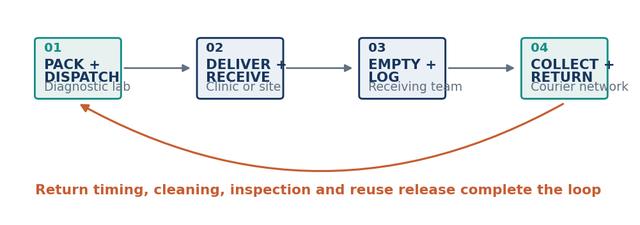
The episode that must be reconstructed
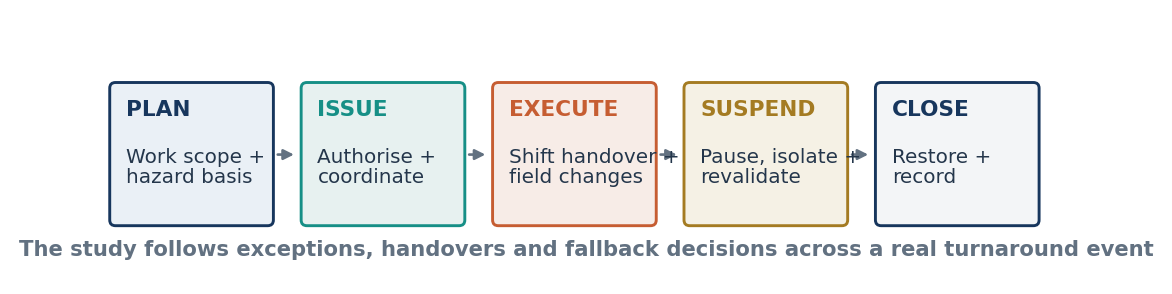
WHY THE GULF COAST MATTERS The study boundary supports comparison across chemical sites that draw on a concentrated turnaround contractor ecosystem while retaining site-specific operating evidence.
WHY INDEPENDENT FIELDWORK Site teams, contractors and technology administrators can experience the same event differently. Neutral outreach helps surface workarounds, paper fallback and ownership gaps that may not be raised in a supplier-led review.
This example and its findings demonstrate a possible engagement structure. They do not represent a completed client project.
EVENT-BASED RESEARCH DESIGN
Turnaround Event Reconstruction
The research follows selected permit episodes through one recent turnaround rather than asking for a general view of digital safety systems. Evidence is paired across the people who planned, issued, used, changed, suspended and supported those permits.
6
SITES
18
INTERVIEWS
12
PERMIT EPISODES
3
SCENARIO REVIEWS
Participant and evidence structure
PARTICIPANT GROUP | INTERVIEWS | EVENT EVIDENCE |
|---|---|---|
Site safety and permit leaders | 4 | Rules, authorisation and exceptions |
Maintenance and turnaround planning | 3 | Work packaging, volume and sequencing |
Permit issuers and area supervisors | 4 | Issue, handover, field change and close-out |
Contractor supervision and workforce | 5 | Access, usability, coordination and fallback |
IT, OT or system administration | 2 | Identity, connectivity, support and audit trail |
Twelve anonymised permit episodes are selected across standard work, shift handover, scope change, suspension and close-out. The design is directional and does not audit site compliance.
Outreach follows the event
OUTREACH STEP | HOW IT WORKS |
|---|---|
Identify the event | Select recent turnarounds with direct digital or hybrid permit experience. |
Select permit episodes | Choose episodes that contain handover, change, suspension or contractor complexity. |
Pair the roles | Recruit at least two relevant perspectives around priority episodes, subject to confidentiality. |
Rehearse the difficult moment | Use scenario walkthroughs to test how participants would respond if connectivity, access or scope changed. |
Selection parameters
Recent turnaround responsibility, permit type, owner or contractor role, shift pattern, digital or hybrid use, exception involvement, site operating context and verifiable participation in the selected event.
QUESTIONS AND FRICTION ANALYSIS
Questions are tied to the point of operational stress
ROLE | BACKGROUND USED | SAMPLE QUESTIONS |
|---|---|---|
Permit leader | A turnaround period when permit demand was at or near its operational peak. | Which approval or coordination step changed under volume? Where did the digital process need a local workaround? |
Contractor supervisor | A work package that crossed shifts or required a change after issue. | How did the crew know the permit remained valid? Who could resolve access or scope problems without delaying the job? |
Field user | The last permit used when connectivity, device access or task conditions were difficult. | What did you do first? Which information was hardest to confirm? When would you revert to another process? |
System support | A high-volume period with identity, device or network support demand. | Which failures could be recovered in the field? What evidence would justify the site's fallback design? |
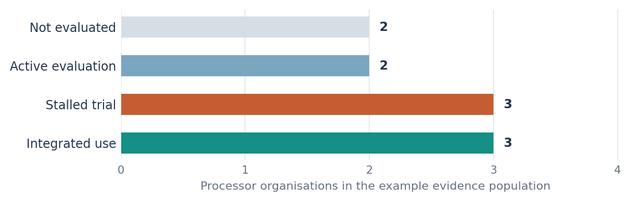
Example event-friction view
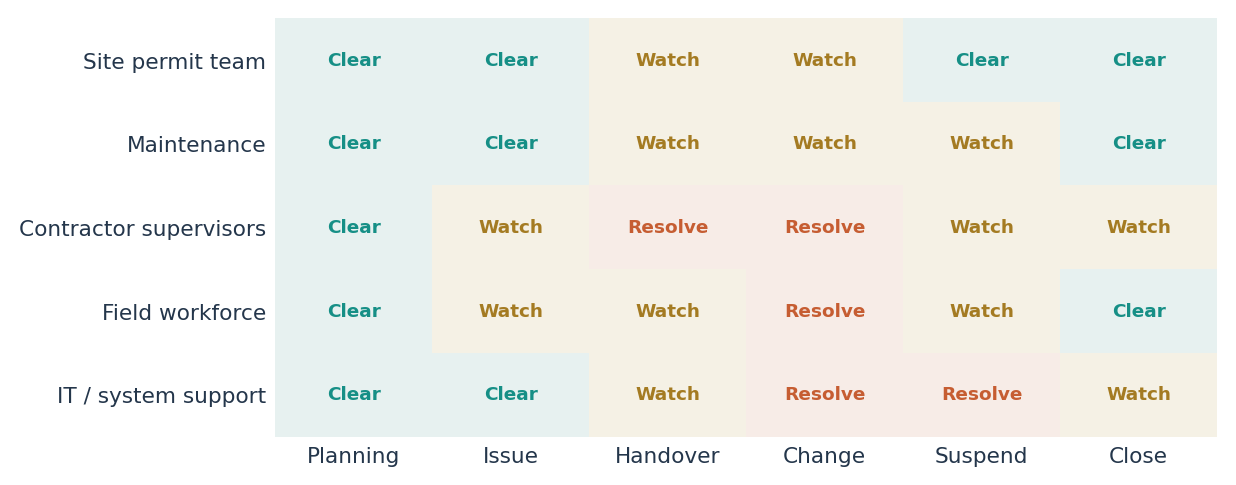
INTERPRETATION The standard workflow may be acceptable, while adoption still fails at the edges: contractor access, mid-task change, shift handover and recovery when the preferred digital path is unavailable.
ADOPTION IMPLICATION
Build a turnaround operating mode before scaling
The example conclusion is that a routine-maintenance demonstration does not answer the site's highest-risk adoption questions. The provider should prove the workflow during a bounded turnaround scenario with contractor onboarding, exception handling and recovery built into the operating design.
PRIORITY | ACTION | ADOPTION EFFECT |
|---|---|---|
01 | Turnaround-mode workflow | Configure role, volume, handover and close-out rules for the event rather than duplicating routine settings. |
02 | Contractor access design | Set identity, training, device and support routes before mobilisation. |
03 | Exception and fallback protocol | Define decision rights, records and recovery when the normal digital route cannot continue. |
04 | Event proof plan | Test representative permit episodes under controlled peak-load conditions before site-wide commitment. |
What the client receives
- Turnaround permit lifecycle and event-friction map
- Paired owner, contractor and field-user episode narratives
- Contractor access, handover and exception requirements
- Turnaround-mode workflow and evidence plan
- Site adoption decision briefing with bounded next steps
Indicative delivery
STAGE | TIMING | ACTIVITY |
|---|---|---|
Frame | Week 1 | Event boundary, permit episode screen and confidentiality plan |
Reconstruct | Weeks 2 to 5 | Role-based outreach, interviews and episode pairing |
Stress-test | Weeks 5 to 6 | Scenario walkthroughs and friction analysis |
Resolve | Week 7 | Turnaround-mode requirements and adoption briefing |
Timing depends on site access, participant confidentiality and availability following the selected turnaround event.
CONTACT US Tell us which operating event must hold before a site can commit. August Research will structure the adoption study around the roles, exceptions and evidence that govern that event.