INDUSTRY ADOPTION STUDY | EXAMPLE ENGAGEMENT
Why similar laundries make different water-recovery decisions
Comparing adopted, evaluating, deferred and stalled closed-loop water recovery decisions across commercial laundries in Catalonia.
The decision behind the study
A water-recovery solution provider saw strong interest from commercial laundries, but similar-looking sites reached different investment decisions. A high-level market survey could describe interest, yet it would not explain why one site proceeded while another deferred after reviewing the same broad value proposition.
CLIENT DECISION Which laundry operating conditions create a credible path to adoption, and how should the offer, site assessment and support model change by segment?
ADOPTION THRESHOLD Adoption means approved installation with a defined reuse application, operating owner, water-quality control, maintenance plan and integration window, not stated interest alone.
The comparison design
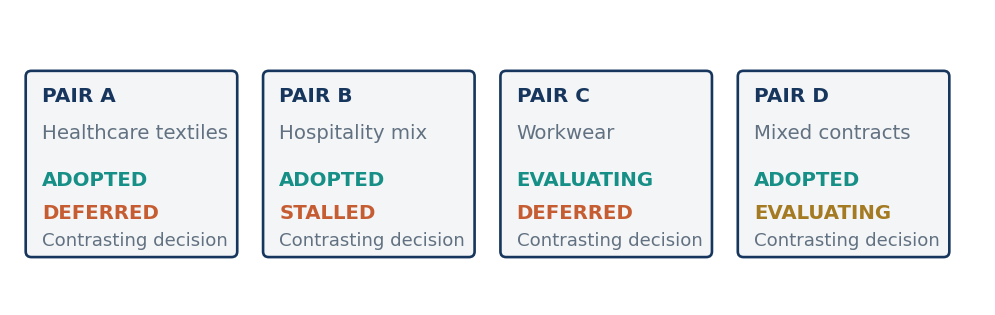
WHY CATALONIA MATTERS Water availability, operating exposure and local investment priorities make geography part of the adoption context. The study does not assume that every Catalan laundry faces the same conditions.
This example and its findings demonstrate a possible engagement structure. They do not represent a completed client project.
COMPARATIVE FIELDWORK
Matched-Site Adoption Comparison
Eight laundries are arranged into four matched pairs. Sites are made comparable on operating context, then contrasted on the actual adoption decision. This isolates the conditions that changed progression more effectively than combining all respondents into an average view.
8
LAUNDRY SITES
12
SITE INTERVIEWS
6
DATA PACKS
2
WALKTHROUGHS
How sites are matched
MATCHING PARAMETER | WHY IT MATTERS |
|---|---|
Service mix | Healthcare, hospitality, workwear or mixed contracts |
Operating scale | Relative throughput, hours and production pattern |
Existing process | Wash system, water treatment and heat recovery context |
Physical fit | Space, connection points and installation constraints |
Decision context | Ownership, capital route, contract horizon and adoption state |
Three additional interviews with solution engineering, laundry equipment service and water-treatment specialists test implementation dependencies without replacing the site evidence.
What the outreach looks like
OUTREACH CONTROL | APPLICATION |
|---|---|
Build contrasting cells | Recruit adopted, evaluating, deferred and stalled sites, not only sustainability leaders. |
Verify the decision | Confirm direct involvement in a recent assessment, investment, installation or deferral. |
Request bounded evidence | Where permission exists, collect non-confidential ranges or operating records relevant to the decision. |
Match before analysis | Lock the pairing logic before comparing outcomes so the conclusion is not driven by convenient examples. |
Independent research advantage
A neutral team can include deferred and stalled sites, separate operating constraints from supplier objections and challenge a business case that would otherwise be built mainly from successful installations.
EVIDENCE AND INTERPRETATION
Questions connect the site context to the investment episode
SITE / ROLE | BACKGROUND USED | SAMPLE QUESTIONS |
|---|---|---|
Adopted site | The period from site assessment through installation and operating handover. | Which condition made approval possible? What had to change in the proposed design? Which operating result is still being watched? |
Deferred site | The most recent proposal or internal review that did not enter the capital plan. | What prevented the decision from progressing? Was the barrier economics, fit, ownership, timing or confidence in water quality? |
Stalled site | The point after technical or commercial effort when the project stopped. | Which assumption changed? Who could not accept the remaining uncertainty? What evidence would reopen the case? |
Operations lead | A typical production week with the site's actual textile and wash mix. | Where could recovered water be used? Which variation or failure would create unacceptable operating consequences? |
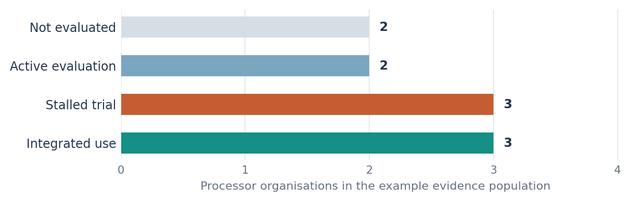
Example adoption-condition view
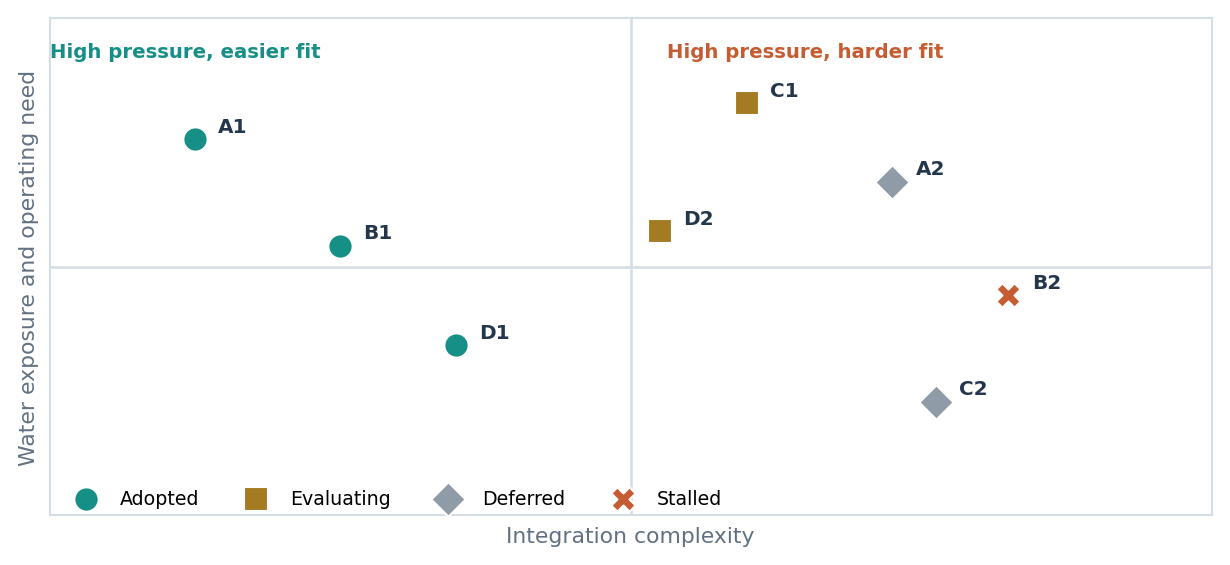
INTERPRETATION High water exposure can create urgency, but it does not guarantee adoption. Sites progress when the operating need is paired with feasible integration, clear ownership and a support model that contains quality and downtime risk.
COMMERCIAL IMPLICATION
Segment by operating fit, not water interest alone
The example conclusion is that the provider should replace a broad savings-led pitch with a site-fit pathway. The first assessment should establish operating need, viable reuse points, integration complexity and service ownership before producing a detailed financial case.
PRIORITY | ACTION | ADOPTION EFFECT |
|---|---|---|
01 | Site-fit screen | Qualify need, process compatibility, space and operating ownership before detailed design. |
02 | Reuse application pathway | Specify where recovered water can enter the process and what quality evidence is required. |
03 | Integration and service plan | Define installation window, maintenance capability and response responsibility. |
04 | Matched proof cases | Use evidence from comparable operating contexts rather than a generic savings claim. |
What the client receives
- Matched-site evidence profiles and adoption contrasts
- Operating-need and integration-complexity segmentation
- Site-fit screening criteria and disqualification rules
- Reuse application, ownership and support requirements
- Priority segment and commercial pathway briefing
Indicative delivery
STAGE | TIMING | ACTIVITY |
|---|---|---|
Match | Week 1 | Site cells, pairing parameters and evidence requests |
Compare | Weeks 2 to 5 | Outreach, interviews, data packs and walkthroughs |
Explain | Weeks 5 to 6 | Matched contrasts and adoption-condition analysis |
Prioritise | Week 7 | Site-fit screen, offer pathway and decision briefing |
Timing depends on access to contrasting sites, permission to review bounded operating evidence and travel requirements.
CONTACT US Tell us which sites appear similar but make different adoption decisions. August Research will build the comparison around operating fit, evidence and the commercial decision you need to make.