INDUSTRY ANALYSIS | AGRICULTURAL BIOLOGICALS
How Could Brazil's Bioinputs Framework Reshape Channel Power?
How a biological-inputs company could choose its commercial route as regulation, on-farm production and agronomic support evolve.
3
CROP CORRIDORS
4
SEASONAL WINDOWS
8
INDUSTRY ROLES
3
CHANNEL MODELS
The business situation
A biological-inputs company wanted to expand in Brazil but faced more than a distribution choice. Product access, agronomic confidence, inventory timing, rural credit and post-application evidence could sit with different participants. A dedicated bioinputs framework also created new implementation questions around commercial supply and production for own use.
DECISION QUESTION Should the company build national distributor reach, anchor through regional cooperatives or invest in a more direct agronomy-led model?
The channel decision
National distribution: Prioritise reach, credit capacity and broad portfolio access.
Cooperative-led: Build around trusted local institutions, seasonal inventory and farm relationships.
Agronomy-led: Retain more influence over trials, recommendation, application and repeat-use evidence.
COMMERCIAL TENSION The route with the widest reach may not control the agronomic proof that drives repeat use, while the route with the strongest field influence may scale more slowly.
CHANGE FORCES
Regulation changes the system through operating rules
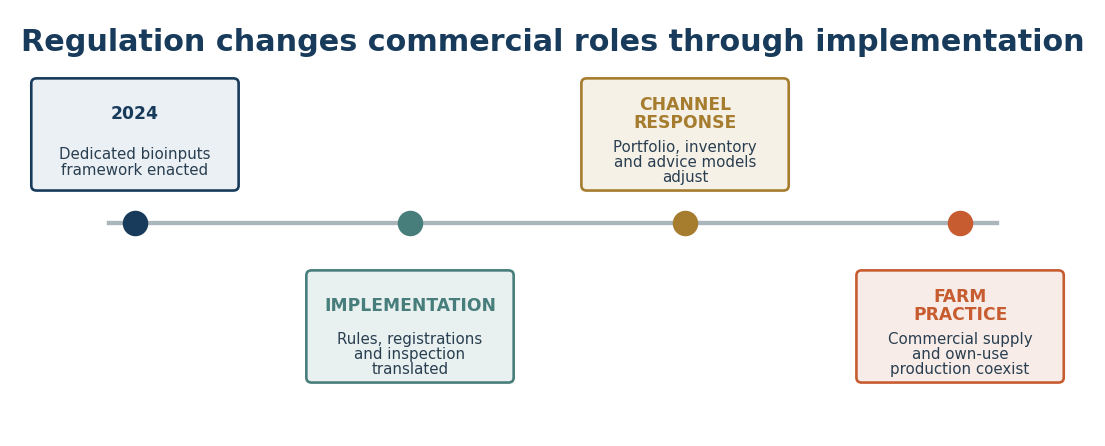
The 2024 framework established a dedicated legal basis for production, use and commercialisation of bioinputs. The strategic effect depends on subsequent implementation, the boundary between commercial supply and own-use production, and how channel participants adapt their portfolios, evidence and services.
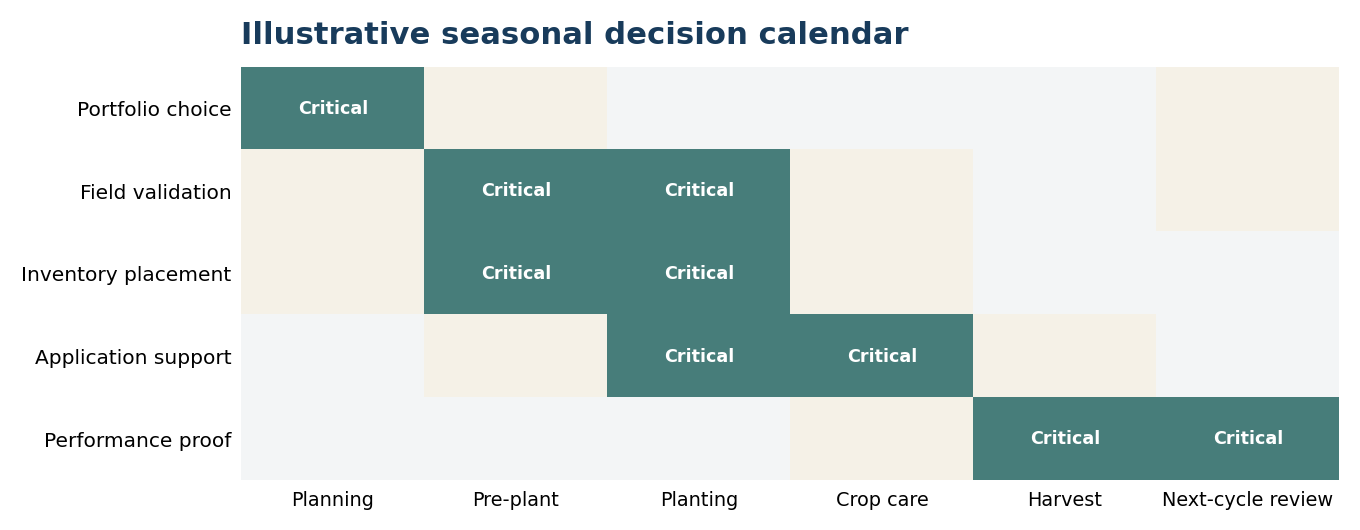
INDUSTRY IMPLICATION Channel influence is not constant through the year. It concentrates around the decisions that must be made before planting and around the evidence that determines repeat use after application.
SYSTEM SCOPE
Follow product, advice, inventory and proof separately
The study would compare soybean and maize systems in Mato Grosso and Parana with sugarcane systems in Sao Paulo. These corridors differ in crop timing, farm scale, cooperative presence, distributor structure and the way agronomic evidence is created and shared.
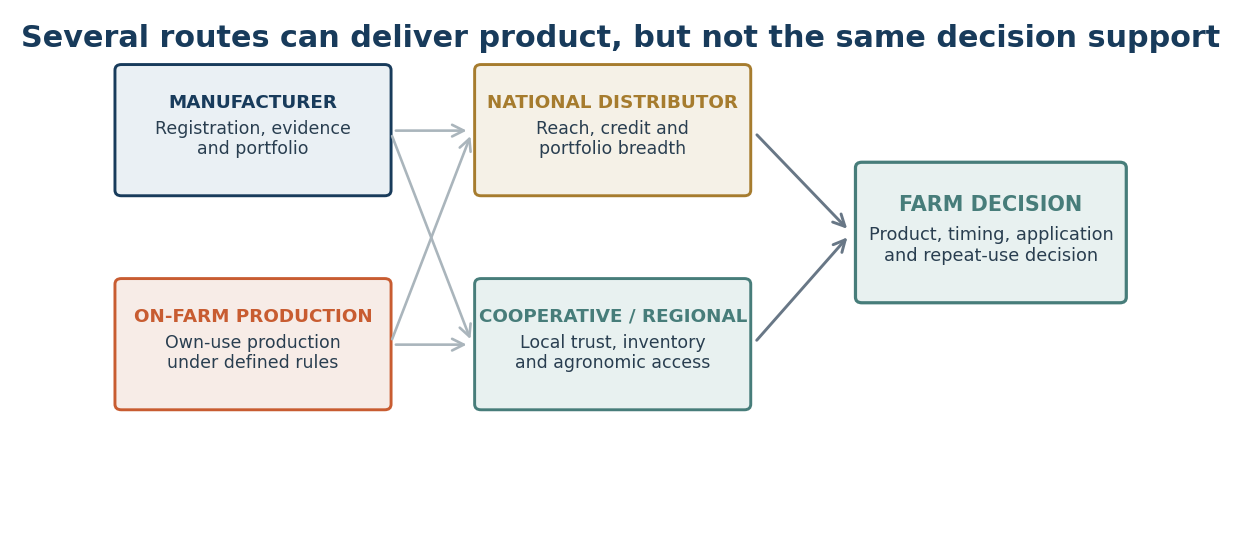
Eight roles included
Biological-input manufacturers; national distributors; regional distributors; cooperatives; agronomists and consultants; research and trial organisations; farm production units; growers and farm managers.
Corridor parameters
CORRIDOR | CROP SYSTEM | PARAMETERS FOLLOWED |
|---|---|---|
Mato Grosso | Soybean and maize rotations | Scale, logistics, large-farm decision systems and second-crop timing |
Parana | Soybean and maize with strong cooperative presence | Local trust, technical assistance, inventory and member economics |
Sao Paulo | Sugarcane systems | Longer crop cycle, mill influence, application planning and performance evidence |
BOUNDARY CONTROL Biocontrols, biostimulants and inoculants remain separate categories when their approval, application, evidence and repeat-use logic differ.
METHODOLOGY
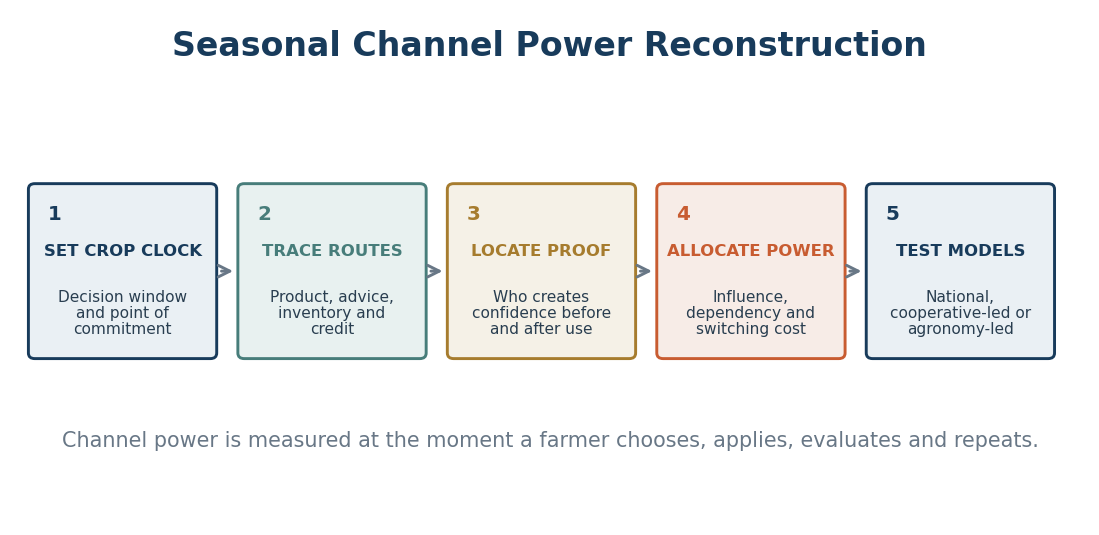
Seasonal Channel Power Reconstruction
This method measures who can influence the decision at each seasonal moment, which resources create that influence and what the manufacturer must control directly rather than assume the channel will provide.
Power tests
TEST | QUESTION APPLIED TO EACH ROLE |
|---|---|
Access | Can the participant reach the farm before the decision window closes? |
Confidence | Can it translate product evidence into a credible local recommendation? |
Availability | Can it place viable inventory under real storage and logistics conditions? |
Commercial leverage | Does it control credit, bundles, rebates, data or switching conditions? |
Learning | Can it capture application quality, outcome and repeat-use evidence? |
METHOD CONTROL Published market growth is used as context, not as proof that one route will win. The channel recommendation depends on crop clock, local evidence, inventory execution and repeat-use learning.
DECISION OUTPUT
Build the route around the missing source of influence
The output would show which partner should carry reach, inventory, credit and agronomic support, and which capabilities the manufacturer must retain to protect product learning and repeat use.
CHANNEL MODEL | WHEN IT BECOMES CREDIBLE | DECISION IMPLICATION |
|---|---|---|
National distribution | Fast reach and working-capital strength matter most | Protect technical positioning, data access and field-support standards |
Cooperative-led | Local trust and seasonal execution are decisive | Design crop-specific evidence, inventory and member-support commitments |
Agronomy-led | Recommendation quality and learning justify greater control | Invest selectively where crop value and adoption friction support the model |
What the client receives
Regulatory implementation map; crop and decision calendar; route-to-farm architecture; channel-role profiles; corridor comparison; inventory and evidence requirements; channel power matrix; model conditions; leading indicators and monitoring plan.
Decision triggers
- A rule changes the viable boundary between commercial supply and own-use production.
- A channel partner cannot place inventory or technical support before the crop decision window.
- Repeat-use evidence remains with the channel and cannot improve the manufacturer's portfolio decisions.
NOTE This example demonstrates a possible Industry Analysis engagement. It does not present client results, distributor recommendations or product claims.
Contact Us
Discuss the crop systems, channel routes and regulatory questions you need to understand. August Research can connect seasonal decisions, operating roles and sources of influence into a practical channel model.
August Research | Market & Business Intelligence