INDUSTRY ANALYSIS | DATA CENTRE COOLING
Where Will Value Move as AI Density Tests Southeast Asia's Cooling Infrastructure?
How a thermal-management company could choose between component supply, system integration and lifecycle performance across Singapore, Johor and Batam.
3
REGIONAL HUBS
4
COOLING ARCHITECTURES
7
BUYING ROLES
2030
DECISION HORIZON
The business situation
A thermal-management company saw rapid data-centre development and higher-density computing across Southeast Asia. It needed to know whether value would remain in cooling equipment or move toward design integration, controls, commissioning and long-term operating accountability.
DECISION QUESTION Where in the cooling value system should the company invest as workload density, tropical climate and infrastructure constraints interact?
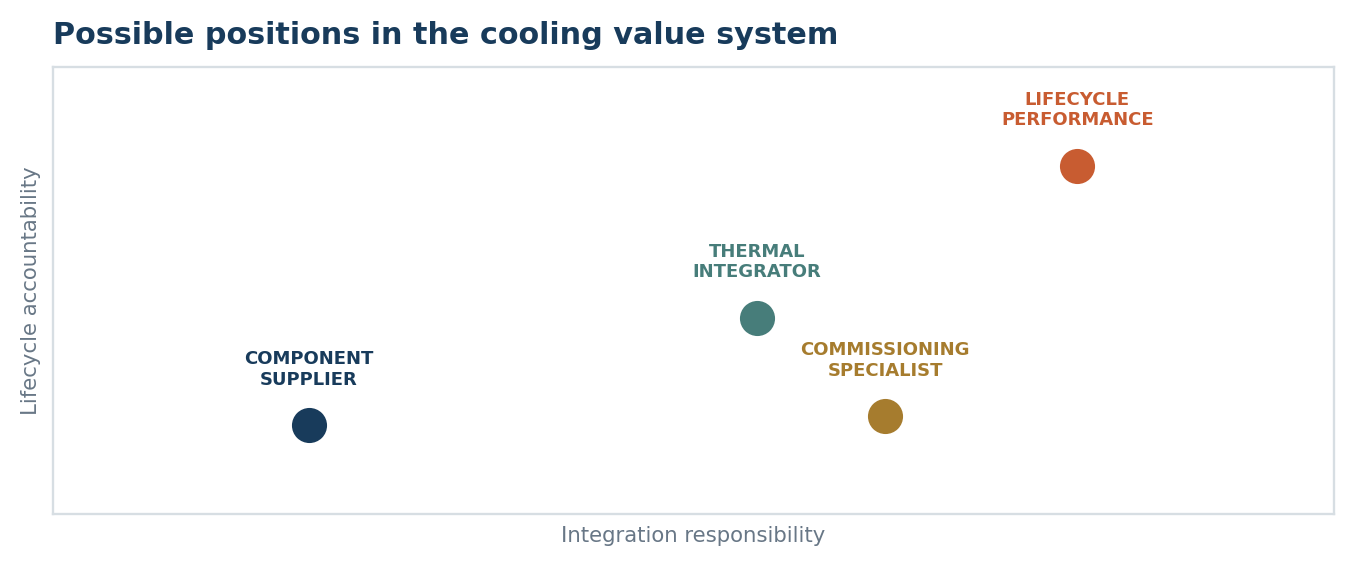
Positions under consideration
Component supplier: Provide heat exchangers, cooling distribution, pumps or controls to integrators.
Thermal integrator: Design and coordinate the cooling architecture around workload and site constraints.
Lifecycle performance: Add commissioning, optimisation, monitoring and maintenance accountability.
COMMERCIAL TENSION Greater accountability can expand value capture, but it also exposes the provider to site design, controls, operating practice and performance variables it may not own.
WHY THE QUESTION MATTERS
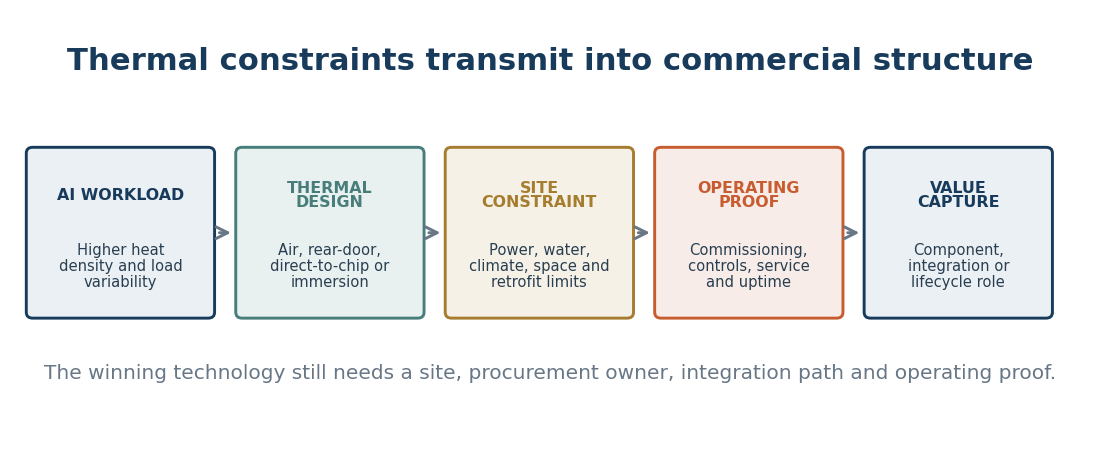
Cooling demand grows through a chain of constraints
Electricity demand from data centres in Southeast Asia is expected to more than double by 2030, with Singapore and southern Malaysia forming a major regional hub. The commercial opportunity is shaped not only by facility growth, but by the way AI workloads raise heat density while power, water, land and efficiency requirements tighten.
Four architectures followed
ARCHITECTURE | LIKELY ROLE | SYSTEM QUESTION |
|---|---|---|
Optimised air | Conventional and lower-density halls | Air path, humidity, fan energy and tropical set points |
Rear-door heat exchange | Targeted higher-density retrofit | Rack interface, water loop and existing hall constraints |
Direct-to-chip liquid | High-density compute zones | Coolant distribution, controls, serviceability and heat rejection |
Immersion | Selected specialist deployments | Fluid handling, hardware compatibility, maintenance and operating model |
INDUSTRY IMPLICATION The same cooling technology can have different value depending on whether it enters a new build, a retrofit, a colocation contract or a hyperscale standard design.
GEOGRAPHIC SYSTEM
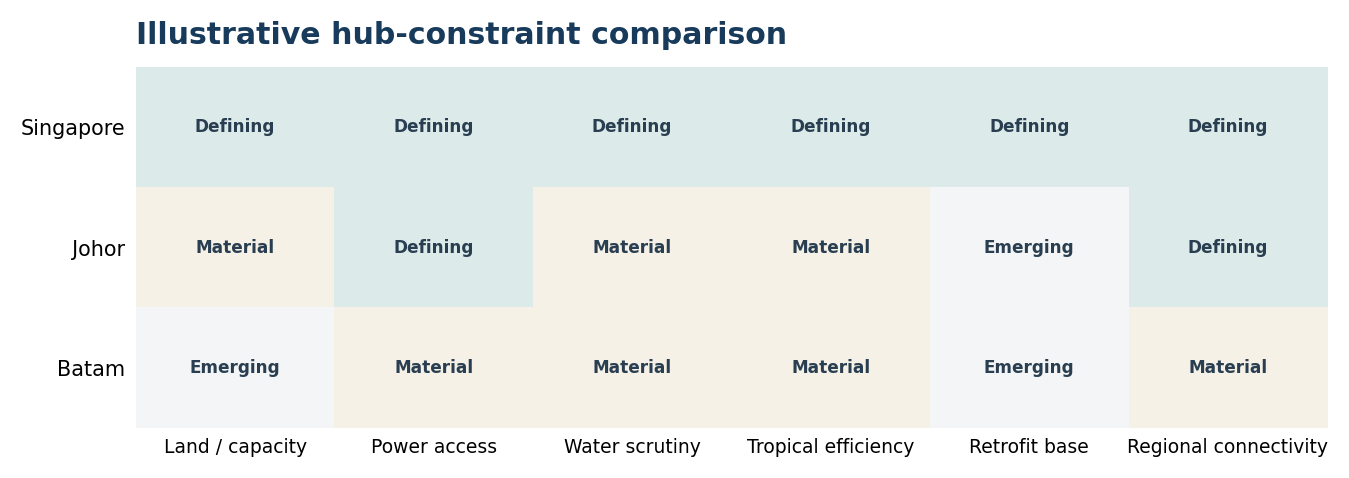
Three connected hubs, three constraint profiles
Singapore, Johor and Batam are treated as connected but not interchangeable systems. Connectivity and customer relationships cross borders, while power access, land, water, approval conditions, supply chains and operating maturity remain location-specific.
Buying roles traced
Owner and developer; colocation operator; hyperscale or enterprise tenant; engineering consultant; mechanical and electrical contractor; thermal equipment and controls provider; facility operations team.
Evidence assembled
EVIDENCE LAYER | WHAT IS RECONSTRUCTED |
|---|---|
Capacity and policy | Announced and operating sites, approvals, efficiency standards and infrastructure access |
Technical system | Workload density, cooling architecture, controls, heat rejection and redundancy |
Procurement | Who specifies, approves, buys, integrates, commissions and maintains |
Operating proof | Efficiency, uptime, water use, service response, maintainability and reference evidence |
BOUNDARY CONTROL A capacity announcement is not counted as an addressable cooling opportunity until timing, development status, workload type and procurement route are known.
METHODOLOGY
Thermal Constraint Transmission
This method follows a workload requirement through the site, system architecture, buying process and operating accountabilities. It reveals where one constraint creates demand for another capability and where the provider would inherit risk.
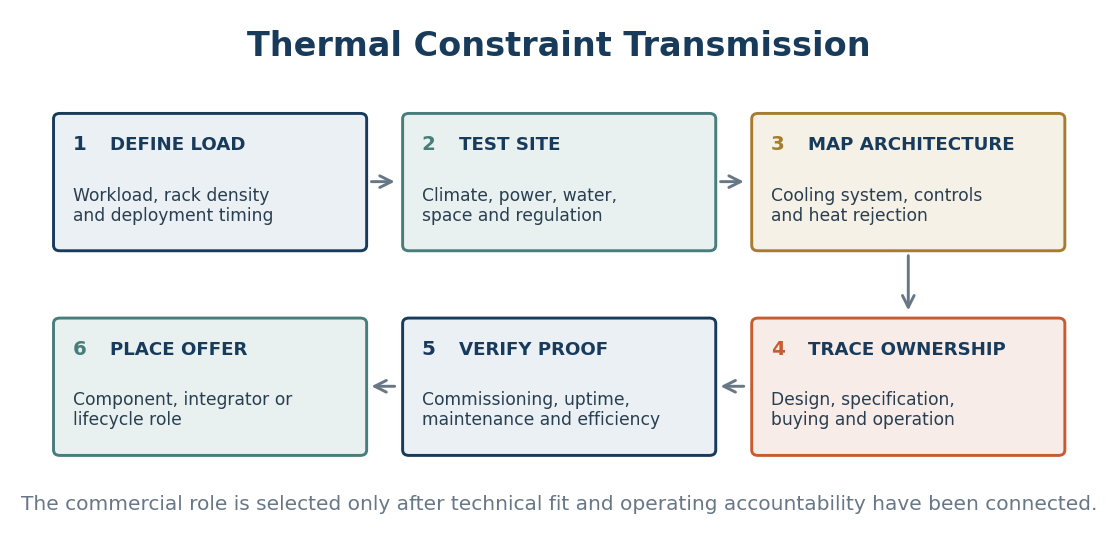
METHOD CONTROL Efficiency claims remain tied to load, climate, system boundary and test condition. A PUE target, component rating and site-level operating result are not treated as equivalent evidence.
DECISION OUTPUT
Choose accountability only where control and proof are sufficient
The analysis would show where the company can credibly own performance, where it needs partners and where a narrower component role protects margin and risk.
POSITION | WHEN IT BECOMES CREDIBLE | EVIDENCE REQUIRED |
|---|---|---|
Component supplier | Standardised demand and strong integrator access | Product fit, specification route, service coverage and data rights |
Thermal integrator | Architecture choices remain open and cross-system coordination creates value | Design capability, partner network, commissioning and project accountability |
Lifecycle performance | Operating optimisation is measurable and controllable | Baseline, sensors, controls access, maintenance scope and remedies |
What the client receives
Regional hub comparison; workload and rack-density scenarios; cooling-architecture map; procurement ownership model; constraint transmission analysis; partner and capability gaps; commercial-position test; proof requirements; decision triggers and monitoring dashboard.
Decision triggers
- A target hub tightens capacity, power, water or efficiency conditions.
- Customer workload density moves beyond the economical range of the current architecture.
- Performance accountability is requested without access to the controls and operating data needed to manage it.
NOTE This example demonstrates a possible Industry Analysis engagement. It does not present client results, technology endorsements or a site-selection conclusion.
Contact Us
Discuss the workloads, hubs and commercial roles you need to understand. August Research can connect thermal design, infrastructure constraints and operating accountability into a clear position in the value system.
August Research | Market & Business Intelligence