PHASE 2 · INNOVATION LANDSCAPE MAPPING · ENGAGEMENT 02
Choosing a climate-resilient cocoa-alternative ecosystem for European product reformulation
A route-level innovation map to determine which ingredient platforms can reduce cocoa exposure without sacrificing processing performance, sensory acceptance or lawful product positioning.
THE DECISION
Should the company pursue fermented local crops, upcycled cocoa sidestreams, plant-cell-derived cocoa ingredients or a reduced-cocoa hybrid for coated wafers and bakery fillings sold in Europe?
Engagement at a glance
Global FMCG manufacturer with chocolate-coated snacks, bakery fillings and seasonal confectionery products.
European Union and United Kingdom, with technology and ingredient developers screened globally.
Public technical, regulatory and commercial activity from 2021 to August 2026.
Select one lead route and one monitored alternative for product work over the next 18 to 30 months.
The situation
Cocoa supply volatility has moved ingredient substitution from a cost exercise to a portfolio-resilience decision. The client does not need a generic list of cocoa-free brands. It needs to understand which technology route can deliver the flavour, colour, fat behaviour and processing stability required in two specific product systems.
The decision is complicated because the innovation routes solve different parts of the problem. Fermented grains or legumes may reproduce roasted flavour and colour. Upcycled cocoa sidestreams may stretch existing cocoa. Plant cell culture may produce real cocoa lipids, but it creates a different scale and regulatory pathway. A hybrid formulation may reach the factory sooner while retaining exposure to cocoa traceability and price.
Why the route decision is becoming urgent
The International Cocoa Organization revised the 2023/24 global cocoa deficit to 489,000 tonnes and estimated only a modest 49,000-tonne surplus for 2024/25. The swing illustrates why a single season of improved supply does not remove structural volatility from product planning.
Commercialisation signals are becoming more diverse. Fazer moved a grain-based cocoa-free coating into full-scale factory production in 2025. Döhler disclosed plans to help Nukoko scale a fava-bean fermentation route into 10,000-litre batches. Barry Callebaut and Planet A Foods announced a long-term partnership around cocoa alternatives later that year. These are different operating models, not interchangeable solutions.
The regulatory clock also affects the comparison. The EU Deforestation Regulation is scheduled to apply to large and medium operators from 30 December 2026 and covers cocoa and relevant derived products. At the same time, the EU Chocolate Directive reserves product names through composition thresholds, including at least 35% total dry cocoa solids for chocolate. A technically successful substitute may therefore require a different category and consumer language.
The formulation-to-market conversion problem
A cocoa alternative must pass several linked tests: reproduce key aroma and colour attributes; deliver the right fat crystallisation and melt; behave predictably during refining, conching, tempering, coating or filling; survive shelf life; meet allergen, novel-food and labelling requirements; and reach a supply scale that supports a branded launch. Evidence in one dimension cannot compensate for failure in another.
What the study must resolve
- Which routes can achieve functional parity in a compound coating and a low-water-activity bakery filling, rather than in a demonstration bar alone.
- Which feedstock, fermentation, ingredient-system, scale-up, sensory and regulatory actors must cooperate for each route.
- Where claims are supported by commercial product, industrial batch, pilot output, laboratory data or marketing language only.
- Which route reduces cocoa exposure without creating a larger labelling, consumer-acceptance or supply-concentration risk.
CORE RESEARCH QUESTION
Which ingredient ecosystem gives the client the strongest path to a scalable, acceptable and legally supportable product, and what evidence should be required before formulation resources are committed?
How the route portfolio is built
The research compares complete innovation routes, not isolated ingredients. Each route is traced from feedstock and conversion process through ingredient functionality, application evidence, manufacturing readiness, regulatory position and branded adoption.
01 Define the two product systems
Specify coating and filling recipes, cocoa-reduction target, sensory benchmark, process temperatures, viscosity window, water activity, shelf-life expectation, clean-label constraints and target cost.
02 Separate the technology routes
Create distinct taxonomies for fermented crops, upcycled sidestreams, carob or grain formulations, biomass or precision-fermented aroma compounds, plant-cell-derived cocoa and reduced-cocoa hybrids.
03 Map the enabling ecosystem
Identify feedstock suppliers, fermentation developers, ingredient formulators, processing-equipment partners, food-grade scale-up assets, analytical laboratories, brands, retailers and regulatory actors.
04 Extract functional evidence
Capture melting profile, solid-fat behaviour, rheology, particle size, aroma chemistry, colour, water activity, oxidation, bloom, allergen status, nutrition, processing compatibility and sensory design.
05 Distinguish maturity signals
Separate laboratory sample, pilot batch, industrial batch, branded launch, repeat order and multi-market availability. Record whether the evidence relates to the target application.
06 Resolve the regulatory route
Assess ingredient authorisation, novel-food exposure, additive or flavour status, allergen implications, permitted sales name, claims and whether cocoa remains within EUDR scope for a hybrid product.
07 Compare ecosystem completeness
Score each route for feedstock continuity, scale-up access, application support, sensory proof, regulatory clarity, manufacturing fit and partner concentration.
08 Set formulation and monitoring gates
Recommend one lead route, one hedge and explicit triggers for technical testing, consumer research or regulatory consultation.
Application-specific evidence rule
A platform is not scored as application-ready because it has produced a bar or tasting sample. The retained evidence must connect the ingredient to the client’s intended process and product format. Performance, scale and regulatory status are recorded separately so one strong claim does not inflate the overall readiness assessment.
Website presentation suggestion: use four selectable route cards. Each card should expand from feedstock to factory and market, exposing the specific evidence required at every handoff.
Technical scope and comparison fields
The scope converts a broad food-technology landscape into a decision matrix for two actual product systems.
Decision lane | Parameters examined | Evidence captured |
|---|---|---|
Sensory system | Cocoa, roasted, fruity and bitter notes; aftertaste; aroma release; colour | Descriptive panel, consumer test, volatile analysis and product launch |
Fat functionality | Solid-fat curve, melting point, polymorph, tempering need, bloom and oxidation | Ingredient specification, DSC or equivalent data, shelf-life test |
Process behaviour | Viscosity, yield stress, particle size, refining, conching, coating and filling stability | Application trial, equipment conditions, defect or rework evidence |
Formulation | Cocoa reduction, sugar, protein, fibre, emulsifier, allergen and nutrition effects | Recipe disclosure, nutrition panel, claim and allergen statement |
Scale and supply | Feedstock geography, batch size, food-grade capacity, throughput and multi-sourcing | Pilot or industrial batch, facility, order, partner and capacity signal |
Regulatory and name | Novel food, flavour or ingredient status, chocolate definition, EUDR exposure and claims | Authority record, legal definition, market label and launch geography |
Ecosystem roles reconstructed
- Feedstock owners, crop processors, sidestream holders and ingredient distributors.
- Fermentation, plant-cell, roasting, lipid and formulation technology developers.
- Food-grade scale-up facilities, analytical and sensory laboratories, and equipment partners.
- FMCG brands, contract manufacturers, retailers, regulatory authorities and naming or claims specialists.
Research boundaries
The study does not perform formulation trials, sensory testing, shelf-life validation, toxicology assessment or formal legal review. Company sustainability and cost claims remain claims unless a transparent method and comparable boundary are available.
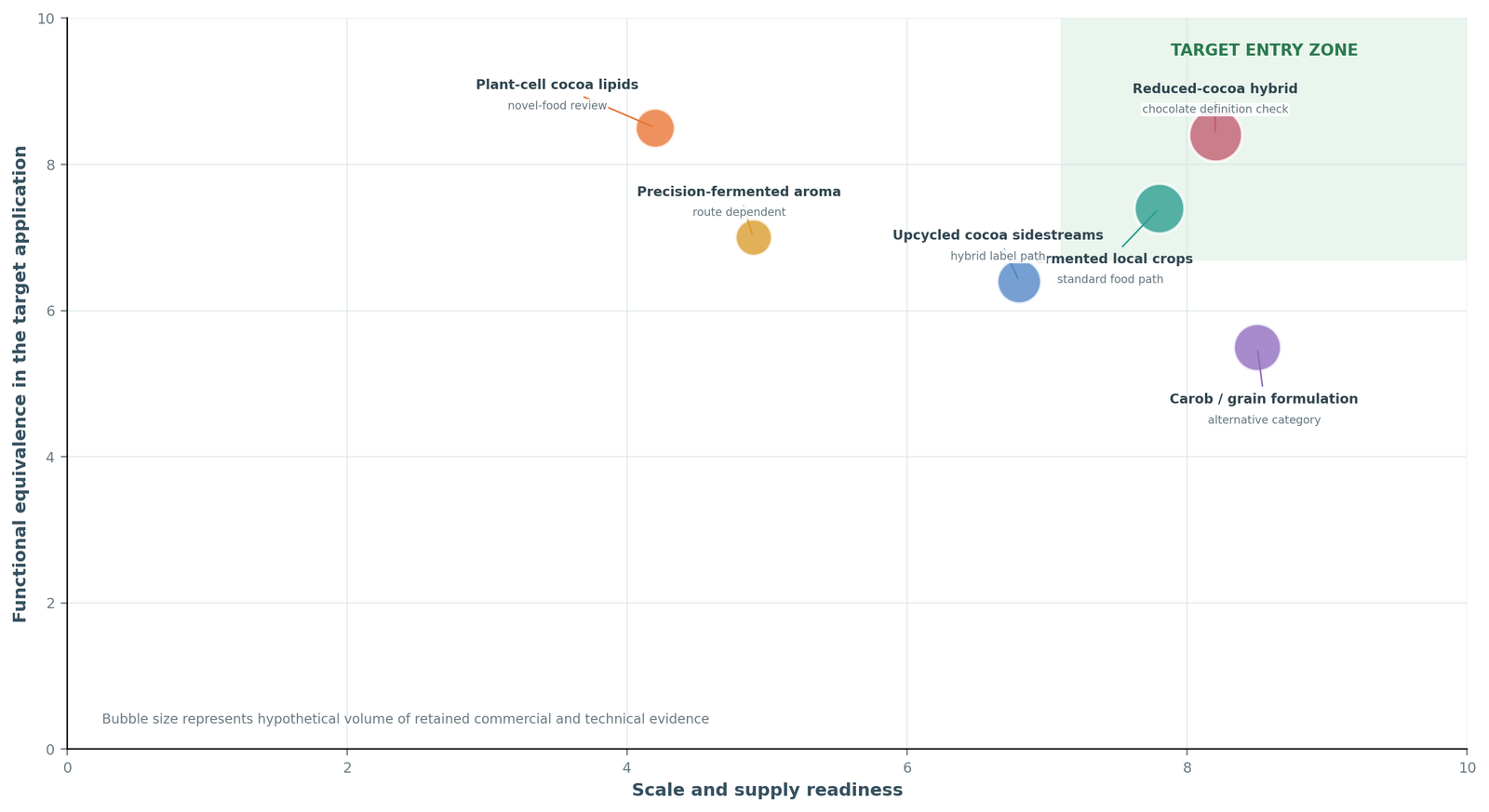
Example output: Route Portfolio Bubble Map
The central visual positions each innovation route by evidence of functional equivalence and evidence of scale and supply readiness. Bubble size represents the depth of retained technical and commercial evidence. Regulatory pathway is shown as a separate label rather than being hidden inside a single maturity score.
How a decision-maker would use it
- Switch between the coating and filling application to see how route position changes.
- Open a bubble to inspect the strongest and weakest evidence fields, not only an overall score.
- Filter routes by cocoa reduction, permitted product name, launch geography or available scale-up partner.
- Compare a full substitution route with a reduced-cocoa hybrid under the same factory and market constraints.
Hypothetical evidence volume
138 retained after application and evidence-quality review.
Mapped across feedstock, technology, scale-up, brand and regulatory roles.
Separated from laboratory samples and concept announcements.
Compared against 23 functional, scale, regulatory and adoption fields.
Website presentation suggestion: let visitors drag a cocoa-reduction target and switch the intended application. Bubbles should move as the weighting of sensory, processing, scale and regulatory fit changes.
What the output might reveal
The findings below demonstrate how the mapped evidence could support the decision. They are hypothetical and would change with the evidence collected.
A reduced-cocoa hybrid may be the fastest resilient route. It could preserve familiar processing behaviour while lowering commodity exposure, but the remaining cocoa portion would still require traceability and may keep the product within EUDR obligations.
Fermented local crops may offer the strongest scale adjacency. Routes based on established food crops can benefit from familiar supply chains and conventional food processing, yet functional performance must be demonstrated separately in coating and filling systems.
Plant-cell cocoa may solve authenticity before it solves volume. A bio-identical lipid or flavour route may support a strong sensory proposition, but food authorisation, cost and food-grade manufacturing capacity could delay portfolio impact.
Product naming is a design input, not a launch-stage check. A route that cannot use the expected chocolate sales name may still succeed, but packaging language and consumer research must be developed early enough to shape the formulation brief.
Recommended decision route
PROVISIONAL DIRECTION
Advance a reduced-cocoa hybrid and a fermented-crop route into parallel feasibility work for coated wafers. Keep plant-cell cocoa as a monitored strategic option until regulatory status, food-grade capacity and target economics become clearer.
Decision gates
- Gate 1: Demonstrate process stability and sensory direction in the target coating and filling systems.
- Gate 2: Confirm permitted ingredient and product naming in the first launch markets.
- Gate 3: Secure an industrial sample and a credible path to two-source supply.
- Gate 4: Validate consumer comprehension and purchase intent for the proposed category language.
Indicative project delivery
A multi-route study of this depth would typically take 7 to 9 weeks. Work would move from product-system framing and route taxonomy through evidence extraction, regulatory mapping, ecosystem reconstruction, route comparison and a decision workshop. Timing may expand where ingredient status or non-English market evidence requires deeper verification.
Search logic, retained records, application fields, evidence-quality tags and source links.
Entity-resolved feedstock, technology, scale-up, brand and regulatory participants.
Coating and filling comparison across sensory, process, shelf-life, formulation and scale fields.
Interactive-ready data plus static views for each product system.
Market-specific flags for novel food, labels, chocolate definitions, claims and EUDR exposure.
Lead route, hedge route, evidence gaps, partner archetypes, formulation gates and monitoring triggers.
Questions reserved for primary validation
- Can the ingredient meet the client’s viscosity, tempering and coating-line conditions at the required cocoa-reduction level?
- How do trained and target-consumer panels describe the product when the category name changes?
- What industrial volume and specification can the partner commit to over the next two launch cycles?
- Which sustainability and cost claims remain valid when assessed on the client’s product and geographic boundary?
Let’s discuss your project
If cocoa volatility is forcing reformulation decisions, the research should begin with the product system and market route, not a generic list of substitutes. Share the application, reduction target, geography and decision horizon, and the innovation map can be built around the evidence your formulation team needs.
Note:
The engagement, client profile, evidence counts, findings and recommendations are hypothetical. Industry context is grounded in publicly available information. Project timing is indicative and depends on taxonomy breadth, source accessibility, language and geographic coverage, evidence quality and profiling depth. Secondary research does not independently validate technical performance, regulatory status, qualification, freedom to operate or commercial access.