PHASE 2 · INNOVATION LANDSCAPE MAPPING · ENGAGEMENT 01
Mapping the glass-core substrate ecosystem for advanced chip packaging
A relationship-led study to determine where a precision-manufacturing company could enter an emerging semiconductor packaging ecosystem, which partners would be needed and what qualification evidence should precede investment.
THE DECISION
Should the company develop a through-glass-via processing tool, build an inline inspection and metrology offer, co-invest in a pilot line, or monitor the ecosystem until qualification evidence becomes stronger?
Engagement at a glance
European precision-processing and machine-vision company exploring semiconductor advanced packaging.
United States, Japan, South Korea, Taiwan, selected European programmes and relevant Chinese activity.
Public activity from 2021 to August 2026, with earlier foundational evidence retained where technically important.
Entry route and partnership sequence for the next 24 to 36 months.
The situation
Advanced AI packages must connect increasingly large chiplet assemblies, high-bandwidth memory and dense power and signal networks. Organic substrates remain essential, but package size, flatness, interconnect density and dimensional stability become harder to manage as architectures expand. Glass-core substrates are being developed as one response because their stiffness, surface quality, electrical properties and adjustable coefficient of thermal expansion can support finer interconnects and larger formats.
The client already understands laser processing and optical inspection. What it lacks is a reliable view of the conversion chain between a promising glass material and a package that an IDM, foundry, OSAT or chip designer is prepared to qualify. Entering too early could lock capital into an immature process route. Entering too late could leave the most valuable pilot and customer relationships with established equipment and substrate suppliers.
Why the decision is becoming urgent
The ecosystem is moving from technical demonstration towards pilot production and customer qualification. Intel has publicly positioned glass substrates for the latter part of this decade and linked their value to higher interconnect density, larger packages and improved dimensional stability. In 2026, Intel and Lens Technology announced work that combines semiconductor packaging expertise with precision glass processing and large-scale manufacturing capability.
Public investment is also targeting the conversion ecosystem, not only the material. The U.S. Department of Commerce has supported glass-core substrate work involving Absolics and a network of more than 30 partners, alongside broader advanced-packaging programmes intended to move research into scalable domestic manufacturing. In Japan, DNP announced a 510 × 515 mm through-glass-via pilot line, with sample provision beginning in 2026 and mass production targeted for fiscal 2028. TOPPAN has also announced an advanced-packaging pilot line scheduled for commissioning in 2026.
These signals do not prove that one process route will dominate. They show that pilot access, process integration, metrology, reliability evidence and customer qualification are becoming the competitive battleground. A conventional list of companies would therefore be insufficient.
The technical conversion problem
A glass panel does not become a qualified package substrate through a single breakthrough. It passes through a chain of dependent handoffs: glass composition and thickness selection; via formation; seed-layer and copper metallisation; dielectric and redistribution-layer build-up; panel handling and singulation; chiplet and memory assembly; thermal and mechanical reliability testing; and customer-specific qualification. A weakness at any handoff can negate the benefit delivered upstream.
What the study must resolve
- Where the client’s laser, panel-handling and machine-vision capabilities solve a documented conversion constraint rather than duplicate a crowded offer.
- Which organisations control pilot access, test vehicles, substrate integration and end-customer qualification in each priority geography.
- Which relationships are active, which remain at laboratory or sample stage, and which critical handoffs lack public evidence.
- What technical and commercial milestones should trigger development, partnership, minority investment or continued monitoring.
CORE RESEARCH QUESTION
Which capability position gives the client a defensible role in the glass-core substrate ecosystem, and what sequence of partners and proof points is required before it commits capital?
How the landscape is constructed
The research is organised around conversion dependencies. Every organisation is mapped to the technical work it can perform, the evidence supporting that capability and the next party that must accept its output. This reveals whether an apparent ecosystem is connected strongly enough to support qualification and scale.
01 Frame the decision and entry routes
Translate the client’s capabilities into four testable choices: through-glass-via process equipment, inline inspection and metrology, pilot-line participation, or monitored non-entry. Define the evidence that would support or reject each route.
02 Build the conversion taxonomy
Structure the landscape by glass material, via formation, via metallisation, dielectric and redistribution layers, panel handling, assembly, reliability, inspection, qualification and scale-up. Resolve synonyms before searching.
03 Capture organisations and capabilities
Identify material suppliers, process developers, equipment vendors, substrate manufacturers, IDMs, foundries, OSATs, chip designers, testbeds, universities, consortia and public funding bodies. Record what each actor can demonstrably do.
04 Reconstruct relationships
Link actors through joint development, funded programmes, supply agreements, pilot-line participation, sample provision, co-authored technical work, test vehicles, qualification statements and manufacturing collaborations.
05 Qualify the evidence
Separate a research claim from a repeatable process, pilot capability, customer sample, qualification programme and mass-production signal. Date-stamp every relationship and retain the original source.
06 Map technical handoffs and gaps
Trace how material, process and inspection outputs move towards substrate build and package qualification. Flag missing owners, single-source dependencies and relationships supported only by promotional statements.
07 Score strategic fit
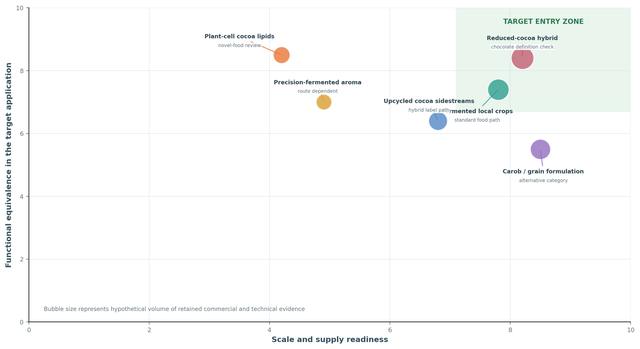
Compare the entry routes against adjacency to the client’s capabilities, qualification access, differentiation, capital intensity, time to evidence, partner dependence and the risk that a competing architecture displaces the route.
08 Define intervention and monitoring
Recommend where to build, partner, observe or stop. Convert uncertain points into primary-research questions and establish observable triggers for revisiting the decision.
Evidence-quality rule
A company is not assigned a capability because it uses a relevant keyword. The map requires a traceable connection between the organisation, the process or asset, the maturity claim and a dated source. A relationship is tagged separately as disclosed, inferred or unverified so that an ecosystem diagram does not imply partnerships that have not been evidenced.
Website presentation suggestion: present the eight stages as a scroll-controlled relay. As the visitor advances, the ecosystem grows from isolated organisations into verified conversion pathways, while weak handoffs remain visibly unresolved.
Technical scope and evidence fields
The scope is specific enough to support an entry decision, but broad enough to capture alternative process routes and the organisations that can enable or block adoption.
Capability lane | Technical parameters examined | Evidence captured |
|---|---|---|
Glass platform | Composition, CTE, thickness, panel size, surface quality, stiffness and electrical loss | Product data, sample availability, pilot use and co-development |
Via formation | Method, via diameter, pitch, aspect ratio, taper, sidewall quality, throughput and damage | Tool demonstration, test vehicle, process window and scale claim |
Metallisation | Seed-layer continuity, conformal or filled copper, adhesion, voids and copper-glass stress | Process partner, reliability result, patent or technical publication |
RDL and build-up | Dielectric compatibility, line and space, registration, layer count and panel uniformity | Substrate integration, pilot output and customer sample |
Handling and inspection | Warp, total thickness variation, breakage, defect detection, via geometry and overlay | Inspection method, inline readiness, throughput and factory integration |
Assembly and reliability | Chiplet or HBM assembly, thermal cycling, moisture, delamination, via cracking and continuity | Test vehicle, test method, qualification owner and disclosed result |
Scale and qualification | Panel format, yield learning, cycle time, equipment compatibility, multi-sourcing and design enablement | Pilot line, sample date, customer programme, capacity and production target |
Actor and relationship fields
- Organisation role, owned capability, location, facility or pilot asset, process stage and stated maturity.
- Relationship type, counterpart, disclosed purpose, start date, current status, evidence strength and last verification date.
- Application target, package architecture, technical dependency, qualification owner and next required handoff.
- Public funding, consortium participation, manufacturing intent, sample timing, production target and multi-sourcing signal.
Research boundaries
The study covers public and licensed secondary sources, including company disclosures, technical papers, patents, public funding records, facility announcements, conference materials, supplier documentation and relevant standards activity. It does not claim freedom to operate, independently verify yield or reliability, confirm undisclosed customer programmes, or replace laboratory and commercial due diligence.
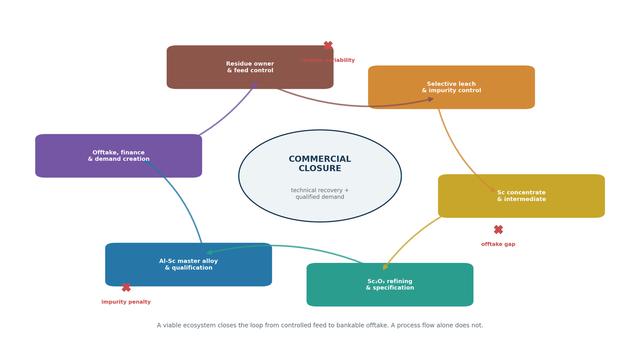
Example output: Capability-to-Qualification Relay Map
Instead of presenting a static company universe, the principal output shows how capability must travel from material and process creation through conversion infrastructure to an adoption owner. Each connection is supported by a dated relationship record. Missing handoffs remain visible rather than being hidden by a complete-looking value chain.
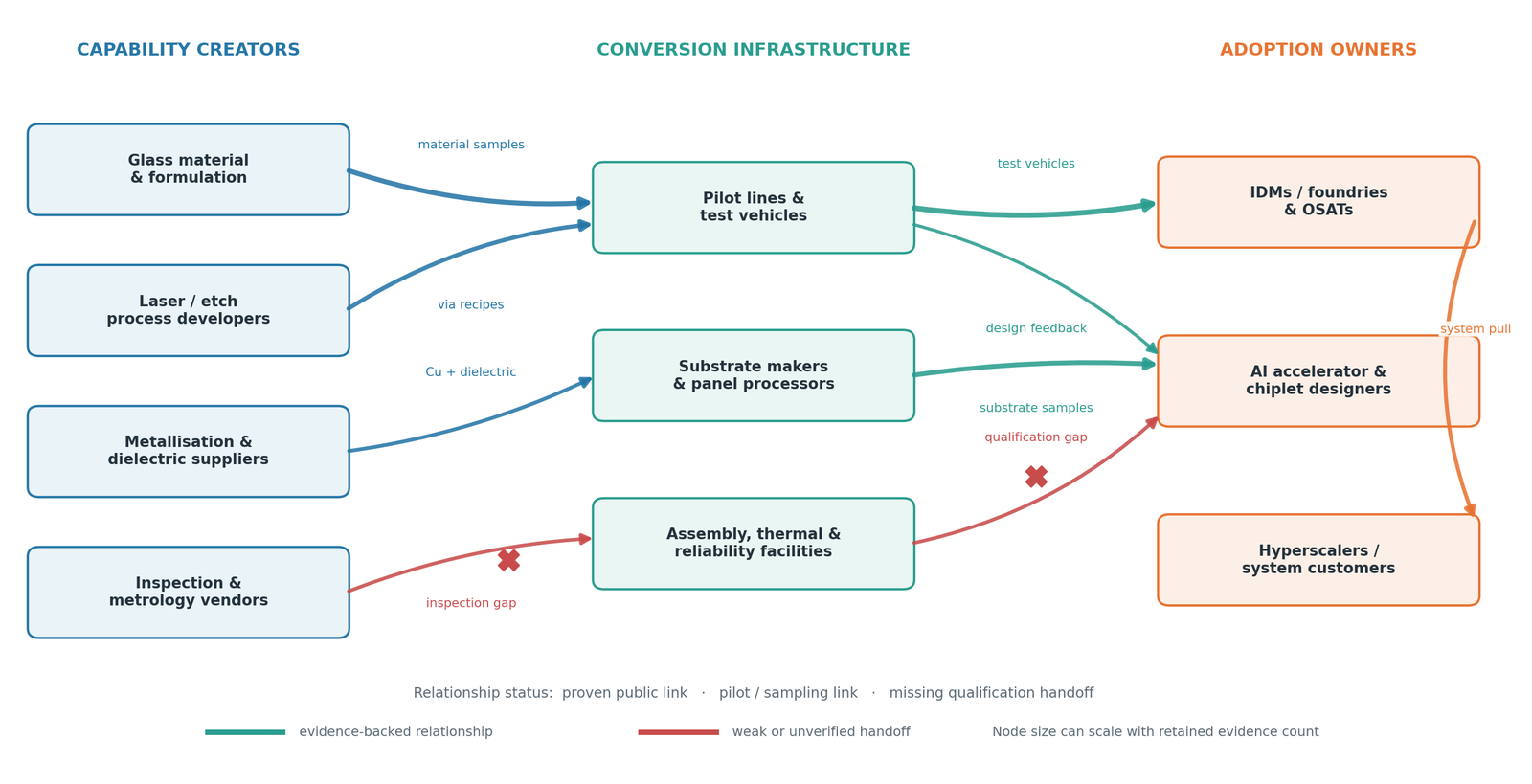
How a decision-maker would use it
- Select an organisation to see its evidenced capabilities, pilot assets, counterparties and most recent activity.
- Filter by geography, package architecture, maturity level or technical lane to expose concentration and missing coverage.
- Follow a conversion route from glass formulation to customer qualification and identify the party responsible for each acceptance step.
- Compare the client’s four entry options against the relationships and proof points that already exist.
Hypothetical evidence volume
124 retained after relevance, duplication and evidence-quality review.
Mapped across ten actor types and six priority geographies.
Including development, funding, pilot, supply, sampling and qualification signals.
Separated from laboratory-only claims and general technology announcements.
Website presentation suggestion: use the relay map as an interactive evidence layer. Hovering over a connection should display the relationship type, date and source category; clicking a red marker should open the unanswered qualification question and the action proposed to close it.
What the output might reveal
The following findings demonstrate how the analysis could translate ecosystem evidence into a decision. They are hypothetical and would change with the evidence collected.
The bottleneck is the handoff, not the availability of glass. Multiple glass platforms and processing routes may be visible, but comparable evidence linking via quality, copper integrity, RDL build and package-level reliability could remain sparse. The client should avoid treating material announcements as proof of a qualified production chain.
Inspection is a more credible adjacency than full substrate manufacture. The client’s machine-vision and panel-handling strengths may align with unresolved needs in via geometry, registration, crack detection and panel uniformity, while avoiding the capital and qualification burden of owning the complete substrate process.
Pilot access is the critical partnership asset. A metrology offer would still require representative panels, shared defect taxonomies and access to test vehicles. The preferred route may therefore be a development partnership with a substrate maker or pilot consortium rather than an independent tool build.
Qualification evidence should govern the investment gates. A first investment gate could require repeatable measurement on large panels; a second could require correlation between inspection signals and destructive reliability results; a third could require inclusion in a customer-facing qualification programme.
Recommended decision route
PROVISIONAL DIRECTION
Pursue a partner-led inline inspection and metrology concept, conditional on access to large-format glass-core test panels and a shared reliability-correlation programme. Defer full through-glass-via equipment development until the client can demonstrate a differentiated process window or secure a lead qualification partner.
Decision gates
- Gate 1: Secure two technically credible panel or substrate partners willing to define measurable defect and acceptance criteria.
- Gate 2: Demonstrate repeatable inspection performance across at least two glass thicknesses and two through-glass-via geometries.
- Gate 3: Correlate non-destructive inspection signals with cross-section, electrical continuity and thermal-cycling outcomes.
- Gate 4: Confirm that a qualification owner will evaluate the tool within a relevant package or test-vehicle programme.
Indicative project delivery
A focused engagement of this depth would typically take 7 to 9 weeks. The work would begin with decision framing and taxonomy design, followed by evidence capture and entity resolution, relationship reconstruction, technical handoff analysis, strategic-fit assessment and a final decision workshop. Weekly working sessions would be used to test scope assumptions and prevent the research from drifting into a generic company landscape.
Search logic, screened and retained records, source links, dates, evidence-quality tags and technical fields.
Entity-resolved organisations, roles, facilities, process capabilities, maturity signals and geographic coverage.
Counterparties, relationship type, disclosed purpose, status, strength, evidence and last verification date.
Interactive-ready data structure plus a static decision view showing connected routes, weak handoffs and concentration.
Comparison of build, partner, pilot-invest and monitor options against fit, capital, qualification access and dependency risk.
PowerPoint narrative covering findings, recommended route, decision gates, partner archetypes and monitoring triggers.
Questions reserved for primary validation
- Which defect signatures currently cause panel rejection, and which can be detected early enough to affect yield?
- What sample formats, process data and reliability results would a pilot partner share under confidentiality?
- Who owns the final acceptance criterion for the relevant substrate and package architecture?
- What level of throughput, tool uptime and factory integration is required before the metrology concept becomes commercially credible?
Let’s discuss your project
If an emerging innovation looks promising but the path from research to qualification remains unclear, the first step is to define the decision, the technical handoffs and the evidence that would justify action. Share the technology, geography, application and investment question, and the landscape can be structured around the decision your team actually needs to make.
Note:
This engagement, client profile, evidence counts, findings and recommendations are hypothetical. Industry context is grounded in publicly available information. Project timing is indicative and depends on taxonomy breadth, source accessibility, language and geographic coverage, evidence quality and the depth of organisation and relationship profiling. Secondary research does not independently validate process yield, reliability, qualification status, freedom to operate or commercial access.