PHASE 2 · INNOVATION LANDSCAPE MAPPING · ENGAGEMENT 03
Closing the scandium recovery ecosystem around European bauxite residue
A commercial-closure map to determine whether a residue owner should build recovery capability, supply an intermediate, partner with a refiner or anchor the chain through alloy offtake.
THE DECISION
Where should an alumina producer participate in the residue-to-scandium chain, and which technical, refining and demand relationships must be secured before a demonstration project is scaled?
Engagement at a glance
European alumina producer with a large bauxite-residue stream and no established scandium business.
European Union, Canada and Australia, with end-use qualification signals screened globally.
Public technical, project, funding and commercial activity from 2018 to August 2026.
Select a partnership and product position for a demonstration-to-commercial pathway over 3 to 6 years.
The situation
Bauxite residue can contain scandium at concentrations that are interesting in aggregate but difficult to recover selectively. The client has access to feedstock and alumina-site infrastructure, yet it does not know whether the most defensible position is a leached concentrate, high-purity scandium oxide, aluminium-scandium master alloy or a partnership model connecting several specialists.
The business case cannot be established from recovery percentage alone. Residue mineralogy, acid consumption, impurity removal, product purity, waste treatment, refining capacity, alloy qualification and dependable offtake are interdependent. A process that produces scandium but lacks a qualified buyer is not a complete innovation ecosystem.
Why ecosystem closure matters now
The European Critical Raw Materials Act is pushing domestic extraction, processing and recycling capacity, including 2030 benchmarks for strategic-material supply chains. This policy direction increases attention on industrial residues, but it does not make every recovery route commercially viable.
The EU-funded SCALE and SCALE-Up programmes have moved the concept from process development towards an integrated commercialisation pathway. SCALE-Up describes a target chain in which 850,000 tonnes per year of bauxite residue could yield 67 tonnes per year of crude scandium concentrate, 22 tonnes per year of scandium oxide and 733 tonnes per year of aluminium-scandium 2% master alloy. These are project targets that still depend on recovery, purity and demand assumptions.
A separate commercial signal comes from Canada. Rio Tinto and Canada Growth Fund announced approximately C$25 million in 2025 to support expansion of scandium-oxide capacity at Sorel-Tracy to nine tonnes per year, accompanied by a Canadian government offtake and marketing arrangement. The structure shows that demand assurance can be as important as the extraction asset.
The residue-to-offtake conversion problem
Scandium is dispersed at low concentration and closely associated with major residue phases. Selective leaching must manage acid consumption and co-dissolution of iron, aluminium, titanium and other elements. The resulting intermediate must then be purified, converted to a specification that a refiner or alloy producer can accept, and tied to applications whose qualification cycle and demand are compatible with the proposed capacity.
What the study must resolve
- Which residue characteristics and pre-treatment routes define the realistic recovery window at the client’s site.
- Which organisations can own leaching, separation, oxide refining, master-alloy production and end-use qualification.
- Where public projects demonstrate integrated handoffs and where they remain disconnected technical work packages.
- Which product position gives the client exposure to scandium value without assuming every capital and market risk.
CORE RESEARCH QUESTION
What combination of feed control, recovery technology, refining partner and offtake structure can close a bankable scandium ecosystem around the client’s bauxite residue?
How commercial closure is tested
The map begins with the residue and works outward to a paying, qualified use. Each stage is assessed for technical acceptance criteria, ownership, evidence of integration and the economic dependency it creates for the next stage.
01 Characterise the decision feed
Define annual residue volume, storage or fresh-stream access, scandium range, mineral association, moisture, alkalinity, particle size, major impurities and available plant utilities.
02 Decompose the recovery flowsheets
Map pre-treatment, acid or alkaline leaching, solid-liquid separation, ion exchange or solvent extraction, precipitation, calcination and residue neutralisation routes without treating them as equivalent.
03 Trace material acceptance criteria
Record scandium concentration, recovery, impurity profile, acid consumption, intermediate form, oxide purity and the specification required by the next processor.
04 Resolve ecosystem ownership
Identify residue owners, hydrometallurgy developers, equipment suppliers, refiners, alloy producers, additive-manufacturing or SOFC users, public programmes and financing actors.
05 Reconstruct integrated demonstrations
Separate isolated laboratory work from pilot campaigns, site-integrated demonstrations, continuous operation, qualified product and disclosed commercial output.
06 Map offtake and qualification
Capture alloy composition, application route, qualification owner, test method, development agreement, offtake, price support and the capacity that demand could credibly absorb.
07 Stress-test closure
Identify where the chain depends on one refiner, one buyer, unproven residue consistency, aggressive recovery assumptions or disposal credits that have not been demonstrated.
08 Select the participation model
Compare licensed recovery, concentrate supply, toll refining, joint venture, oxide production and master-alloy integration against capability, capital and demand risk.
Mass-and-relationship rule
The same quantity basis must be followed from residue through concentrate, oxide and alloy. Project targets are not treated as operating production, and a technical collaboration is not treated as offtake unless the disclosed relationship supports purchase or demand commitment.
Website presentation suggestion: build the method as a loop that can be entered at any product stage. Selecting a stage should reveal its acceptance specification, owner, next buyer and unresolved dependency.
Technical and commercial scope
The research joins flowsheet evidence to product acceptance and demand so that the client can see where value is created and where risk accumulates.
Closure stage | Technical parameters examined | Commercial evidence captured |
|---|---|---|
Residue control | Fresh or stored stream, Sc grade, mineralogy, moisture, alkalinity and variability | Ownership, annual availability, sampling and site integration |
Leaching | Reagent, temperature, time, solid-liquid ratio, recovery and impurity dissolution | Pilot scale, campaign duration, reagent supply and equipment |
Separation | Selectivity, resin or solvent, loading, stripping, losses and recycle | Intermediate specification, consumables, stability and operator |
Sc₂O₃ refining | Purity, Fe/Al/Ti limits, precipitation, calcination and batch consistency | Refiner acceptance, capacity, tolling and qualification sample |
Master alloy | Sc content, melt practice, recovery, homogeneity, casting form and certification | Alloy partner, product specification and customer development |
End use and offtake | Mechanical or SOFC performance, qualification method and substitution threshold | Buyer, volume, price mechanism, offtake and application timing |
Residual liabilities | Neutralisation, water, secondary waste, residue reuse and environmental controls | Permit, disposal cost, liability owner and circularity claim |
Relationships that determine closure
- Residue owners, alumina operators and site-utility or waste-management teams.
- Hydrometallurgy developers, separation-media suppliers, engineering firms and pilot facilities.
- Scandium refiners, aluminium master-alloy producers and application qualification partners.
- Aerospace, defence, additive-manufacturing and solid-oxide-fuel-cell users, public funders and strategic buyers.
Research boundaries
The study does not estimate a bankable reserve, validate metallurgical recovery, produce a process design, calculate definitive capital or operating cost, confirm environmental permits or provide a commodity price forecast. These require site data, test work and specialist engineering.
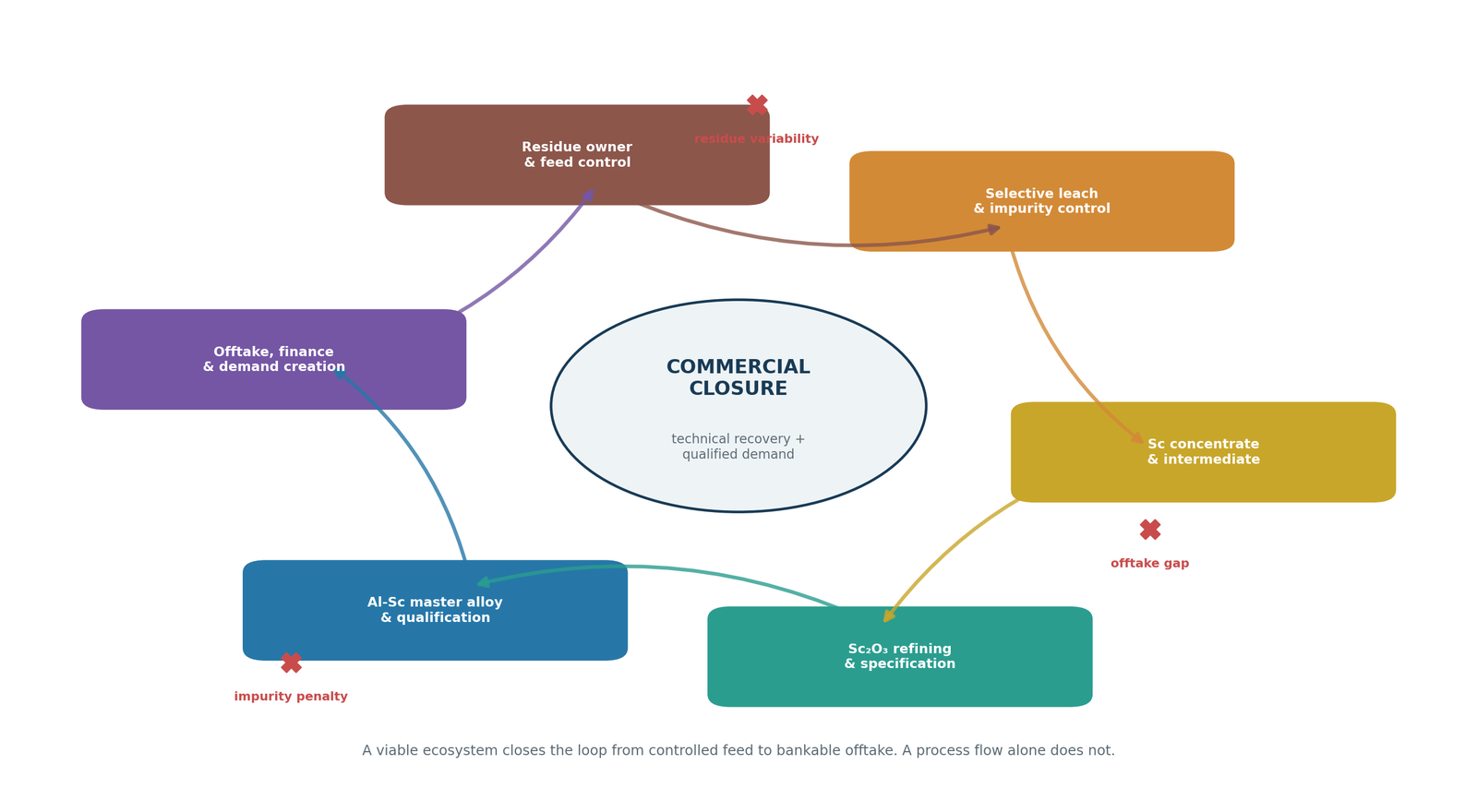
Example output: Residue-to-Offtake Commercial Closure Wheel
The principal output shows whether the chain closes from controlled residue to qualified demand. Missing links are marked at the point where a downstream party must accept the material, rather than being buried in a generic value-chain diagram.
How a decision-maker would use it
- Start with the client’s residue and follow the product specification required at each transfer.
- Switch between technical, ownership and commercial views without changing the material basis.
- Open a gap marker to see the evidence missing, the party able to close it and the effect on the participation model.
- Compare a concentrate-supply route with oxide or master-alloy integration under the same demand assumptions.
Hypothetical evidence volume
103 retained across process, project, policy and commercial sources.
Mapped across residue, recovery, refining, alloy and end-use roles.
Each linked to an acceptance specification and relationship status.
Separated from laboratory-only flowsheet studies.
Website presentation suggestion: animate the wheel using a constant feed basis. As visitors change recovery or purity assumptions, the downstream quantity and closure risk should update visibly.
What the output might reveal
The findings below demonstrate how the mapped evidence could support the decision. They are hypothetical and would change with the evidence collected.
The strongest asset may be controlled feed, not a proprietary flowsheet. Long-term access to a characterised residue stream and plant utilities can make the client a necessary ecosystem partner even when separation technology is sourced externally.
A crude concentrate can reduce capital exposure but creates acceptance risk. This position is credible only if a refiner has defined impurity and concentration limits and is willing to process representative material.
Offtake must be built before full oxide capacity. The small and developing scandium market can be disrupted by relatively modest new supply. A staged capacity plan should therefore be tied to alloy or application qualification rather than a broad demand forecast.
A partnership chain may be more defensible than vertical integration. The client may retain feed and leaching control, use specialist refining and master-alloy partners, and anchor the route through a strategic buyer or public procurement structure.
Recommended decision route
PROVISIONAL DIRECTION
Develop a site-integrated concentrate demonstration while negotiating a toll-refining specification and a staged alloy-development agreement. Defer investment in a complete oxide and master-alloy chain until material acceptance and offtake conditions are evidenced.
Decision gates
- Gate 1: Confirm residue variability and recovery across a representative continuous sampling campaign.
- Gate 2: Produce an intermediate that meets a named refiner’s impurity and concentration specification.
- Gate 3: Convert refined oxide into repeatable master-alloy batches and complete an application-relevant test plan.
- Gate 4: Tie expansion capacity to an offtake, procurement or jointly funded qualification programme.
Indicative project delivery
A multi-stage ecosystem map would typically take 8 to 10 weeks because technical and commercial evidence must be normalised to a common material basis. Work would include residue and flowsheet taxonomy, project and relationship reconstruction, product-specification mapping, demand and offtake analysis, participation-model comparison and a decision workshop.
Feed, operating conditions, recovery, impurities, product and evidence-quality fields.
Quantity basis, specification, owner, accepting party, evidence and gap status.
Entity-resolved recovery, refining, alloy, end-use, funding and policy participants.
Interactive-ready structure and static decision view of the complete chain.
Concentrate, toll-refining, joint-venture, oxide and master-alloy routes compared.
Recommended position, partner archetypes, gates, unresolved tests and monitoring triggers.
Questions reserved for primary validation
- How does recovery and impurity loading change across fresh residue, stored residue and seasonal operating conditions?
- What intermediate specification will a refiner accept and how will treatment charges or payability be structured?
- What alloy batch and application test would a buyer regard as meaningful qualification evidence?
- Which waste, water and permitting liabilities remain with the residue owner under each partnership model?
Let’s discuss your project
If an industrial residue contains a critical material but the route to a paying specification is unclear, the landscape should connect feed, process, product and buyer. Share the residue, current test evidence, target product and investment decision, and the ecosystem can be mapped around commercial closure.
Note:
The engagement, client profile, evidence counts, findings and recommendations are hypothetical. Industry context is grounded in publicly available information. Project timing is indicative and depends on taxonomy breadth, source accessibility, language and geographic coverage, evidence quality and profiling depth. Secondary research does not independently validate technical performance, regulatory status, qualification, freedom to operate or commercial access.