PHASE 2 · INNOVATION LANDSCAPE MAPPING · ENGAGEMENT 05
Mapping the clinical adoption ecosystem for normothermic organ perfusion
An organ-specific innovation map to determine where a monitoring and viability-assessment company can participate without confusing device performance, clinical evidence, service delivery and allocation policy.
THE DECISION
Should the company develop a liver-perfusion biomarker module, enter kidney assessment through a centralised service, partner with an existing device platform or monitor the field until viability criteria are better standardised?
Engagement at a glance
Medical-device and diagnostics company with fluid sensing, optical measurement and regulated-data capabilities.
United States and Europe, with organ-specific regulatory, trial and service models compared.
Public device, clinical, policy and service activity from 2021 to August 2026.
Choose an organ, platform position and validation pathway for the next 2 to 4 years.
The situation
Normothermic perfusion can preserve an organ under near-physiological conditions and generate functional data before transplantation. The opportunity is attractive to a diagnostics company because the circuit can provide repeated measurements. The risk is that organ, device, workflow and regulatory pathways differ substantially.
Liver, heart, lung and kidney perfusion are not one market. A marker useful during back-to-base liver perfusion may not translate to portable heart preservation or centralised kidney assessment. The client therefore needs to identify a precise clinical decision, the device and service partners that control access, and the evidence required for a measurement to influence acceptance or treatment.
Why the adoption ecosystem is changing
Donation after circulatory death is becoming more common. HRSA reports that U.S. DCD donors with at least one recovered organ represented 49.2% of deceased donors with recovered organs in 2025, up from 42.9% in 2024 and 36.1% in 2023. More DCD activity increases the need for preservation, assessment and standard operating evidence.
Approved-device and service models are expanding. FDA expanded the OCS Heart indication to DCD hearts in 2022; its reported clinical study included 94 of 100 recipients alive at six months. In June 2026, FDA approved LungFX for controlled ex vivo reassessment of procured lungs after initial cold storage, illustrating a centralised-service route alongside portable devices.
The measurement layer is also moving into multicentre validation. ClinicalTrials.gov lists an 850-patient, 10-to-15-site U.S. and U.K. study of flavin mononucleotide as a liver viability marker, starting in 2026. A separate European observational programme plans to establish reference outcomes across machine-perfusion modalities using up to 10,000 cases.
The measurement-to-clinical-decision problem
A sensor or biomarker becomes valuable only when it can be measured reliably in the perfusion circuit, interpreted within an organ-specific protocol, linked to post-transplant outcomes and used by a clearly identified decision-maker. Device compatibility, consumables, sterility, calibration, alarm behaviour, data integrity, workflow and regulatory evidence must support the same clinical claim.
What the study must resolve
- Which organ and perfusion workflow creates the clearest unmet assessment decision for the client’s measurement capability.
- Which device manufacturers, transplant centres, OPOs, service operators and trial networks control representative data and access.
- Which markers are exploratory, operationally used, under multicentre validation or incorporated into a regulated device claim.
- How ex vivo normothermic machine perfusion differs from in situ normothermic regional perfusion in actors, safeguards, evidence and policy exposure.
CORE RESEARCH QUESTION
Where can the client’s measurement platform change an organ-specific acceptance or treatment decision, and what clinical and operational ecosystem is required to validate that role?
How clinical adoption is mapped
The landscape is organised around a clinical decision rather than around perfusion publications. Each candidate measurement is traced from analytical performance through device integration, protocol use, multicentre evidence, workflow ownership, regulatory pathway and adoption economics.
01 Separate organ and perfusion modalities
Distinguish liver, kidney, heart and lung workflows; portable continuous, end-ischaemic or centralised service models; hypothermic, subnormothermic and normothermic approaches; and ex vivo perfusion from in situ NRP.
02 Define the target clinical decision
Specify whether the measurement supports organ acceptance, discard avoidance, perfusion adjustment, therapeutic delivery, preservation termination or post-transplant risk prediction.
03 Build the marker taxonomy
Capture pressure, flow, resistance, oxygen consumption, lactate, glucose, pH, bile chemistry, urine output, creatinine clearance, FMN, imaging and organ-specific functional signals.
04 Map devices and access routes
Identify approved and investigational platforms, disposables, sensor interfaces, transplant centres, OPOs, centralised services, trial networks and data custodians.
05 Grade clinical evidence
Separate analytical association, single-centre feasibility, prospective validation, multicentre outcome correlation, decision threshold and regulated claim.
06 Reconstruct workflow and data handoffs
Trace sampling, calibration, interpretation, alarm, organ-offer timing, documentation, registry fields, transport and the professional accountable for the decision.
07 Overlay regulatory and policy exposure
Assess device modification, accessory or software implications, clinical-study route, postmarket obligations, allocation compliance, data governance and relevant NRP safety policy without conflating modalities.
08 Select the adoption position
Compare embedded module, disposable assay, software interpretation, centralised assessment service and research-partner routes against access, evidence burden and time to clinical influence.
Clinical-use evidence rule
A marker is not classified as adoption-ready because it correlates with organ function in a small study. The map records study design, organ, perfusion modality, sample size, timing, endpoint, threshold, validation setting and whether the result changed an actual clinical or operational decision.
Website presentation suggestion: let visitors select an organ and clinical decision. The surrounding ecosystem should reconfigure to show the relevant devices, evidence networks, service actors and policy layer.
Organ-specific technical and adoption scope
The scope links measurement science to the device, workflow and evidence environment in which an adoption claim would need to survive.
Adoption layer | Parameters examined | Evidence captured |
|---|---|---|
Perfusion protocol | Temperature, duration, pressure, flow, oxygenation, perfusate and intervention rules | Organ, modality, device, protocol and operating owner |
Measurement | Analyte or signal, range, sampling, calibration, frequency, interference and failure mode | Analytical method, device interface, repeatability and quality control |
Viability decision | Acceptance, discard, treatment, termination, threshold and time available | Decision-maker, criterion, override and documented use |
Clinical evidence | Study design, sites, cases, donor type, comparator, endpoint and follow-up | Registry, trial, publication, outcome link and validation status |
Operations | Transport, staffing, training, disposables, sterility, setup, remote support and uptime | Service model, centre capability, SOP and implementation evidence |
Regulatory and quality | Device role, intended use, software, accessory, change control, adverse event and postmarket | Approval, study route, recall or safety signal, quality owner and jurisdiction |
Policy and economics | Allocation, OPO workflow, data reporting, procurement, reimbursement and cost ownership | Policy, payer or acquisition treatment, contract and adoption owner |
Clinical ecosystem roles reconstructed
- Perfusion-device developers, sensor and assay suppliers, software providers and disposable manufacturers.
- Transplant centres, surgeons, perfusionists, pathology and laboratory teams, OPOs and organ-logistics providers.
- Centralised assessment services, clinical-trial networks, registries, data custodians and professional societies.
- FDA and European authorities, quality and postmarket teams, OPTN or allocation-policy actors, procurement and reimbursement stakeholders.
Research boundaries
The research does not determine organ suitability, define a clinical threshold, evaluate a patient, validate an assay, provide regulatory advice or compare device safety. Ex vivo NMP and in situ NRP are treated as distinct modalities with different operational and ethical contexts.
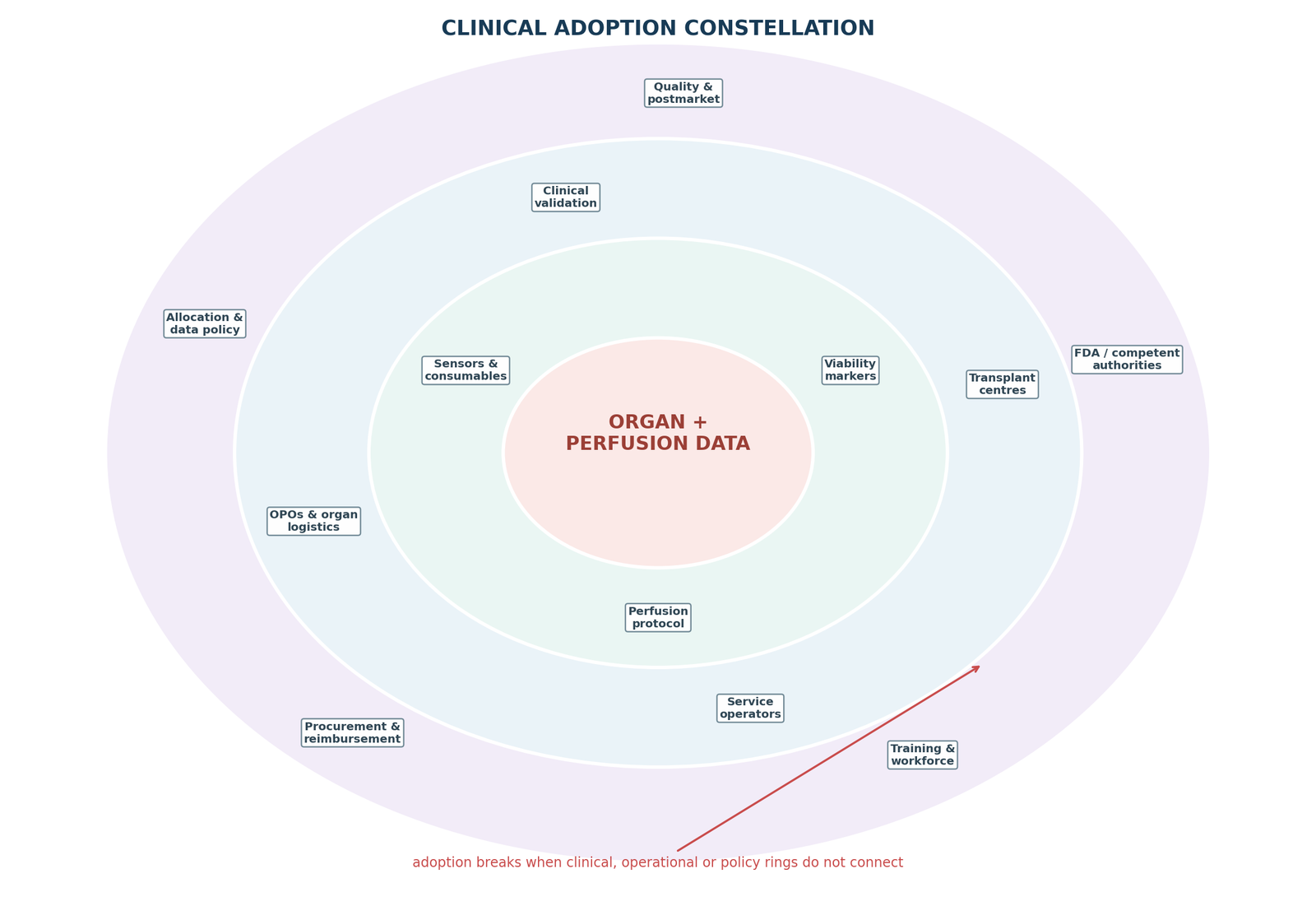
Example output: Clinical Adoption Constellation
The output places the organ and perfusion data at the centre, surrounded by measurement and protocol, clinical validation and service actors, and the outer policy and adoption environment. A technology is investable only if the rings connect around one defined clinical decision.
How a decision-maker would use it
- Choose the organ and intended clinical decision before viewing technologies or companies.
- Open a marker to see its analytical, clinical and decision-use evidence as separate layers.
- Follow the data from circuit measurement to interpretation, organ acceptance and outcome validation.
- Expose whether the adoption bottleneck is device access, multicentre evidence, workflow ownership or policy integration.
Hypothetical evidence volume
157 retained across devices, trials, policy, services and clinical evidence.
Mapped across device, centre, OPO, trial, service and policy roles.
Linked to organ, modality, endpoint and evidence maturity.
Including platform access, multicentre study, service and data collaboration.
Website presentation suggestion: use concentric rings that redraw when the organ or modality changes. Unconnected nodes should remain visible to show why a promising marker has not yet reached routine decision use.
What the output might reveal
The findings below demonstrate how the mapped evidence could support the decision. They are hypothetical and would change with the evidence collected.
A liver biomarker module may offer the clearest evidence pathway. Liver NMP already has regulated platforms, active multicentre marker validation and repeated perfusate or bile sampling, creating a more defined route than a broad multi-organ sensor strategy.
The client should avoid owning the entire perfusion platform. Its defensible contribution may be an analytically controlled measurement and interpretation layer integrated with an existing device or clinical network.
Multicentre comparability is the central adoption bottleneck. A marker must survive differences in device, protocol, donor characteristics, sampling and endpoint definitions before a decision threshold can be considered portable.
Centralised services can accelerate access but add workflow dependencies. They can concentrate expertise and data, yet transport, allocation timing, responsibility and data transfer must be designed with OPOs and transplant centres.
Recommended decision route
PROVISIONAL DIRECTION
Prioritise a liver-perfusion biomarker and data module through partnership with an established platform and multicentre validation network. Maintain a monitored kidney-assessment route, particularly where centralised services can provide representative access, but do not pursue a multi-organ claim at the outset.
Decision gates
- Gate 1: Confirm analytical performance in the relevant perfusate or bile matrix and across intended device conditions.
- Gate 2: Agree a prospective multicentre protocol with an organ-specific endpoint and predefined analysis plan.
- Gate 3: Demonstrate that the result is available within the clinical decision window and changes or supports documented action.
- Gate 4: Define the regulated product role, quality ownership, training, data and postmarket responsibilities with the platform partner.
Indicative project delivery
An organ-specific clinical adoption map would typically take 8 to 10 weeks. Work would include modality and decision framing, device and marker taxonomy, trial and evidence extraction, relationship and service-model mapping, regulatory and policy overlay, adoption-position assessment and a decision workshop. Wider multi-organ coverage would require a longer programme.
Study design, organ, modality, marker, endpoint, threshold, outcome and evidence-quality fields.
Platforms, centres, OPOs, services, trials, data networks and policy actors.
Marker-to-decision links, timing, user, workflow, validation and unresolved gaps.
Interactive-ready organ views and static adoption maps.
Embedded module, assay, software, service and research-partner routes compared.
Recommended organ and position, validation gates, partner archetypes and monitoring triggers.
Questions reserved for primary validation
- Can the measurement be made repeatably in the intended perfusate, device and sampling workflow?
- Which transplant professional owns the result and how would it alter an acceptance or treatment decision?
- What outcome and sample size would a multicentre network regard as adequate validation?
- How will platform integration, quality ownership, training, data transfer and postmarket responsibilities be divided?
Let’s discuss your project
If a perfusion technology or biomarker looks promising but the route to clinical use is unclear, begin with one organ and one decision. Share the intended measurement, workflow, geography and development stage, and the ecosystem can be mapped around the evidence and partnerships required for adoption.
Note:
The engagement, client profile, evidence counts, findings and recommendations are hypothetical. Industry context is grounded in publicly available information. Project timing is indicative and depends on taxonomy breadth, source accessibility, language and geographic coverage, evidence quality and profiling depth. Secondary research does not independently validate technical performance, regulatory status, qualification, freedom to operate or commercial access. Normothermic ex vivo machine perfusion and normothermic regional perfusion are distinct and should not be interpreted as interchangeable procedures.