INVESTMENT ILLUSTRATION 02
Can a clinical trial site network scale across Poland and Czechia?
A regional acquisition thesis tested through site productivity, investigator depth, sponsor mix and integration capacity.
EUR 58m
EQUITY ENVELOPE
30 months
ACQUISITION PERIOD
Two countries
PLATFORM GEOGRAPHY
Majority stakes
CAPITAL ROUTE
CAPITAL QUESTION Should a healthcare investor form a multi-site clinical research platform, and how quickly can acquired sites be integrated without weakening recruitment performance or sponsor continuity?
The investment tension
THESIS CLAIM | WHAT MUST BE PROVEN |
|---|---|
Replication | A strong flagship site does not prove that investigator relationships and patient access can be reproduced elsewhere. |
Concentration | Growth can look attractive while revenue remains dependent on one sponsor, therapy area or principal investigator. |
Integration | Quality systems, contracting, data and recruitment processes must converge without interrupting active studies. |
The research therefore evaluates the network as an operating system, not as a collection of site addresses.
SITE AND MARKET RECONSTRUCTION
Start with trial flow, then connect it to site capacity
CTIS and other trial registries identify study activity, locations, sponsors, therapy areas and status. Corporate records, site disclosures, investigator histories and transaction evidence then reveal which locations belong to scalable operating groups and which depend on individual relationships.
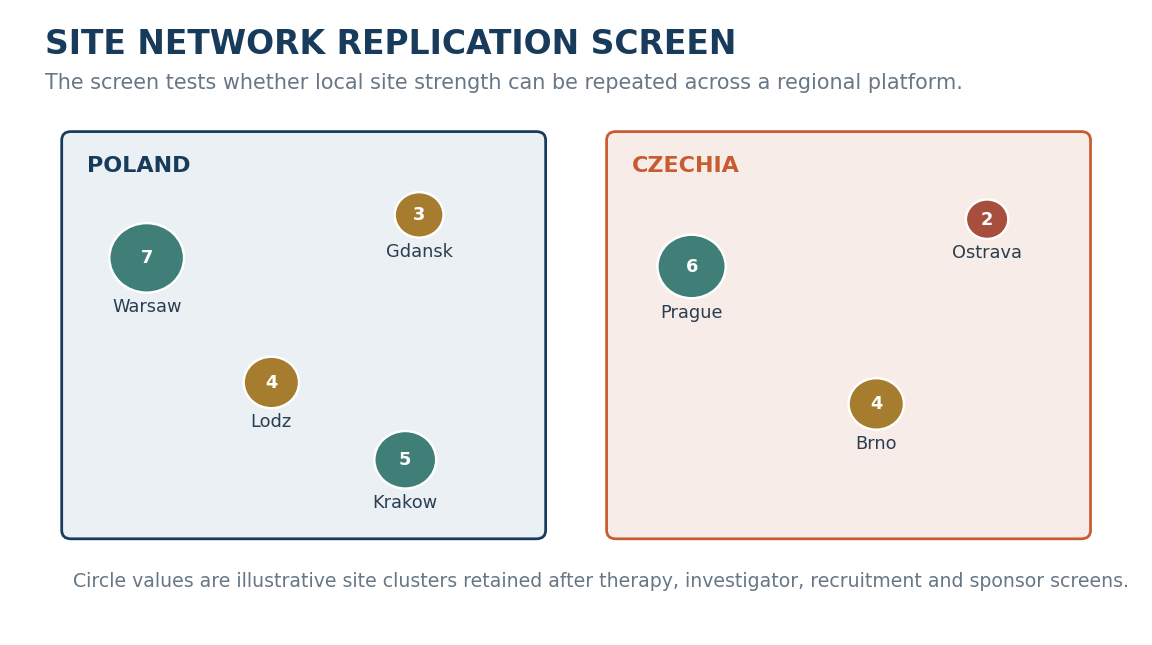
Site Network Replication Test
RESEARCH MODULE | EXECUTION |
|---|---|
Trial-flow ledger | Reconstruct active and completed trials by sponsor, therapy, phase, location and enrolment period. |
Site identity graph | Resolve trading names, legal entities, locations, investigators and ownership into one operating view. |
Capacity test | Compare recruitment cadence, investigator cover, coordinator load and repeat sponsor activity. |
Replication test | Identify which practices are institutional and which depend on one site, person or referral channel. |
Acquisition sequence | Order targets by strategic fit, integration load and contribution to sponsor and therapy diversification. |
Databases can include CTIS, ClinicalTrials.gov, national company registries, statutory accounts, transaction databases and disclosed sponsor or site records.
PLATFORM QUALITY
Measure concentration before assigning a platform premium
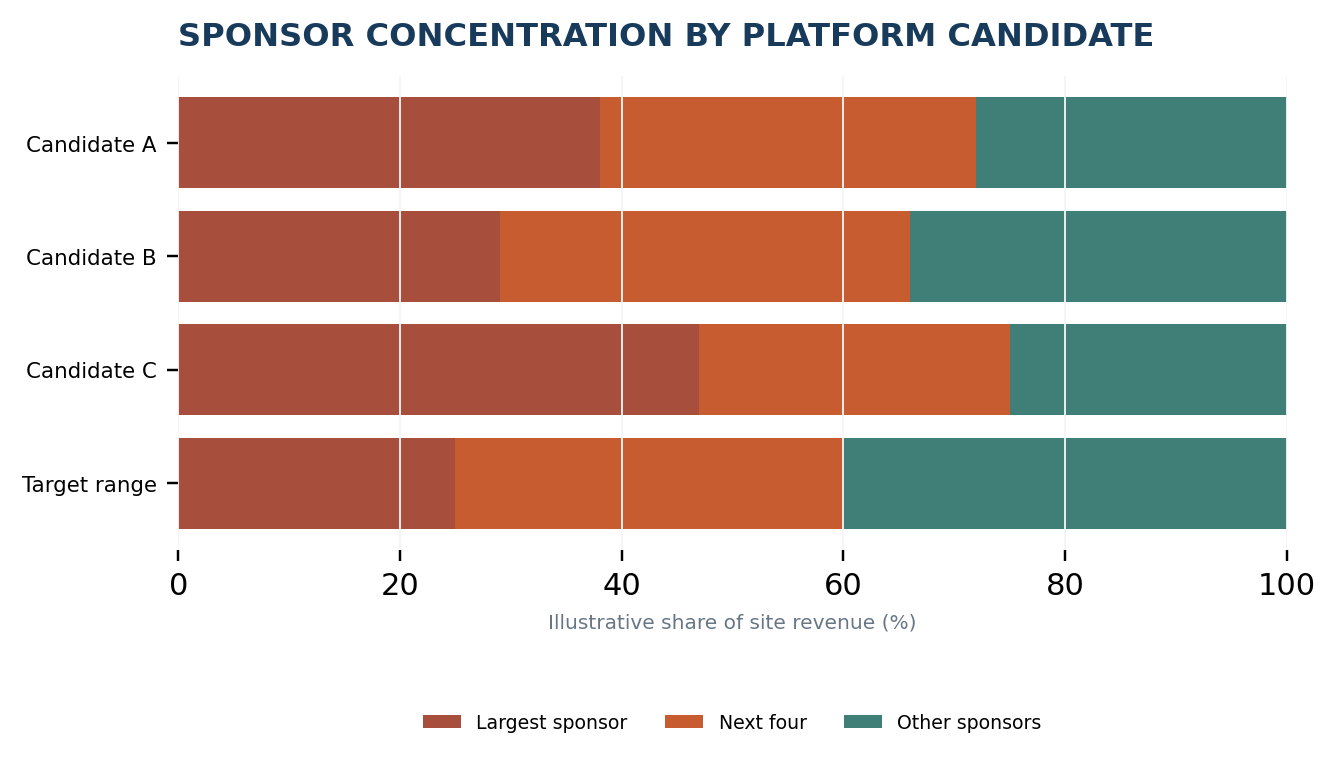
Two networks with similar revenue can carry very different risk. The research separates recurring multi-sponsor activity from short-lived volume and shows whether the proposed acquisition sequence genuinely diversifies the platform.
QUALITY LENS | EVIDENCE CONSTRUCTED |
|---|---|
Recruitment reliability | Participants enrolled per active study relative to target and over time |
Investigator resilience | Active investigators, replacement depth and revenue exposure to the lead investigator |
Sponsor repeat rate | Sponsors returning with another study and elapsed time between awards |
Therapy balance | Revenue and recruitment exposure by therapy area and study phase |
Site economics | Coordinator intensity, start-up burden, utilisation and contribution after central costs |
SHORTLIST RESULT From an illustrative universe of 57 sites and 18 operating groups, six groups advance to full review and two qualify as credible platform anchors.
INTEGRATION STRESS
The acquisition pace must remain below the operating breakpoint
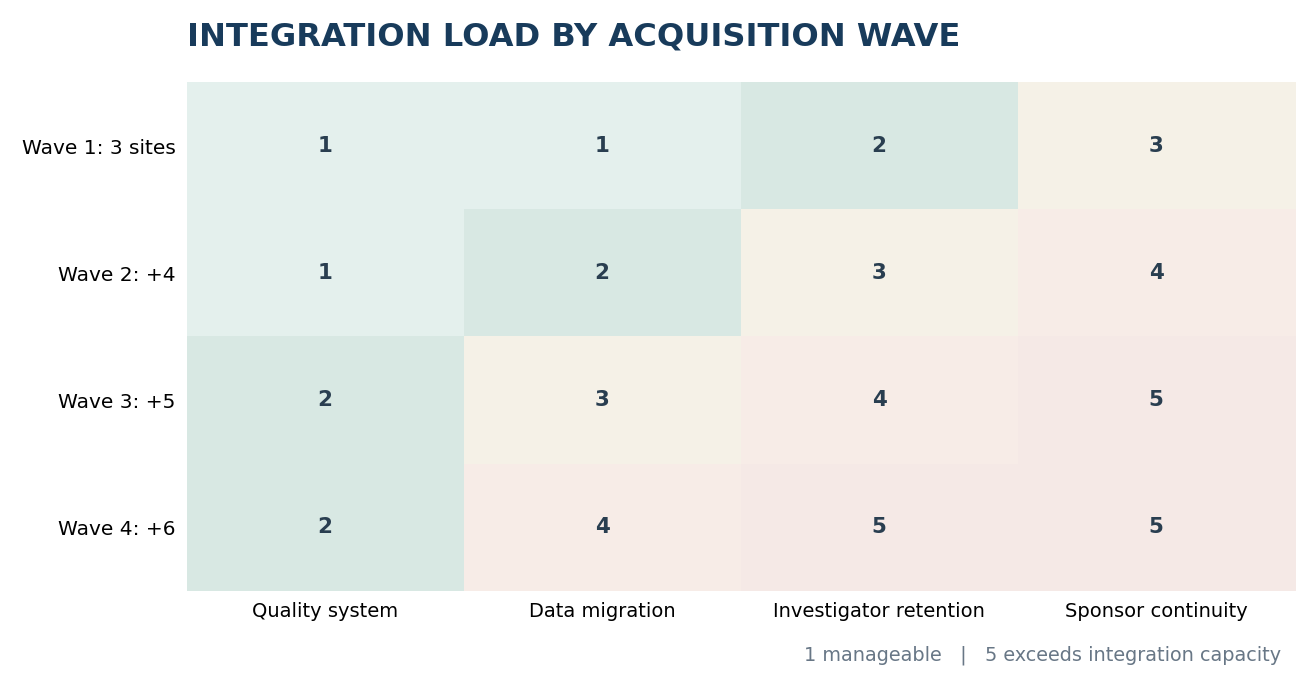
The stress test models the interaction between acquisition timing and operational workload. It asks when harmonising systems, retaining investigators and protecting sponsor relationships begins to consume more capacity than the platform can absorb.
VARIABLE | BASE CASE | BREAKPOINT | CAPITAL RESPONSE |
|---|---|---|---|
Recruitment performance | 88% of target | Below 72% for two quarters | Pause the next acquisition wave |
Investigator cover | 1.6 active investigators per site | Below 1.2 | Retain local leadership and add succession plan |
Largest sponsor share | 31% | Above 42% | Condition value on sponsor diversification |
Integration duration | 7 months per wave | Above 10 months | Reduce wave size |
Coordinator turnover | 14% | Above 22% | Delay centralisation of site operations |
Illustrative values show the decision logic. A real engagement would rebuild each range from the selected sites and the investor's operating plan.
INVESTMENT RESPONSE
Build around one anchor, then earn the right to accelerate
The example supports a staged regional platform rather than simultaneous acquisition across both countries. The first anchor provides central sponsor contracting and quality infrastructure; the second wave proceeds only after recruitment and investigator retention remain within the approved range.
Conditions for progression
- Acquire one anchor group with repeat sponsor evidence across at least three therapy areas.
- Keep the largest sponsor below 35% of projected platform revenue after the second wave.
- Secure named succession cover for every investigator responsible for more than 15% of forecast revenue.
- Complete quality and data migration before adding more than four sites in the next wave.
- Track recruitment performance monthly and stop acquisition activity if the breakpoint is crossed twice.
What the client receives
Trial-flow ledger | Site identity graph | Sponsor concentration view | Investigator dependency register | Acquisition sequence | Integration stress model | Investment conditions
DELIVERY A focused two-country assessment can typically be completed in six to seven weeks, depending on the number of legal entities, sites and therapy areas in scope.
Note: The client, opportunity universe, financial assumptions, findings and conclusion are illustrative. They demonstrate the research approach and are not presented as an actual client outcome.
Contact Us
TEST WHETHER A SITE NETWORK CAN SCALE Share the target geography, capital route and acquisition pace. August Research will reconstruct the site universe, operating dependencies and integration breakpoints required for the decision.