INVESTMENT ILLUSTRATION 04
Which Romanian grain operators can absorb minority growth capital?
An operator-level assessment of throughput quality, logistics optionality and working-capital resilience.
EUR 16m
GROWTH CAPITAL
Minority
INVESTMENT ROUTE
3 years
EXPANSION PLAN
Romania
GEOGRAPHY
CAPITAL QUESTION Which storage and handling operator can deploy new capital into debottlenecking, rail access and working capital without making the investment dependent on one harvest, trader or export route?
Why reported capacity is not enough
- Nominal tonnes do not show the condition, utilisation or turnover of the storage estate.
- Strong harvest-year revenue can hide weak cash conversion and large seasonal financing needs.
- Road, rail, Danube and Constanta access create different price, timing and disruption exposure.
- A minority investor also needs evidence that governance and capital allocation can be protected.
The research treats each operator as a flow of grain, cash and decision rights rather than as a static asset list.
RESEARCH ARCHITECTURE
Throughput Resilience Ledger
Every facility is connected to its crop catchment, intake pattern, storage turns, transport modes, customer mix and financing cycle. The ledger makes it possible to see whether planned capex removes a real bottleneck or merely adds underused capacity.
LEDGER MODULE | HOW IT IS BUILT |
|---|---|
Catchment reconstruction | Map crop production, weather exposure and procurement radius around each facility. |
Asset reality | Verify storage type, condition, drying, testing, loading, rail and port connections. |
Flow model | Estimate monthly intake, storage turns, handling throughput and route allocation. |
Operator economics | Reconstruct fees, trading exposure, energy use, receivables, inventory and debt cycle. |
Governance screen | Assess ownership, related parties, capital allocation and minority protection needs. |
Pressure ledger | Apply harvest, energy, route and liquidity pressures individually and together. |
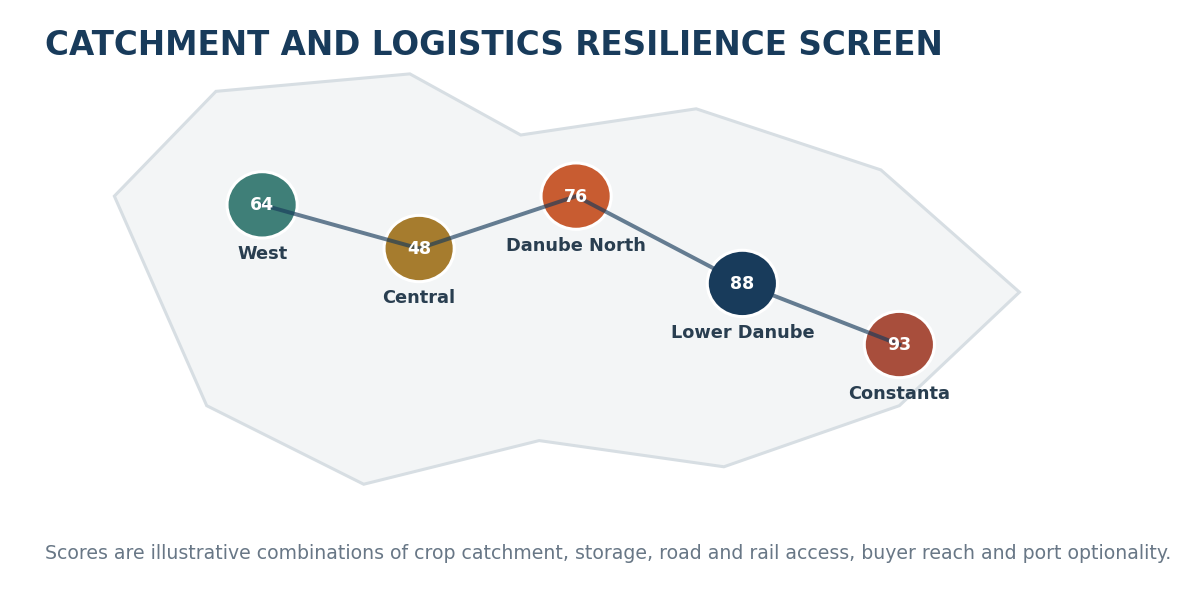
OPERATOR COMPARISON
Separate asset scale from usable throughput
The shortlist is ranked on evidence that can support cash generation across seasons. Capacity receives credit only when the operator can source grain, move it through the system and finance the cycle without excessive concentration.
CANDIDATE | STORAGE | TURNS | ROUTE | TOP BUYER | RESPONSE |
|---|---|---|---|---|---|
Operator A | 82 kt | 2.3x | Rail + road | 31% | Advance |
Operator B | 110 kt | 1.5x | Road | 46% | Conditional |
Operator C | 64 kt | 2.7x | Danube + road | 27% | Advance |
Operator D | 145 kt | 1.2x | Road + rail | 55% | Stop |
SHORTLIST RESULT From 21 operators screened, seven enter the comparable ledger and three advance to management-independent diligence. Two remain credible minority investment candidates.
CAPITAL STRESS
A viable expansion must survive the seasonal cash peak
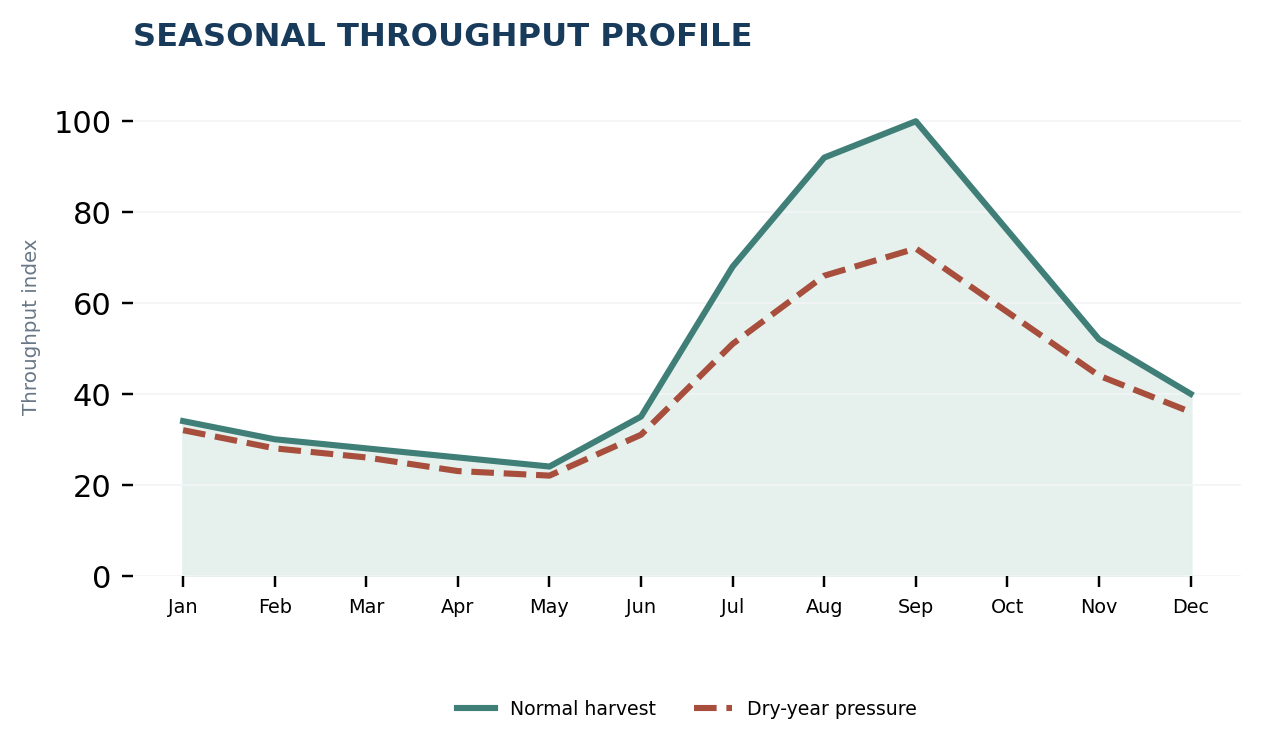
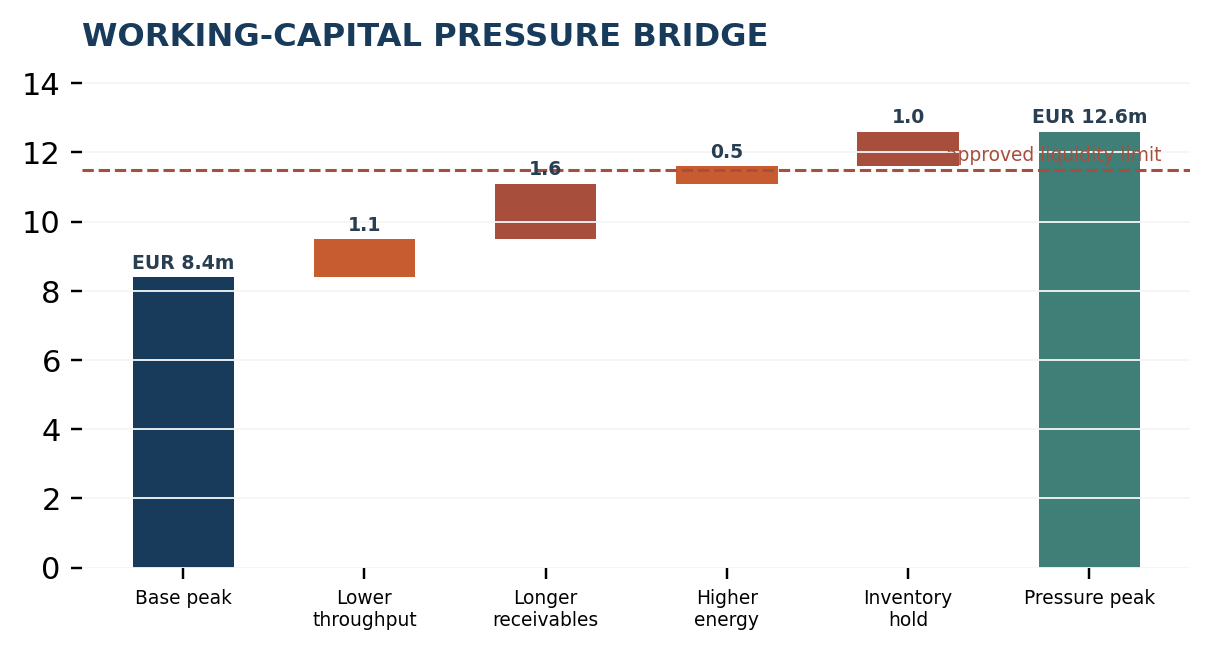
The example combines a 22% harvest-volume reduction, higher drying cost and slower customer payment. This reveals whether expansion capex and seasonal liquidity compete for the same capital at the worst point in the year.
VARIABLE | BASE CASE | PRESSURE | BREAKPOINT |
|---|---|---|---|
Harvest volume | 185 kt | 144 kt | Below 138 kt |
Storage turns | 2.3x | 1.8x | Below 1.7x |
Energy cost | EUR 1.9m | +35% | Above EUR 2.8m |
Receivable days | 39 | +18 days | Above 62 days |
Peak liquidity need | EUR 8.4m | EUR 12.6m | Above EUR 11.5m |
The figures are illustrative and would be replaced with operator accounts, facility evidence and the investor's approved financing assumptions.
INVESTMENT RESPONSE
Invest in throughput control, not capacity alone
The example advances Operator C because its route optionality, faster storage turns and lower buyer concentration preserve value under a dry-year scenario. Capital is phased between intake debottlenecking, loading improvements and a ring-fenced liquidity facility.
Conditions attached to the minority investment
- Release expansion capex only after signed throughput commitments cover 55% of the first-year target.
- Separate seasonal working capital from the fixed-asset investment budget.
- Require approval rights for related-party transactions, material debt and capex reallocation.
- Maintain at least two viable outbound transport routes for the expanded facility.
- Review crop, throughput and receivable triggers monthly during the harvest cycle.
What the client receives
Operator universe | Facility and ownership ledger | Catchment map | Throughput model | Logistics optionality score | Working-capital stress case | Minority protection questions
DELIVERY A focused operator screen and resilience assessment can typically be completed in six weeks. Timing depends on entity complexity, facility coverage and the availability of financial evidence.
Note: The client, opportunity universe, financial assumptions, findings and conclusion are illustrative. They demonstrate the research approach and are not presented as an actual client outcome.
Contact Us
TEST THE FLOW OF GRAIN, CASH AND CONTROL Share the target operators, geography and capital purpose. August Research will reconstruct the asset base, throughput economics and pressure points that determine whether growth capital can be deployed responsibly.