INVESTMENT ILLUSTRATION 05
Should Growth Capital Back an
Industrial Training Network in Mexico?
A demand-to-placement investment test across five manufacturing corridors.
USD 24m
GROWTH EQUITY
5 corridors
MARKET SCREEN
5 years
INVESTMENT HORIZON
Training network
CAPITAL ROUTE
INVESTMENT QUESTION Can a private industrial training network convert employer skill demand into repeatable enrolment, completion and placement outcomes while expanding facilities and instructor capacity?
Employer demand can be genuine while the investment case remains weak. Training supply must be close enough to learners and plants, programmes must match specific occupations, and placement evidence must survive verification rather than relying on advertised success rates.
GEOGRAPHIC OPPORTUNITY
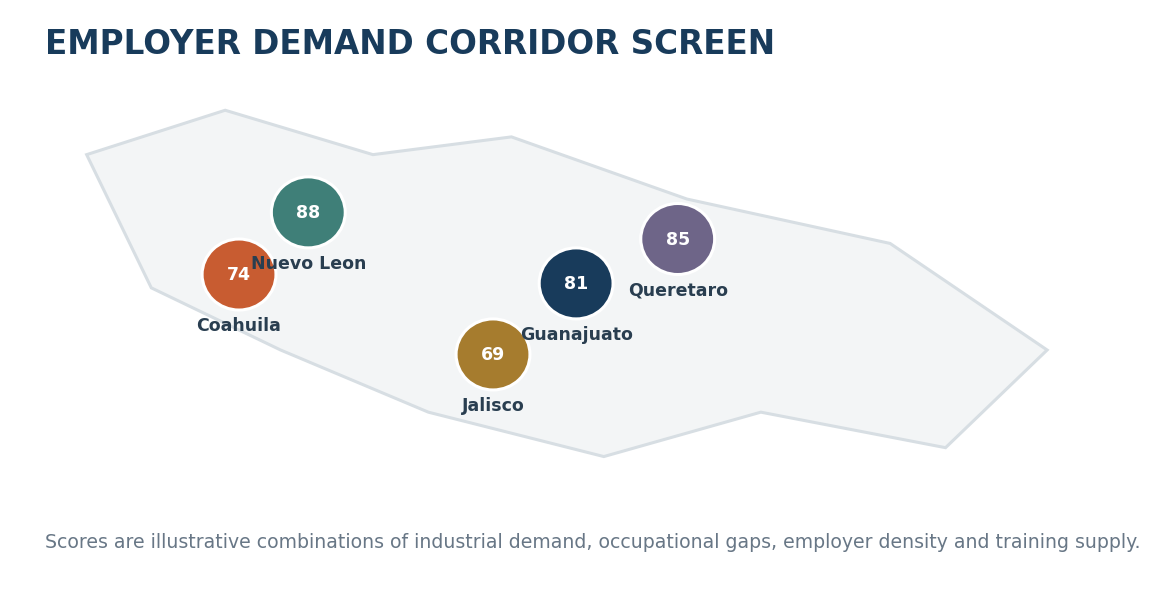
Follow occupational demand through industrial corridors
The research links plant investment, expansion, hiring signals and occupational demand to the location and capacity of training providers. Geography matters because learner travel, employer access, equipment needs and instructor availability all constrain delivery.
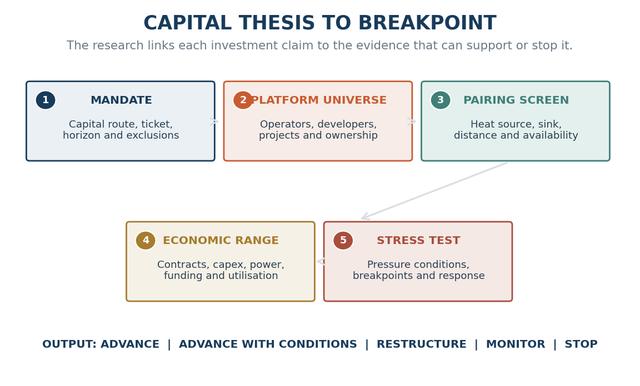
Employer Demand Conversion Test
TEST MODULE | EXECUTION |
|---|---|
Demand signal | Track plant expansion, job postings, occupation mix, wage pressure and employer certification needs. |
Provider universe | Resolve campuses, programmes, legal entities, accreditations, ownership and delivery format. |
Programme fit | Match curriculum, equipment and training hours to the occupations showing durable demand. |
Outcome verification | Reconcile enrolment, completion, certification and placement definitions across providers. |
Scale route | Model campus, mobile-lab, employer-sponsored and blended expansion options. |
Breakpoint test | Stress learner conversion, completion, employer placement and instructor capacity. |
Inputs can include INEGI and DENUE, employment and education records, CONOCER standards, employer disclosures, job-posting databases, campus and accreditation records, company accounts and transaction databases.
COMMERCIAL CONVERSION
The opportunity is only valuable when demand converts into verified placement
The study reconstructs a full annual cohort rather than relying on enrolment alone. Each stage is defined consistently so the investor can see where demand is lost, which programmes create employer pull and where additional spending would improve outcomes.
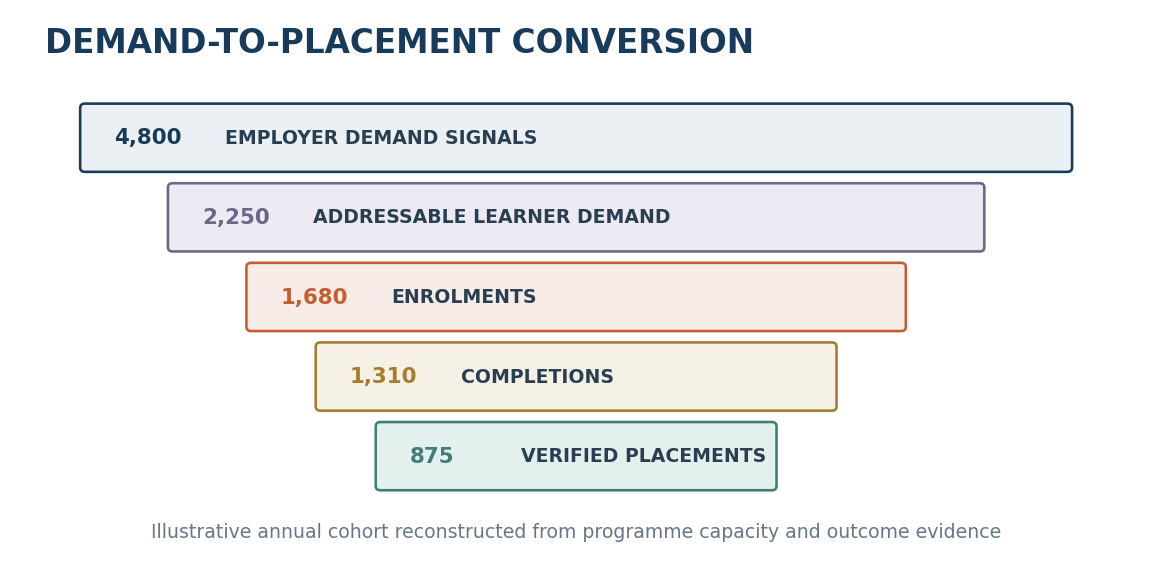
CONVERSION STAGE | EVIDENCE STANDARD |
|---|---|
Employer demand | Job and investment signals translated into occupation-level annual demand |
Learner reach | Catchment population, prerequisite skills, affordability and travel burden |
Enrolment | Applications converted after financing, schedule and entry requirements |
Completion | Learners meeting attendance, practical and assessment requirements |
Placement | Employment verified within the defined window and relevant occupation |
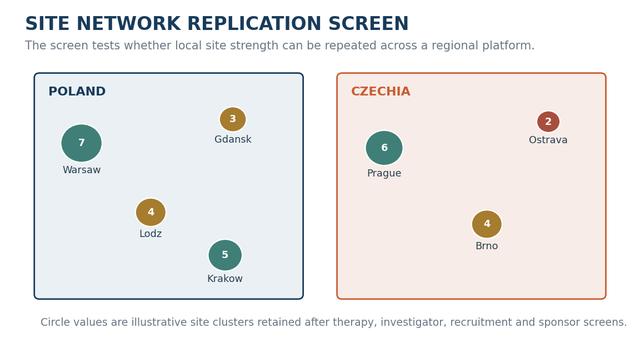
SCREENING RESULT An illustrative universe of 68 providers narrows to 14 with relevant industrial programmes and four credible platform candidates after outcome and capacity verification.
DELIVERY STRESS
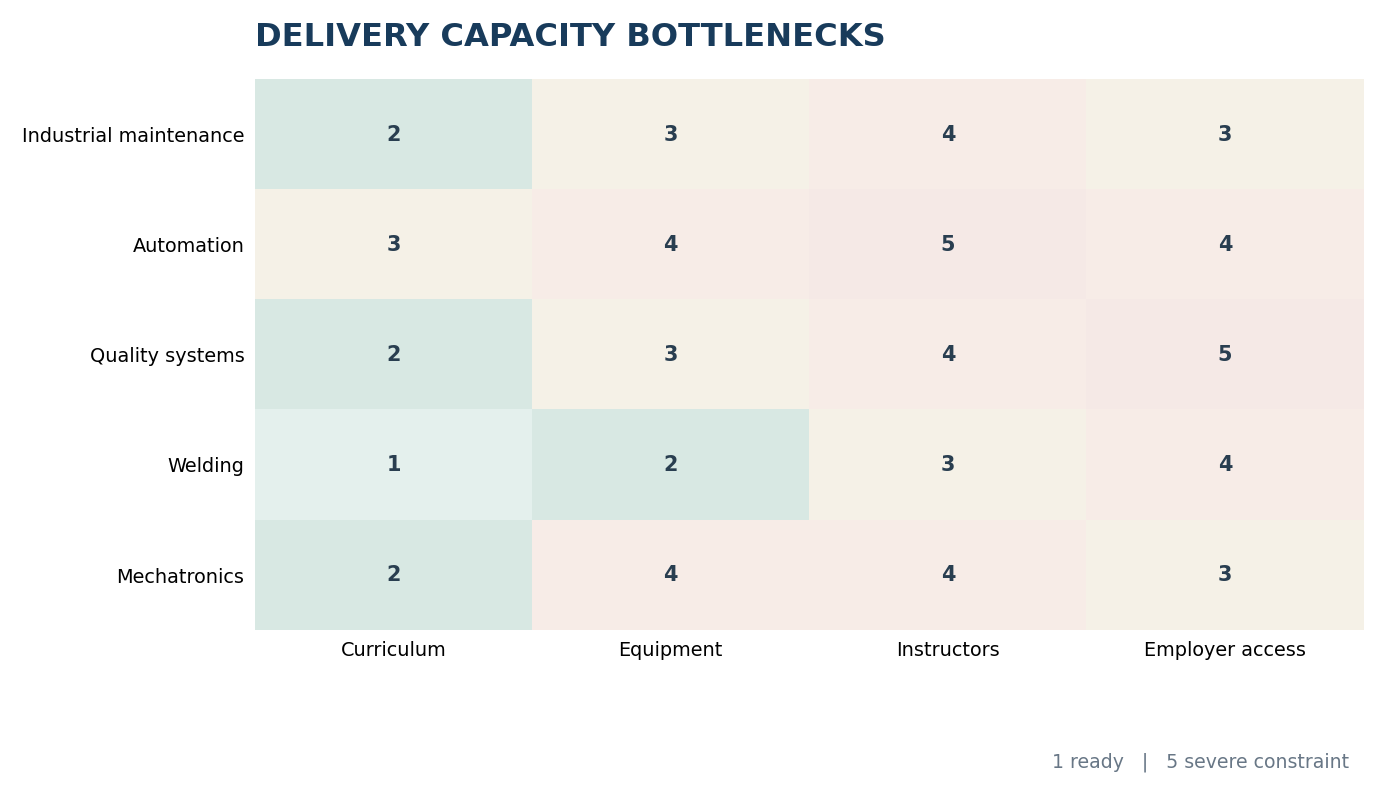
Instructor capacity becomes the binding constraint
The example shows attractive employer demand for automation and mechatronics, but expansion fails if experienced instructors and training equipment cannot be added at the same pace as enrolment. The stress test links each additional cohort to the resources required to deliver it.
VARIABLE | BASE CASE | PRESSURE | BREAKPOINT |
|---|---|---|---|
Enrolment conversion | 35% | 27% | Below 24% |
Completion | 78% | 68% | Below 65% |
Verified placement | 67% | 57% | Below 55% |
Instructor utilisation | 82% | 91% | Above 94% |
Employer-sponsored share | 38% | 25% | Below 22% |
All cohort sizes, ratios and investment values are illustrative and would be rebuilt for the selected providers and programmes.
CAPITAL RESPONSE
Advance through employer-backed corridor clusters
The example advances a two-corridor platform in Nuevo Leon and Queretaro. Growth capital is tied to employer-sponsored cohorts and instructor recruitment, with Guanajuato retained as the next expansion option after placement evidence is established.
Conditions before expansion
- Secure employer commitments covering at least 35% of first-year training seats.
- Verify completion and placement definitions at programme level before valuing outcome claims.
- Recruit or contract instructors before opening additional automation and mechatronics cohorts.
- Use mobile equipment only where employer demand is dispersed and repeat utilisation is supported.
- Stop campus expansion if verified placement remains below 55% for two consecutive cohorts.
What the client receives
Employer demand map | Provider and programme universe | Demand-to-placement funnel | Outcome verification grid | Instructor capacity model | Corridor expansion sequence | Capital release conditions
DELIVERY A five-corridor platform assessment can typically be completed in six to seven weeks, depending on programme coverage, entity structure and the accessibility of outcome evidence.
Note: The client, opportunity universe, financial assumptions, findings and conclusion are illustrative. They demonstrate the research approach and are not presented as an actual client outcome.
Contact Us
CONNECT EMPLOYER DEMAND TO INVESTABLE DELIVERY Share the occupations, corridors and capital route under consideration. August Research will test provider capacity, outcome evidence and the conditions required for responsible expansion.