INVESTMENT & OPPORTUNITY RESEARCH
Should Capital Back Germany's
Industrial Waste Heat Service Platforms?
A stress tested investment case for a platform that finances, owns and operates contracted waste heat projects.
Germany
GEOGRAPHY
EUR 40m
CAPITAL ENVELOPE
4 years
DEPLOYMENT WINDOW
Platform equity
INVESTMENT ROUTE
INVESTMENT QUESTION Should an infrastructure investor commit a EUR 40 million capital envelope to a German waste heat services platform, and what must be contracted before each capital tranche is released?
The opportunity appears attractive because Germany now exposes large volumes of reported waste heat and supports eligible efficiency investments. The investment case, however, depends on matching usable heat with reliable buyers, converting project pipelines into contracts and controlling the cost of heat upgrading and distribution.
INDUSTRY CONTEXT
Visible heat does not automatically create an investable project
Germany's public waste heat platform has made commercial heat sources more visible. The underlying records include annual heat quantity, maximum thermal output, availability profiles, controllability and temperature. These fields improve discovery, but they do not prove that a provider can secure the heat source, connect a suitable buyer and earn an acceptable return.
23,000+
REPORTED WASTE HEAT POTENTIALS
207 TWh
REPORTED ANNUAL WASTE HEAT VOLUME
>2.5 GWh
COMPANY REPORTING THRESHOLD
Public platform snapshot used to frame the example. The figures describe reported potential, not economically recoverable supply.
Why the capital decision remains difficult
The source may not be firm: Reported volume can vary with production schedules, shutdowns, temperature and the company's own efficiency plans.
The buyer may not be close enough: Pipeline distance, network access, land rights and heat losses can change an attractive source into a weak project.
Contracts carry different risks: Source access, heat offtake, indexation, minimum volume and outage provisions determine who absorbs volatility.
The service model can be misunderstood: Engineering contractors, project developers, energy service companies and asset owners do not offer the same investment exposure.
Funding cannot rescue weak economics: Available incentives can improve capital efficiency, but the case must remain viable if support is delayed or reduced.
Decision boundary
This study evaluates the investability of a provider platform and its project pipeline. It does not certify engineering performance, provide regulated investment advice or replace detailed legal, tax, technical and financial diligence.
RESEARCH METHODOLOGY
Reconstruct the investment thesis before ranking providers
The research begins with the client's capital route and return conditions, then links provider evidence to project level source and sink economics. A provider advances only when the platform thesis and the underlying project evidence remain consistent.
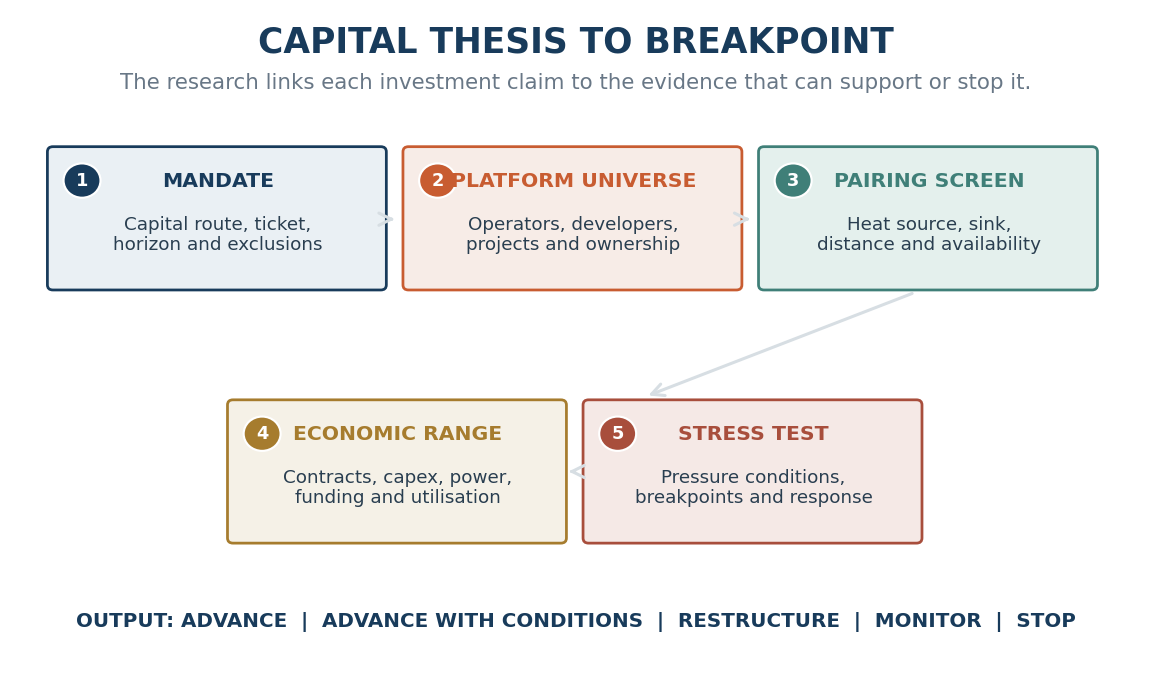
How the research is carried out
RESEARCH OBJECT | EXECUTION |
|---|---|
Mandate register | Record ticket, ownership preference, deployment window, excluded technologies, return hurdle and mandatory conditions. |
Provider universe | Identify developers, contractors, energy service companies and asset owners; resolve ownership, projects, funding and role. |
Project linkage | Connect each provider to disclosed sources, buyers, networks, heat characteristics, contracts and project status. |
Economic range | Reconstruct capital need, heat price logic, power exposure, utilisation, funding contribution and deployment timing. |
Breakpoint test | Apply plausible adverse conditions and define the exact point at which the investment route must change. |
Evidence environment
The study can integrate the German waste heat platform, municipal heat plans, funding rules, corporate registries, statutory accounts, transaction databases, project announcements, procurement records and disclosed contracts. Every material claim retains its date, entity, confidence and effect on the investment thesis.
OPPORTUNITY FILTERING
Filter the project geography and the provider universe separately
A national list of heat sources and a national list of providers answer different questions. The first identifies where projects may work. The second identifies who can originate, finance and operate them. The two are connected only after the source, sink and commercial responsibilities are visible.
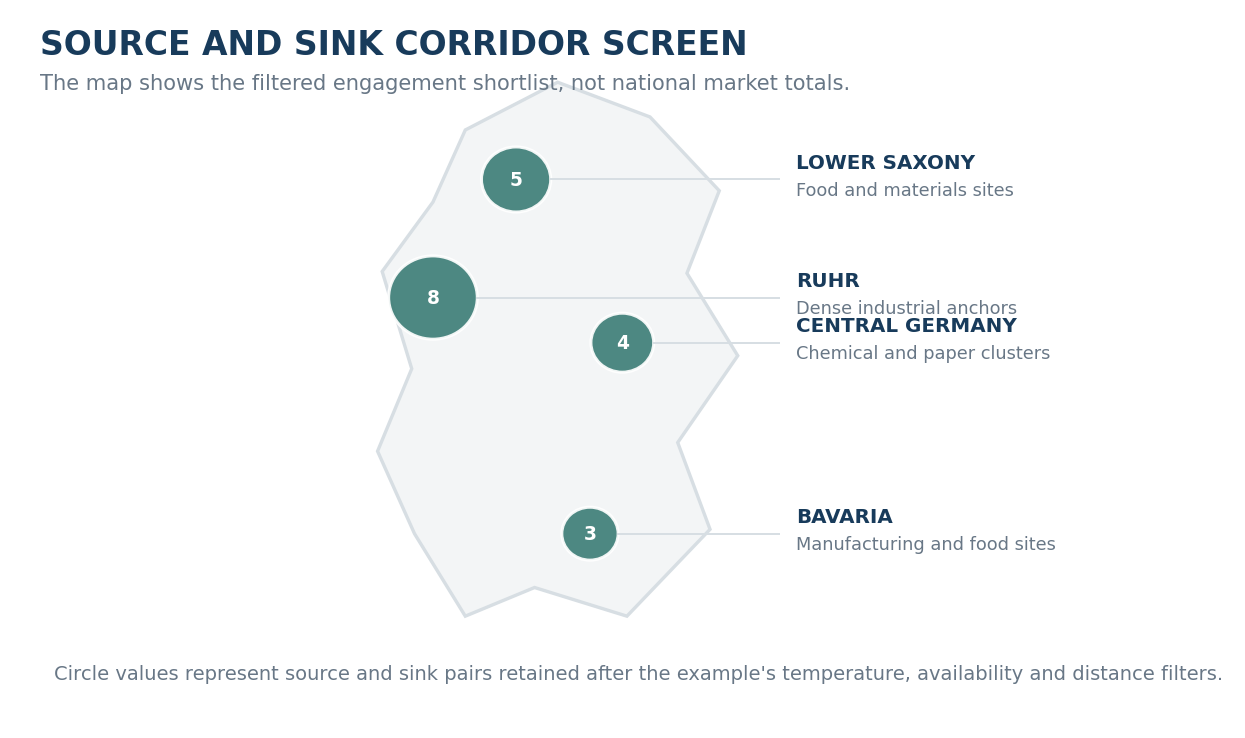
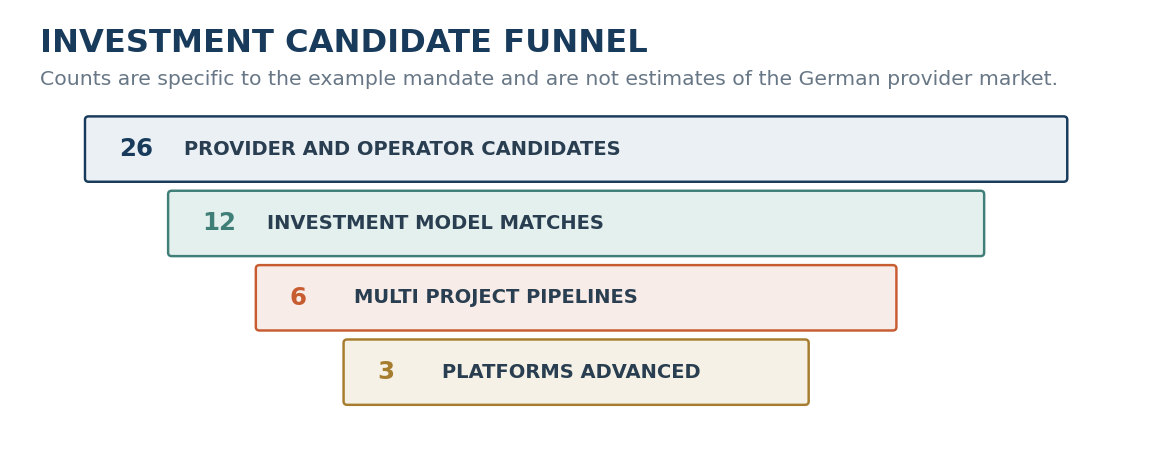
Example pairing parameters
PARAMETER | WHAT IS TESTED |
|---|---|
Heat quality | Average temperature, annual quantity, maximum output and controllability |
Availability | Monthly profile, planned outages, operating hours and production dependence |
Proximity | Straight line distance, feasible route, heat loss and network connection |
Sink quality | Demand profile, buyer credit, alternative fuel and contract duration |
Delivery readiness | Rights, permits, engineering maturity, capex evidence and planned commissioning |
INVESTMENT STRESS TEST
Identify which assumptions carry the most investment value
The model does not apply one generic downside percentage. Each material assumption receives its own supported range, pressure condition and breakpoint. Individual shocks are tested first, followed by combinations that could occur together.
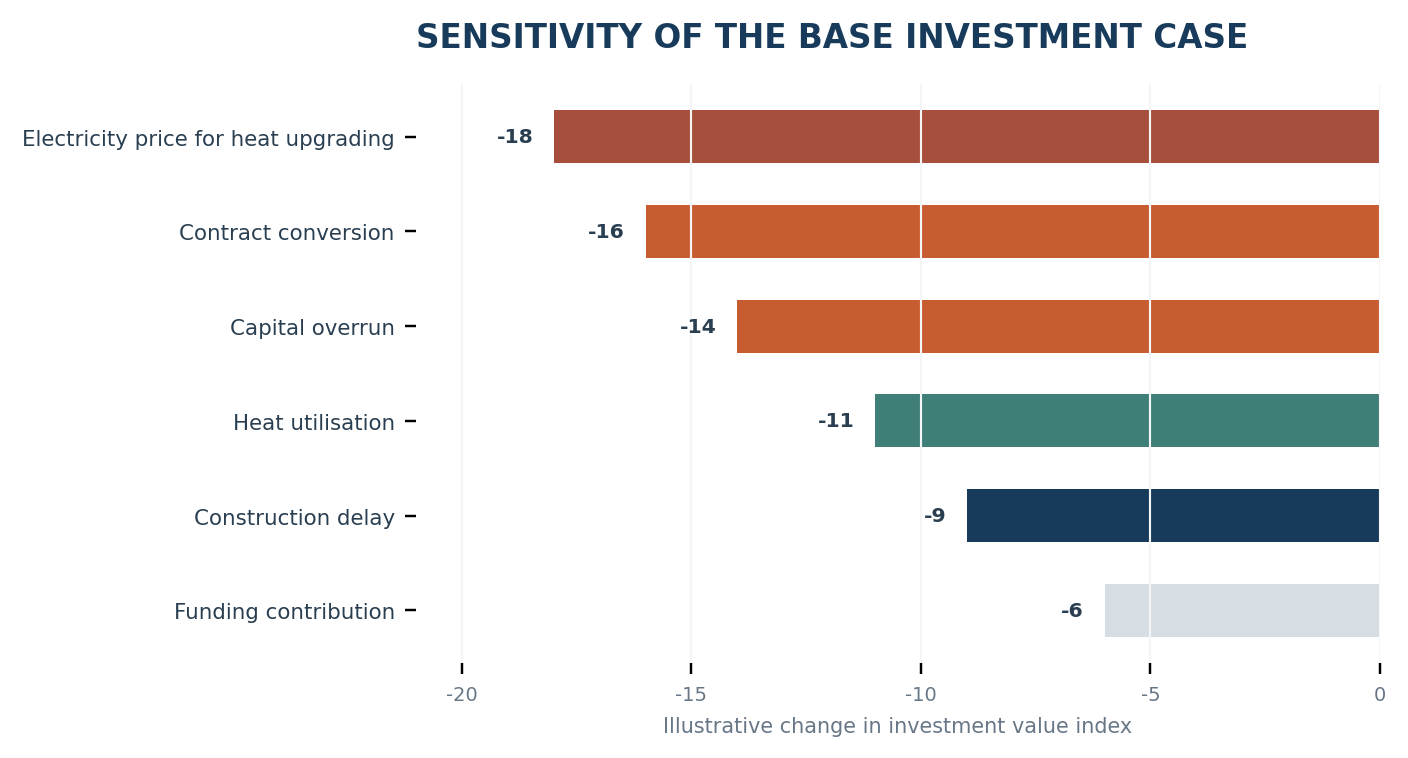
THESIS VARIABLE | BASE EVIDENCE | PRESSURE | BREAKPOINT |
|---|---|---|---|
Contracted heat volume | 68% of planned volume | 52% | Below 50% before second tranche |
Weighted availability | 6,200 hours | 4,800 hours | Below 4,500 hours |
Median source and sink distance | 6.4 km | 10.0 km | Above 12.0 km |
Power price for heat upgrading | EUR 92/MWh | EUR 125/MWh | Above EUR 135/MWh without pass through |
Portfolio capital requirement | EUR 36m | +18% | Above EUR 44m |
Value concentration | Top two projects at 43% | 58% | Above 65% |
All engagement specific values on this page demonstrate the analytical logic. They would be replaced by current project evidence and the client's approved investment assumptions.
CAPITAL RESPONSE
Advance with conditions, not on the headline opportunity alone
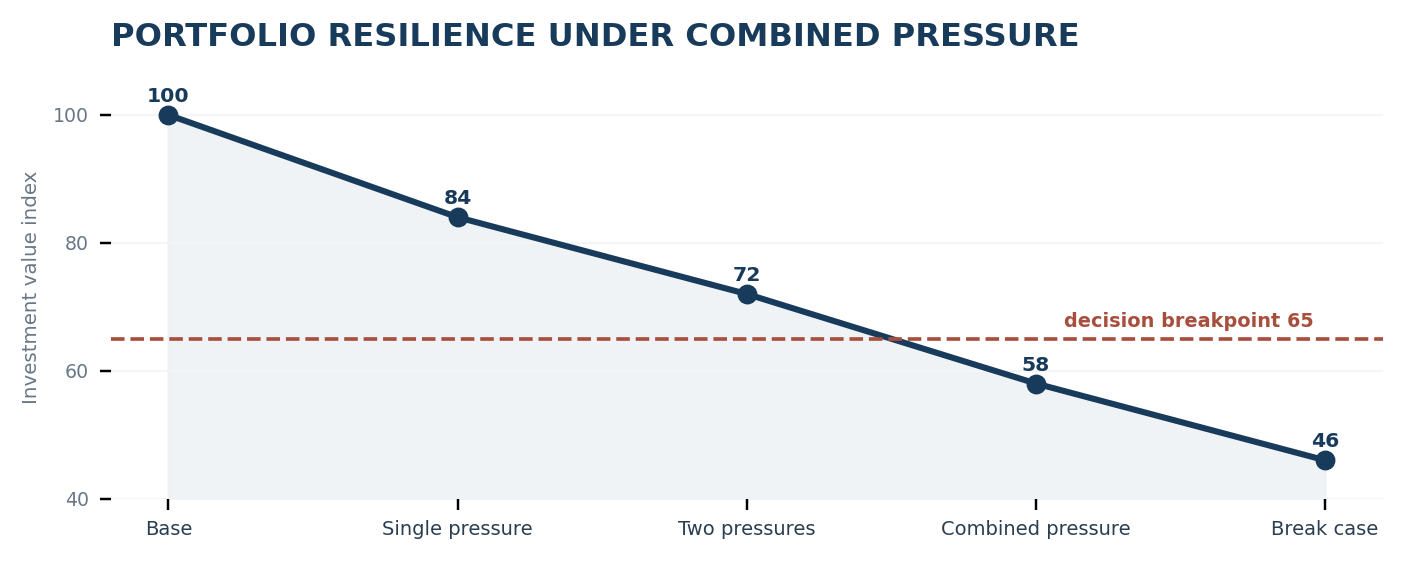
In this example, the base case remains investable under one material pressure. The combined electricity, contract conversion and capital pressure case falls below the client's decision threshold. The appropriate response is staged commitment with explicit release conditions.
Conditions before capital release
- Execute source access and heat offtake agreements for at least three anchor projects.
- Contract at least 65% of planned heat volume before releasing the second capital tranche.
- Limit any single project to 30% of committed platform capital.
- Require price pass through or another protection for heat pump power exposure above the approved breakpoint.
- Retain a 15% capital contingency until fixed price delivery evidence is available.
What the client receives
Provider universe | Project asset ledger | Source and sink corridor screen | Contract maturity view | Economic range model | Stress test register | Investment conditions | Diligence questions
DELIVERY A focused mandate can be delivered in approximately six weeks. Timing depends on provider coverage, the accessibility of project and contract evidence, and the number of scenarios required.
Note: The client, candidate counts, engagement assumptions, model outputs and conclusion are illustrative. They show how the research could support a real investment decision and are not presented as an actual client outcome.
Contact Us
STRESS TEST THE THESIS BEFORE CAPITAL IS COMMITTED Tell us the sector, geography, investment route and conditions you are considering. August Research will define the opportunity universe, evidence model and breakpoints required for the decision.