PHASE 2 ILLUSTRATION 4 BUSINESS SOFTWARE
Market Entry Assessment Brazil Workforce Scheduling Software
An illustrative operating model decision for a European software company
DECISION
PRODUCT
MARKET
PLANNING HORIZON
Pilot entry model
Workforce SaaS
Brazil
First 18 months
Decision question
Can the company enter Brazil with its workforce scheduling platform, which customer segments and operating model should be tested first, and what privacy, contracting, billing and support conditions must be resolved?
Illustrative recommendation
Run a Brazilian Portuguese pilot in two customer verticals through a controlled hybrid model. Keep product governance and enterprise selling with the manufacturer, use a local implementation and support partner, and use a compliant local billing route. Defer a subsidiary until conversion, retention, support load and contract economics meet defined thresholds.
The hypothetical client provides workforce planning, shift allocation and labour analytics for multi-site employers. The platform processes employee and manager information and may involve international data transfers. The product is established in Europe but has not been localised for Brazilian workflows, contracts or support. All scores and recommendations are illustrative.
Opportunity reconstruction
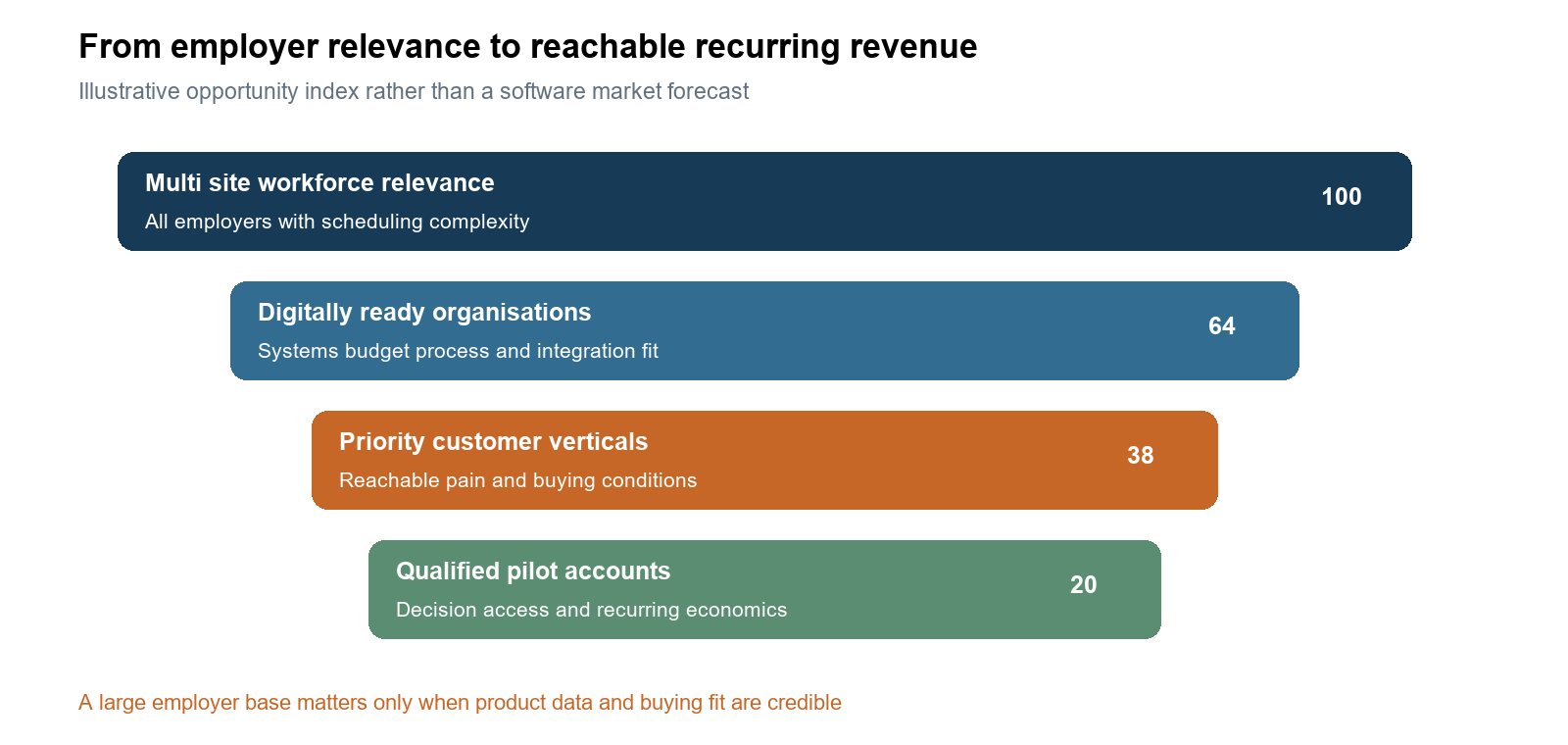
The demand case is reconstructed from employer structure, shift complexity, labour processes, existing software, integration needs, buying authority, local-language expectations and recurring economics. Industry counts alone do not establish software demand or the willingness to replace an existing scheduling process.
Evidence stream | Source route | Question answered |
|---|---|---|
Employer universe | IBGE business labour and sector statistics | Multi-site employer concentration and target vertical scale |
Buying activity | Public procurement portals job postings partner evidence and customer interviews | Active digital projects decision makers and implementation expectations |
Technology stack | Customer websites vendor case studies app marketplaces and integration documentation | Installed systems workflows and likely switching friction |
Pricing and billing | Public contracts competitor offers authorised payment and tax routes | BRL price structure taxes collections and discount expectations |
Product demand | Account discovery pilot usage and cohort retention | Actual activation adoption expansion and renewal potential |
Market access pathway
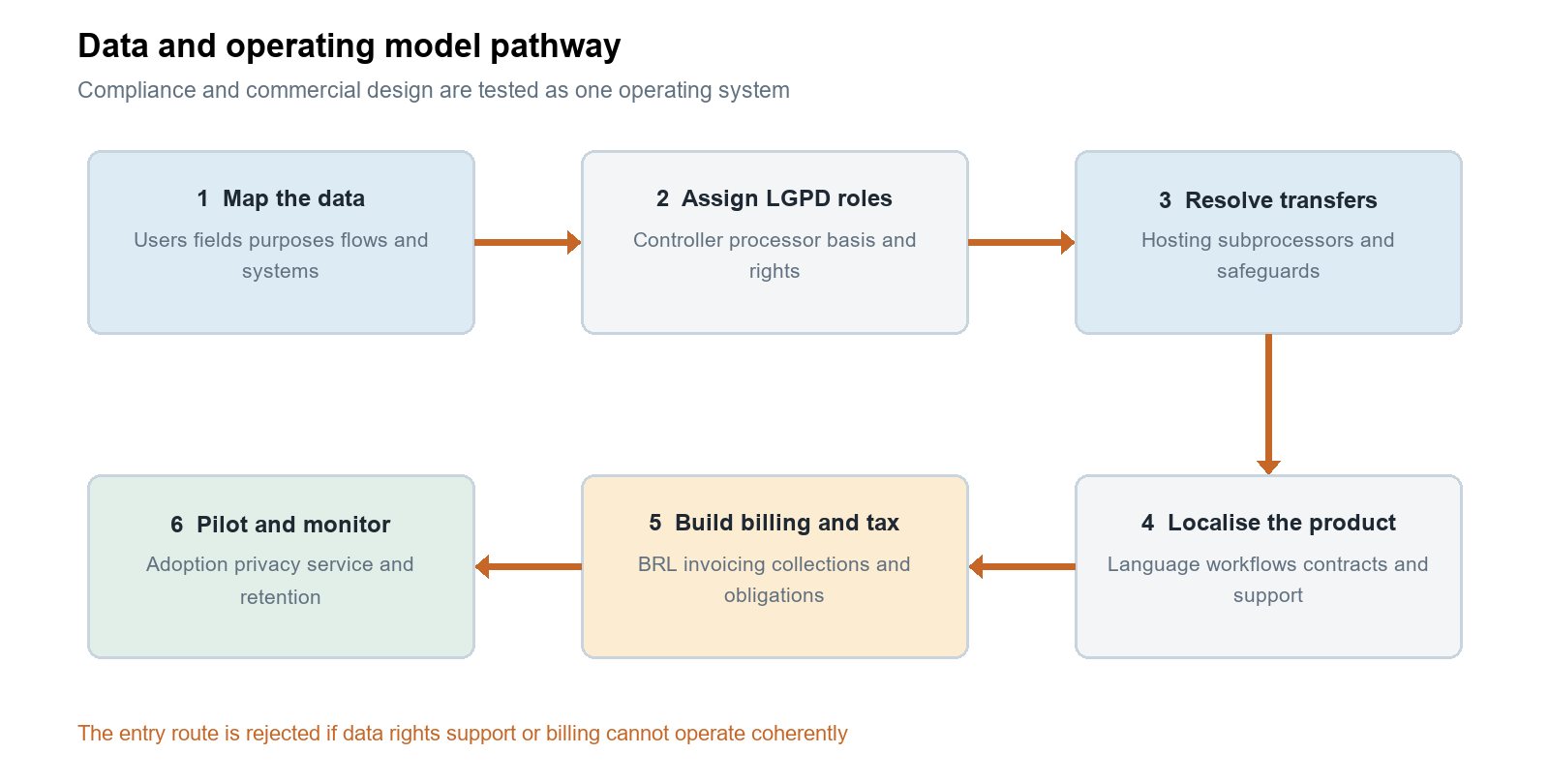
Brazil's LGPD applies to personal-data processing within its scope, and the ANPD regulates international transfer mechanisms. The assessment therefore maps data flows, roles, legal bases, notices, rights handling, vendors, security and transfer safeguards before selecting hosting and contracting arrangements. Tax, invoicing and payment routes are evaluated separately with qualified advisers.
Entry gate | Primary source | Evidence required |
|---|---|---|
Data protection law | Planalto LGPD text and ANPD guidance | Scope roles legal bases rights governance incidents and accountability |
International transfers | ANPD international transfer regulation and guidance | Applicable mechanism clauses transparency and operational safeguards |
Business establishment | Receita Federal state and municipal portals | CNPJ invoicing tax registration and local entity implications |
Payments | Banco Central do Brasil and authorised providers | Collections settlement foreign exchange and payment-partner structure |
Public procurement | Compras gov br and contracting authorities | Specifications contract terms competitors pricing and buying process |
Priority segments and markets
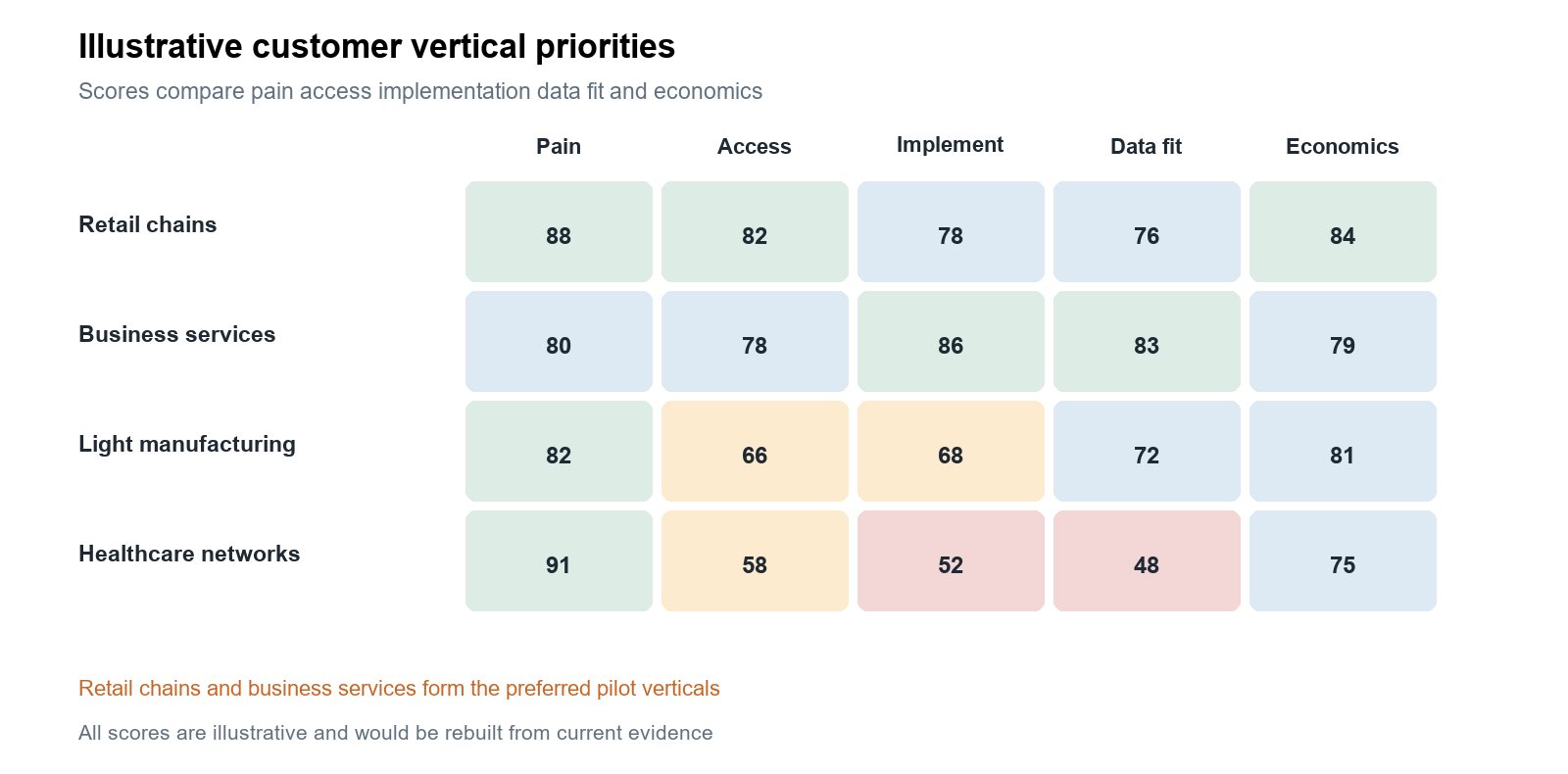
The illustration compares verticals by scheduling pain, account access, implementation fit, data complexity and recurring economics. Retail chains and business services offer the strongest first learning case. Healthcare may have strong need but introduces more complex workflows and sensitive-data questions.
Option | Role in the entry plan | Evidence to confirm |
|---|---|---|
Retail chains | Primary pilot vertical | Integration buying cycle and store-manager adoption |
Business services | Second pilot vertical | Use-case consistency and expansion economics |
Light manufacturing | Build pipeline after workflow validation | Shift rules integration and site support |
Healthcare networks | Defer pending complexity review | Sensitive data workflow and implementation burden |
Entry route and operating model
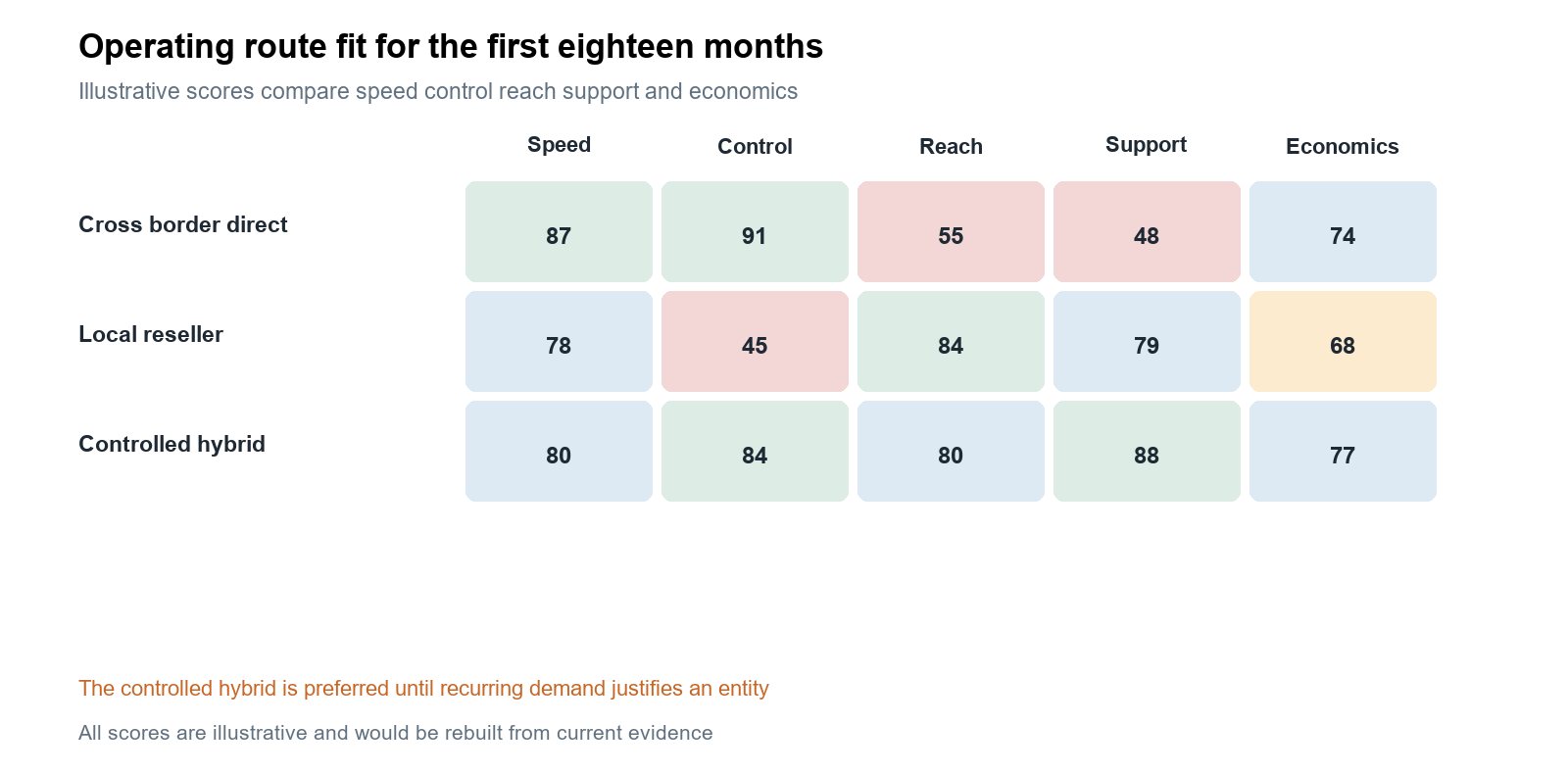
Cross-border direct selling is fast but can produce weak local implementation and billing friction. A reseller offers local access but may distance the company from customer and product evidence. The controlled hybrid keeps enterprise selling and product decisions with the manufacturer while adding local implementation, support and billing capability.
Route | Strength | Exposure | Illustrative fit |
|---|---|---|---|
Cross border direct | Fast and controlled | Local support billing and procurement friction | Limited test only |
Local reseller | Market access and relationships | Low product and customer visibility | Insufficient alone |
Controlled hybrid | Local execution with product governance | Requires precise roles and shared data | Preferred |
Pressure cases
- Transfer safeguards require remediation Delay production data movement while completing contracts architecture and notices.
- Local price expectations are twenty percent lower Test packaging and service scope before accepting lower recurring margin.
- Implementation takes twice the expected effort Narrow integrations and verticals or redesign onboarding before scaling.
Recommended entry decision
Run a Brazilian Portuguese pilot in two customer verticals through a controlled hybrid model. Keep product governance and enterprise selling with the manufacturer, use a local implementation and support partner, and use a compliant local billing route. Defer a subsidiary until conversion, retention, support load and contract economics meet defined thresholds.
Decision gate | Illustrative acceptance condition | Action if unmet |
|---|---|---|
Data model | Roles legal bases rights security and transfer route are operational | Do not process production data |
Product localisation | Portuguese workflows notices contracts and support are accepted | Continue sandbox only |
Qualified demand | Named accounts progress through a credible buying process | Refine vertical or proposition |
Recurring economics | Price tax billing partner cost and support meet the margin floor | Repackage or defer |
Implementation | Onboarding integrations and adoption fit the planned effort | Narrow scope or add capacity |
Route control | Customer usage service and compliance data remain visible | Replace or redesign partner model |
What would change the recommendation
The recommendation moves to defer if compliant data flows cannot be established, product localisation remains superficial, local price and tax treatment undermine recurring margin, or implementation effort prevents repeatable deployment. Strong conversion retention and partner performance would support a local entity decision.
Decision control plan
The pilot tracks qualified pipeline, sales-cycle length, activation, weekly active managers, scheduled employees, implementation hours, integration defects, support resolution, privacy requests, churn risk, recurring margin and partner data completeness.
First ninety days
- Define the customer and data boundary Fix vertical users workflows fields integrations and processing purposes.
- Resolve legal and operating routes Map LGPD roles transfers contracts billing tax and support dependencies.
- Reconstruct demand Build named accounts buying signals competitors and price evidence.
- Design the pilot Choose two verticals accounts implementation scope measures and stop gates.
- Issue the entity decision Recommend continued cross-border operation hybrid expansion or local establishment.
What August Research would deliver
- Entry decision dossier The vertical route localisation and investment recommendation.
- Customer and demand model Named accounts buying conditions competitors and reachable recurring revenue.
- Data and compliance map Roles flows transfers vendors rights and evidence gaps.
- Operating model Selling implementation support billing and partner responsibilities.
- Pilot scorecard Adoption economics privacy service and entity decision gates.
Official source trail
Source | Website | Use in the assessment |
|---|---|---|
Brazilian law | planalto.gov.br | Official LGPD and related legal text |
Data protection regulator | gov.br/anpd | Guidance regulations international transfers and enforcement updates |
Business and labour data | ibge.gov.br | Enterprise employment sector and regional statistics |
Tax and payments | gov.br/receitafederal and bcb.gov.br | Registration invoicing payment and foreign-exchange context |
Procurement and IP | compras.gov.br and gov.br/inpi | Public buying specifications awards and trademark evidence |
Scope boundary
This illustration does not replace Brazilian privacy, employment, tax, payment, cybersecurity or corporate legal advice, nor technical security testing or customer contract negotiation.
The client, scores, funnel indices, thresholds and recommendation are hypothetical. Official sources are named to show where an actual engagement would obtain and verify current evidence.