PHASE 2 ILLUSTRATION 2 FOOD AND BEVERAGE
Market Entry Assessment Germany High Protein Oat Drink
An illustrative new product line decision for a European food producer
DECISION
PRODUCT
MARKET
PLANNING HORIZON
Pilot or defer
High protein oat drink
Germany
First 12 months
Decision question
Should the producer add a high-protein oat drink to its portfolio in Germany, which proposition and channels should be tested first, and what evidence must support a wider launch?
Illustrative recommendation
Proceed to a controlled product and channel pilot with two formulations, limited retail distribution and a measurable repeat-purchase test. Do not commit to national listings until the protein claim, ingredient status, German label, packaging obligations, price ladder, co-manufacturing economics and repeat demand support the same commercial case.
The hypothetical client already sells ambient plant-based beverages in parts of Europe but has not competed in a high-protein format. It can use an EU co-manufacturer and existing logistics, although the formulation introduces new claims, sensory, packaging and cost assumptions. All scores, volumes and recommendations are illustrative.
Opportunity reconstruction
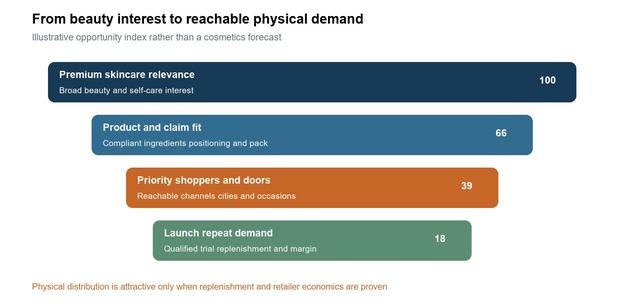
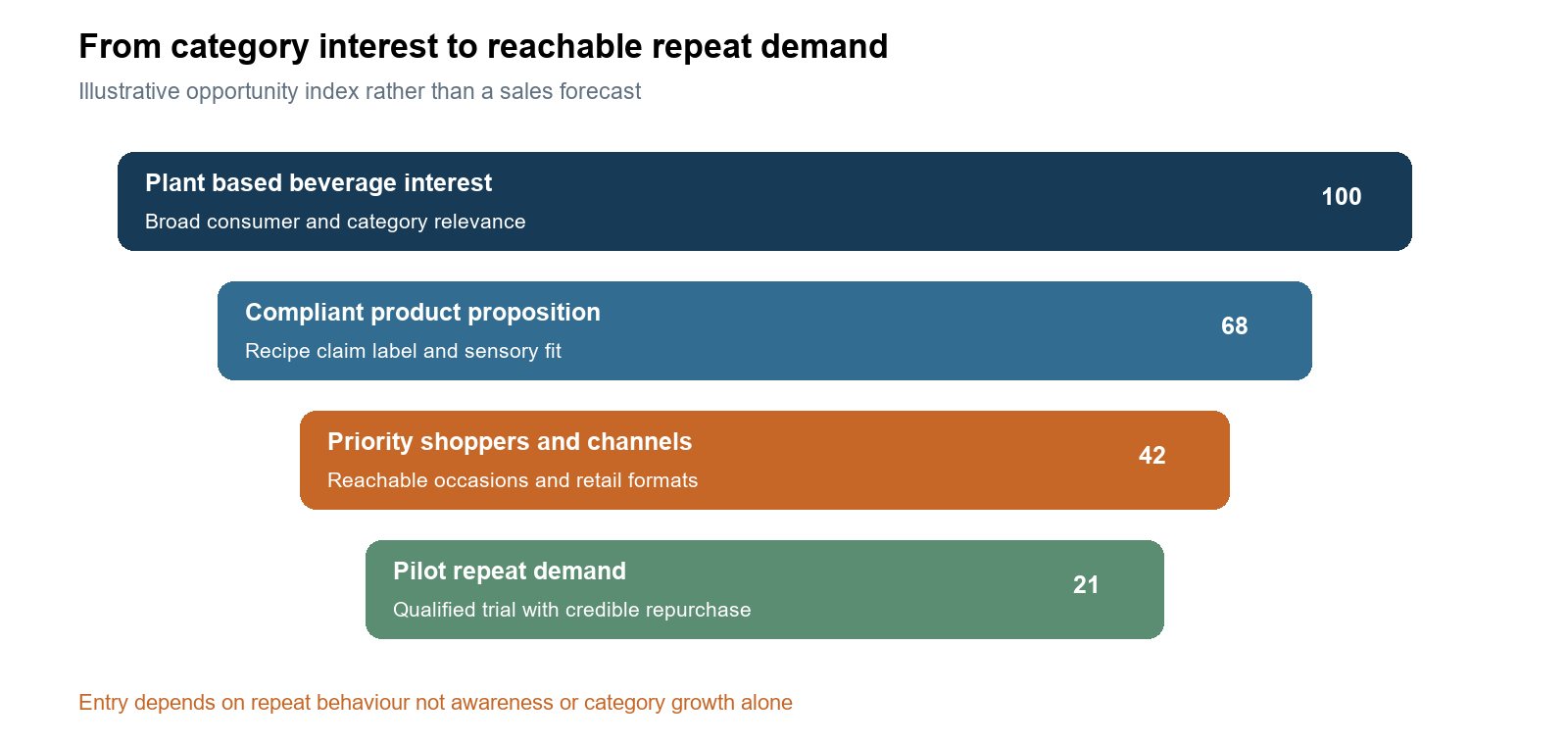
The category opportunity is narrowed through dietary occasion, protein need, flavour acceptance, price tolerance, pack format, channel economics and credible repeat purchase. Market size is useful context, but the entry decision depends on the number of shoppers and retailers reachable with a compliant and profitable proposition.
Evidence stream | Source route | Question answered |
|---|---|---|
Consumer expenditure | Destatis and Eurostat household and consumption data | Category spending context and household pressure |
Observed assortment | Retailer websites store checks and licensed retail panels | Price pack size claims flavours promotions and shelf density |
Search and discussion | Google Trends reviews forums and social listening | Questions occasions complaints and emerging language to validate |
Product economics | Co-manufacturer quotes ingredient benchmarks retailer terms and logistics | Minimum runs landed cost promotion and gross margin |
Trial and repeat | Retail pilot data e-commerce cohorts and customer research | Conversion repeat rate substitution and willingness to pay |
Market access pathway
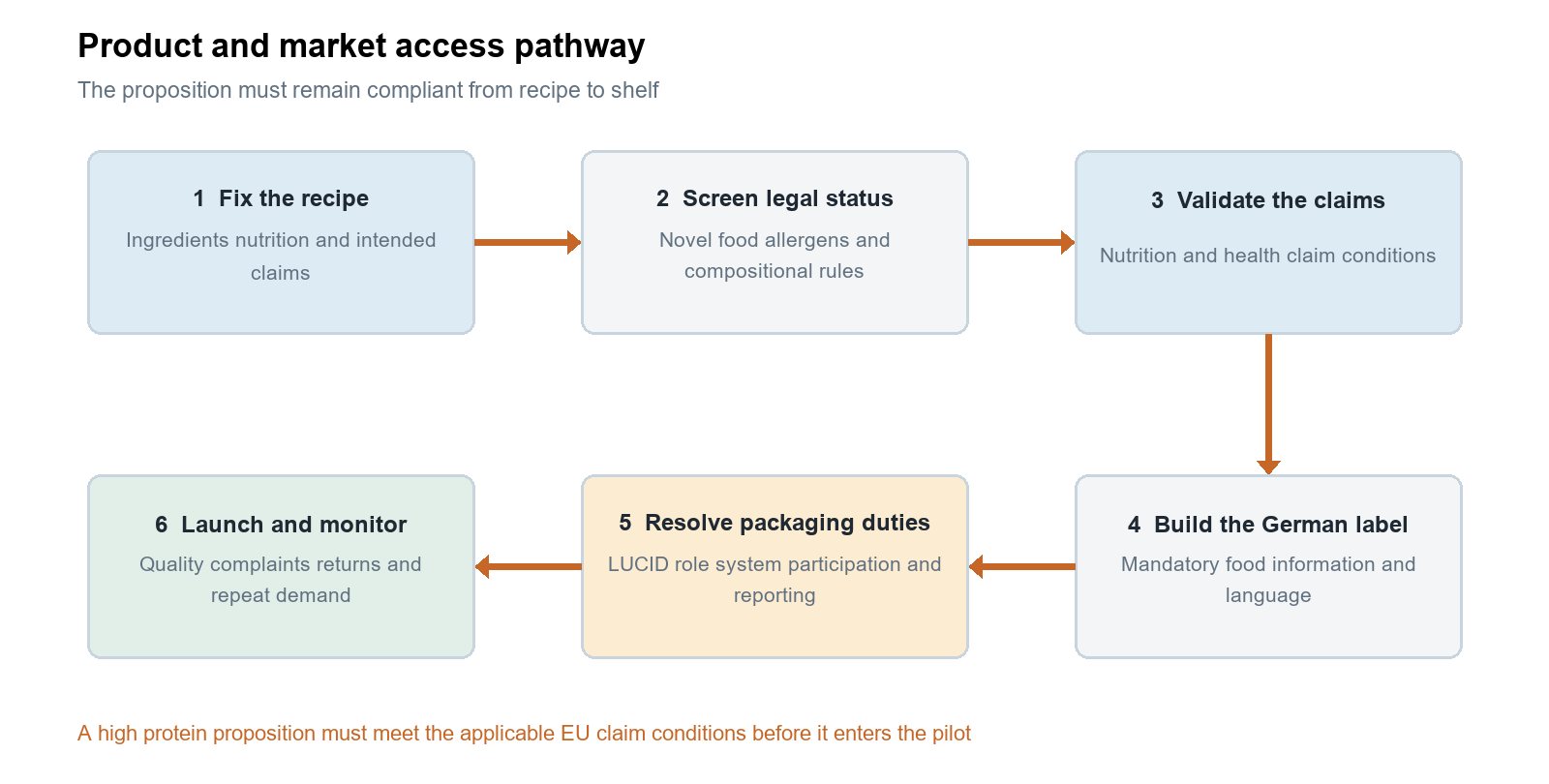
The product boundary is established before market signals are interpreted. Regulation EU 1169 2011 governs mandatory food information and nutrition labelling, while Regulation EC 1924 2006 governs nutrition and health claims. Any unfamiliar ingredient or process is screened against the EU novel-food framework. German packaging responsibilities are confirmed through the LUCID Packaging Register and the current producer-responsibility rules.
Entry gate | Primary source | Evidence required |
|---|---|---|
Food information | European Commission Food Safety and EUR Lex | Ingredients allergens nutrition declaration language and presentation |
Nutrition claims | EU Nutrition and Health Claims Register | Permitted wording and conditions for the protein proposition |
Ingredient status | European Commission Novel Food Catalogue and Union List | Whether an ingredient or process requires further authorisation |
Packaging | ZSVR and the LUCID Packaging Register | Producer role registration system participation and reporting |
Market surveillance | German federal and state food authorities | Competent authorities recalls warnings and enforcement context |
Priority segments and markets
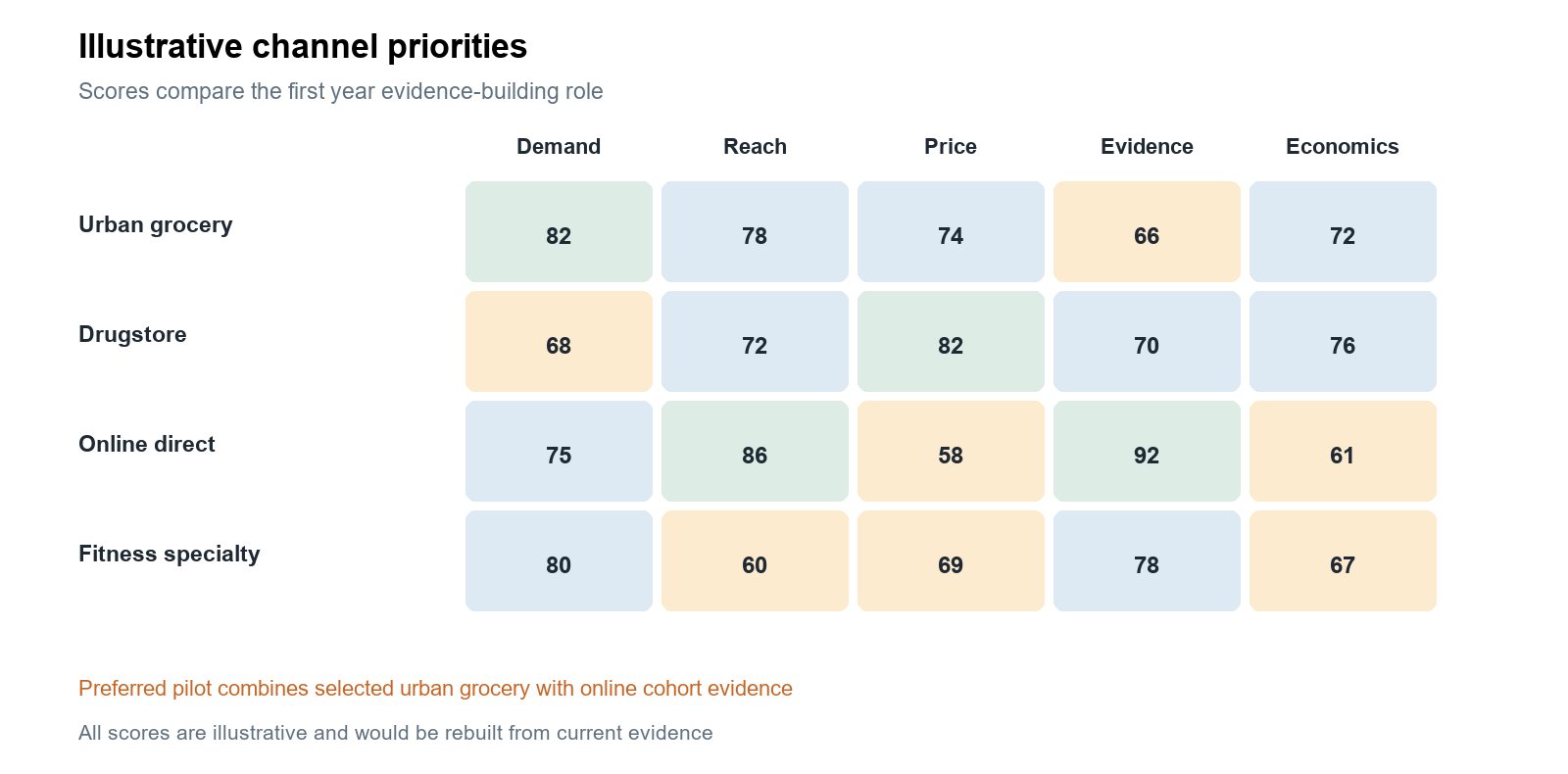
The launch design compares channels by shopper fit, reach, price realisation, evidence quality and economics. A mixed pilot creates better evidence than a national grocery push because online cohorts reveal repeat behaviour while selected stores test shelf conversion and promotion dependence.
Option | Role in the entry plan | Evidence to confirm |
|---|---|---|
Urban grocery | Physical conversion and retailer acceptance | Repeat sales without sustained promotion |
Online direct | Fast proposition and cohort test | Acquisition cost and reorder economics |
Drugstore | Health-oriented shopper and price test | Buyer interest and category placement |
Fitness specialty | Use-case credibility and feedback | Whether the segment is large enough to scale |
Entry route and operating model
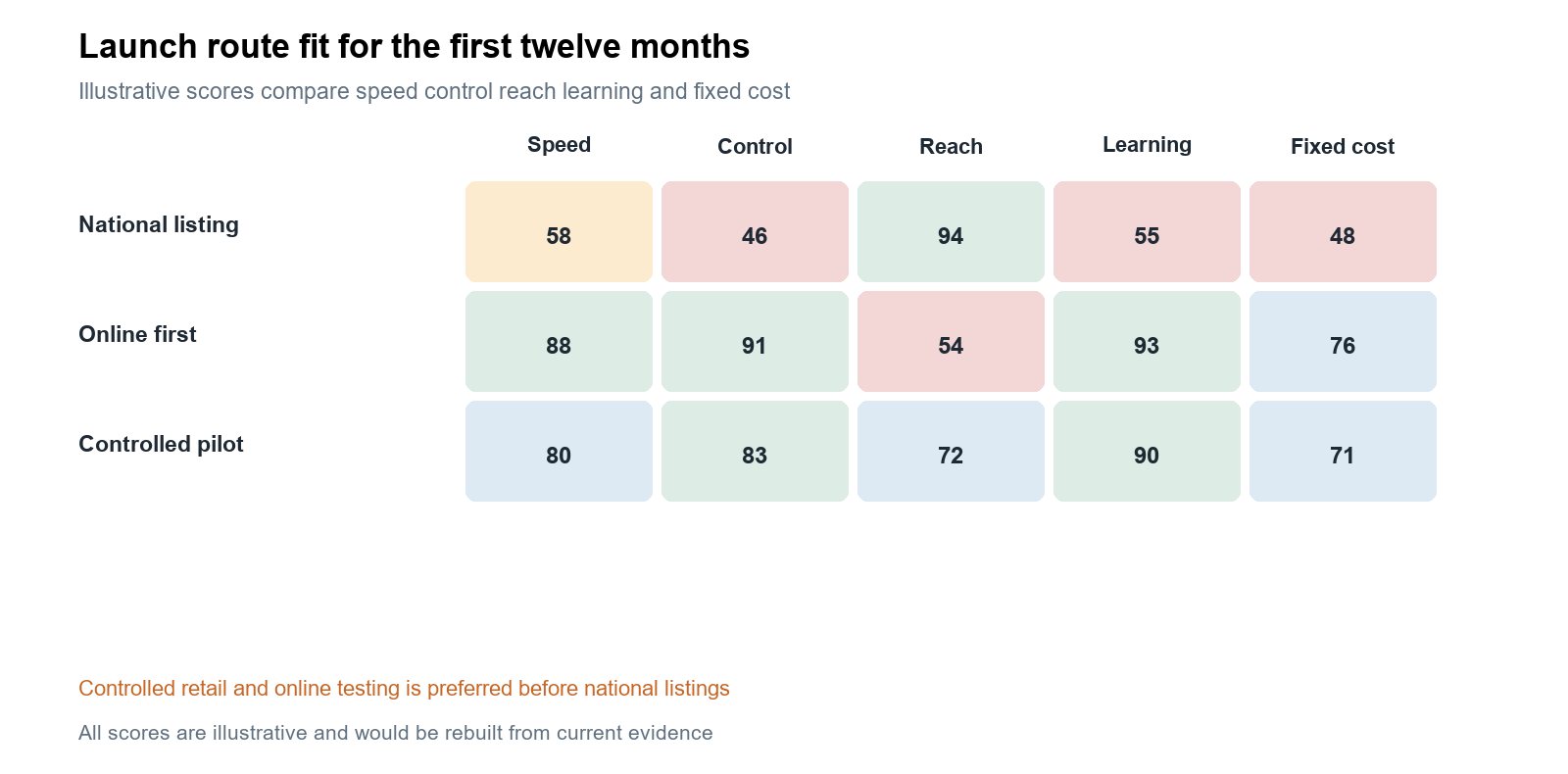
The producer can pursue a national retailer listing, a controlled retail and direct pilot, or an online-first launch. The controlled pilot provides the strongest learning-to-investment balance because it limits listing exposure while generating both shelf and repeat-purchase evidence.
Route | Strength | Exposure | Illustrative fit |
|---|---|---|---|
National listing | Immediate scale | High listing and promotion exposure | Defer |
Online first | Rapid feedback and cohort visibility | Weak proof of physical shelf conversion | Supporting channel |
Controlled pilot | Balanced shelf and repeat evidence | Requires retailer and data coordination | Preferred |
Pressure cases
- The protein claim cannot be used Retest the proposition without claim-led pricing before committing launch packaging.
- Repeat purchase remains below the pilot threshold Reformulate or stop even if initial trial and retailer interest are strong.
- Co-manufacturing cost rises by twelve percent Reduce complexity and pack variants before accepting lower margin or raising price.
Recommended entry decision
Proceed to a controlled product and channel pilot with two formulations, limited retail distribution and a measurable repeat-purchase test. Do not commit to national listings until the protein claim, ingredient status, German label, packaging obligations, price ladder, co-manufacturing economics and repeat demand support the same commercial case.
Decision gate | Illustrative acceptance condition | Action if unmet |
|---|---|---|
Claims and label | All product and promotional claims meet the confirmed legal conditions | Remove claims or defer |
Sensory acceptance | Target consumers accept taste texture and aftertaste | Reformulate |
Repeat demand | Observed repurchase supports the planned velocity | Stop or reposition |
Price and promotion | Demand is not dependent on uneconomic discounting | Reset price pack or channel |
Supply economics | Minimum runs waste logistics and retailer terms support the margin floor | Simplify or defer |
Packaging compliance | Producer responsibility and reporting are operational | Do not place product on market |
What would change the recommendation
The recommendation moves to defer if the intended claim is not available, sensory testing exposes a material product gap, repeat purchase remains weak, retail velocity depends on unsustainable promotion, or minimum manufacturing runs create excessive inventory risk. Strong repeat behaviour and stable gross margin would support wider listings.
Decision control plan
The pilot tracks weighted distribution, on-shelf availability, trial, repeat purchase, realised price, promotion depth, returns, complaints, co-manufacturing yield and expiry exposure. National expansion is approved only when repeat demand and supply economics remain credible outside the launch cohort.
First ninety days
- Freeze the proposition Confirm recipe pack sizes claims target shopper and price hypothesis.
- Complete the regulatory screen Validate ingredients novel-food status allergens label claims and packaging responsibilities.
- Reconstruct the category Map assortment prices promotions velocities and retailer category logic.
- Design the pilot Select stores online cohorts measures thresholds and inventory limits.
- Issue the scale decision Recommend reformulation expansion delay or withdrawal from the evidence.
What August Research would deliver
- Entry decision dossier The product channel and investment recommendation with evidence confidence.
- Demand and assortment model Reachable demand competitor shelf map price ladder and repeat assumptions.
- Regulatory product map Ingredient claim label packaging and surveillance requirements.
- Pilot scorecard Measures thresholds pressure cases and stop or scale gates.
- Commercial case Volume price promotion manufacturing logistics and inventory sensitivities.
Official source trail
Source | Website | Use in the assessment |
|---|---|---|
EU food information | food.ec.europa.eu and eur-lex.europa.eu | Mandatory labelling nutrition information and official guidance |
EU claims and novel food | food.ec.europa.eu and efsa.europa.eu | Permitted claims scientific opinions and ingredient status |
German packaging | verpackungsregister.org | LUCID registration producer responsibility and public register |
German demand | destatis.de and ec.europa.eu/eurostat | Household consumption demographics prices and retail context |
Market observation | Retailers commercial panels and pilot data | Assortment pricing promotion trial and repeat behaviour |
Scope boundary
This illustration does not replace food-law advice, laboratory or sensory testing, label approval, retailer negotiation, packaging registration, tax advice or production qualification.
The client, scores, funnel indices, thresholds and recommendation are hypothetical. Official sources are named to show where an actual engagement would obtain and verify current evidence.