PHASE 2 ILLUSTRATION 5 CONSUMER GOODS
Market Entry Assessment Japan Premium Skincare
An illustrative physical distribution decision for a European skincare brand
DECISION
PRODUCT
MARKET
PLANNING HORIZON
Controlled launch
Two hero skin products
Japan
First 18 months
Decision question
Should the brand establish physical distribution in Japan, which products and channels should lead the launch, and what classification, claims, importer, labelling and retail conditions must be resolved?
Illustrative recommendation
Launch two hero products through a licensed local marketing and import route, supported by controlled Japanese e-commerce and selected specialty beauty doors. Defer department-store expansion and broad drugstore distribution until classification, ingredient and claims review, Japanese packaging, retailer economics, replenishment and repeat purchase are proven.
The hypothetical client is a European premium skincare brand with strong online sales in its home markets. It proposes a facial serum and moisturiser with performance-led marketing language. Japan offers brand-building potential but requires local regulatory interpretation, a qualified commercial route and evidence that physical retail economics can support the price position. All scores are illustrative.
Opportunity reconstruction
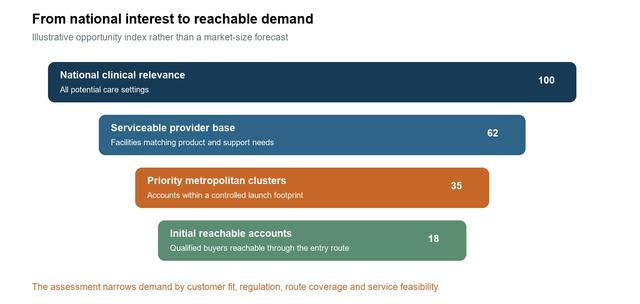
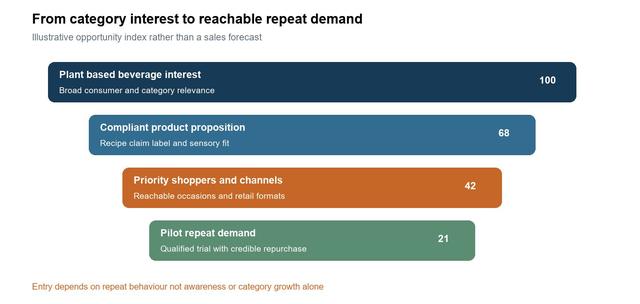
The opportunity is narrowed through shopper need, regimen fit, ingredient and claim acceptability, price ladder, channel role, store economics, tester and sampling requirements, inventory lead time and repeat purchase. Social attention and cross-border online sales are treated as signals rather than proof of sustainable physical demand.
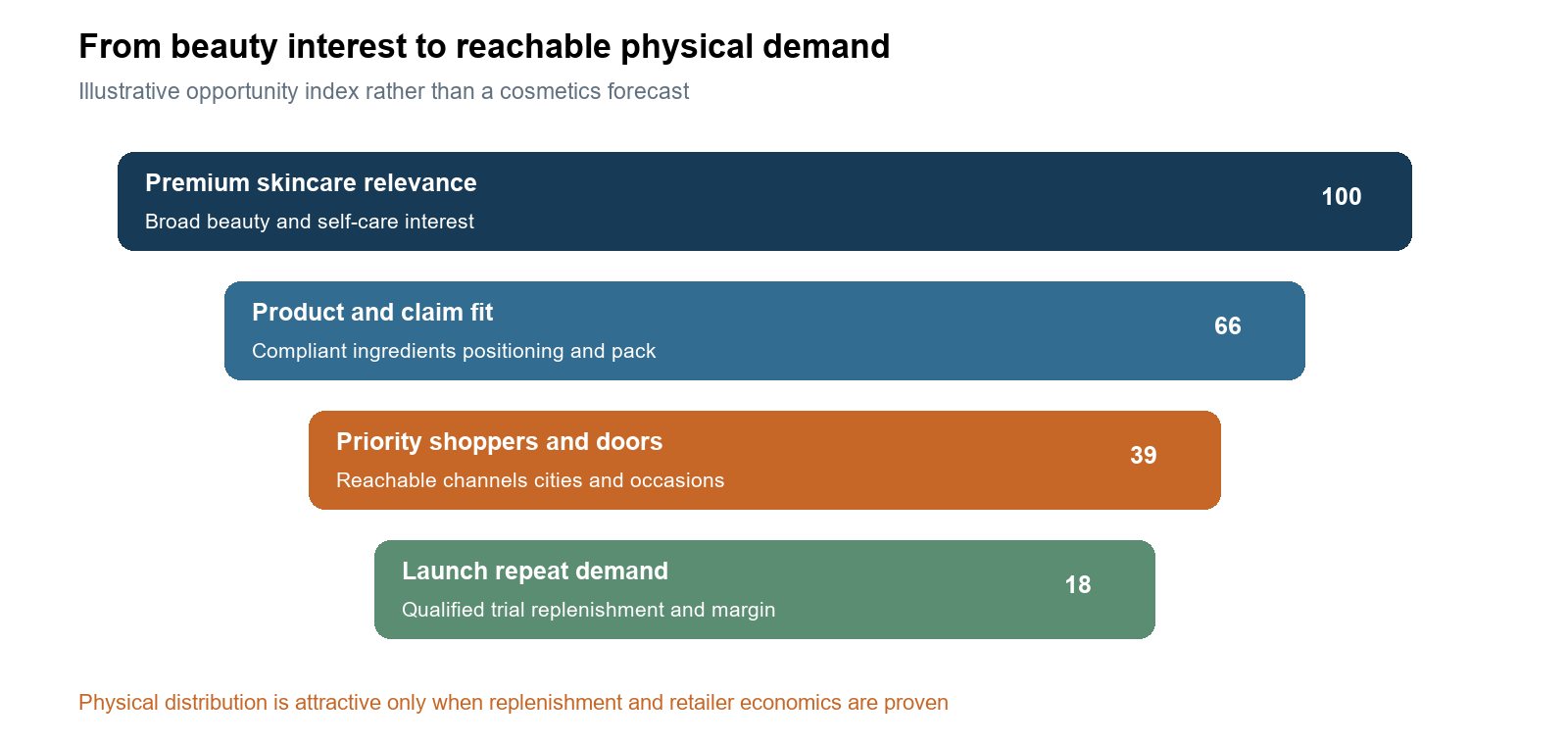
Evidence stream | Source route | Question answered |
|---|---|---|
Household and retail context | e Stat Statistics Bureau and METI commercial statistics | Consumer expenditure retail sales demographics and channel context |
Observed assortment | Department specialty drugstore and marketplace listings | Price claims ingredients pack sizes reviews and promotional intensity |
Import pattern | Japan Customs and trade statistics for relevant Chapter 33 codes | Product flows origins values tariff and customs treatment |
Consumer evidence | Search reviews beauty media social listening and customer research | Needs routines credibility barriers and repurchase signals |
Channel economics | Retailer terms importer quotes logistics and returns | Margin sampling testers inventory service and working capital |
Market access pathway
PMDA states that ordinary cosmetics do not require product marketing approval when they comply with the Standards for Cosmetics, while products containing active ingredients are generally classified as quasi-drugs and require approval. The specific classification, marketing-authorisation-holder structure, ingredient status, notifications and Japanese labelling are confirmed with MHLW and qualified local advisers before launch.
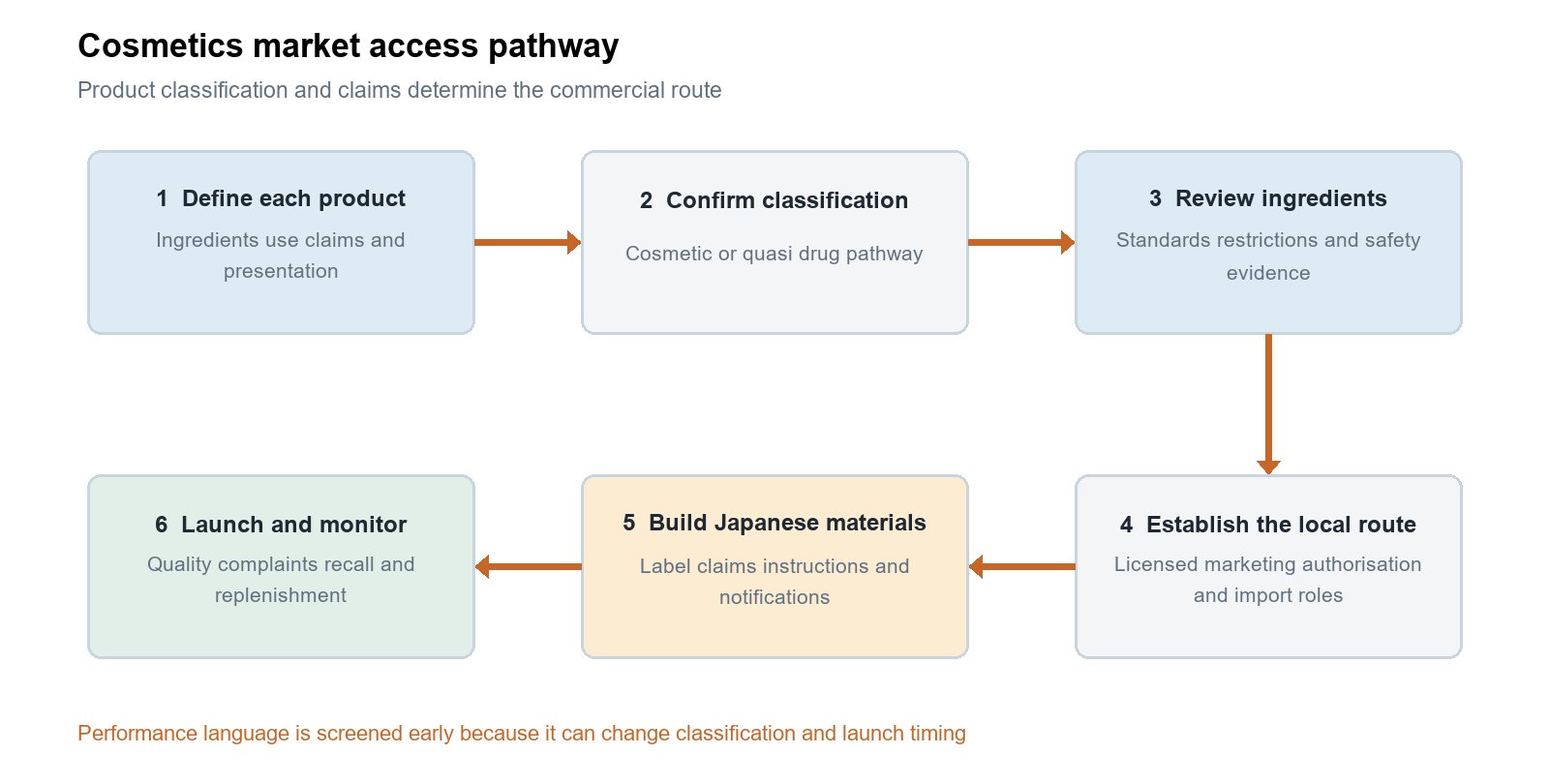
Entry gate | Primary source | Evidence required |
|---|---|---|
Classification and standards | MHLW and PMDA official cosmetics information | Cosmetic versus quasi drug route standards ingredients and approvals |
Local commercial licence | Prefectural and MHLW guidance | Marketing authorisation manufacturing import and quality roles |
Claims and consumer protection | MHLW Consumer Affairs Agency and advertising rules | Permitted product language substantiation and presentation |
Customs and tariff | Japan Customs tariff schedule and advance-ruling route | HS code duty consumption tax documents and import procedure |
Brand protection | Japan Patent Office and J PlatPat | Trademark availability ownership and conflicting marks |
Priority segments and markets
Channels are compared by brand fit, customer reach, price protection, evidence quality and working-capital economics. Premium e-commerce and specialty beauty provide the best first learning environment. Department stores can strengthen prestige but introduce slower negotiations, counters, staffing and inventory commitments.
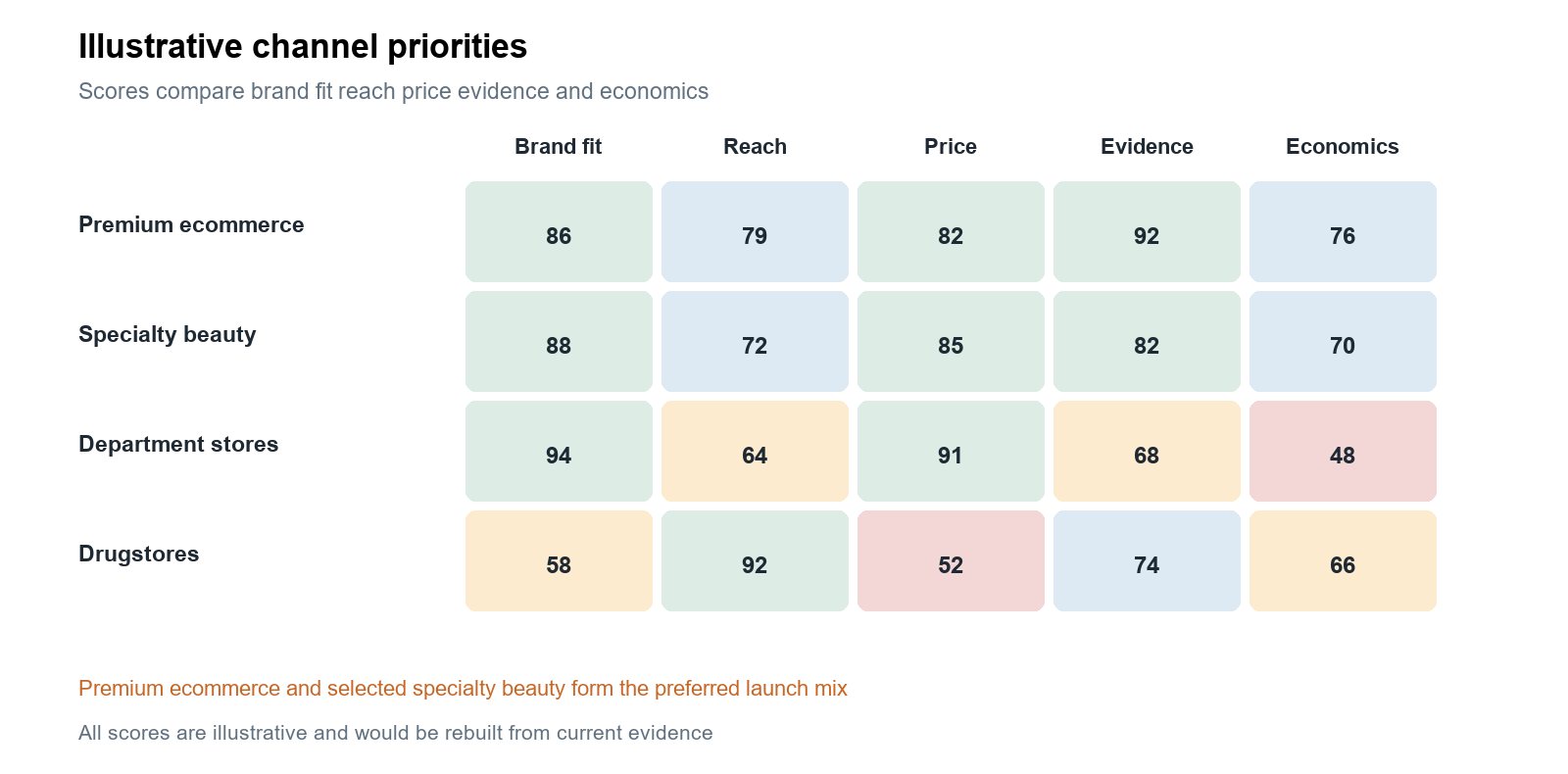
Option | Role in the entry plan | Evidence to confirm |
|---|---|---|
Premium e-commerce | Controlled storytelling and cohort evidence | Acquisition cost fulfilment and repeat purchase |
Specialty beauty | Physical trial advice and brand fit | Door productivity training and replenishment |
Department stores | Potential second-wave prestige channel | Counter staffing concessions inventory and slow setup |
Drugstores | Broad reach after proposition proof | Price pressure assortment scale and brand dilution |
Entry route and operating model
Cross-border marketplace sales create speed but do not establish a compliant physical route or strong retailer relationships. A local subsidiary increases control but adds cost before demand is proven. A licensed importer and marketing partner with brand, inventory and account controls provides the best first-stage balance.
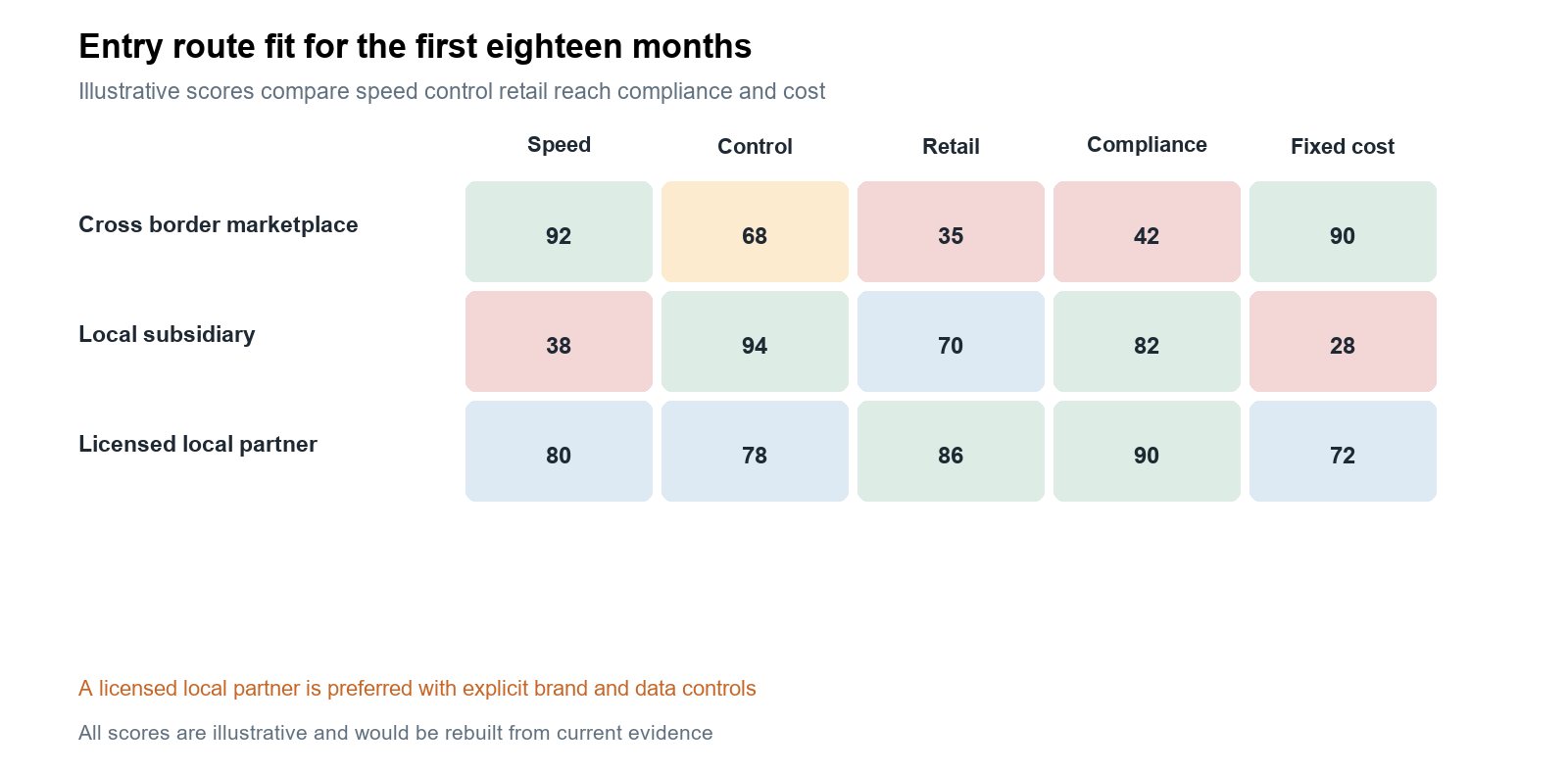
Route | Strength | Exposure | Illustrative fit |
|---|---|---|---|
Cross border marketplace | Fast demand signal | Weak physical route and compliance control | Research signal only |
Local subsidiary | Maximum brand and account control | High fixed cost before repeat evidence | Defer |
Licensed local partner | Regulatory route retail access and local execution | Requires governance and inventory transparency | Preferred |
Pressure cases
- A hero product is treated as a quasi drug Rebuild timing claims cost and launch sequence before committing packaging or retailer dates.
- Retailer margin is eight points above plan Reduce channel scope sampling cost and assortment before lowering the brand price.
- Trial is strong but replenishment is weak Stop door expansion and investigate regimen fit usage period and proposition credibility.
Recommended entry decision
Launch two hero products through a licensed local marketing and import route, supported by controlled Japanese e-commerce and selected specialty beauty doors. Defer department-store expansion and broad drugstore distribution until classification, ingredient and claims review, Japanese packaging, retailer economics, replenishment and repeat purchase are proven.
Decision gate | Illustrative acceptance condition | Action if unmet |
|---|---|---|
Product classification | Each SKU claim and ingredient follows a confirmed pathway | Reformulate reclassify or defer |
Local licensed route | Quality safety import and marketing roles are documented | Do not import for sale |
Japanese materials | Label claims instructions and consumer communication are approved | Hold launch inventory |
Reachable demand | Named channels and shoppers support the price and regimen | Narrow proposition |
Retail economics | Margin testers sampling returns freight and inventory meet the floor | Redesign channel mix |
Replenishment | Repeat purchase and door productivity support expansion | Stop new-door rollout |
What would change the recommendation
The recommendation moves to defer if classification changes the launch path, the local licensed route cannot provide quality and inventory visibility, Japanese claims weaken the proposition, retailer economics erode the price architecture, or replenishment remains weak. Proven repeat and controlled door economics would support selective expansion.
Decision control plan
The pilot tracks product approval milestones, landed inventory, on-shelf availability, tester conversion, sample-to-purchase, realised price, returns, complaints, reorder interval, repeat purchase, door productivity and partner reporting quality.
First ninety days
- Fix the SKU and claims boundary Confirm ingredients functions language pack and target shopper.
- Resolve the regulatory route Validate classification standards local licences notifications claims and label.
- Reconstruct the channel Map retailers marketplaces price ladders competitors terms and door economics.
- Select the partner and pilot Define licensed roles inventory visibility doors cohorts and measures.
- Issue the expansion decision Recommend more doors new channels reformulation delay or withdrawal.
What August Research would deliver
- Entry decision dossier The SKU channel partner and investment recommendation.
- Accessible demand model Priority shoppers channels cities price ladder and repeat assumptions.
- Regulatory product map Classification ingredients claims local roles customs and label requirements.
- Channel economics Margins testers sampling freight inventory returns and working capital.
- Pilot scorecard Launch measures pressure cases and door expansion gates.
Official source trail
Source | Website | Use in the assessment |
|---|---|---|
Cosmetics regulation | mhlw.go.jp and pmda.go.jp | Classification standards ingredients licences notifications and official guidance |
Customs and imports | customs.go.jp and trade statistics | Tariff schedules classification import values origins and procedures |
Demand and retail | e-stat.go.jp and meti.go.jp | Household expenditure demographics retail sales and commercial statistics |
Claims and consumers | caa.go.jp | Consumer protection representation advertising and labelling context |
Brand and market route | jpo.go.jp J PlatPat JETRO and retailer evidence | Trademark route market guidance channels prices and competitor activity |
Scope boundary
This illustration does not replace Japanese regulatory, legal, customs, tax or claims advice, product safety review, local licence verification, retailer negotiation, trademark counsel or consumer testing.
The client, scores, funnel indices, thresholds and recommendation are hypothetical. Official sources are named to show where an actual engagement would obtain and verify current evidence.