PHASE 2 ILLUSTRATION 1 MEDICAL DEVICES
Market Entry Assessment India Portable Ultrasound
An illustrative decision case for a European manufacturer assessing a controlled entry into India
DECISION
PRODUCT
MARKET
PLANNING HORIZON
Controlled entry
Portable ultrasound
India
First 18 months
Decision question
Should the manufacturer enter India with its portable ultrasound platform, which customers and regions should form the first launch wave, and which regulatory, channel and service conditions must be resolved before capital is committed?
Illustrative recommendation
Proceed to a controlled distributor-led pilot rather than a full national launch. Use one accountable import and distribution route, retain manufacturer control over target-account selection and clinical application support, and limit the first wave to metropolitan clusters that can be served within defined response times. Expansion should occur only after the licensing pathway, purchaser eligibility controls, landed economics and service model are confirmed.
The hypothetical client has an established portable ultrasound system outside India and is considering entry without an immediate local manufacturing investment. The initial proposition is aimed at private hospitals, diagnostic centres and selected public procurement opportunities. All market scores, volumes, economics and recommendations in this document are illustrative.
Opportunity reconstruction
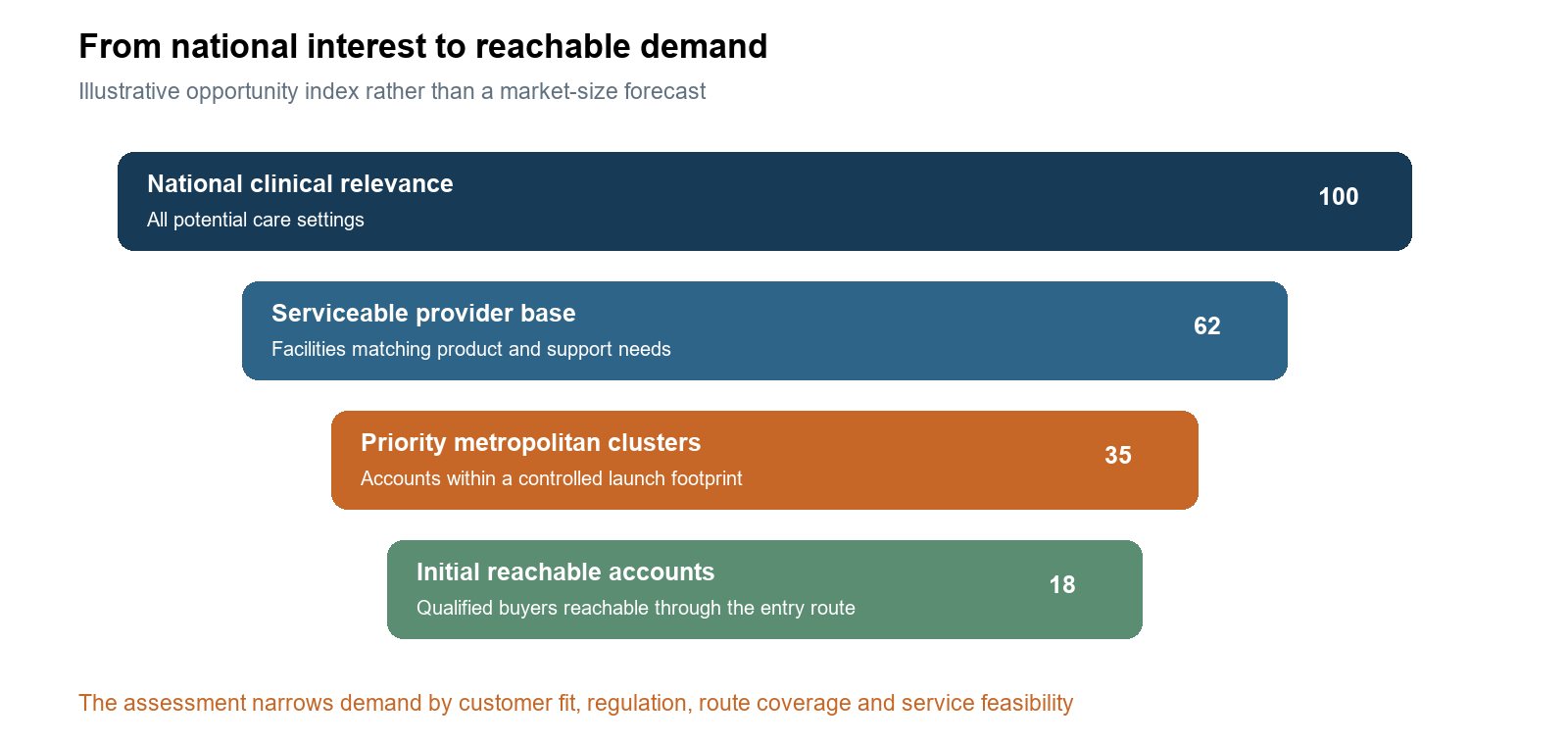
A national healthcare need does not translate directly into accessible demand. The analysis narrows the opportunity through facility fit, intended clinical use, equipment budgets, procurement route, buyer eligibility, channel reach and the ability to install, train and service the system.
Evidence stream | Source route | Question answered |
|---|---|---|
Healthcare facilities | National Health Authority hospital systems, Health Facility Registry, HMIS and data.gov.in | Which facilities provide the relevant services and have the infrastructure to use the device |
Procurement activity | Government e Marketplace, central and state tender portals, hospital procurement notices | Where equipment is being purchased, with what specifications, quantities and service obligations |
Import pattern | Department of Commerce TradeStat for HS 9018 12 and relevant subcategories | How import value, supplying countries and product mix are changing |
Observed price and offer | Tender awards, distributor catalogues, hospital listings and direct quotations | What price bands, warranty terms, probes, software and training are included |
Competitive presence | CDSCO records, company filings, manufacturer and distributor websites, conference and tender evidence | Which suppliers are active, how they reach customers and where evidence remains incomplete |
Regulatory and market access pathway
The entry route begins with the exact device, intended use, model family and claims. CDSCO classifies medical devices by risk and requires the current classification and applicable standards to be confirmed before the dossier is planned. The CDSCO medical-device portal states that an import application is made in Form MD 14 through SUGAM for an import licence in Form MD 15.
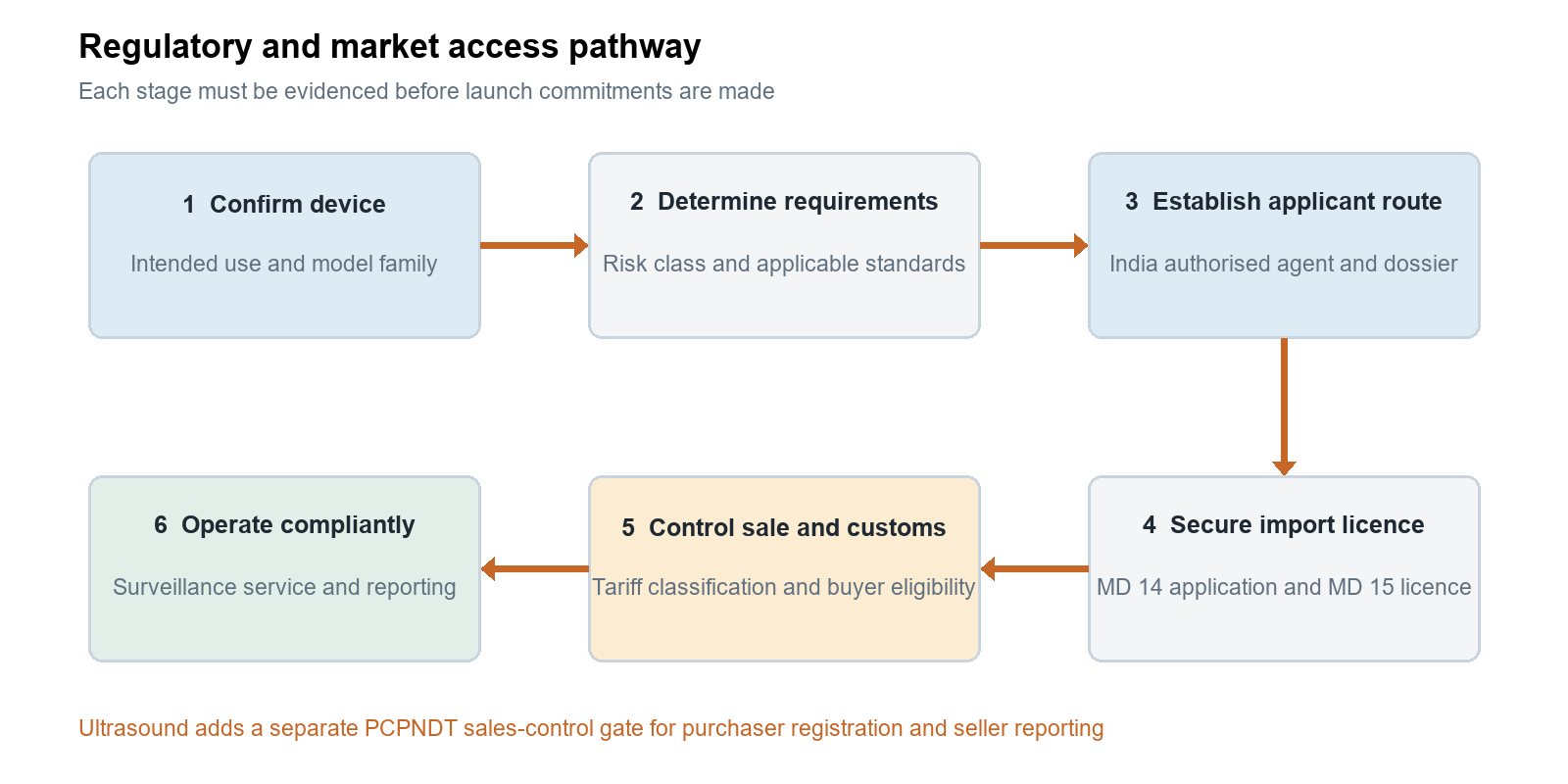
Ultrasound creates a second control layer. Section 3B of the PCPNDT Act prohibits the sale of ultrasound or imaging equipment capable of detecting foetal sex to an unregistered buyer. The channel design must therefore verify purchaser status and support the seller reporting and record requirements that apply to the transaction.
Entry gate | Primary official source | Evidence required |
|---|---|---|
Device and risk route | CDSCO Medical Device and Diagnostics portal and current classification notices | Device description, intended use, models, accessories, risk class and licensing authority |
Import dossier | Medical Devices Rules 2017, CDSCO checklists and SUGAM | Authorised-agent power, regulatory certificates, quality-system evidence, plant and device master-file content |
Applicable standards | BIS Standards portal and CDSCO standards notices | Electrical safety, essential performance, software, cybersecurity and labelling standards relevant to the system |
Ultrasound sales control | India Code and the Ministry of Health PCPNDT materials | Buyer registration, undertakings, sales records and reporting process |
Customs and tariff | CBIC and Tax Information Portal | Confirmed HS code, duty, exemptions, valuation, documentation and landed-cost treatment |
Regional and customer prioritisation
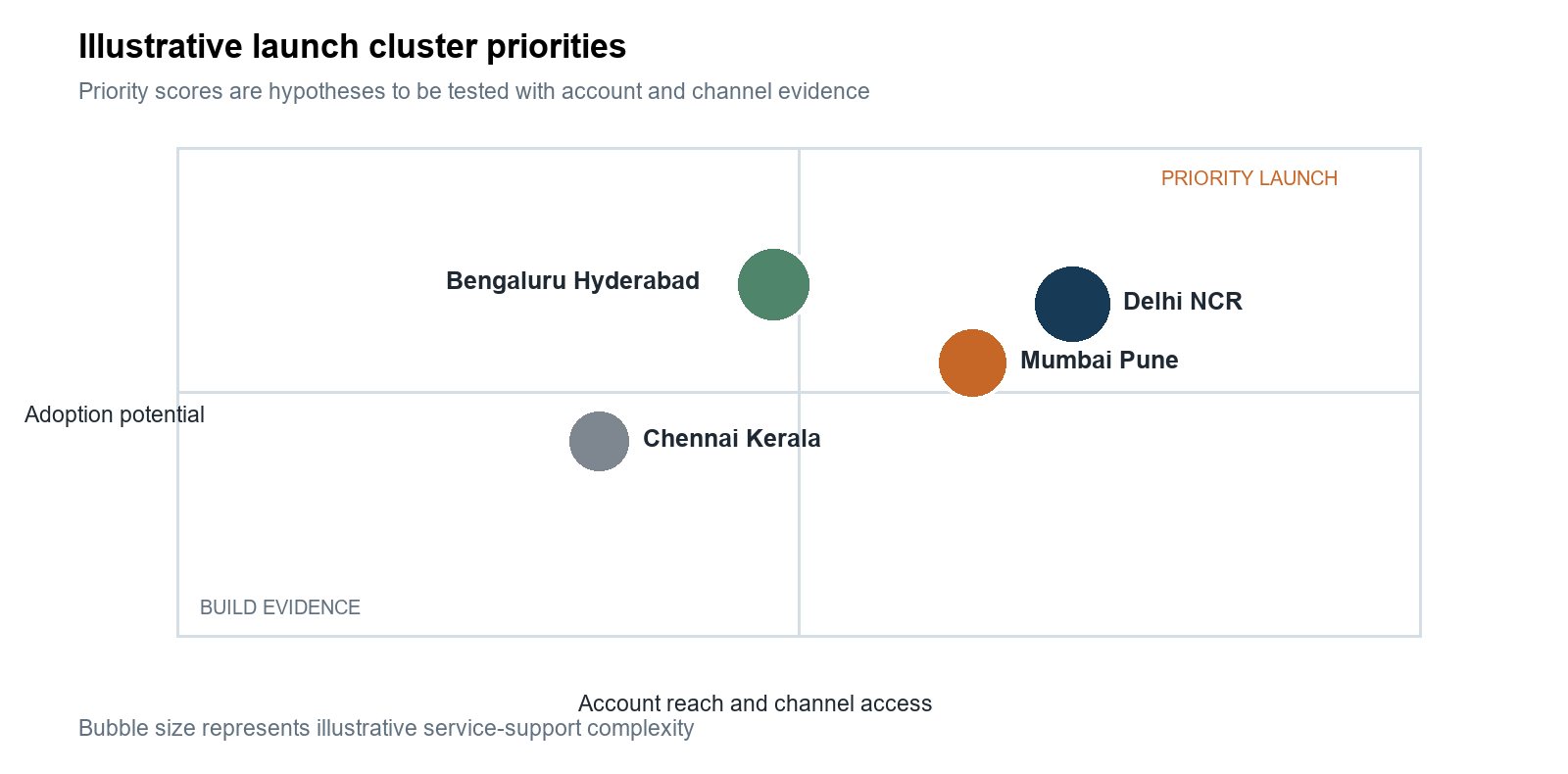
The first-wave geography should be determined by reachable accounts and service capability, not population alone. The illustration uses four combined metropolitan clusters to show how the method compares provider density, procurement activity, private-sector access, distributor coverage, logistics, clinical application support and evidence confidence.
Illustrative cluster | Launch role | Evidence to confirm |
|---|---|---|
Delhi NCR | Anchor accounts and public procurement visibility | Qualified hospital list, tender pipeline, buyer registration and service coverage |
Mumbai Pune | Private hospital and diagnostic network test | Account economics, distributor relationships, installed base and reference-site potential |
Bengaluru Hyderabad | Technology-led private provider test | Clinical use cases, integration expectations, training needs and support capacity |
Chennai Kerala | Second-wave option after service proof | Regional distributor depth, response times, pricing and account conversion |
The cluster scores are not factual rankings. An engagement would rebuild them using current account, procurement, channel and service evidence, then expose the assumptions that most affect the order of entry.
Entry route and operating model
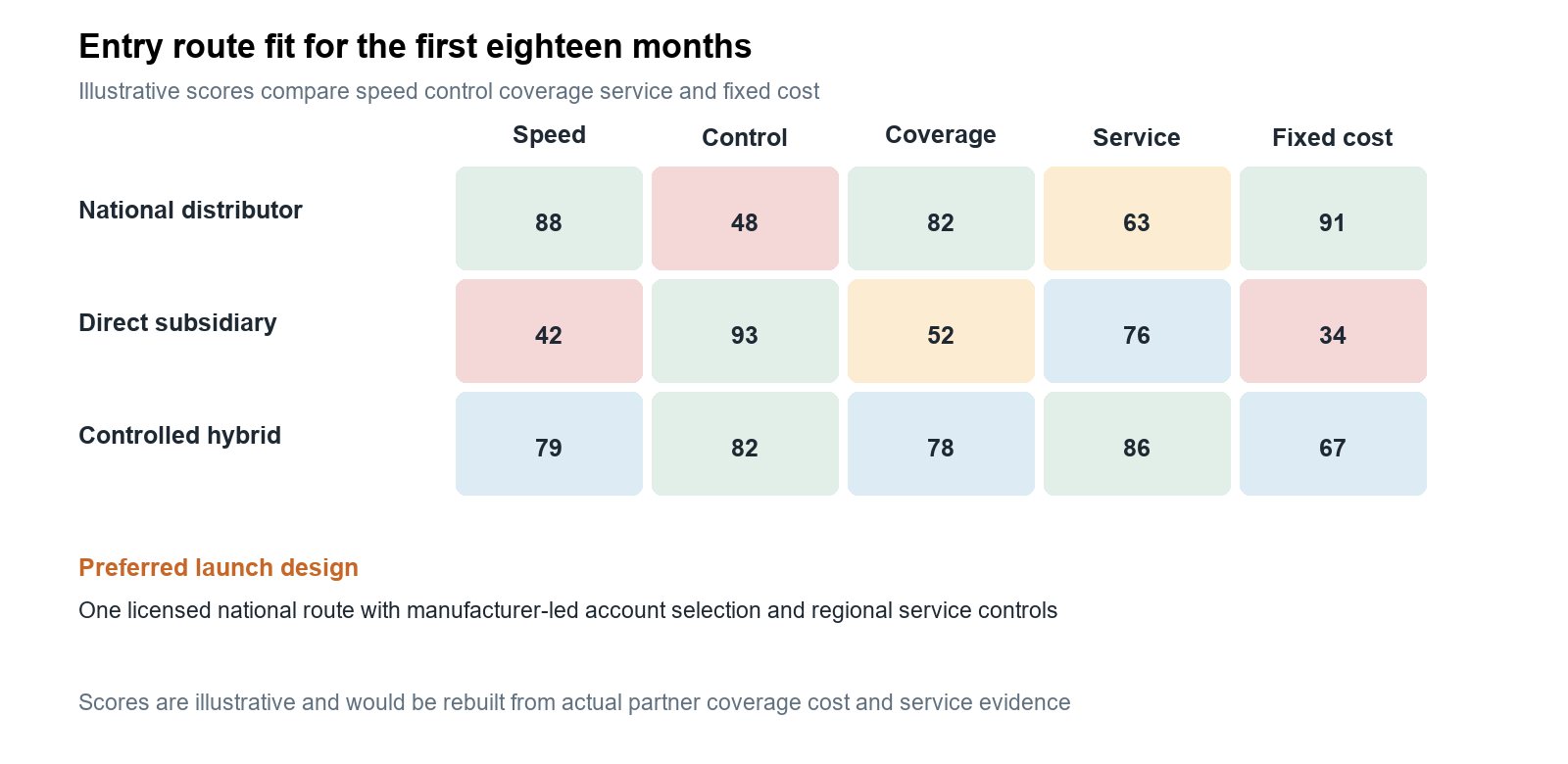
A national distributor offers speed and reach but can weaken account visibility and service control. A direct subsidiary increases control but requires greater fixed investment and takes longer to establish. The controlled hybrid retains one licensed route while the manufacturer controls priority accounts, training standards, service data and expansion gates.
Route | Strength | Exposure | Illustrative fit |
|---|---|---|---|
National distributor | Fastest access and broadest existing reach | Lower account transparency and variable clinical or service attention | Use only with strong data and service obligations |
Direct subsidiary | Highest control over pricing accounts and capability | Slower setup higher fixed cost and limited initial coverage | Revisit after demand and service density are proven |
Controlled hybrid | Combines licensed route with manufacturer governance | Requires disciplined role design and joint operating data | Preferred pilot structure |
Pressure cases
- Licensing takes six months longer Complete partner diligence and account validation, but do not commit launch inventory until the critical licence path is confirmed.
- Landed cost increases by fifteen percent Protect the pilot by narrowing the customer segment, testing configuration choices and avoiding national price commitments.
- Service response cannot meet the target Reduce the launch footprint or add certified regional service capacity before selling outside the supported clusters.
Recommended entry decision
Advance a controlled market-entry pilot subject to six decision gates. The recommendation is not a commitment to national rollout. It is permission to invest in the evidence and operating controls required to determine whether a scalable India entry exists.
Decision gate | Illustrative acceptance condition | Action if unmet |
|---|---|---|
Regulatory route | Current risk class dossier route and licence sequence confirmed | Pause external launch commitments |
Ultrasound sales control | Purchaser verification record and reporting process operational | Do not supply affected accounts |
Qualified demand | Named first-wave accounts support the use case and price logic | Redefine segment or proposition |
Landed economics | Price configuration duty channel cost and warranty support the margin floor | Reprice redesign configuration or defer |
Service readiness | Installation training escalation and parts support meet the promised response | Narrow geography or add capacity |
Partner control | Account data compliance obligations and performance rights are contractually visible | Replace or redesign the route |
What would change the recommendation
A material change in device classification, a licensing route that delays the launch beyond the commercial window, an inability to operate PCPNDT controls, weak account-level willingness to buy, an uneconomic landed configuration or insufficient service capacity would move the decision from pilot to defer or reject. Stronger account conversion and repeatable service economics would support expansion.
Decision control plan
The pilot would track qualified-account progression, regulatory milestones, realised selling price, discount leakage, installation cycle, training completion, service response, utilisation and partner data quality. Expansion would be approved only when these measures support the same customer and economic case used to justify entry.
First ninety days
- Confirm the product boundary Fix intended use models probes software claims and target users before regulatory and market evidence is compared.
- Resolve the regulatory pathway Validate current class standards authorised-agent structure dossier needs PCPNDT controls and tariff treatment.
- Build the account universe Combine NHA HMIS procurement and observed provider evidence into a named and classified target list.
- Test the entry route Assess importer distributor and service candidates against coverage compliance data access economics and escalation requirements.
- Issue the pilot decision Recommend the launch clusters account sequence investment gates monitoring measures and conditions for expansion or withdrawal.
What August Research would deliver
- Entry decision dossier The recommendation, rejected alternatives, evidence confidence and conditions that govern the decision.
- Accessible demand model A source-linked account and demand reconstruction rather than a single top-down market estimate.
- Regulatory and access map Licensing standards customs PCPNDT and procurement pathways with evidence gaps and owners.
- Route and partner requirements The capabilities data rights service model economics and controls required from the entry route.
- Pilot and monitoring plan The account sequence pressure cases thresholds and expansion or withdrawal gates.
Official source trail
Source | Website | Use in the assessment |
|---|---|---|
CDSCO | cdsco.gov.in | Medical Devices Rules classification notices import pathway checklists standards notices and safety updates |
India Code and PCPNDT | indiacode.nic.in and pndt.mohfw.gov.in | Governing legislation purchaser registration sale restrictions and reporting controls |
BIS | standards.bis.gov.in | Applicable Indian standards amendments and related conformity information |
CBIC and TradeStat | cbic.gov.in taxinformation.cbic.gov.in and tradestat.commerce.gov.in | Tariff customs notifications HS code evidence import trends and supplying countries |
NHA HMIS and OGD | nha.gov.in hospitals.pmjay.gov.in and data.gov.in | Healthcare facility service and public-system evidence used to reconstruct reachable demand |
Government procurement | gem.gov.in and central or state tender portals | Specifications quantities award patterns prices warranty and service requirements |
Scope boundary
This illustration demonstrates secondary research and decision analysis. It does not replace regulatory advice, legal interpretation, product classification, licence submission, tax advice, clinical validation, quality-system assessment, distributor contracting or on-site technical diligence.
The client, opportunity index, scores, pressure cases, thresholds and recommendation are hypothetical. Official sources are named to show where an actual engagement would obtain and verify evidence at the date of the decision.