PHASE 2 ILLUSTRATION 3 INDUSTRIAL EQUIPMENT
Market Entry Assessment Southeast Asia Industrial Air Compressors
An illustrative regional prioritisation decision for a European equipment manufacturer
DECISION
PRODUCT
MARKETS
PLANNING HORIZON
Prioritise entry
Efficient compressors
Four ASEAN markets
First 24 months
Decision question
Which of Thailand, Vietnam, Indonesia and Malaysia should receive first investment for an energy-efficient industrial air-compressor line, and what route can deliver sales and aftermarket service without overextending the manufacturer?
Illustrative recommendation
Use Thailand as the first operating market, build a parallel qualified pipeline in Vietnam, serve Malaysia selectively through an established technical distributor and keep Indonesia in an evidence-building stage. Operate through a regional governance hub with country-level specialists rather than granting one exclusive regional mandate.
The hypothetical client sells mid-sized rotary screw compressors and monitoring software to food processing, electronics, automotive suppliers and general manufacturing. It requires distributor-led sales but depends on installation quality, preventive maintenance, parts availability and energy-savings credibility. All rankings and scores are illustrative.
Opportunity reconstruction
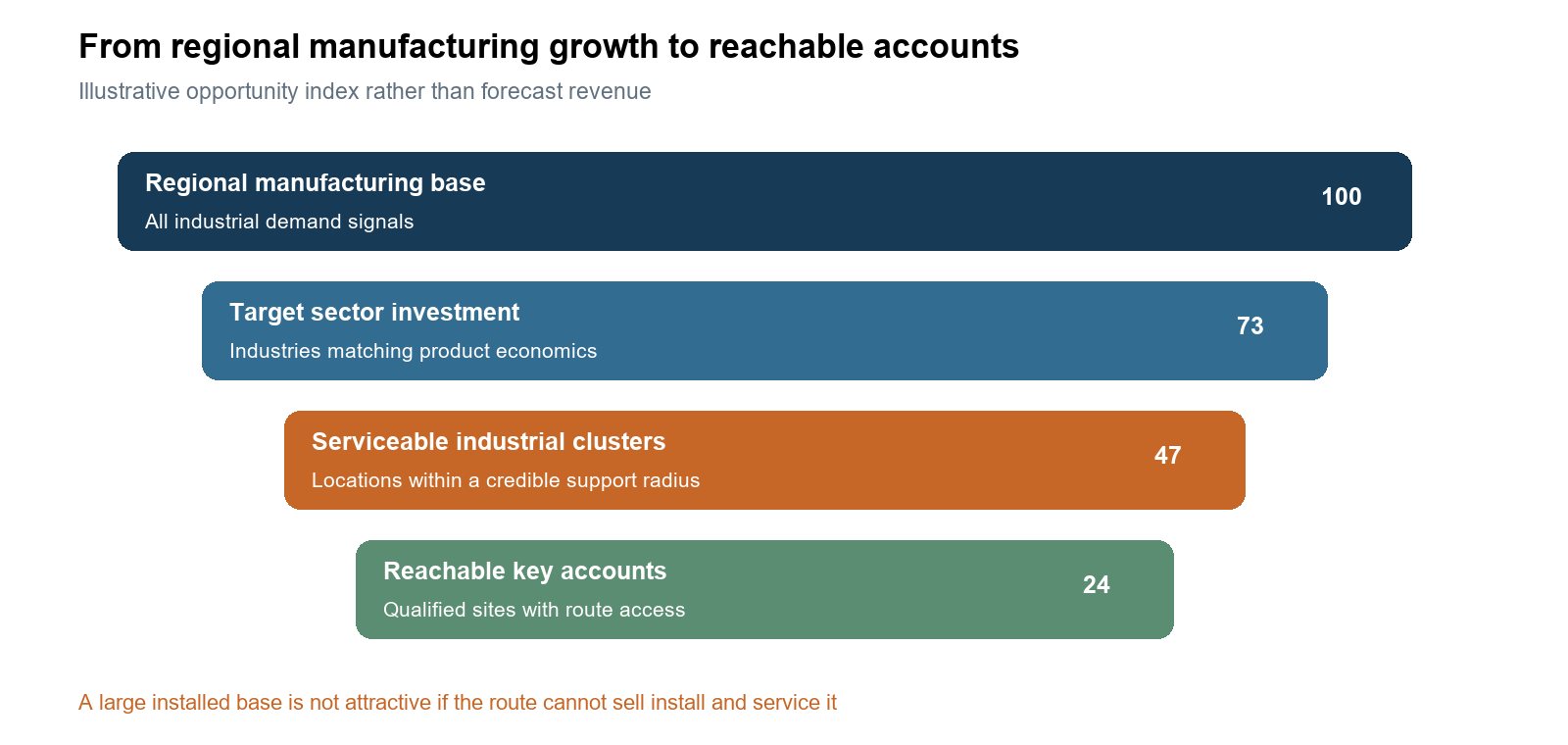
Regional manufacturing growth is filtered through target-industry investment, imported-equipment demand, electricity economics, customer concentration, distributor reach, service coverage and payment conditions. The comparison preserves country differences rather than converting all evidence into one unexplained score.
Evidence stream | Source route | Question answered |
|---|---|---|
Manufacturing activity | ASEANstats and national statistical offices | Industrial production investment and target-sector concentration |
Equipment trade | UN Comtrade WTO Tariff and Trade Data and national customs | Imports by product partner tariff and time period |
Operating environment | World Bank Enterprise Surveys and Logistics Performance Index | Power logistics customs finance and firm-level constraints |
Installed base signals | Tender maintenance distributor and customer-site evidence | Equipment brands age capacity and replacement triggers |
Energy case | Energy ministries utilities tariff schedules and customer evidence | Savings proposition payback and sensitivity to utilisation |
Market access pathway
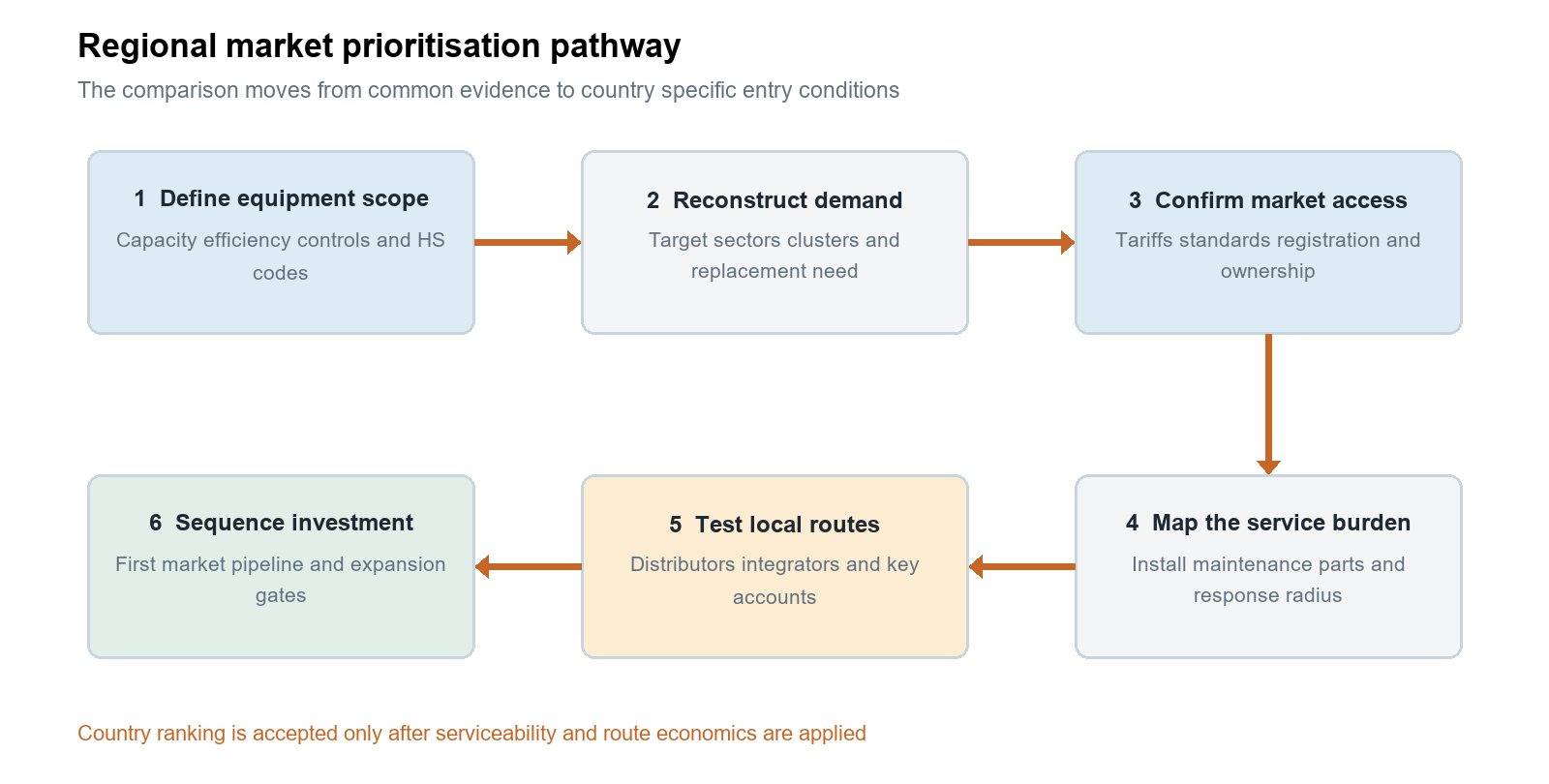
The product and HS boundary is fixed before cross-country trade data are compared. WTO Tariff and Trade Data, UN Comtrade and national customs portals establish tariffs and import patterns, while national standards bodies and ministries identify technical requirements. Investment agencies and company registries clarify establishment and distributor structures.
Entry gate | Primary source | Evidence required |
|---|---|---|
Regional comparison | ASEANstats | Manufacturing FDI trade transport and macroeconomic indicators |
Tariff and imports | WTO Tariff and Trade Data UN Comtrade and national customs | Applied duty origin import value quantity and supplier countries |
Operating conditions | World Bank Enterprise Surveys and Logistics Performance Index | Infrastructure power customs finance and business constraints |
Country rules | National standards ministries investment agencies and legal portals | Product standards registration foreign ownership tax and local establishment |
Company evidence | Registries filings distributor websites tenders and customer references | Route coverage technical depth installed base and financial continuity |
Priority segments and markets
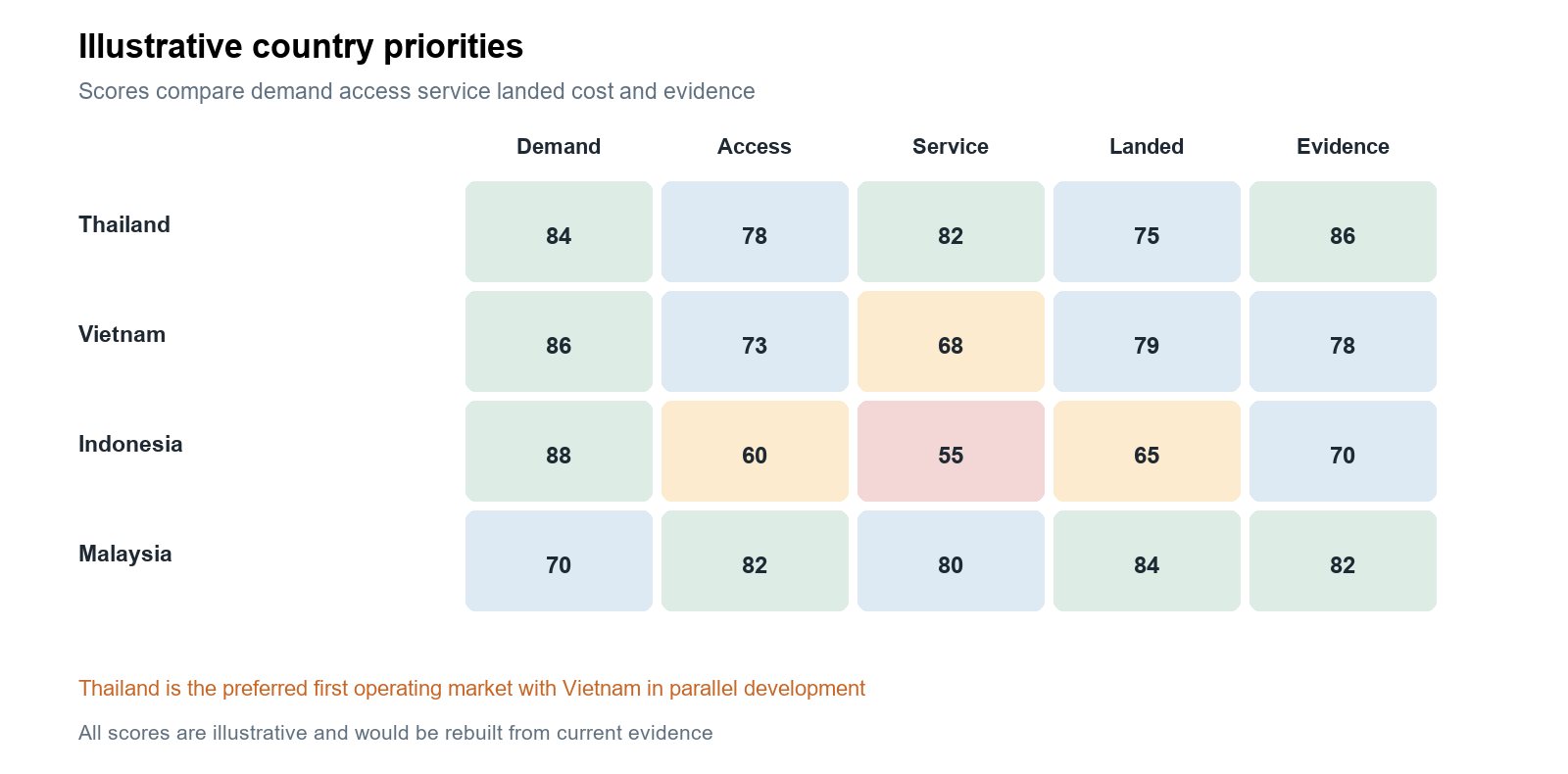
The illustrative ranking evaluates demand fit, access, service readiness, tariff and landed-cost position, and evidence confidence. Thailand leads because it combines a credible target-sector base with serviceable clusters and route evidence. Vietnam remains strategically attractive but requires a stronger service and partner plan.
Option | Role in the entry plan | Evidence to confirm |
|---|---|---|
Thailand | First operating market | Distributor capability and target account conversion |
Vietnam | Parallel pipeline and partner build | Service radius parts plan and payment structure |
Malaysia | Selective sales through strong technical route | Segment depth and economics at limited scale |
Indonesia | Evidence-building stage | Geographic service burden route quality and landed cost |
Entry route and operating model
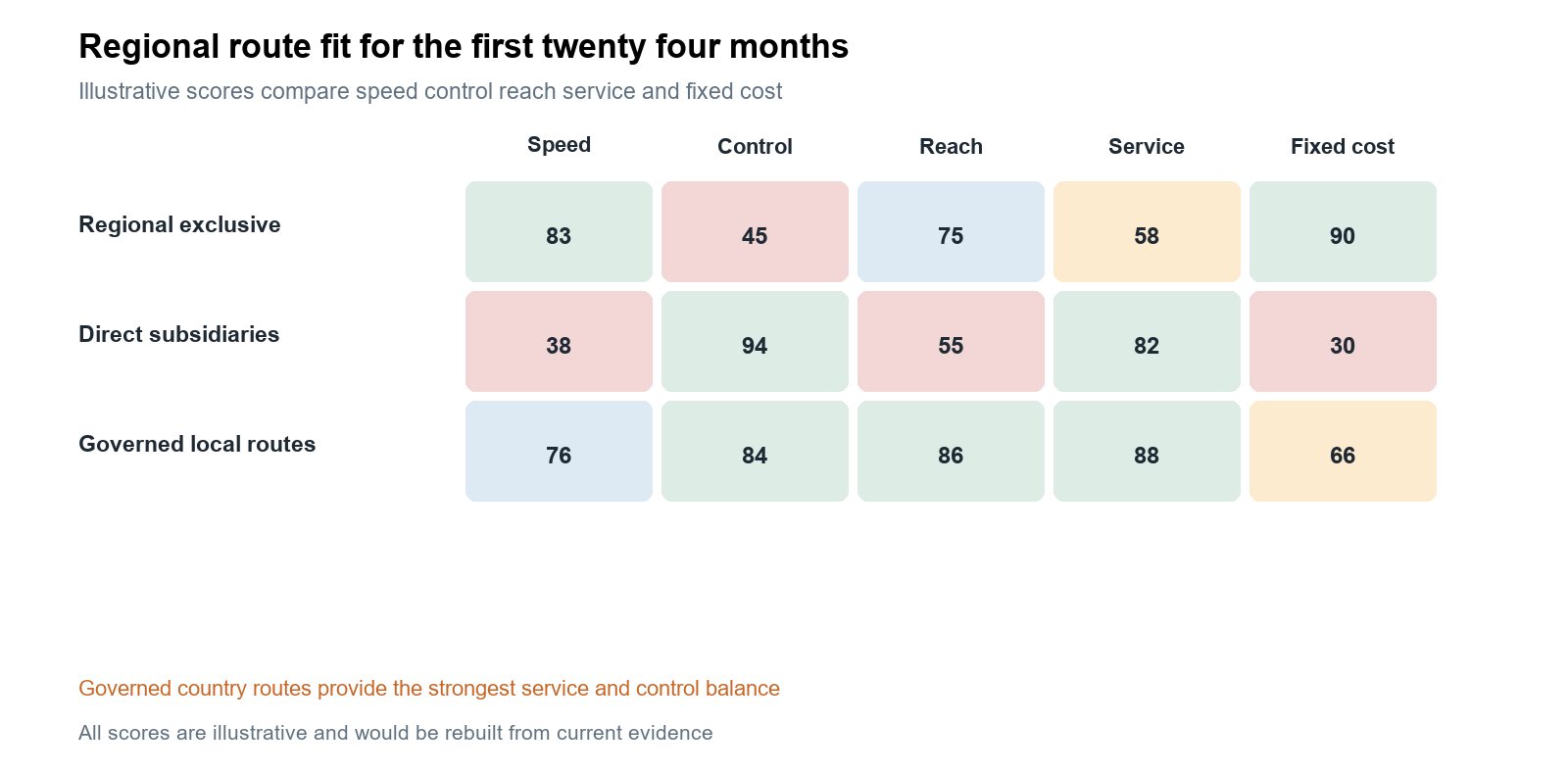
A single regional distributor simplifies contracting but can hide country-level capability gaps. Direct subsidiaries create control but require more scale than the initial evidence supports. A regional governance hub with qualified country distributors preserves local reach while keeping account, service and performance data visible.
Route | Strength | Exposure | Illustrative fit |
|---|---|---|---|
Regional exclusive | Simple and fast | Uneven country depth and low transparency | Reject |
Direct subsidiaries | Maximum control | Capital and management burden before demand proof | Defer |
Governed country routes | Local capability with regional controls | Requires disciplined partner management | Preferred |
Pressure cases
- Energy prices fall Test whether reliability maintenance and digital monitoring still justify the proposition.
- A distributor loses key technicians Use certification staffing and response-time gates before expanding territory.
- Freight and duty add fifteen percent to landed cost Reconfigure inventory origin and target segment before discounting.
Recommended entry decision
Use Thailand as the first operating market, build a parallel qualified pipeline in Vietnam, serve Malaysia selectively through an established technical distributor and keep Indonesia in an evidence-building stage. Operate through a regional governance hub with country-level specialists rather than granting one exclusive regional mandate.
Decision gate | Illustrative acceptance condition | Action if unmet |
|---|---|---|
Country demand | Named target accounts and replacement triggers support a viable pipeline | Move investment to the next market |
Market access | Tariff standards registration and ownership route are confirmed | Pause commitment |
Service capability | Certified coverage parts and escalation meet the operating promise | Narrow geography or replace route |
Energy economics | Customer payback remains credible under pressure cases | Reposition proposition |
Distributor control | Account data service data and performance rights are visible | Do not grant territory |
Landed margin | Price cost freight duty and warranty meet the margin floor | Redesign route or defer |
What would change the recommendation
The ranking changes if a country lacks a credible service partner, tariff or certification costs alter the landed position, target-sector investment weakens, or account access remains indirect. A proven multi-country service platform could accelerate regional expansion; otherwise, investment remains sequenced.
Decision control plan
The programme tracks qualified pipeline, quotation conversion, realised price, installation time, technician certification, first-time fix rate, parts availability, receivables and distributor data quality. Country expansion is earned through operating evidence, not regional headline growth.
First ninety days
- Fix the comparison boundary Define equipment capacity applications software service and HS code mapping.
- Build country evidence Reconcile ASEAN national trade industry tariff and infrastructure data.
- Map industrial clusters Identify target sectors plants investments and service radii.
- Evaluate local routes Test distributor technical commercial financial and data capability.
- Issue the sequence Recommend the first market parallel pipeline and expansion gates.
What August Research would deliver
- Country priority dossier Comparable evidence rankings uncertainty and entry sequence.
- Reachable demand model Target sectors clusters accounts and replacement triggers.
- Market access map Tariffs standards registration ownership and landed-cost requirements.
- Route and service model Distributor requirements technician coverage parts and performance controls.
- Expansion scorecard Country milestones pressure cases and capital gates.
Official source trail
Source | Website | Use in the assessment |
|---|---|---|
ASEAN regional data | aseanstats.org | Manufacturing FDI trade transport population and macro indicators |
Trade and tariffs | ttd.wto.org and comtradeplus.un.org | Applied tariffs import values quantities partners and product trends |
Operating environment | worldbank.org enterprise surveys and LPI | Infrastructure logistics power finance and firm constraints |
National evidence | Country statistics customs standards and investment portals | Current country requirements industrial activity and entry conditions |
Commercial evidence | Registries tenders distributors and customer sites | Company capability installed base price service and account access |
Scope boundary
This illustration does not replace technical certification, customs or tax advice, distributor due diligence, site visits, engineering assessment, local contracting or customer validation.
The client, scores, funnel indices, thresholds and recommendation are hypothetical. Official sources are named to show where an actual engagement would obtain and verify current evidence.