MARKET OPPORTUNITY ASSESSMENT | HEALTHCARE DIAGNOSTICS
Ambient-Stable Sample Preservation
for Rural Diagnostic Networks
Testing whether a preservation kit could reduce avoidable sample loss across referral routes in Kenya and Tanzania.
DECISION QUESTION Could an ambient-stable preservation format improve access to centralized testing without adding unacceptable assay, workflow or biosafety risk?
The access problem
Rural collection sites can depend on specimen referral networks that connect clinics, pickup routes, district hubs and centralized laboratories. The commercial gap cannot be inferred from distance alone. The opportunity depends on the specimen, assay, stability window, transport practice, laboratory acceptance and the cost of a failed or repeated collection.
What had to be resolved
- Which specimen and assay pairings experience a meaningful transport constraint.
- Where cold-chain dependence creates cost, delay or loss that preservation could address.
- Whether the kit fits collection, packaging, biosafety and laboratory accession practices.
- Which routes offer enough recurring demand for a controlled commercial pilot.
ASSESSMENT OUTCOME PURSUE A NARROW PILOT. Start with one specimen and assay pairing on variable referral routes, not a universal preservation claim.
ROUTE-DEFINED OPPORTUNITY
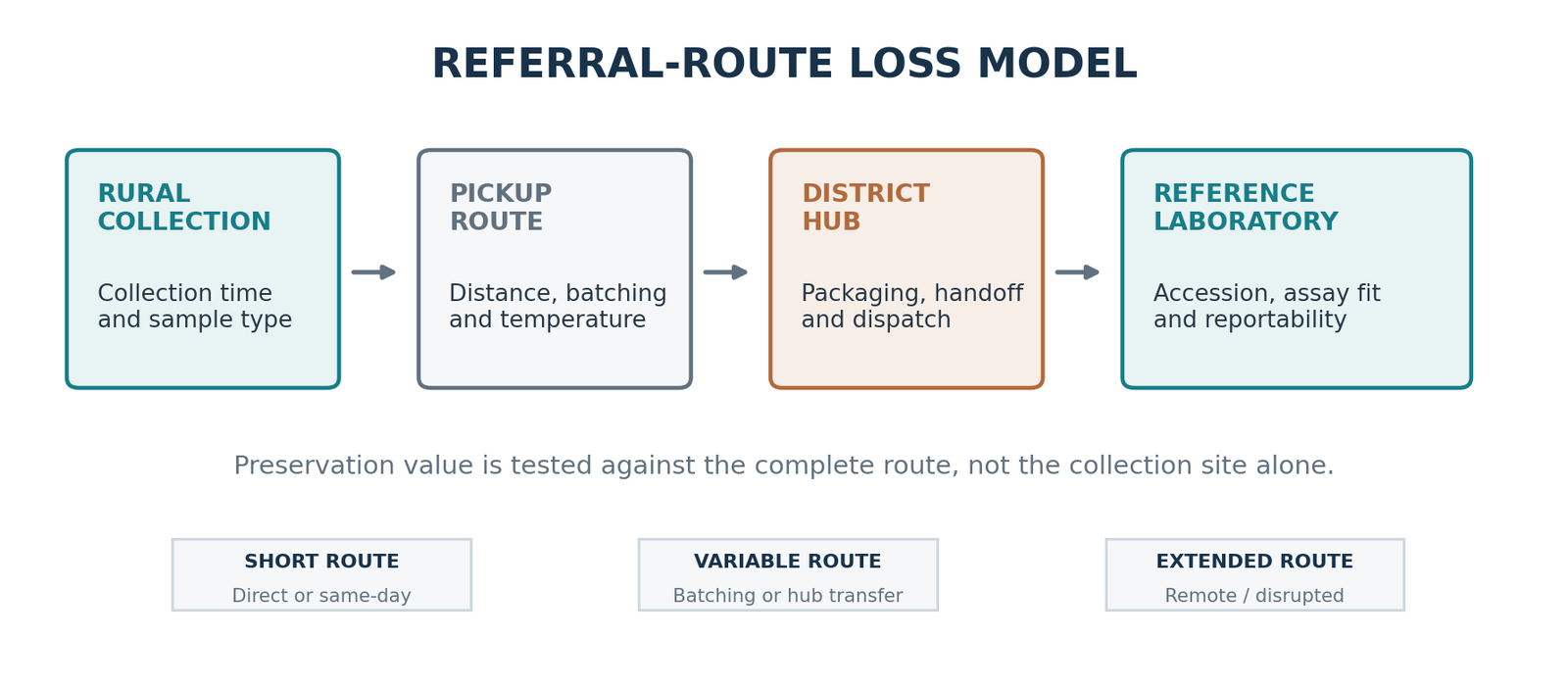
The market is a network of handoffs
The study maps the complete referral route because every handoff changes the usable stability window and the party that would need to adopt the kit.
Scope parameters
PARAMETER | STUDY BOUNDARY |
|---|---|
Geography | Kenya and Tanzania, with rural-to-centralized testing routes assessed separately |
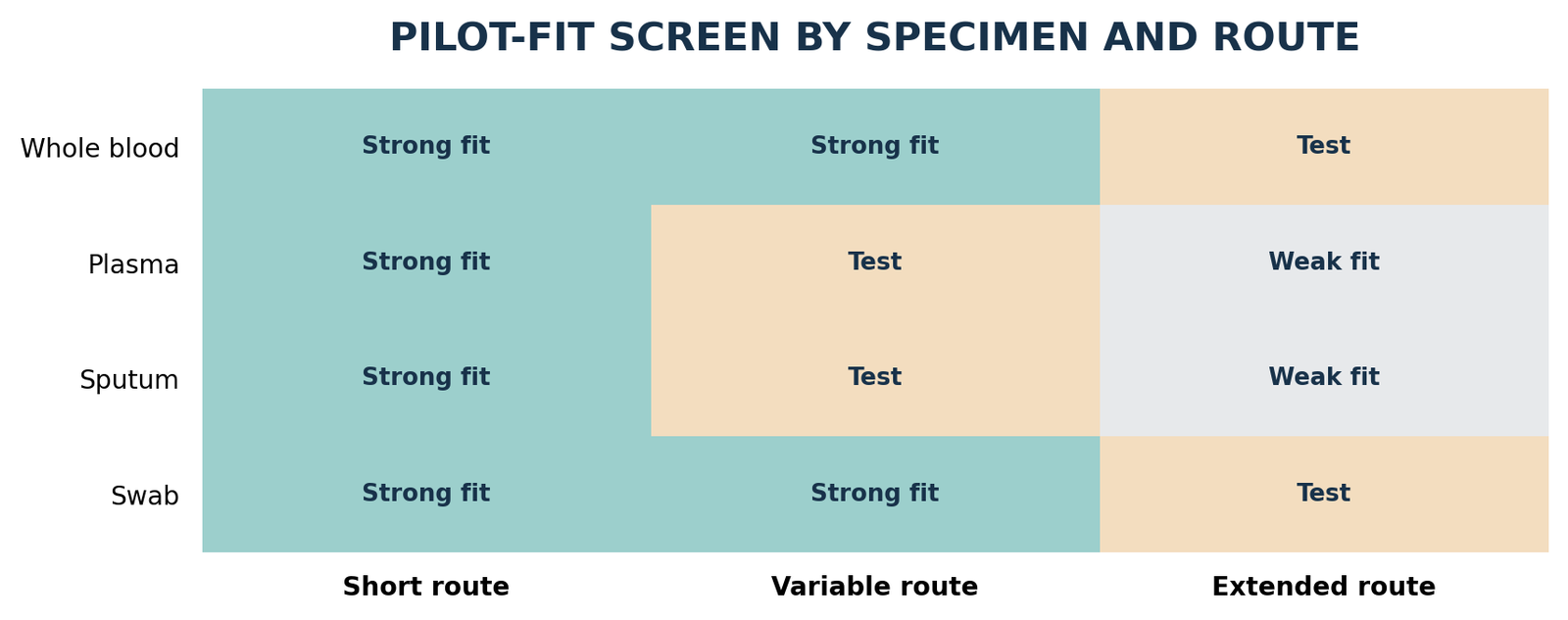
Specimens | Whole blood, plasma, sputum and swabs screened before selecting the pilot pairing |
Route types | Direct same-day, variable hub-transfer and extended or disrupted access routes |
Buyer system | Public programmes, private laboratory networks, implementing partners and distributors |
Time horizon | Near-term pilot feasibility and a three-year route expansion pathway |
BOUNDARY The opportunity is not the total diagnostic-testing market. It is the recurring set of collections for which preservation changes reportable-test access.
METHODOLOGY
Referral-Route Loss Model
The method reconstructs time, temperature, batching and handoff exposure for each route. It then tests whether a preservation format removes a material failure point without creating a new laboratory or biosafety barrier.
EVIDENCE LAYER | ANALYTICAL USE | DECISION TEST |
|---|---|---|
Network architecture | Collection points, hubs, laboratories and transport schedules | Where exposure occurs |
Assay and specimen requirements | Stability, packaging, volume and acceptance conditions | Whether preservation is technically compatible |
Workflow evidence | Collection steps, training burden and accession practice | Whether adoption is operationally realistic |
Cost and loss proxies | Repeat collection, discarded sample, cold-chain and route costs | Whether the avoided burden supports value |
Supplier and channel landscape | Existing formats, distributors and programme routes | Whether access and differentiation are defensible |
OPPORTUNITY FINDINGS
A transport product must solve a reportability problem
Strongest need: Variable routes where batching and hub transfer create uncertainty that cannot be solved reliably by faster couriering alone.
Weakest thesis: A broad ambient-stable kit for every specimen. The laboratory requirements and failure modes differ too widely.
Commercial buyer: The organization accountable for referral performance, not necessarily the individual collection site.
Conditions for a viable pilot
CONDITION | EVIDENCE REQUIRED BEFORE LAUNCH |
|---|---|
Assay compatibility | Matched preservation and assay validation for the selected pairing |
Workflow fit | Collection and accession steps that can be trained and audited |
Route value | Documented reduction in cold-chain burden, sample loss or repeat collection |
Procurement route | A programme, laboratory network or distributor able to standardize use |
Scale pathway | Adjacent routes and assays that can be added without changing the core system |
COMMERCIAL IMPLICATION Lead with a route-specific access claim supported by validation, not with ambient stability as a standalone feature.
RECOMMENDED RESPONSE
Build the pilot around one accountable network
- Select one country network, one specimen and one assay where transport exposure is clearly documented.
- Define the complete workflow from collection through laboratory accession before finalizing the kit configuration.
- Use route-level cost and loss proxies to set the commercial value case.
- Expand only after reportability, training burden and procurement ownership are demonstrated.
What August Research would deliver
OUTPUT | CLIENT USE |
|---|---|
Referral-route opportunity map | Locate the handoffs and route types where preservation can change access. |
Specimen-assay fit screen | Reject incompatible pairings before commercial investment. |
Serviceable network model | Estimate recurring demand from eligible collection flows. |
Adoption and procurement map | Identify the organization that can standardize and fund use. |
Pilot specification | Define route, assay, workflow, evidence and expansion gates. |
CONTACT US August Research can assess where diagnostic access is constrained by the referral route and identify the smallest credible pilot capable of proving commercial value.