MARKET OPPORTUNITY ASSESSMENT | FOOD AND NUTRITION
Protein-Rich Savoury Snacks
for Older Adults in Japan
Assessing whether demographic need can become an everyday food occasion rather than a specialist nutrition proposition.
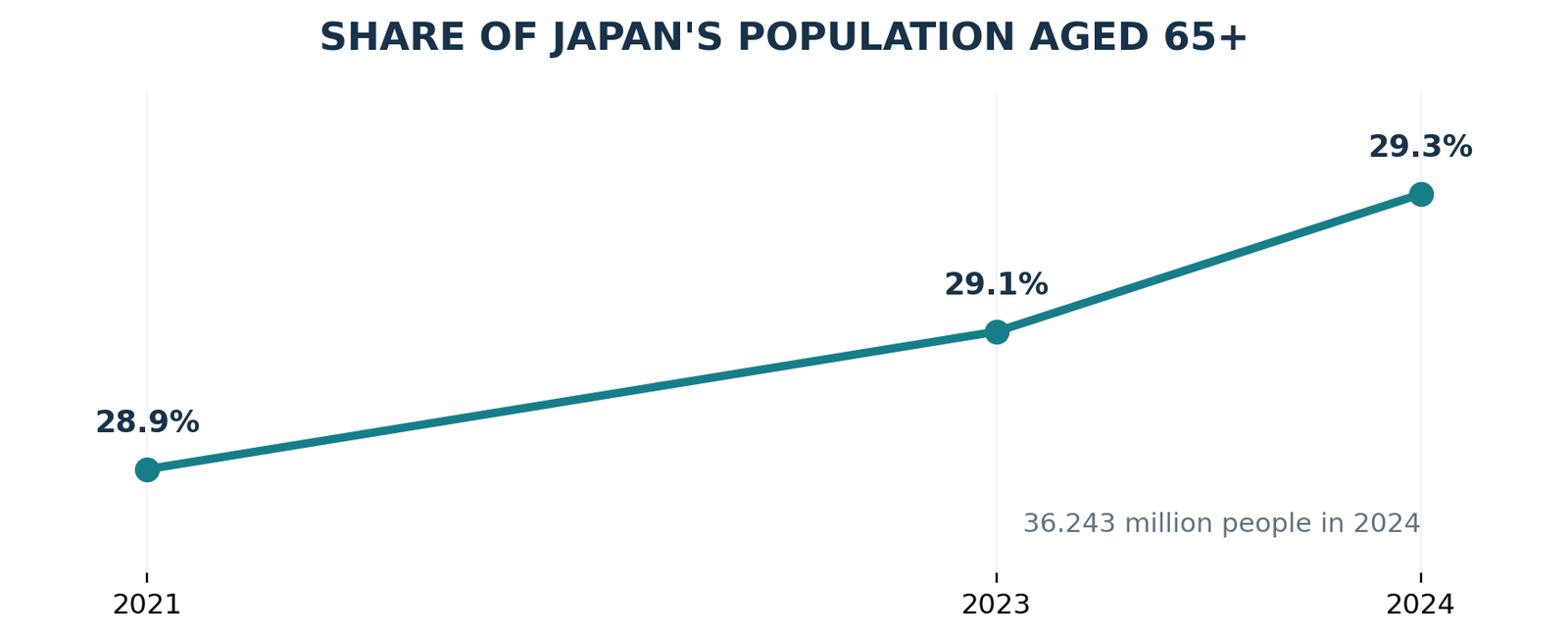
29.3% of Japan's population was aged 65 or older in 2024, representing 36.243 million people.
The business situation
A food company was considering a compact savoury snack with meaningful protein for older consumers. Demographic scale alone did not prove an opportunity. The product needed to fit familiar flavours, portion expectations, texture, sodium awareness, shopping channels and an occasion in which consumers would choose it without viewing it as medical nutrition.
DECISION QUESTION Can a protein-rich savoury snack create a repeatable everyday occasion among older adults, and which product and channel design would make it credible?
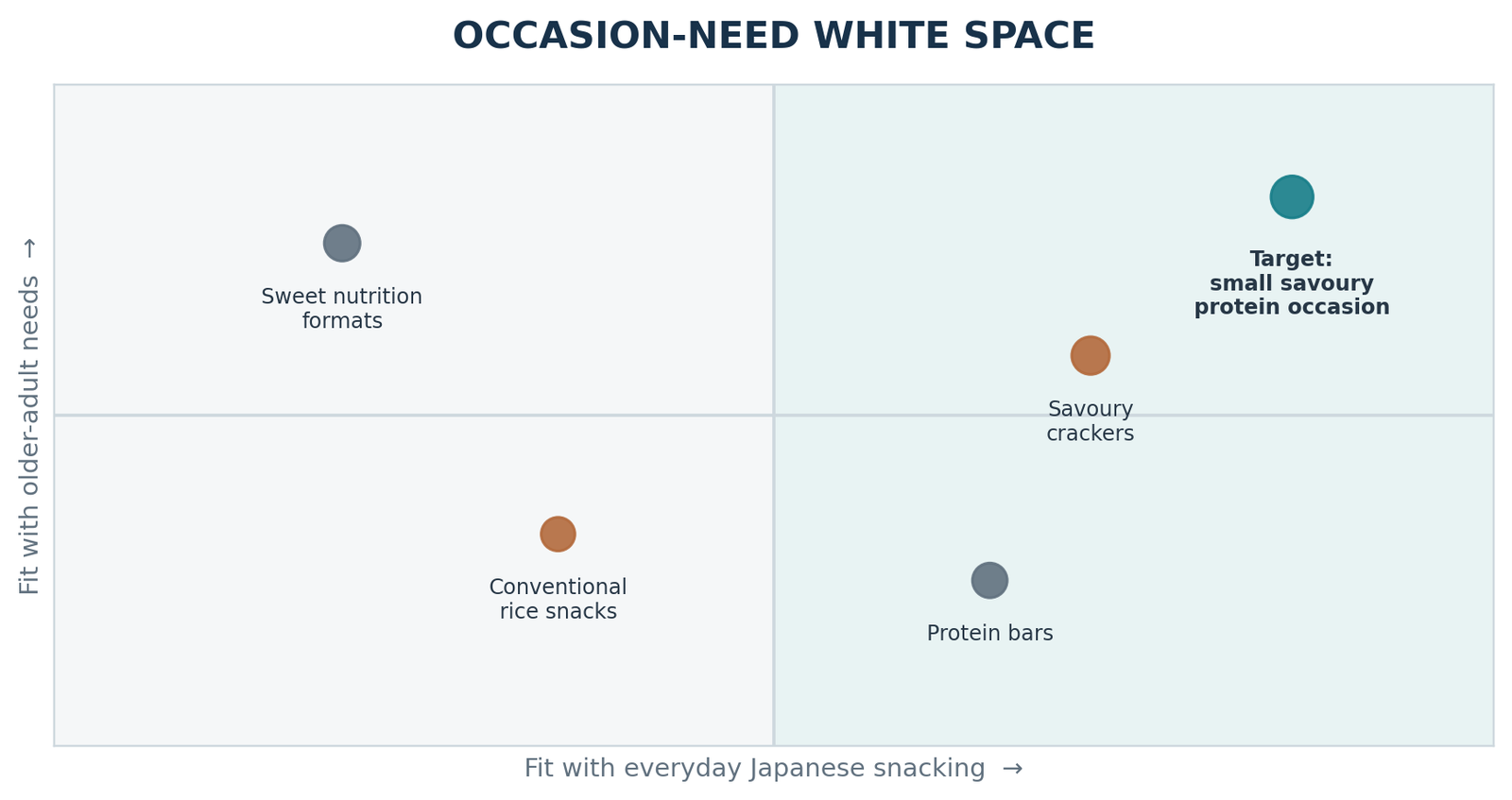
ASSESSMENT OUTCOME SHAPE. Build around a small savoury accompaniment occasion, not a Western-style protein bar repositioned for seniors.
DEMOGRAPHIC AND CATEGORY CONTEXT
A large population is not the same as an addressable occasion
Opportunity boundaries
DIMENSION | BOUNDARY USED IN THE ASSESSMENT |
|---|---|
Consumer | Independent adults aged 65+, with needs segmented by activity, appetite and household situation |
Occasion | Mid-morning, afternoon or small evening accompaniment, separate from meal replacement |
Format | Shelf-stable, portion-controlled savoury products suitable for everyday retail |
Channels | Supermarkets, convenience, drugstores, e-commerce and selected senior-living retail routes |
Geography | National category scan with Tokyo, Osaka and regional ageing markets used as contrasting demand settings |
COMMERCIAL BOUNDARY The target is not every older consumer. It is the subset whose preferred occasion, texture and shopping route align with the proposition.
METHODOLOGY
Occasion-Need White Space Model
The method starts with real eating occasions and then overlays older-adult needs, category supply and the client's formulation capabilities. A gap qualifies only when it is both behaviourally natural and commercially reachable.
Four evidence lenses
LENS | WHAT IS EXAMINED | QUESTION ANSWERED |
|---|---|---|
Occasion | When, why and with what the product would be eaten | Is there a natural repeat occasion? |
Need | Protein relevance, portion, texture, satiety and dietary guardrails | Does the format solve a meaningful need? |
Supply | Snack formats, claims, flavours, price points and channels | Is the space genuinely under-served? |
Client fit | Formulation, manufacturing, sourcing and brand permissions | Can the client win credibly? |
DECISION RULE A demographic need becomes an opportunity only when it connects with a repeatable occasion and an offer the company can deliver without over-medicalizing the experience.
OPPORTUNITY FINDINGS
The strongest opening is a familiar savoury accompaniment
OPPORTUNITY ELEMENT | ASSESSMENT |
|---|---|
Need | Protein relevance is credible, but should sit behind taste and everyday convenience. |
Occasion | A small accompaniment or light snack is more natural than a large nutrition bar. |
Product | Easy bite, controlled portion, familiar savoury profile and clean handling are central. |
Channel | Mainstream grocery and drugstore routes support normalization; specialist channels can support trial. |
Positioning | Healthy ageing and everyday nourishment are stronger than performance nutrition language. |
What would weaken the opportunity
- A hard or dry format that prioritizes protein density over eating comfort.
- A high-sodium taste solution that conflicts with the wider health proposition.
- A brand and package that signals frailty or medical dependence.
- A premium price unsupported by a clear everyday benefit.
COMMERCIAL IMPLICATION Test the product as food first. Nutrition should strengthen the reason to choose it, not replace taste, familiarity and occasion fit.
RECOMMENDED RESPONSE
Develop a narrow proposition before sizing the category
- Create two or three savoury product territories tied to named occasions.
- Benchmark texture, portion and flavour expectations alongside protein and sodium guardrails.
- Model serviceable demand by occasion frequency and reachable channels, not by the total 65+ population.
- Use a staged launch to test repeat purchase before extending into broader healthy-ageing formats.
What August Research would deliver
OUTPUT | CLIENT USE |
|---|---|
Occasion map | Prioritize the moments in which the snack can become routine. |
Senior need-state architecture | Separate demographic labels from actual product requirements. |
Category whitespace map | See where existing formats already satisfy the need. |
Proposition and channel territories | Choose concepts that fit both consumer behaviour and commercial reach. |
Serviceable-demand model | Estimate opportunity from target occasions, adoption and repeat frequency. |
CONTACT US August Research can translate demographic change into a specific product, occasion and channel opportunity that a food business can evaluate and act on.