MARKET OPPORTUNITY ASSESSMENT | INDUSTRIAL AUTOMATION
Machine-Vision Retrofit Packages
for Central European Food Processors
Identifying inspection tasks that justify modular automation when full-line replacement is commercially unrealistic.
DECISION QUESTION Could a modular machine-vision package serve mid-sized processors in Poland, Czechia and Slovakia, and which applications offer the clearest route to payback?
The business situation
A machine-vision supplier saw growing demand for quality assurance but faced a fragmented installed base. Mid-sized processors often operate mixed-age lines, short production runs and packaging formats that change frequently. The opportunity was not simply to sell a camera. It was to identify repeatable inspection problems that could be integrated with limited downtime, controlled engineering effort and a payback case buyers could defend.
The commercial choice
- Select application modules rather than launch a broad retrofit platform.
- Define the line conditions that make a plant eligible or unsuitable.
- Choose direct, integrator or equipment-partner routes by application complexity.
- Separate policy enthusiasm for digitalization from purchase-ready demand.
ASSESSMENT OUTCOME PURSUE SELECTIVELY. Prioritize label, date-code and seal checks on stable packaging stations; defer complex process-control applications.
OPPORTUNITY STRUCTURE
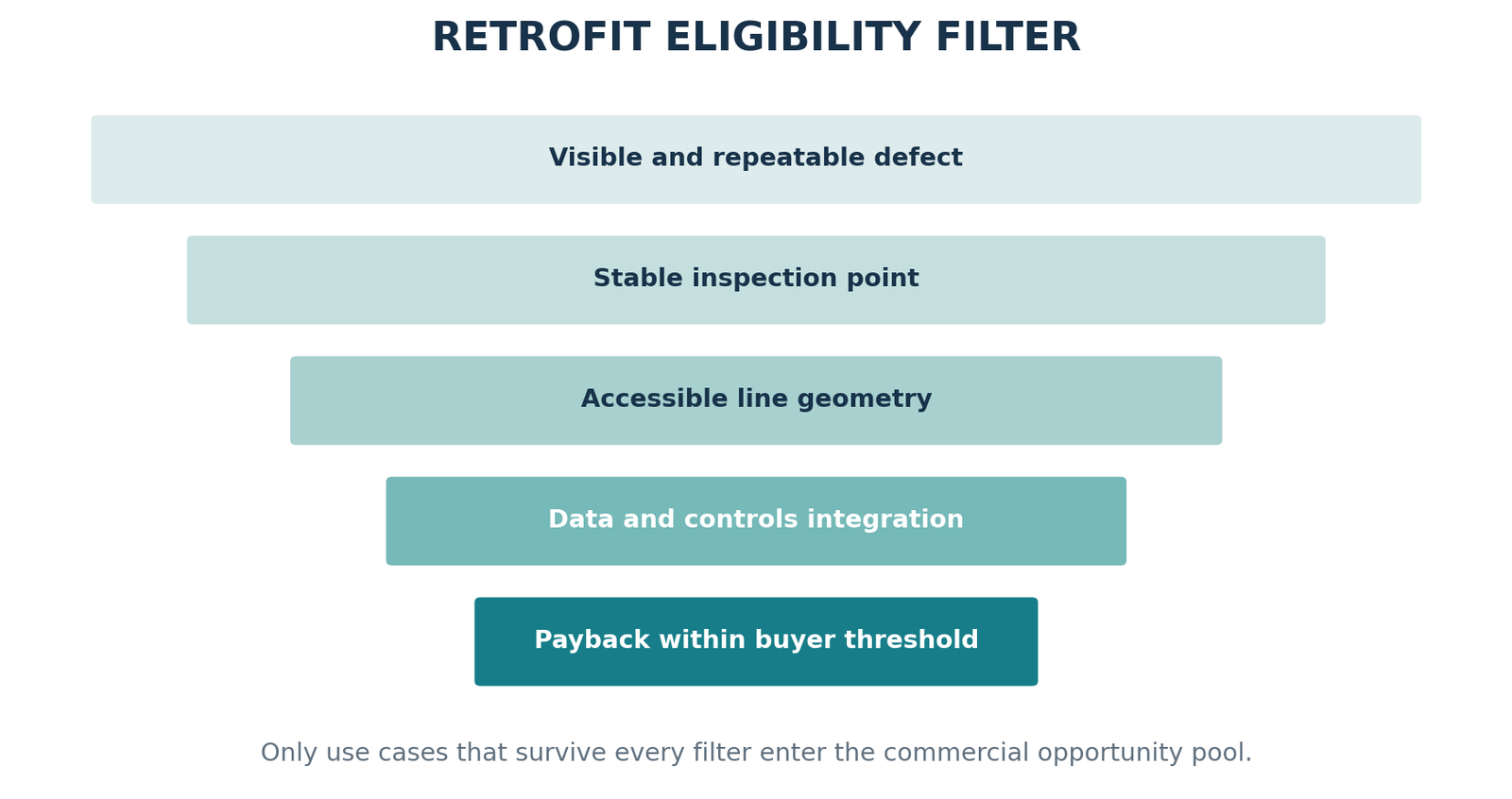
The plant becomes addressable only after five filters
Scope architecture
PARAMETER | ASSESSMENT BOUNDARY |
|---|---|
Geography | Poland, Czechia and Slovakia, assessed by processor concentration and integration ecosystem |
Plant segment | Mid-sized processors with existing automated packaging or handling stations |
Applications | Label, code, seal, count, orientation and selected surface-defect inspection |
Installed-base constraint | Retrofit without complete line replacement or prolonged production shutdown |
Decision horizon | Commercial launch focus for the next 24 months |
DIGITAL CONTEXT EU policy targets broad SME digital progress by 2030, but this study qualifies opportunity from plant-level conditions and economics rather than policy targets.
METHODOLOGY
Retrofit Eligibility Stack
Each use case is tested through a stack of technical, operational and commercial conditions. A high-value defect is not enough if the image cannot be captured consistently, the line cannot be accessed or integration costs destroy the payback.
ELIGIBILITY LAYER | EVIDENCE ASSEMBLED | REJECT CONDITION |
|---|---|---|
Defect economics | Scrap, rework, complaint, recall and giveaway exposure | Failure has little economic consequence |
Imageability | Visibility, contrast, speed, orientation and variability | Defect cannot be captured consistently |
Mechanical access | Mounting, lighting, enclosure and cleaning constraints | Retrofit requires major line redesign |
Integration | PLC, reject mechanism, data and operator workflow | Controls or workflow cannot accept the module |
Commercial payback | Installed cost, downtime, support and avoided burden | Payback exceeds buyer threshold |
OPPORTUNITY FINDINGS
Inspection modules outperform a general automation promise
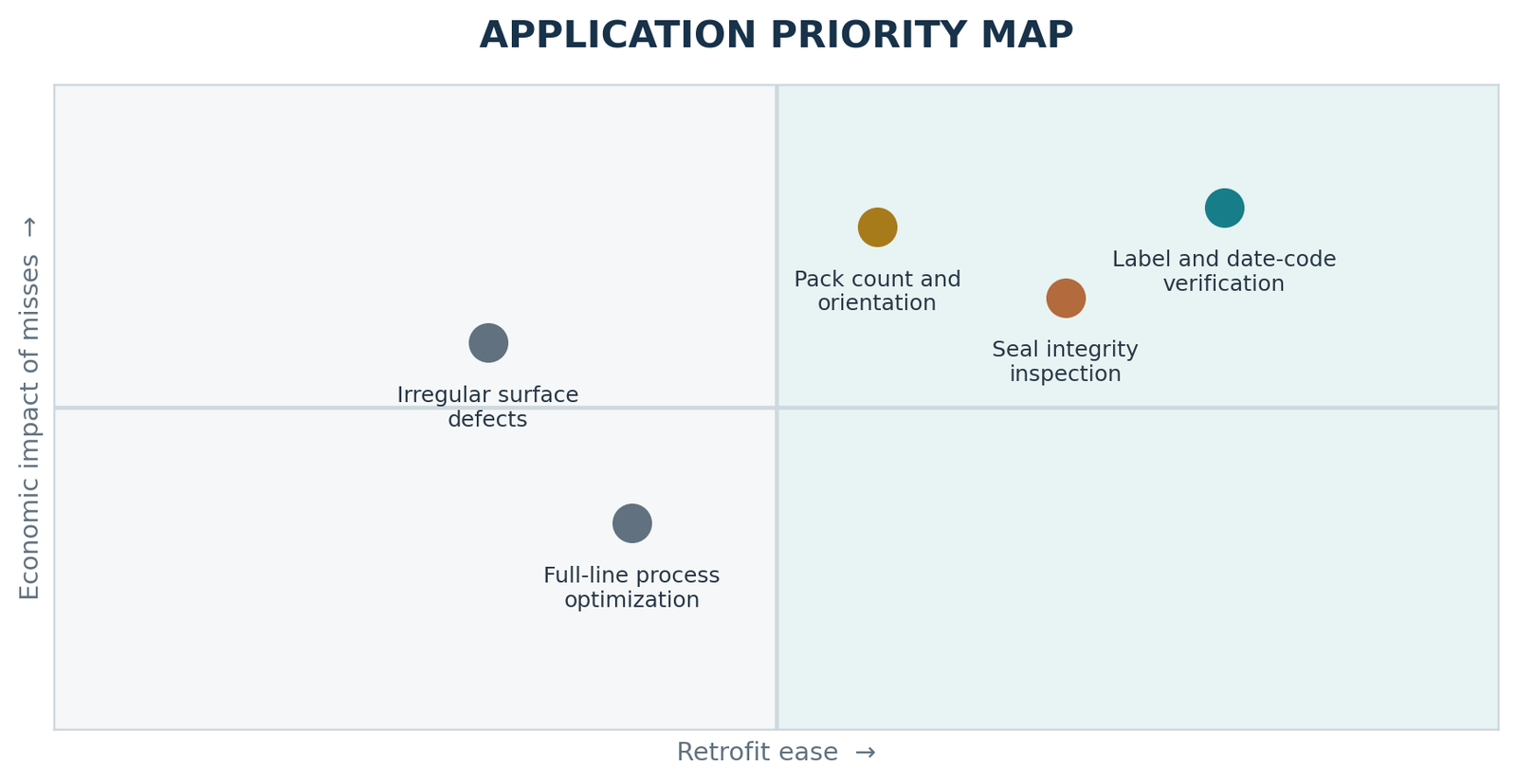
Best entry applications: Label presence, date-code verification, pack count and selected seal checks at stable packaging stations.
Best-fit plants: Sites with repeatable product presentation, accessible reject points and an existing controls owner or integration partner.
Lower-fit applications: Irregular food surfaces, highly variable presentation and closed legacy lines requiring major mechanical changes.
Route-to-market implications
APPLICATION TYPE | PREFERRED ROUTE | REASON |
|---|---|---|
Standard packaging checks | Packaged module through local integrators | Repeatable hardware and configuration |
Multi-line site deployment | Direct sale with certified integration partner | Requires common data and support design |
OEM-adjacent upgrade | Partnership with packaging-equipment supplier | Access to installed base and mechanical fit |
Complex surface inspection | Project-led evaluation | Higher variability and engineering burden |
COMMERCIAL IMPLICATION Launch by application and line condition. A generic 'AI vision for food' proposition would hide the eligibility rules that determine success.
RECOMMENDED RESPONSE
Build a repeatable module and an explicit no-fit screen
- Productize two initial inspection modules with defined line-speed, presentation and integration ranges.
- Create a rapid eligibility screen that rejects unsuitable plants before engineering effort is committed.
- Recruit integrators by installed-base access and food-environment capability, not geography alone.
- Use a reference architecture for reject handling, operator alerts and evidence capture.
What August Research would deliver
OUTPUT | CLIENT USE |
|---|---|
Plant archetype map | Identify the installed-base situations most likely to accept retrofit. |
Application priority matrix | Select modules by impact, repeatability and retrofit ease. |
Eligibility and no-fit rules | Protect sales and engineering resources from weak opportunities. |
Partner landscape | Choose integrators and OEM routes by application need. |
Serviceable-demand model | Forecast addressable modules from eligible lines and replacement cycles. |
CONTACT US August Research can identify where an automation capability fits the installed base, which applications deserve productization and what conditions should disqualify a prospect.