MARKET OPPORTUNITY ASSESSMENT | SPECIALTY CHEMICALS
Occupied-Hospital Floor Repair
in Saudi Arabia and the UAE
How an industrial flooring producer could determine whether a product idea represents a defensible opportunity or needs to be reshaped around hospital operations.
DECISION QUESTION Is there a commercially attractive unmet need for low-odour, rapid-return floor repairs in occupied hospitals, and what must the offer include to be meaningfully different?
The business situation
A specialty chemicals producer was considering a rapid-curing floor repair system for hospitals that could not tolerate lengthy ward, corridor or clinical-area closures. The initial concept focused on chemistry: faster cure, lower odour and a hard-wearing finish. The commercial question was harder. Similar product claims were already available, while hospital repairs are governed by infection control, access, cleaning, substrate condition and the certainty of reopening the area on time.
What had to be decided
- Whether the unmet need was sufficiently distinct from existing flooring products.
- Which hospital zones and repair situations created the strongest urgency.
- Whether value sat in the formulation, the installation protocol or a bundled service model.
- Which conditions would justify a focused launch, a redesigned offer or no further investment.
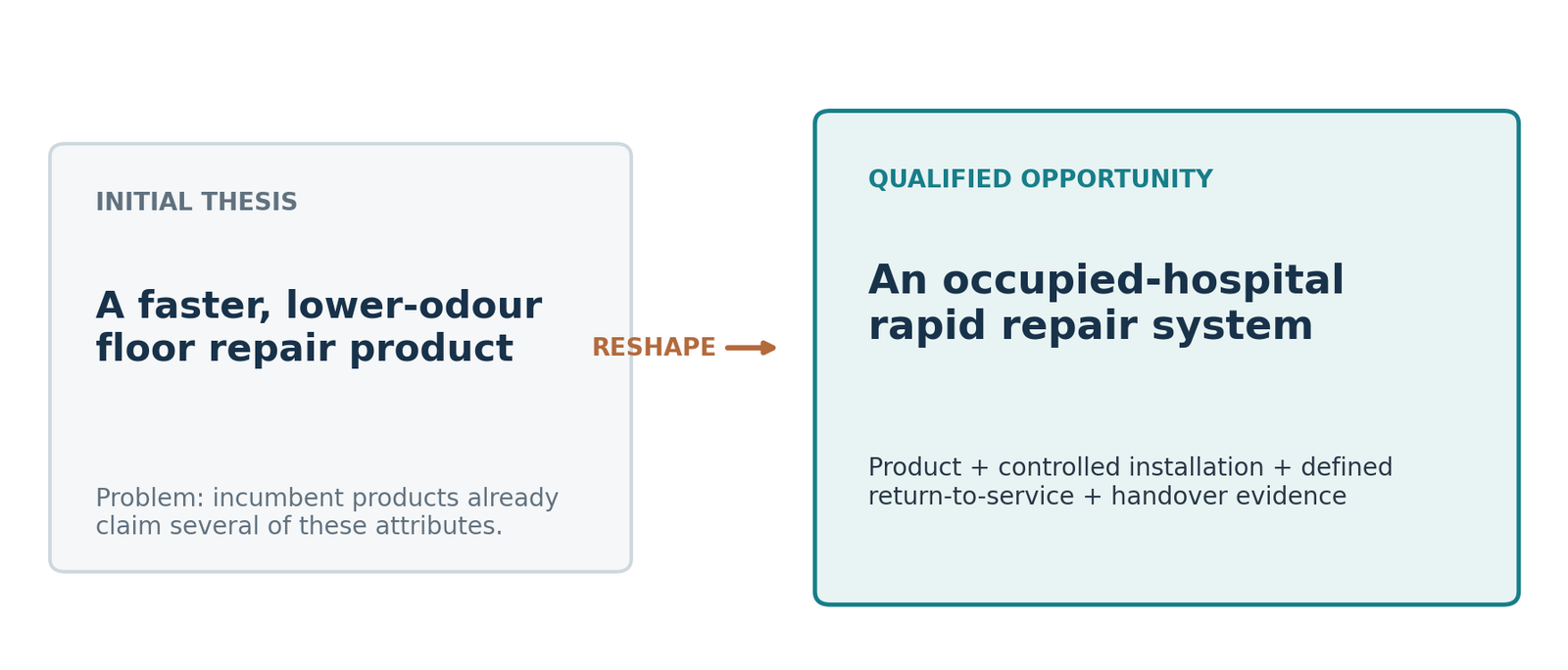
ASSESSMENT OUTCOME SHAPE. The opportunity was stronger as an occupied-hospital repair system than as a standalone low-odour resin.
OPPORTUNITY CONTEXT
A geographic scope defined by operating relevance
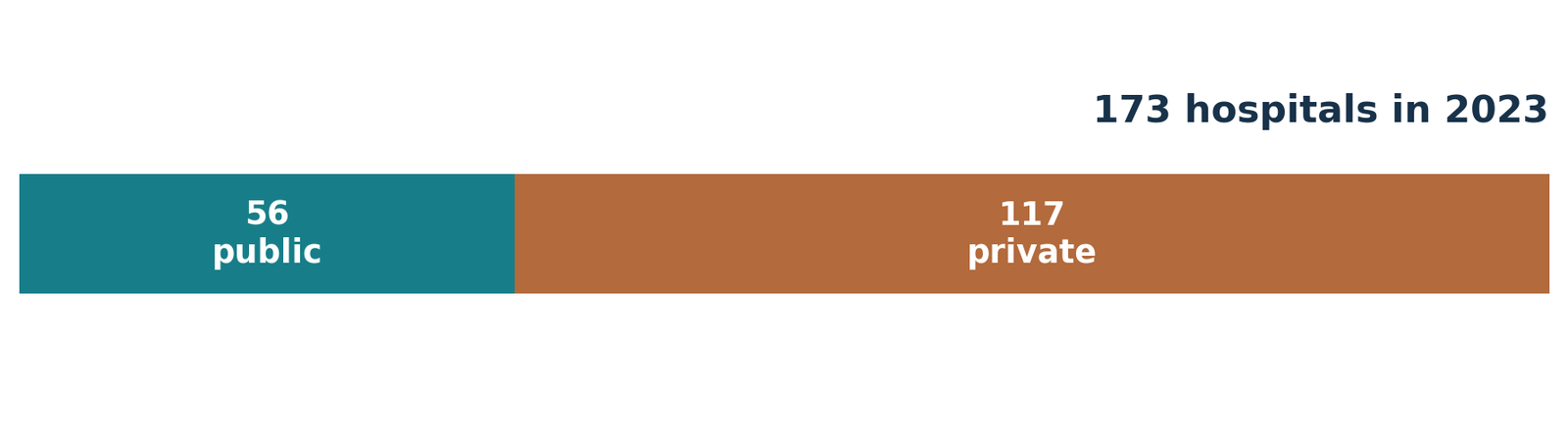
Saudi Arabia and the UAE were selected because hospital modernization, private-sector participation and year-round operating demands create a relevant setting for repairs inside active facilities. The geography was not treated as one uniform Gulf market. Procurement structures, hospital ownership, approved-contractor practices and project access were assessed separately.
Demand signals examined
SIGNAL | WHY IT MATTERS TO THE OPPORTUNITY |
|---|---|
Occupied-site repair | Clinical areas may need to remain operational while local repairs are completed. |
Infection-control requirements | Dust, debris and work-zone controls affect preparation methods and contractor access. |
Return-to-service certainty | A nominal cure time is less useful than a dependable reopening window for the actual zone. |
Cleaning and safety | The repaired surface must fit cleaning, slip-resistance and maintenance requirements. |
Climate and substrate | Storage, application conditions and substrate moisture can affect site reliability. |
SIZING PRINCIPLE Demand would be modelled from eligible facilities, repair occasions, serviceable area and system value per square metre. A broad flooring-market CAGR would not answer this niche decision.
METHODOLOGY
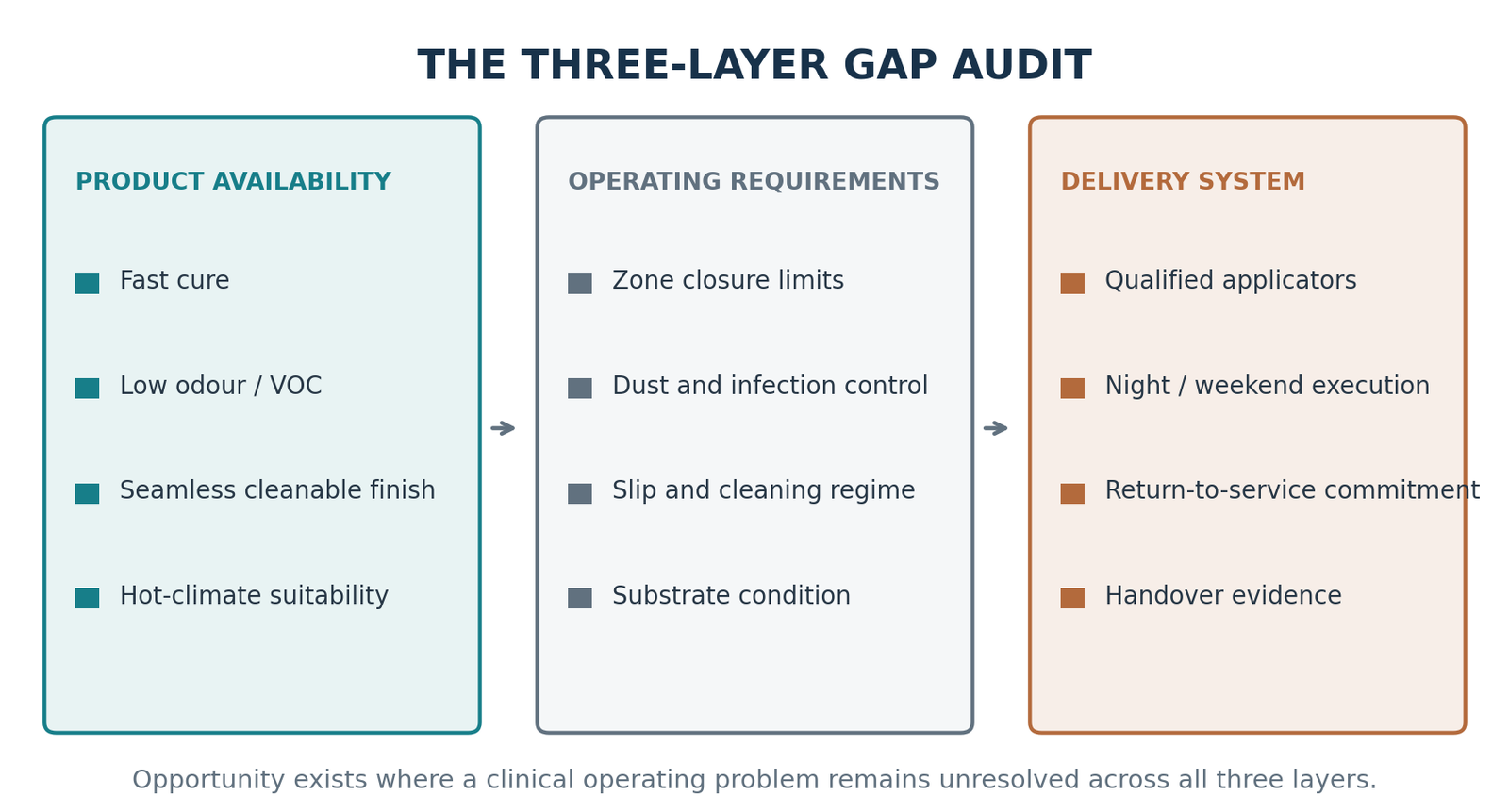
Three-Layer Gap Audit
The study tests whether a real opportunity remains after existing product claims are separated from the operating problem and the delivery model required to solve it. The layers are assessed independently before a proposition is designed.
How existing information is used
EVIDENCE ROUTE | WHAT IS EXTRACTED | DECISION ROLE |
|---|---|---|
Hospital and health-system records | Facility base, ownership, renovation and modernization signals | Defines where repair demand could exist |
Product and technical literature | Cure, odour, VOC, substrate, temperature, cleaning and safety claims | Tests whether the product gap is already served |
Procurement and project evidence | Specifications, tender language, approved systems and contractor requirements | Reveals the route to qualification |
Clinical renovation guidance | Work-zone containment, dust control and reopening constraints | Translates product attributes into operating requirements |
Installer and channel evidence | Coverage, service windows, warranty and handover practices | Tests whether the offer can be delivered consistently |
QUALIFICATION RULE The opportunity advances only when a material operating problem remains unresolved, a reachable buyer can act on it and the client can build an advantage that is difficult to copy.
OPPORTUNITY FINDINGS
The gap moved from chemistry to delivery certainty
The desk assessment indicated that fast curing, low odour, low VOC and tropical suitability were not sufficient sources of differentiation on their own. The less consistently addressed need was the complete operating package required to repair a defined hospital zone and return it to use predictably.
REQUIREMENT | VISIBLE COVERAGE | OPPORTUNITY INTERPRETATION |
|---|---|---|
Fast cure and low odour | Strong | Common product-level claims reduce distinctiveness |
Cleanable, seamless surface | Strong | Expected category performance rather than a unique benefit |
Infection-control compatible preparation | Uneven | Depends on the method, equipment and site controls |
Defined zone reopening window | Uneven | Requires installation and operating conditions, not chemistry alone |
Approved applicator response | Variable | Coverage and off-hours availability shape serviceability |
Handover and maintenance evidence | Limited | Creates confidence for facilities and clinical operations |
Where demand should be tested first
Priority repair situations: Localized failures in corridors, service areas and selected clinical support zones where shutdown time is costly but full-floor replacement is unnecessary.
Priority buyers: Facilities management, engineering, infection prevention, procurement and the approved contractor network. Each controls a different acceptance condition.
Lower-priority situations: New-build projects and large planned refurbishments where rapid reopening is less decisive and established systems can be specified early.
WHAT CHANGED The addressable opportunity became smaller than a general hospital-flooring market, but more specific, defensible and actionable.
COMMERCIAL RESPONSE
Reshape the offer around an operating promise
The proposition to develop
- A defined repair-zone protocol covering preparation, containment, application and reopening.
- Performance windows tied to realistic substrate and environmental conditions.
- A trained applicator network capable of planned night and weekend response.
- A concise handover pack covering completed work, cure conditions, cleaning and maintenance.
- A pilot pathway for selected hospital zones before broader clinical-area claims are made.
What August Research would deliver
OUTPUT | HOW THE CLIENT WOULD USE IT |
|---|---|
Opportunity qualification card | See the customer problem, evidence strength, reachable demand and competitive whitespace in one view. |
Hospital repair occasion map | Prioritize zones and repair situations where closure time changes purchasing value. |
Existing-solution coverage matrix | Avoid investing in attributes already well served by competitors. |
Serviceable-demand model | Estimate demand from repair occasions and eligible facilities rather than a broad category total. |
Offer and pilot specification | Define the product, protocol, partner capability and evidence needed for a controlled market test. |
CONTACT US If a product idea appears promising but the real unmet need is unclear, August Research can test the market problem, incumbent coverage and client advantage before larger commercial commitments are made.