MARKET OPPORTUNITY ASSESSMENT | COMMERCIAL MOBILITY
Independent Battery-Health Certification
for Used Electric Commercial Vans
Testing whether a trusted condition certificate could improve remarketing decisions in the UK, Netherlands and Belgium.
DECISION QUESTION Is there a defensible role for an independent certificate before vehicle battery data becomes more standardized, and should the model differ between the UK and Benelux?
ASSESSMENT OUTCOME SHAPE BY GEOGRAPHY. Pilot a transaction-focused certificate now, while designing Benelux data compatibility for the EU battery-passport environment.
TRUST-GAP CONTEXT
Battery state affects value, but evidence is fragmented
Used electric vans carry a condition question that mileage and age do not answer completely. Fleets, leasing companies, dealers, finance providers and buyers may see different diagnostic outputs, warranty records and usage histories. The opportunity lies in translating available evidence into a consistent transaction decision without overstating precision.
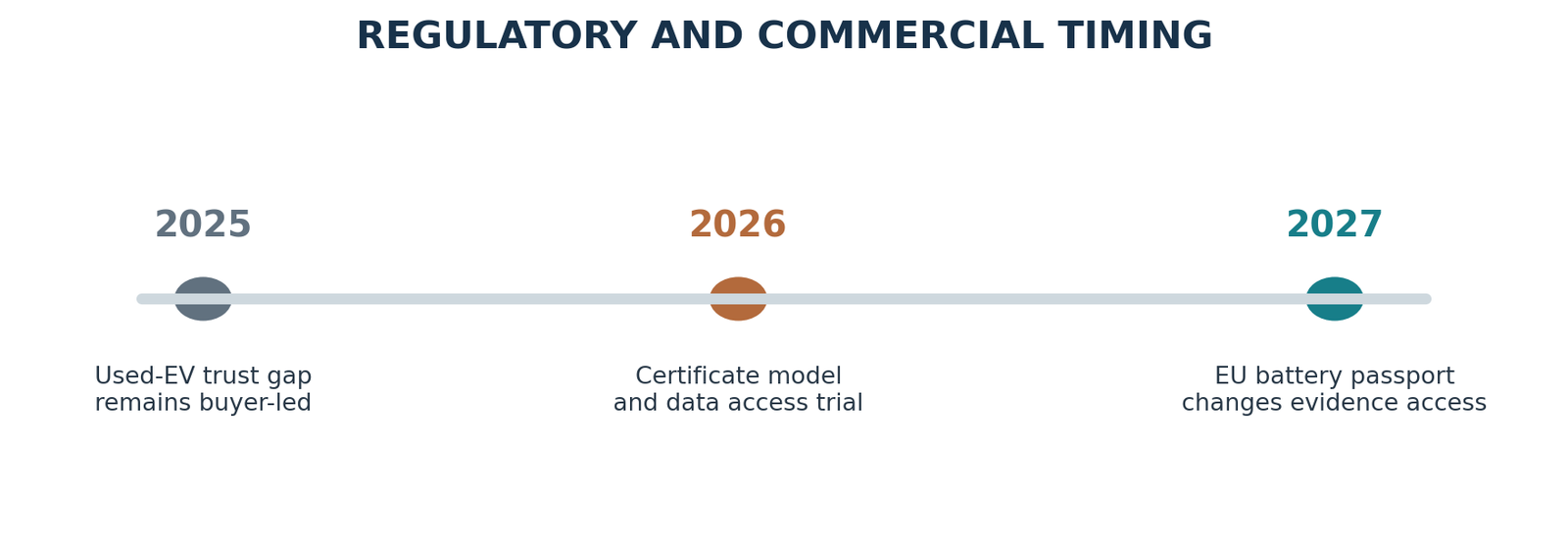
Geographic parameters
MARKET | TIMING FACTOR | OPPORTUNITY IMPLICATION |
|---|---|---|
United Kingdom | State-of-health access is improving, but EU battery-passport rules do not apply directly | Focus on inspection consistency and remarketing use |
Netherlands | Mature electric mobility ecosystem and future EU passport context | Design for data interoperability and fleet channels |
Belgium | Cross-border remarketing and EU passport context | Test certificate portability and auction integration |
BOUNDARY The certificate is not a battery warranty and does not predict every future failure. Its value is a consistent, auditable view of current evidence and uncertainty.
METHODOLOGY
Transaction Trust Model
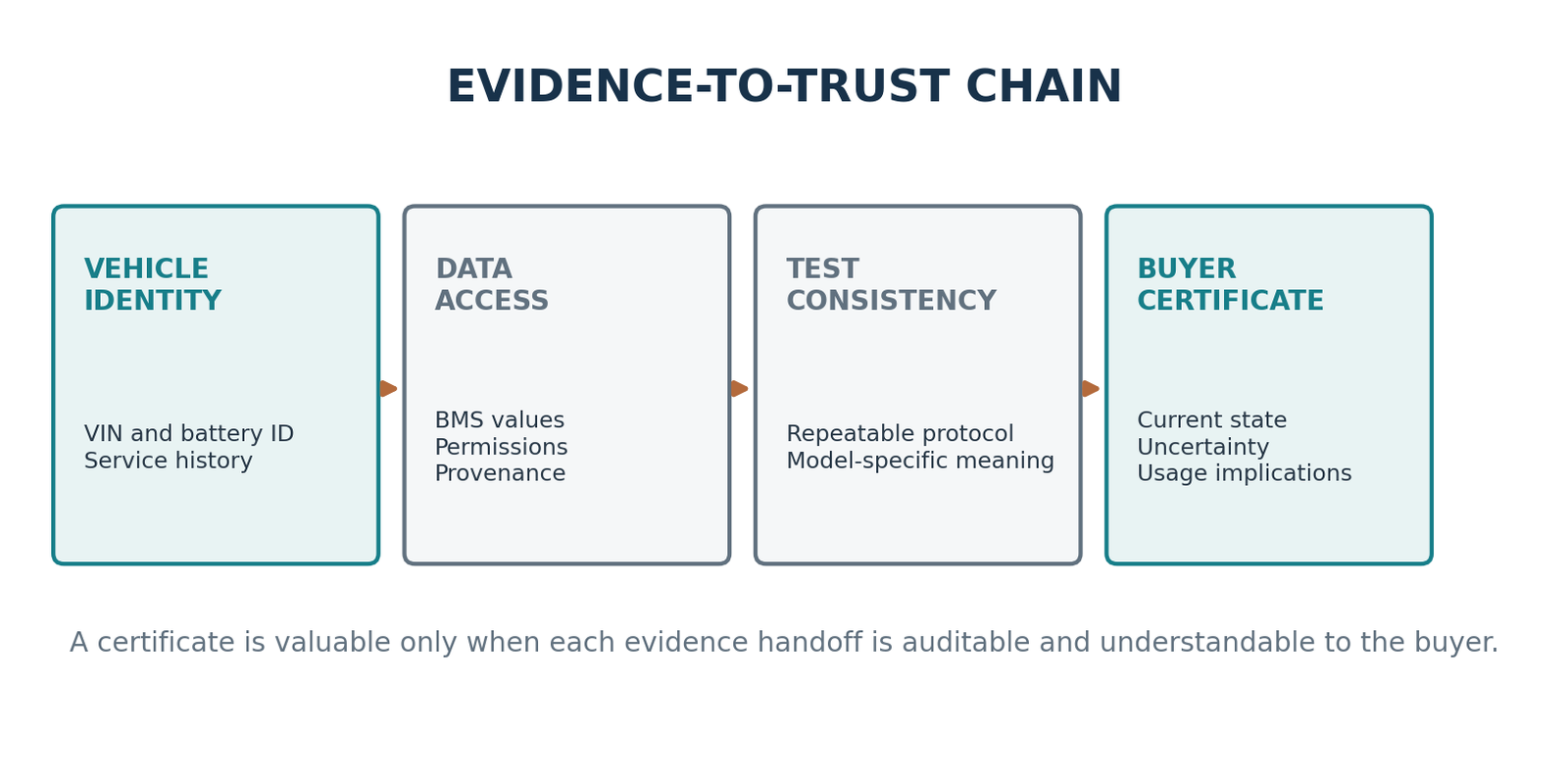
The method works backwards from the transaction decision. It identifies what each buyer needs to trust, tests whether the required data can be obtained consistently and defines the minimum certificate capable of changing a sale, valuation or finance decision.
TRUST QUESTION | EVIDENCE ASSESSED | COMMERCIAL TEST |
|---|---|---|
Is this the correct battery? | Vehicle identity, pack identity, service and replacement history | Can evidence be bound to the asset? |
Is the data accessible? | BMS values, diagnostic permissions and manufacturer variation | Can the service cover enough models? |
Is the result comparable? | Protocol, temperature, charge state and model-specific interpretation | Can repeat tests remain consistent? |
Is uncertainty visible? | Missing history, calibration limits and confidence bands | Will buyers understand what is not known? |
Does it change the transaction? | Valuation, warranty, finance, auction and procurement use | Will a channel pay or require it? |
Opportunity model
SERVICEABLE TRANSACTIONS Eligible used electric vans × participating channels × certificate attachment rate × fee per certificate
The model uses transaction flow and model coverage rather than the total vehicle parc. It can be refreshed as battery-data access, vehicle age and regulation change.
OPPORTUNITY FINDINGS
The service must be channel-embedded to become valuable
OPPORTUNITY CONDITION | INTERPRETATION |
|---|---|
Model coverage | A certificate cannot scale if diagnostic access works only for a small number of vehicle variants. |
Channel trigger | Auction, lease return, fleet disposal or finance approval must create a repeatable testing moment. |
Certificate clarity | State of health, evidence source, uncertainty and usage implications must be understandable to a non-technical buyer. |
Independence | The assessor must be separate from the seller and use an auditable protocol. |
Regulatory adaptability | The data model should accept future passport and standardized state-of-health information without becoming redundant. |
Recommended initial positioning
- For the UK, support lease return, auction and fleet disposal decisions with a repeatable inspection certificate.
- For Benelux, build certificate fields that can reconcile with future EU battery-passport data.
- Present confidence and data limitations explicitly rather than converting every result into one headline score.
COMMERCIAL IMPLICATION The opportunity is not a one-off consumer test. It is a verification layer embedded in recurring commercial-vehicle transactions.
RECOMMENDED RESPONSE
Pilot where the certificate changes a real transaction
- Choose one remarketing channel and a limited set of high-volume electric-van models.
- Define the protocol, evidence hierarchy and uncertainty language with the channel before field deployment.
- Track whether the certificate changes valuation confidence, sale time, warranty decisions or buyer acceptance.
- Expand geography only when data access and certificate interpretation remain consistent.
What August Research would deliver
OUTPUT | CLIENT USE |
|---|---|
Transaction and stakeholder map | Identify where a certificate can become required or paid for. |
Vehicle-model coverage screen | Understand how data access limits the serviceable market. |
Certificate evidence architecture | Define data fields, confidence and buyer-facing interpretation. |
Geographic timing matrix | Separate UK and Benelux launch logic. |
Serviceable-transaction forecast | Model revenue from eligible transactions and attachment rate. |
CONTACT US August Research can evaluate whether a trust gap can support a recurring verification service and design the evidence, channel and geographic model required to commercialize it.