PHASE 2 ILLUSTRATION / BIOPHARMACEUTICALS
Selecting a Biologics CDMO
for Clinical Supply and Scale-Up
How a clinical-stage biotechnology company could compare three manufacturing partners when the fastest available site is not the strongest long-term choice.
DECISION
CLINICAL NEED
CANDIDATES
ASSESSMENT HORIZON
Select a CDMO
First GMP batch in 9 months
3 shortlisted sites
Clinical to commercial
DECISION QUESTION Which CDMO should be appointed for Phase II drug-substance manufacturing, and what must be controlled now to preserve a credible commercial scale-up path?
The hypothetical client is a European clinical-stage biotechnology company developing a monoclonal antibody for a rare autoimmune indication. Its immediate requirement is technology transfer and a first GMP drug-substance batch within nine months. The longer-term relationship must also support process validation, increased batch demand and supply to Europe and the United States.
Three anonymous CDMOs have reached the shortlist. Candidate A has the strongest global network and commercial track record but cannot offer a credible manufacturing start for fourteen months. Candidate B offers an earlier slot, strong biologics quality systems and a workable governance model, but its commercial scale path is less developed. Candidate C can start fastest, although the evidence supporting quality maturity, subcontractor control and future capacity is weaker.
Why the apparent front-runner may not be the right appointment
The initial procurement comparison favoured Candidate A because it had the largest network, the highest stated capacity and the greatest number of commercial products supported. That ranking changed when the client requirement was reconstructed as a critical path rather than a capability checklist.
Timing conflict Candidate A's earliest credible start would miss the clinical programme's required manufacturing window by approximately five months.
Scale-path uncertainty Candidate B could meet the clinical window, but future demand would require reserved expansion capacity or a controlled second-site strategy.
Evidence asymmetry Candidate C's rapid availability was attractive, yet several claims depended on group-level statements rather than site-specific operating evidence.
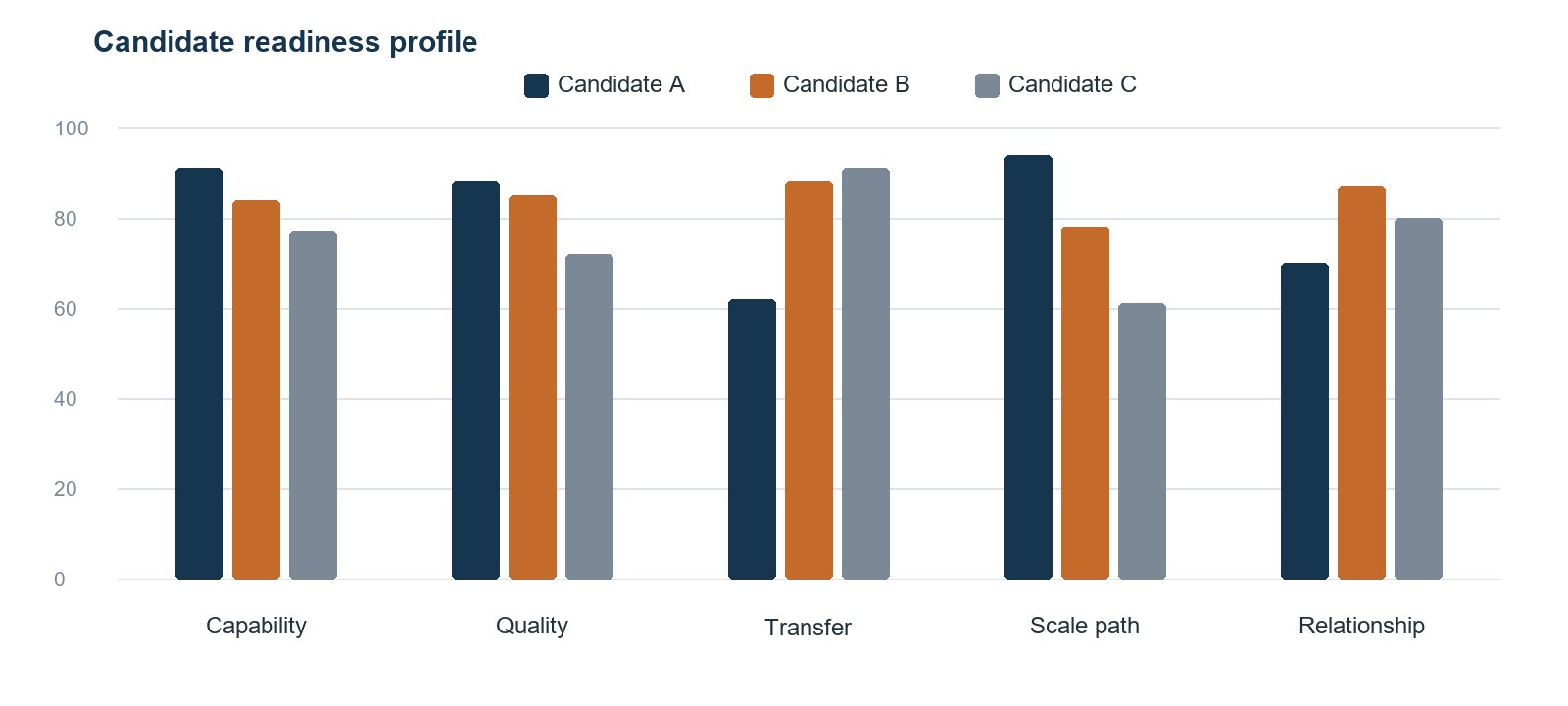
Candidate B does not lead every category. It becomes the strongest clinical-stage option because its transfer readiness, quality position and relationship-control model align most closely with the decision deadline.
Methodology: Transfer-to-Scale Readiness Test
The assessment uses a service-specific methodology designed around the loss points between technical transfer, clinical manufacturing and commercial scale-up.
Critical-path reconstruction Map the sequence from data-room access and cell-bank transfer through engineering runs, analytical readiness, GMP manufacture, release and stability. Each candidate's stated timeline is tested against dependencies rather than accepted as a single date.
Site-level evidence separation Distinguish corporate network capabilities from the facility, suite, quality unit and team that would perform the client's work.
Transfer-friction analysis Identify process, analytical, material, documentation and equipment differences that could create rework or delay during technology transfer.
Capacity-window verification Compare announced capacity with credible slot availability, competing programme commitments, campaign structure and future reservation requirements.
Quality and governance fit Examine inspection history, quality systems, deviation and change-control expectations, information access, escalation routes and the proposed quality-agreement structure.
Scale-path stress test Test whether the clinical appointment remains viable if demand accelerates, a batch fails, the launch timing changes or a second site becomes necessary.
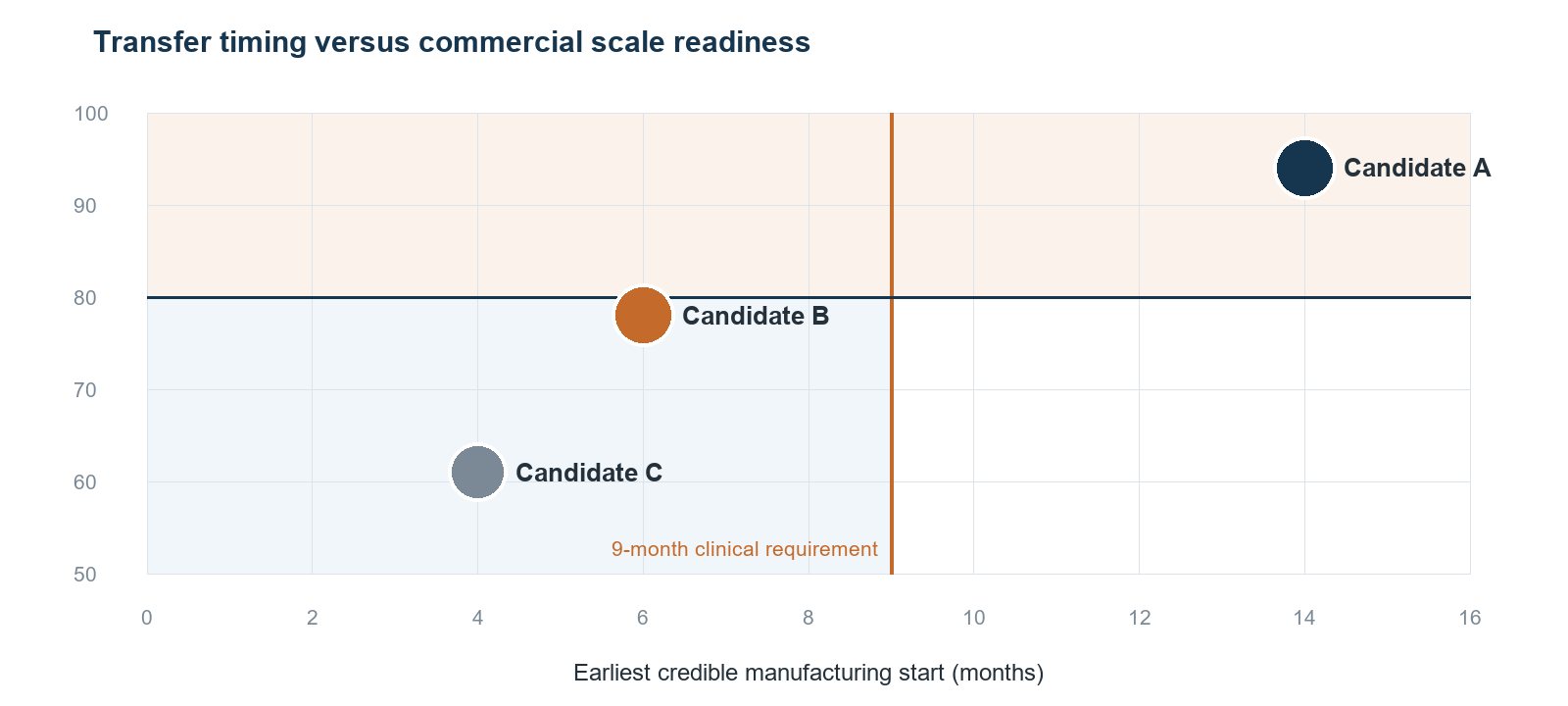
The candidate evidence picture
Decision factor | Candidate A | Candidate B | Candidate C |
|---|---|---|---|
Earliest credible GMP start | 14 months | 6 months | 4 months |
Relevant biologics experience | Extensive commercial | Strong clinical / selected commercial | Primarily early clinical |
Direct scale path | Strong multi-site network | Moderate; expansion reservation needed | Limited beyond current suite |
Technology-transfer fit | Moderate equipment mismatch | High platform similarity | High flexibility; less evidence |
Quality-governance position | Mature but standardised | Mature and adaptable | Developing |
Subcontracting visibility | Generally clear | Clear with two dependencies | Incomplete |
Illustrative evidence confidence | 83 / 100 | 80 / 100 | 66 / 100 |
The figures are not intended to simulate a final GMP qualification decision. They demonstrate how secondary research and supplied-document analysis can change the shortlist before formal audits, contracting and technical diligence begin.
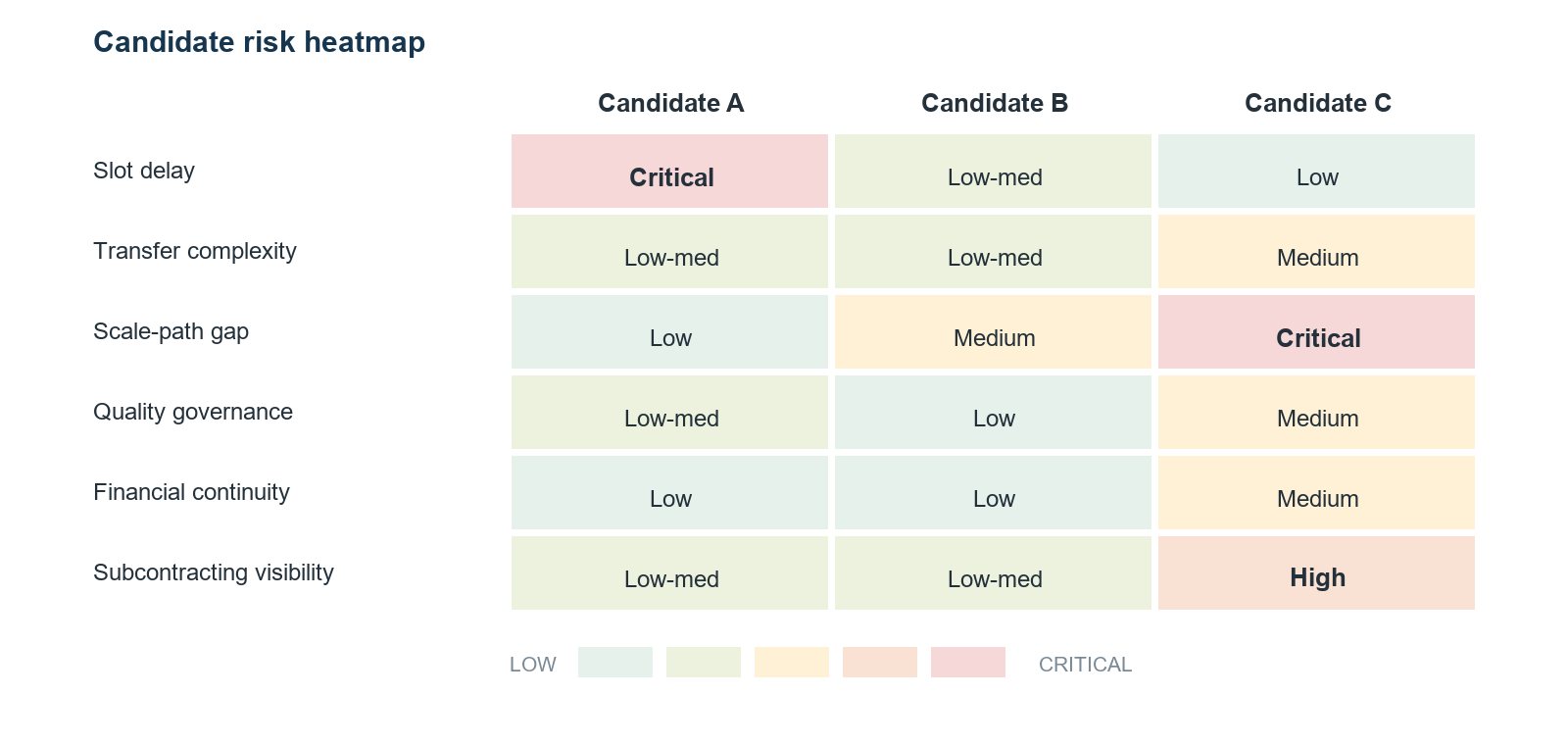
Stress-testing the appointment
Candidate B was tested against three conditions that could materially change the selection decision.
Pressure case 1 - clinical demand increases by 40% The candidate remains viable only if the client reserves an additional manufacturing window before completion of the first GMP batch. Without that reservation, future campaign timing becomes the dominant exposure.
Pressure case 2 - technology transfer slips by twelve weeks The clinical milestone can still be protected if analytical-method work begins in parallel and the client establishes a joint weekly issue-resolution forum. A longer delay would require escalation to the contingency candidate.
Pressure case 3 - commercial timing accelerates Candidate B would need to demonstrate a controlled scale or second-site route earlier than planned. The recommendation therefore requires a scale-path decision gate before pivotal development begins.
Recommended relationship decision
QUALIFY WITH CONDITIONS Advance Candidate B as the preferred Phase II manufacturing partner, subject to capacity reservation, site-specific quality confirmation, agreed information access and an explicit commercial scale-path gate.
Required condition | Decision control | Trigger for escalation |
|---|---|---|
Clinical manufacturing slot | Reserve the first GMP and one contingency window | Reservation not contractually secured |
Technology-transfer plan | Joint dependency schedule with named owners | Critical-path delay exceeds twelve weeks |
Quality governance | Quality agreement before engineering manufacture | Material access or change-control gaps remain |
Commercial scale path | Formal gate before pivotal programme commitment | No credible capacity route within agreed horizon |
Fallback position | Maintain Candidate A as a monitored contingency | Candidate B fails a defined qualification gate |
Candidate A should remain under observation as a potential later-stage or contingency option. Candidate C should not progress until its site-level quality evidence, subcontracting structure and scale pathway can be established with greater confidence.
What August Research would deliver
Decision dossier A concise appointment case showing the preferred candidate, conditions, rejected alternatives and unresolved evidence.
Critical-path model A dependency-led transfer and manufacturing timeline that separates stated dates from credible execution dates.
Candidate evidence matrix Site-level comparison covering capability, quality, capacity, transfer, governance, subcontracting and scale readiness.
Stress-test and control plan Pressure cases, decision breakpoints, escalation triggers and conditions for qualification or contingency activation.
Indicative project delivery
Stage | Focus | Indicative timing |
|---|---|---|
Decision definition | Mandate, product boundary, timeline and exclusion criteria | Week 1 |
Evidence reconstruction | Entities, sites, capabilities, quality and capacity | Weeks 1-2 |
Candidate comparison | Transfer path, dependencies, governance and confidence | Weeks 3-4 |
Stress test | Pressure cases, controls and contingency logic | Week 5 |
Decision package | Recommendation, conditions and next diligence priorities | Week 6 |
Scope boundary
This illustration represents secondary research and supplied-document analysis conducted before formal quality audits, technical due diligence, legal review and contracting. Those activities remain necessary before a regulated manufacturing appointment is finalised.
All companies, scores, capacity statements, timelines, findings and recommendations in this illustration are hypothetical. They are designed to demonstrate the methodology and the form of decision support that an actual engagement could provide.
LET'S DISCUSS YOUR MANUFACTURING-PARTNER DECISION August Research can help reconstruct the evidence behind a CDMO shortlist, identify the conditions that determine suitability and prepare the client for focused technical, quality and commercial diligence.
EVALUATE A CDMO | COMPARE MANUFACTURING PARTNERS