PHASE 2 ILLUSTRATION / ELECTRIC-VEHICLE BATTERIES
Selecting a Closed-Loop Battery
Recycling Partner
How a battery manufacturer could compare recyclers when headline recovery rates do not establish battery-grade yield, traceability or dependable supply.
DECISION
MATERIAL FOCUS
CANDIDATES
PLANNING HORIZON
Choose a recycling partner
Lithium, nickel and cobalt
3 shortlisted recyclers
2028-2032
DECISION QUESTION Which recycler should support a European closed-loop programme, and what conditions are required to turn waste-processing claims into qualified, traceable material supply?
The hypothetical client manufactures electric-vehicle battery cells in Europe and is designing a closed-loop arrangement for production scrap and future end-of-life returns. It requires secure feed acceptance, high-quality recovered intermediates, battery-grade qualification, transparent mass balance and a credible path to contracted supply.
Recycler A has the longest operating history and broad collection relationships but sells part of its output through external refiners. Recycler B controls the most complete processing and qualification chain and offers detailed batch genealogy. Recycler C has the largest announced capacity and lowest processing fee, although much of that capacity is still ramping and its downstream chain is less transparent.
Why recovery rate is not the same as usable closed-loop output
Headline recovery percentages can describe one process stage while leaving feed acceptance, intermediate losses, refining location, product specification and allocation rights unresolved. The decision therefore follows material from the client's gate to qualified battery-grade output.
Yield definition Recycler A reported strong metal recovery, but the share returning as material qualified for the client's cathode chain was lower after external refining and specification losses.
Ramp-up exposure Recycler C's announced capacity exceeded current demonstrated throughput, increasing uncertainty about commissioning, feedstock competition and qualified output timing.
Closed-loop integrity Recycler B did not have the largest nameplate capacity, yet it showed the clearest link between accepted feed, mass balance, refining, product qualification and client allocation.
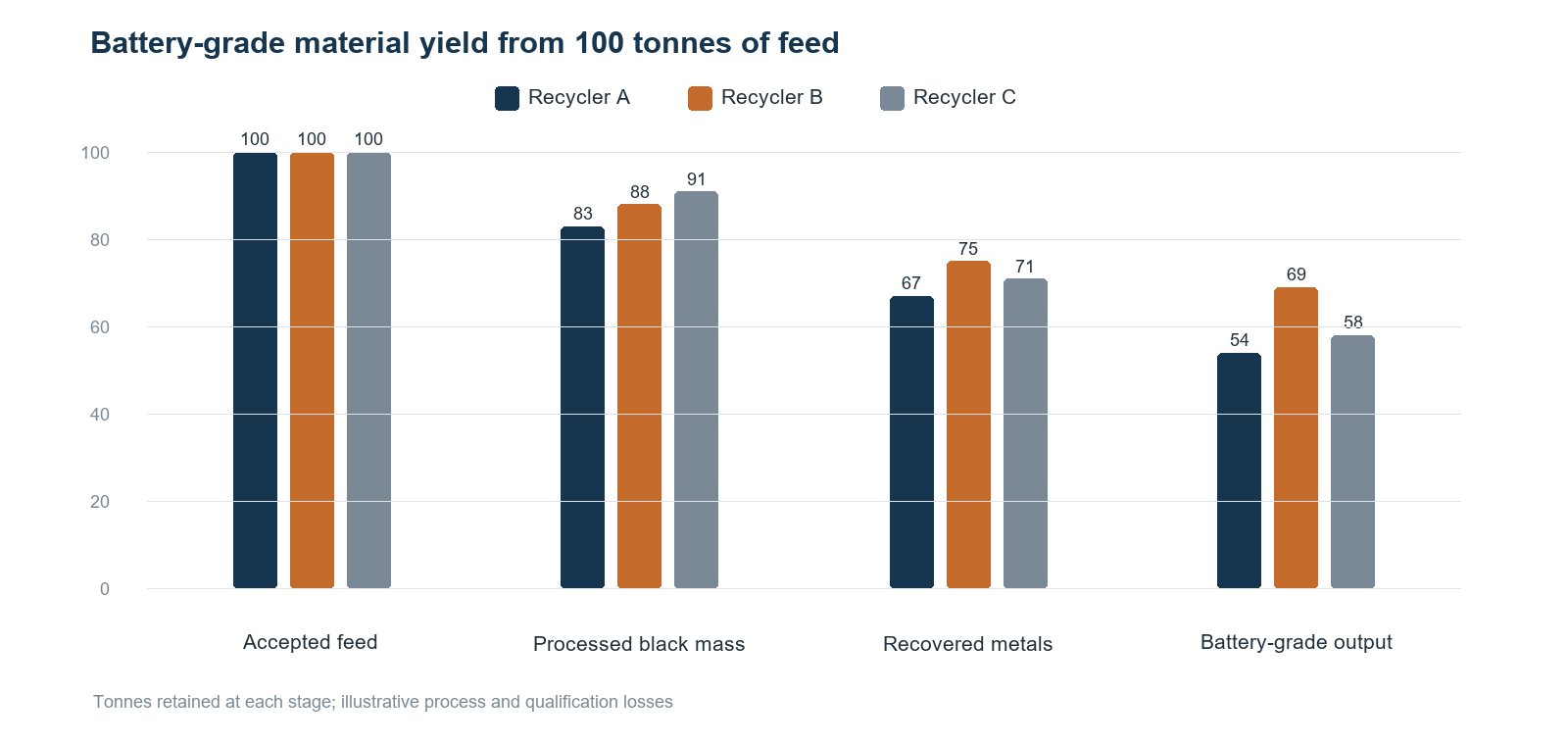
Methodology: Closed-Loop Material Integrity Test
The assessment reconstructs both the physical material pathway and the evidence pathway required to support a long-term recovered-material partnership.
Feed-to-product mass balance Track material through acceptance, preprocessing, black mass, hydrometallurgy or refining, purification and final qualification using consistent boundaries.
Asset and ramp verification Separate operating capacity from announced capacity and test commissioning status, utilisation, permits, bottlenecks and competing feed commitments.
Traceability chain Examine origin records, batch genealogy, facility links, allocation methods, carbon data and downstream custody across every entity handling the material.
Qualification and offtake fit Compare output specification, sample history, change control, rejection handling and rights to receive qualifying material rather than an undifferentiated pool.
Feedstock and policy stress test Test lower return volumes, collection competition, price shifts, ramp delay and tighter recycled-content evidence requirements.
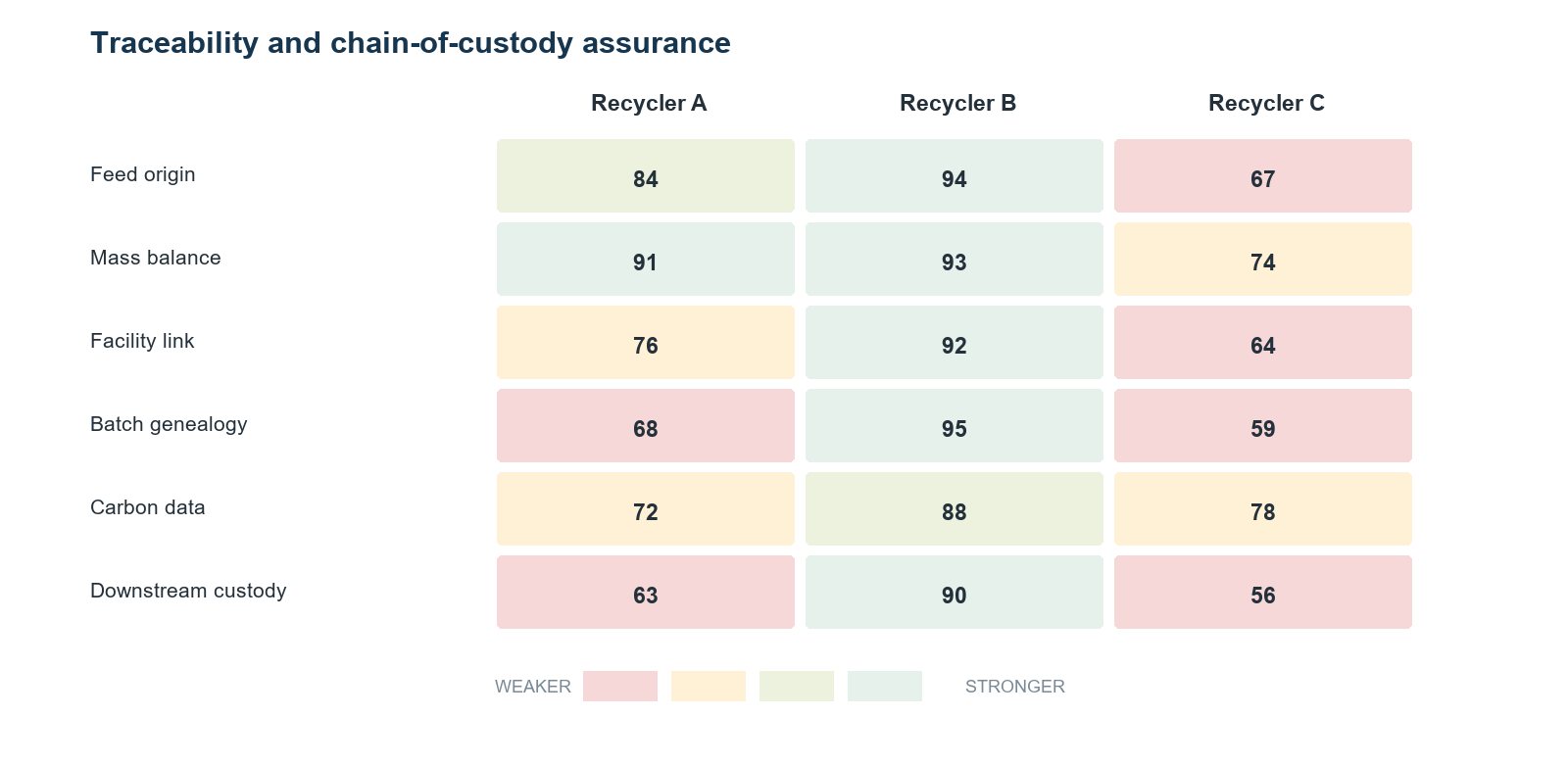
The candidate evidence picture
Decision factor | Recycler A | Recycler B | Recycler C |
|---|---|---|---|
Operating-chain control | Preprocess plus external refining | Integrated process and qualification | Mixed operating and ramping assets |
Battery-grade yield | Moderate | Highest of shortlist | Moderate, still stabilising |
Traceability model | Good at intake | Batch-linked end to end | Partial downstream visibility |
Qualified 2030 allocation | 7.8 kt | 9.1 kt | 7.0 kt |
Feedstock security | Broad collection base | Contracted scrap plus returns | Dependent on new sourcing |
Commercial position | Mid-range | Premium with allocation rights | Lowest processing fee |
Evidence confidence | 84 / 100 | 94 / 100 | 67 / 100 |
The assessment demonstrates how secondary research can focus subsequent technical, environmental, legal and commercial diligence. Final appointment would still require facility inspection, process validation, specification testing, audit rights and verified regulatory compliance.
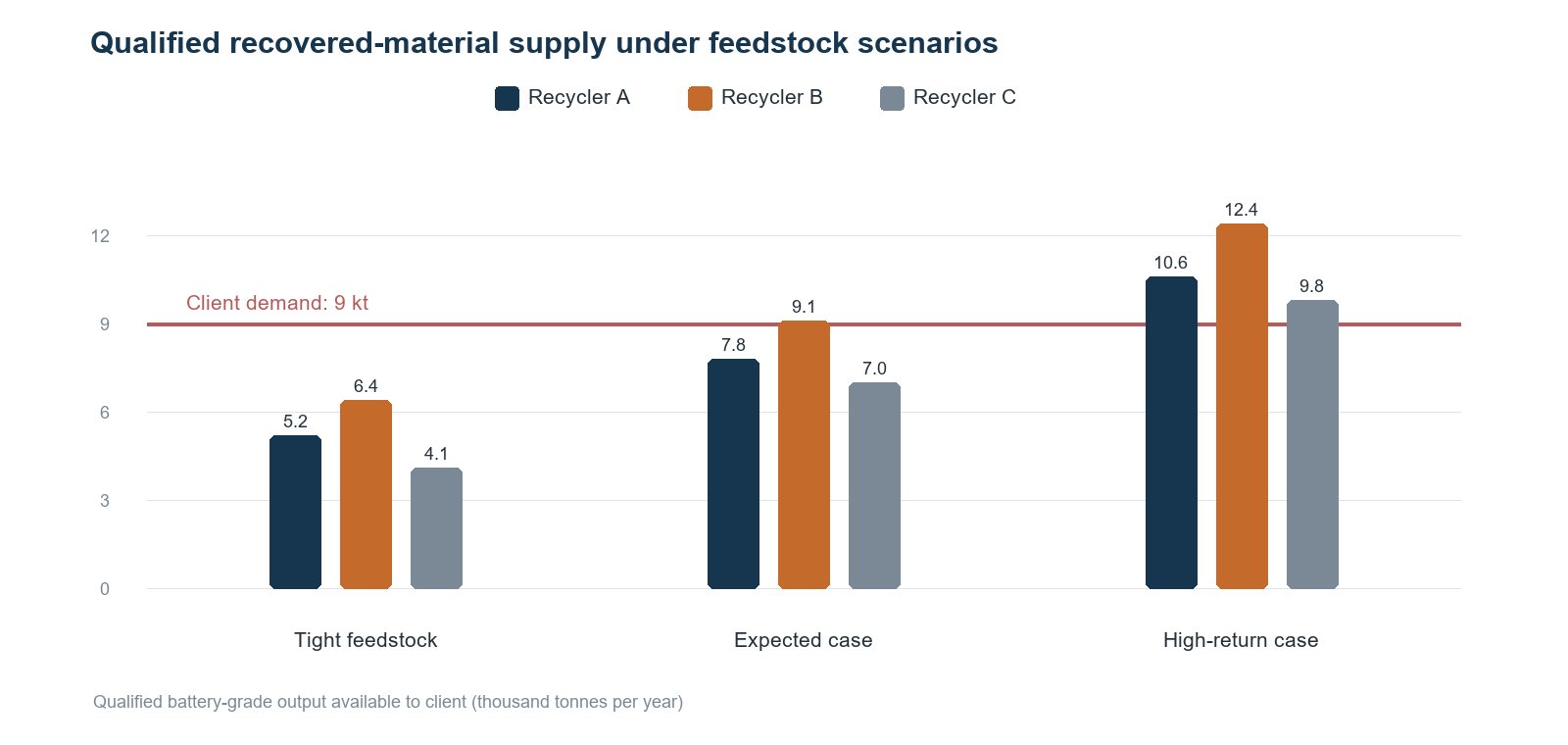
Recommended relationship decision
NEGOTIATE A GATED CLOSED-LOOP AGREEMENT Select Recycler B as the preferred partner, subject to verified operating throughput, product qualification, auditable mass balance, client allocation rights and staged volume commitments linked to feedstock and ramp evidence.
Required condition | Decision control | Escalation trigger |
|---|---|---|
Material qualification | Agreed specification, samples and change control | Repeated failure against agreed product specification |
Mass balance | Auditable batch and facility-level reconciliation | Unexplained material or attribute allocation gap |
Volume allocation | Client rights tied to qualifying output | Forecast allocation falls below agreed demand floor |
Asset ramp | Milestone evidence before volume step-up | Commissioning or utilisation gate missed |
Downstream custody | Approved entities and continuing audit access | Unapproved refiner or custody-chain change |
Recycler A should remain a secondary route for feed flexibility and contingency processing. Recycler C should not receive strategic volume until operating throughput, downstream traceability and qualified-output evidence are demonstrated at the relevant facilities.
What August Research would deliver
Material-path dossier A feed-to-qualified-product reconstruction showing entities, facilities, process boundaries, yields and allocation rights.
Capacity and ramp evidence Comparison of operating, commissioned, permitted and announced capacity against competing feedstock and offtake commitments.
Traceability assurance matrix Evidence on origin, mass balance, batch genealogy, carbon information and downstream custody.
Closed-loop decision controls Qualification gates, volume triggers, audit rights, escalation conditions and contingency routes.
Indicative project delivery
Stage | Focus | Indicative timing |
|---|---|---|
Mandate definition | Materials, specifications, volumes, geography and horizon | Week 1 |
Chain reconstruction | Entities, facilities, processes and downstream partners | Weeks 1-2 |
Candidate comparison | Yield, capacity, traceability, qualification and economics | Weeks 3-4 |
Scenario testing | Feedstock, ramp, price and evidence pressure cases | Week 5 |
Decision package | Recommendation, gates and diligence priorities | Week 6 |
Scope boundary
This illustration represents secondary research and supplied-document analysis conducted before facility audits, technical validation, environmental and regulatory review, legal due diligence and contracting.
All recyclers, capacities, yields, volumes, scores, commercial positions, findings and recommendations in this illustration are hypothetical and are included only to demonstrate the methodology.
LET'S DISCUSS YOUR RECYCLING-PARTNER DECISION August Research can reconstruct a recycler's material and evidence chains, distinguish announced capacity from qualified output and define the controls required for a durable closed-loop partnership.
EVALUATE A RECYCLING PARTNER | SECURE CLOSED-LOOP MATERIAL