PHASE 2 ILLUSTRATION / FOOD & COLD-CHAIN LOGISTICS
Selecting a Gulf Cold-Chain
Logistics Provider
How a frozen-food manufacturer could choose a regional logistics partner when temperature control is only as strong as the weakest handoff.
DECISION
MARKETS
CANDIDATES
PRODUCT CONDITION
Select a 3PL
Saudi Arabia and UAE
3 regional providers
Frozen at -18°C
DECISION QUESTION Which logistics provider should manage import, cross-dock, storage and final-mile delivery, and what evidence is needed to keep the temperature-controlled chain intact across both markets?
The hypothetical client is a European producer of premium frozen meals preparing a Saudi Arabian and United Arab Emirates launch. Its logistics partner must coordinate port clearance, frozen storage, inter-city line haul and delivery to modern retail and food-service customers.
Provider A offers the largest regional network and the broadest warehouse footprint. Provider B operates fewer facilities but presents stronger end-to-end monitoring, custody records and exception response. Provider C has the lowest quoted cost and good final-mile reach, yet relies on multiple subcontracted depots and transport fleets.
Why warehouse capacity does not establish cold-chain control
The initial comparison focused on pallet positions, fleet size and headline geographic coverage. The decision changed when the service was tested at the handoffs where temperature records, physical custody and corrective action can separate.
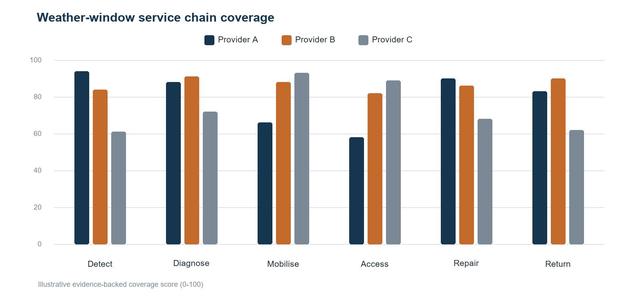
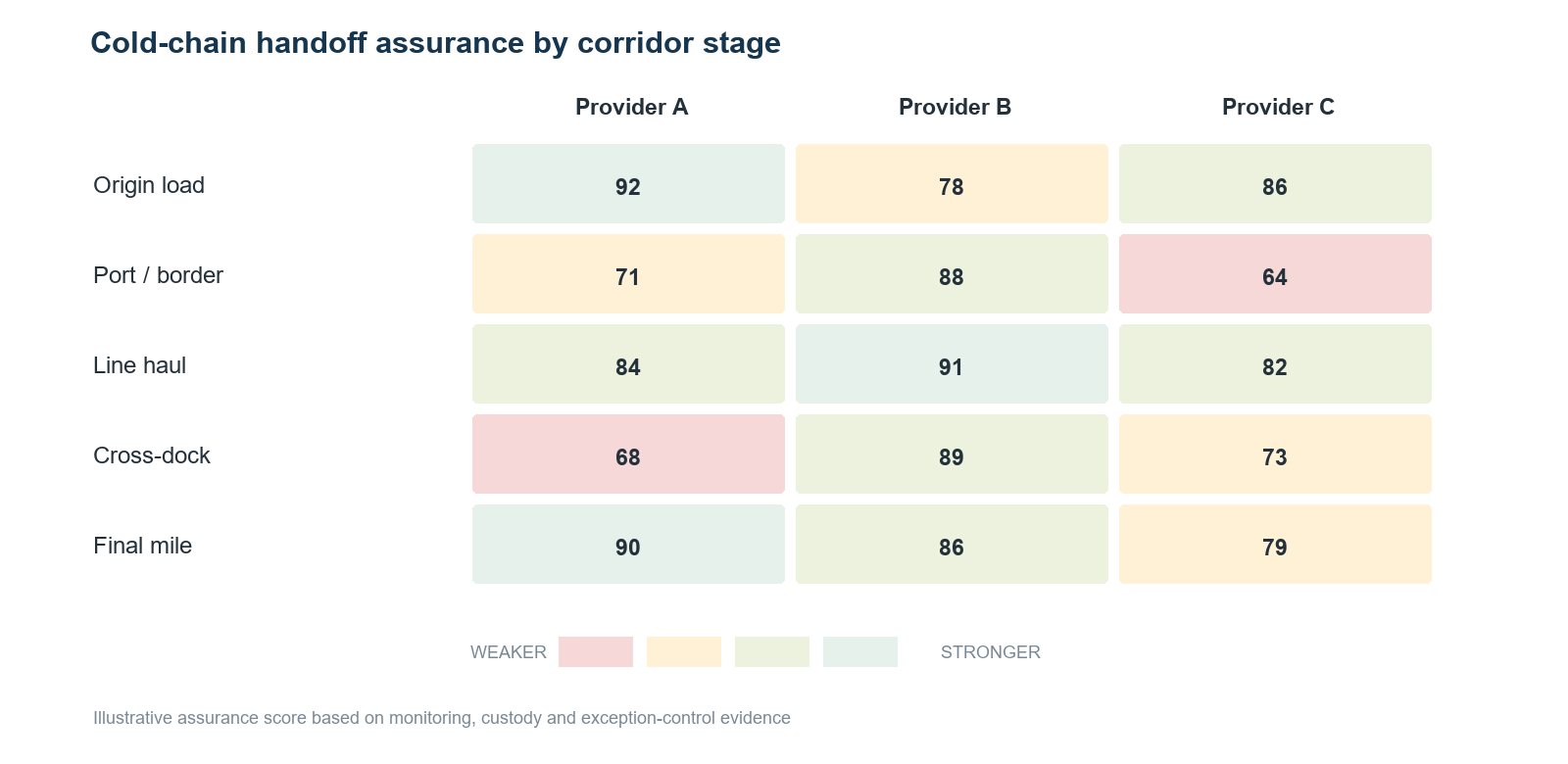
Handoff visibility Provider A could demonstrate strong origin and final-mile controls, but records at border and cross-dock stages were less consistently connected.
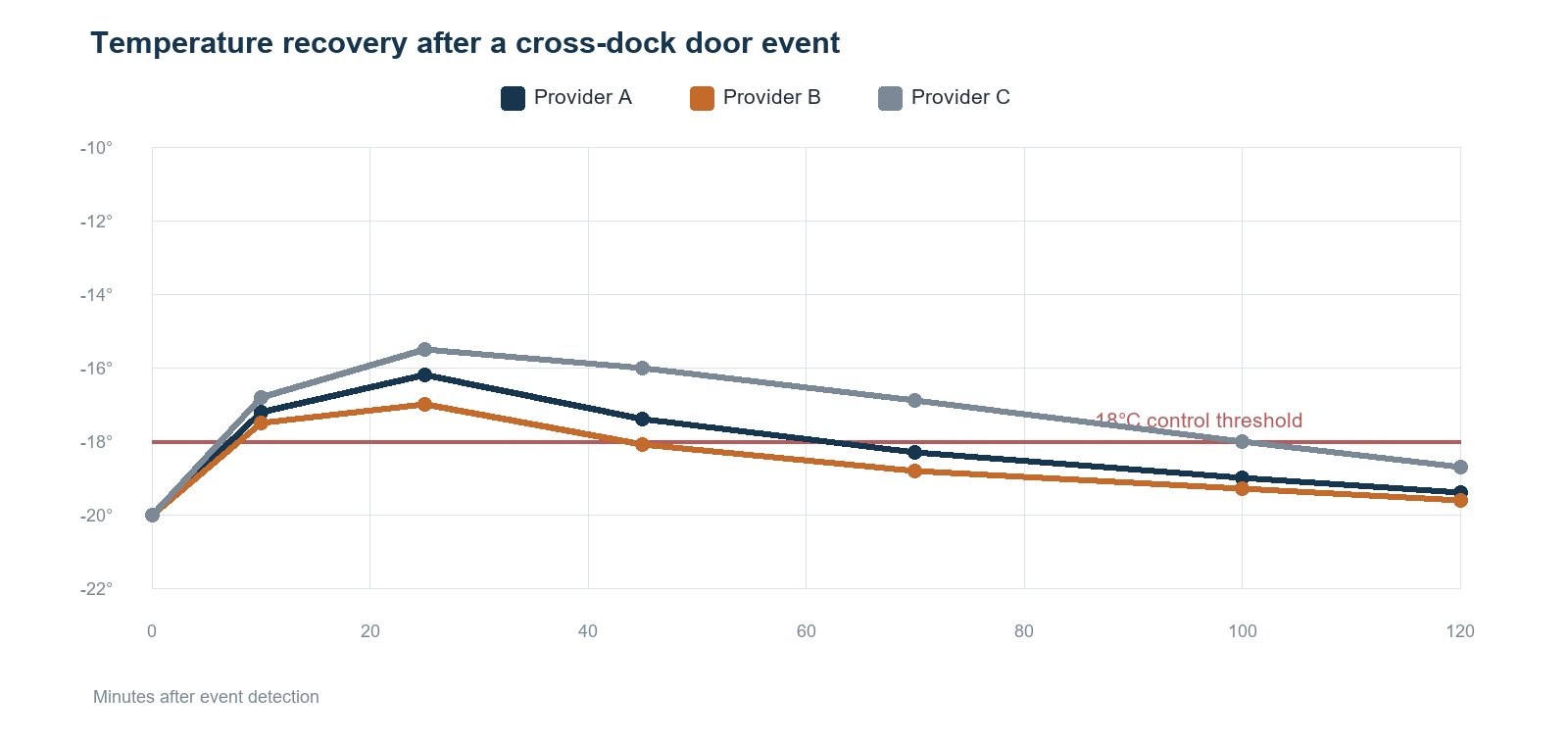
Exception response Provider B showed the clearest sequence from data-logger alert to quarantine, product assessment, customer communication and corrective action.
Subcontractor opacity Provider C's reach depended on separate depot and transport partners whose monitoring standards and escalation rights were not uniformly evidenced.
Methodology: Temperature-Controlled Corridor Assurance Test
The assessment treats the logistics offer as a connected corridor rather than a collection of assets. Evidence is tested at every change of custody and every point where the product can leave active temperature control.
Corridor reconstruction Map the product journey from origin release through port, border, storage, cross-dock and customer delivery, including legal entities and subcontracted operators.
Control-chain verification Test refrigeration capability, calibration, continuous logging, record retention, alarm routing, custody transfer and quarantine authority at each stage.
Excursion-response test Reconstruct how a temperature event is detected, contained, investigated and resolved, including the time before the client receives decision-grade evidence.
Peak-load and disruption test Examine seasonal demand, border delay, power interruption, equipment failure and route substitution to determine where control degrades.
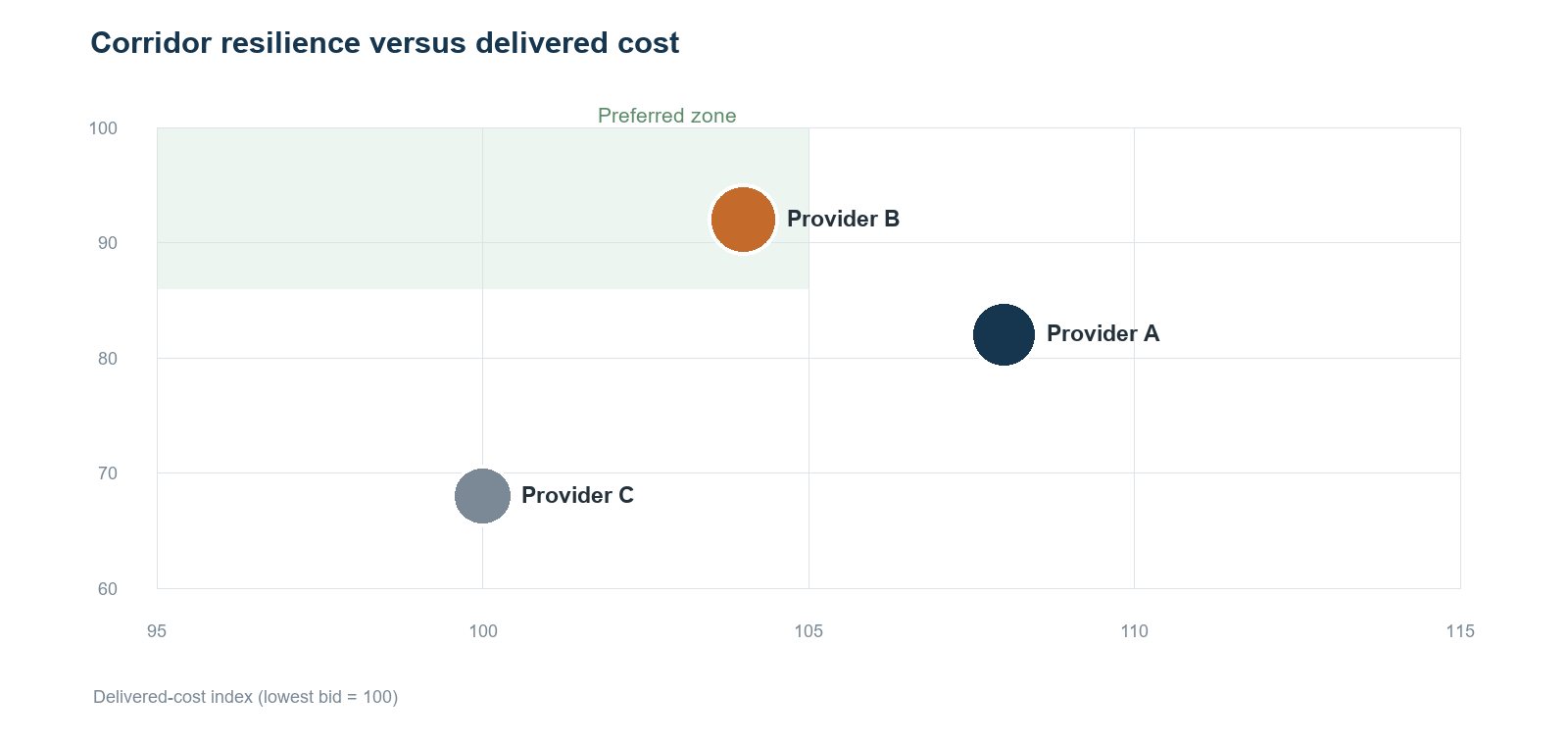
Cost-to-assurance comparison Compare delivered cost with evidence-backed corridor resilience, separating low price from transferred or unpriced risk.
The candidate evidence picture
Decision factor | Provider A | Provider B | Provider C |
|---|---|---|---|
Saudi / UAE facilities | Broad owned network | Selected owned hubs | Mixed partner network |
Continuous monitoring | Strong in core facilities | End-to-end, single portal | Mixed devices and portals |
Border-stage records | Available by request | Integrated into shipment file | Subcontractor dependent |
Excursion authority | Regional quality team | Named 24/7 response cell | Escalation varies by partner |
Peak-season capacity | High, shared pool | Reserved capacity offered | Nominally flexible |
Delivered-cost index | 108 | 104 | 100 |
Evidence confidence | 86 / 100 | 91 / 100 | 69 / 100 |
The figures demonstrate pre-appointment decision support. Operational audits, product-specific validation, route qualification, contractual review and local legal advice remain necessary before live distribution.
Recommended relationship decision
PILOT, THEN APPOINT Advance Provider B into a controlled two-corridor pilot, subject to uninterrupted shipment-level data, approved subcontractors, defined quarantine authority and verified peak-season capacity.
Required condition | Decision control | Escalation trigger |
|---|---|---|
Temperature record | One continuous shipment file across all handoffs | Any unexplained break in logger or custody data |
Exception response | 24/7 alert and quarantine workflow with named owners | Client notified more than 30 minutes after alert |
Subcontracting | Pre-approved operators and equivalent control standards | Unapproved depot, fleet or route substitution |
Peak capacity | Reserved frozen space and line-haul allocation | Confirmed capacity falls below agreed seasonal floor |
Pilot conversion | Two corridors pass agreed acceptance measures | Repeated excursion or incomplete root-cause evidence |
Provider A should remain the contingency for capacity overflow and specific locations. Provider C should not progress to a regional mandate until its subcontractor control and shipment-level monitoring can be made consistent.
What August Research would deliver
Corridor evidence dossier A stage-by-stage account of operators, assets, controls, records and dependencies across the proposed route network.
Handoff assurance matrix Comparison of custody, temperature logging, alarm response and quarantine authority at each transfer point.
Disruption stress test Scenario analysis covering border delay, equipment failure, power loss, peak demand and route substitution.
Pilot and appointment controls Acceptance measures, evidence requirements, escalation triggers and contingency logic.
Indicative project delivery
Stage | Focus | Indicative timing |
|---|---|---|
Mandate definition | Products, temperatures, markets, routes and service boundaries | Week 1 |
Corridor reconstruction | Entities, facilities, fleets, handoffs and subcontractors | Weeks 1-2 |
Control comparison | Monitoring, records, response and capacity | Weeks 3-4 |
Disruption testing | Peak load, delay, failure and route substitution | Week 5 |
Decision package | Pilot recommendation, conditions and diligence priorities | Week 6 |
Scope boundary
This illustration represents secondary research and supplied-document analysis conducted before site audits, route validation, legal review, product-release decisions and commercial contracting.
All providers, routes, scores, temperatures beyond the stated product condition, costs, findings and recommendations in this illustration are hypothetical and are included only to demonstrate the methodology.
LET'S DISCUSS YOUR LOGISTICS-PARTNER DECISION August Research can reconstruct a proposed cold chain, identify weak handoffs and define the evidence and pilot conditions required before regional appointment.
EVALUATE A COLD-CHAIN PARTNER | PROTECT PRODUCT INTEGRITY