PRODUCT PERCEPTION STUDY | FOOD AND NUTRITION
Does the Sensory Experience Support a Fermented Chickpea Protein Positioning?
A blind-to-branded study in Singapore designed to show whether fermentation and protein language strengthens the product meaning or makes an everyday snack feel too functional.
SETTING
Central-location sessions in Singapore
PRODUCT
Two coded prototypes and a branded proposition
DECISION
Which sensory profile and positioning should progress
Background
A food company was developing a savoury fermented chickpea protein snack. The concept promised protein, plant-based ingredients and a differentiated fermentation story. The client needed to know whether the actual crunch, aroma and aftertaste supported that meaning, and whether the branded explanation improved credibility or introduced expectations the sensory experience could not meet.
The perception gap
BLIND EXPERIENCE
What the snack tastes and feels like without explanation
BRANDED MEANING
What protein and fermentation language makes people expect
MARKET ACTION
Whether the combined experience supports repeat consideration
THE DECISION
Progress the current sensory profile, reformulate a specific cue, or reposition the snack so the promise and the eating experience reinforce each other.
Why independent sensory moderation mattered
Brand teams can unintentionally explain unfamiliar flavours or steer participants toward the intended health benefit. Independent, coded tasting preserved first sensory interpretation before the proposition was revealed.
02 | FIELDWORK AND EXPOSURE DESIGN
Blind-to-Branded Sensory Reconciliation
A split order controls whether the brand story changes the product experience or merely explains it after the fact.
Illustrative sample architecture
GROUP | COUNT | SCREEN | EXPOSURE |
|---|---|---|---|
Mainstream savoury snack users | 24 | Consumes packaged savoury snacks at least weekly | Blind-first coded tasting |
Protein or better-for-you snack users | 24 | Buys protein, functional or plant-forward snacks | Balanced blind and branded order |
Plant-protein engaged users | 24 | Familiar with legume-based or alternative-protein foods | Brand-first then coded confirmation |
Additional commercial viewpoint
Six retail category buyers or merchandisers would review the sensory summary, pack concept and shelf role separately. Their evidence would not be merged with consumer liking scores.
Central-location fieldwork
SESSIONS
Six moderated sessions of about 12 consumers
ORDER
Randomised coded samples and balanced reveal
CONTROL
Standardised portion, water, timing and palate reset
CAPTURE
Immediate ratings, open language and short interviews
Outreach parameters
RECRUITMENT Consumer panel access would be combined with targeted screening for snack frequency, dietary pattern, protein-category use and relevant allergies or exclusions.
GEOGRAPHY Central sessions reduce product-transport variation and support consistent preparation across Singapore participants from different residential and work areas.
SAFETY AND CONSENT Ingredient, allergy and exclusion screening would be agreed before recruitment. The client remains responsible for product safety and approved test use.
Note: The 72-consumer and six-buyer structure is illustrative. Final volumes depend on product readiness, incidence, exclusions, session capacity and field permissions.
03 | QUESTIONS AND SENSORY EVIDENCE
Separate what was experienced from what the proposition made it mean
The sequence captures spontaneous sensory language before functional positioning narrows interpretation.
Question background
EXAMPLE TASTING CONTEXT
Taste the coded snack in the order provided. Evaluate only what you experience. After the concept is shown, explain whether the words 'fermented chickpea protein' fit, improve or conflict with that experience.
Sample questions
NOTICE What did you notice first about aroma, crunch, flavour and aftertaste?
INTERPRET Without the pack, what type of snack does this seem to be, and for what occasion?
REVEAL After seeing the proposition, which sensory cues now feel expected and which feel inconsistent?
BELIEVE Does the experience make the protein and fermentation story more credible, or does it feel added on?
ACT Would you consider this for everyday snacking, a functional occasion, trial only or not at all?
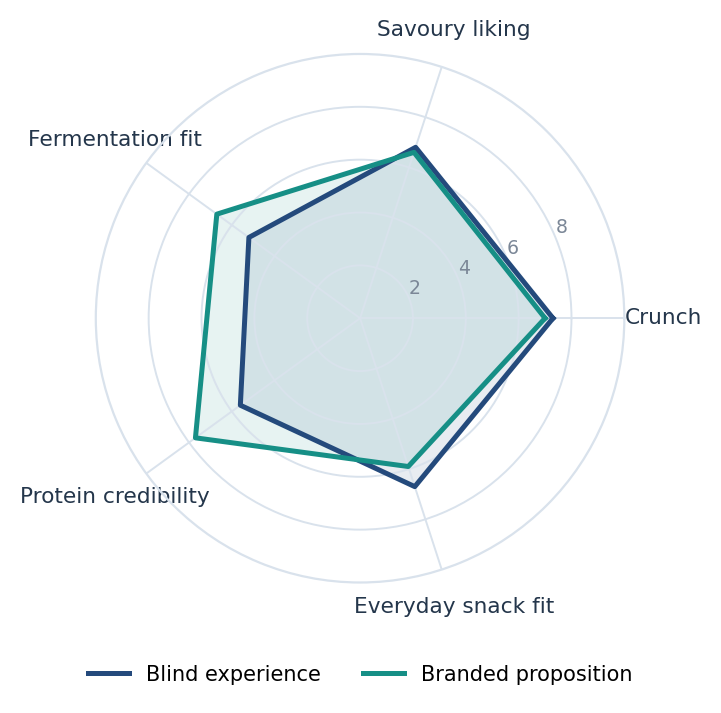
Exhibit | Sensory-positioning profile
04 | DECISION OUTPUT
Align the sensory promise with the occasion
The analysis does not select a winner score. It identifies which sensory cue supports or undermines the intended product meaning.
Illustrative interpretation
SIGNAL | INTERPRETATION | DECISION |
|---|---|---|
Crunch | Strong snack-category cue in both exposures | Retain as the lead sensory promise |
Fermented aroma | More acceptable after explanation but still polarising | Clarify language or refine the aroma threshold |
Protein positioning | Credibility rises after brand reveal | Use as support, not the only consumption reason |
Everyday fit | Falls when the product feels overly functional | Anchor the offer in a familiar savoury occasion |
What the client would receive
SENSORY-POSITIONING GAP
Blind and branded meaning differences
CUE DIAGNOSTIC
Aroma, texture and aftertaste effects
AUDIENCE CONTRAST
Mainstream, functional and plant-protein views
PRODUCT DECISION BRIEF
Reformulate, reposition, retain or retest
INDICATIVE DELIVERY Often 6 to 8 weeks, subject to prototype stability, safety review, recruitment incidence, session capacity and buyer availability.
STUDY BOUNDARIES This work evaluates sensory and product perception. It does not establish nutrition, health benefit, shelf life, food safety, allergen compliance, regulatory compliance or commercial demand.
Note: All scores, counts and findings are hypothetical and are included only to demonstrate the possible analysis.
Contact Us
DISCUSS YOUR PRODUCT PERCEPTION QUESTION
Tell us the product, prototypes, sensory uncertainty, audience and positioning decision. August Research will design the exposure order, recruitment and perception analysis around the product question.