PRODUCT PERCEPTION STUDY | AGRICULTURAL INPUTS
Which Cues Make a Foliar Micronutrient Credible for Grape Production?
A role-separated study in the Nashik grape belt designed to identify what growers, agronomists and agri-input dealers each need to believe before recommending or trialling a concentrate.
SETTING
Nashik, Niphad, Sinnar and Pimpalgaon Baswant
STIMULUS
Concentrate, label, crop-stage guide and evidence cards
DECISION
Which message and proof route should support launch
Background
A crop-input company was preparing a concentrated foliar micronutrient for table-grape vineyards. Its pack communicated rapid uptake, crop compatibility and ease of tank mixing. The same signals could be interpreted differently: growers might look for visible crop response, agronomists for a credible nutrient rationale, and dealers for a product they could explain without creating misuse or complaint risk.
THE PERCEPTION RISK
One label was expected to carry three different proof burdens. A message persuasive to the grower could still feel technically incomplete to the agronomist or commercially risky to the dealer.
What needed to be resolved
EFFICACY
What makes the promised crop response believable?
COMPATIBILITY
What suggests the concentrate will fit current spray practice?
RECOMMENDATION
What would make each role trial, advise or stock it?
Why independent fieldwork mattered
Dealer-led or company-led conversations can turn into product promotion. Separate neutral sessions preserved the language each role used before claims were explained, revealing where commercial familiarity, local practice or professional responsibility changed the interpretation.
02 | PARTICIPANT AND OUTREACH DESIGN
Three role groups, three proof responsibilities
Geography shaped both recruitment and the product scenarios. Participants needed current experience with grape nutrition decisions in the Nashik production system.
ROLE | COUNT | SCREEN | OUTREACH ROUTE |
|---|---|---|---|
Grape growers or vineyard managers | 14 | Personally decides foliar nutrition or spray trials; commercial grape production in the previous two seasons | Targeted grower recruitment, local referrals and field-network contacts |
Agronomists and crop advisers | 8 | Advises grape vineyards and reviews nutrient, crop-stage or compatibility decisions | Professional recruitment through crop-advisory and technical networks |
Agri-input dealers | 8 | Stocks or recommends foliar products to grape growers in the selected clusters | Dealer mapping, targeted calls and market-route recruitment |
Screening and field parameters
CROP EXPOSURE
Table grapes, current or recent season
DECISION ROLE
Direct trial, advice, recommendation or stocking influence
PRACTICE MIX
Different spray schedules, farm sizes and dealer routes
LANGUAGE
Marathi or Hindi sessions with technical terms retained
How outreach would be managed
CLUSTER ROUTING Recruitment would be balanced across the Nashik city market and surrounding production clusters so one dealer network or adviser circle did not dominate the evidence.
CONFLICT CONTROL Participants would not be recruited through the salesperson responsible for their account when that relationship could suppress criticism.
SESSION FORMAT Growers could join short local sessions or field-adjacent interviews. Agronomists and dealers would be interviewed separately to prevent professional hierarchy from shaping responses.
Note: Counts are illustrative. Final recruitment depends on crop calendar, response, travel, language and product-handling feasibility.
03 | SCOPE-SPECIFIC METHODOLOGY
Role-Split Proof Calibration
Each role receives the same product stimulus but completes a different decision task. The analysis then identifies the minimum proof needed by each role.
GROWER TASK | Choose whether to trial on a defined vineyard block | Pack, crop-stage use card and visible-result statements | Trial confidence and conditions |
|---|---|---|---|
AGRONOMIST TASK | Decide whether the product can enter an advisory recommendation | Composition logic, timing, compatibility and evidence cards | Technical proof threshold |
DEALER TASK | Decide whether to stock and explain the offer | Pack hierarchy, common objections, use limits and support materials | Sellability and complaint risk |
Question background
EXAMPLE GROWER CONTEXT
Imagine you are considering this concentrate for a table-grape block at the crop stage shown. Review only the label and evidence cards provided. Assume no prior relationship with the manufacturer and do not infer performance claims that are not shown.
Sample questions
NOTICE Which label element first tells you what problem this product is intended to solve?
INTERPRET What does the concentration and crop-stage language make you expect about efficacy, safety and mixing?
BELIEVE Which evidence would have to be local, crop-specific or independently verified before you rely on it?
COMPARE How does this proof differ from what you normally need before trialling, advising or stocking a foliar input?
ACT What is the smallest next commitment you would make, and what would still stop it?
Evidence captured after each role task
MEANING
Efficacy and compatibility inferred from the pack
MINIMUM PROOF
Evidence cards selected as essential
CONDITIONS
Crop, stage, tank mix and trial limits
NEXT ACTION
Trial, recommend, stock, seek proof or reject
04 | ILLUSTRATIVE FINDINGS AND DECISION
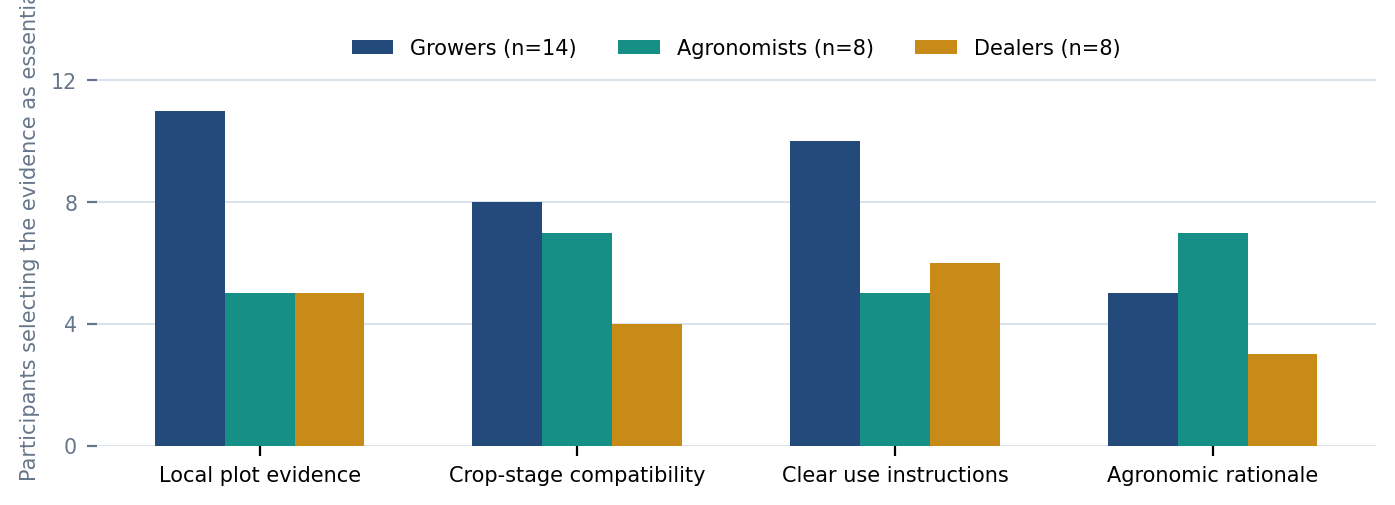
Different roles did not require the same proof
The figures below show how the output could distinguish proof thresholds without treating a small specialised sample as a market estimate.
Exhibit | Proof selected as essential
Illustrative recommendation
ROLE | LEAD MESSAGE | PROOF PLACED NEXT |
|---|---|---|
Growers | Visible crop need and trial | Local plot evidence and trial guide |
Agronomists | Crop-stage and nutrient rationale | Compatibility and composition evidence |
Dealers | Clear use and boundaries | Use guide and escalation route |
What the client would receive
PROOF-THRESHOLD LADDER
Minimum proof by role
PACK INTERPRETATION MAP
Pack cues shaping meaning
ROLE QUESTION BANK
Prompts for later fieldwork
LAUNCH BRIEF
Message, proof and trial sequence
INDICATIVE DELIVERY Often 6 to 8 weeks, subject to crop calendar, cluster travel, participant response, language and stimulus readiness.
STUDY BOUNDARIES Perception evidence does not validate agronomic efficacy, crop safety, compatibility or regulatory compliance. Findings remain limited to the stimuli, roles and scenarios tested. All counts and findings are hypothetical.
Contact Us
DISCUSS YOUR PRODUCT PERCEPTION QUESTION
Tell us the crop, product stage, decision roles, geography and proof uncertainty. We will design the outreach and evidence framework around the launch decision.