PRODUCT PERCEPTION STUDY | WORKPLACE TECHNOLOGY
Would a Posture Feedback Clip Feel Supportive or Supervisory?
A dual-context study in Toronto designed to show how the same wearable changes meaning when it is introduced as a personal wellbeing tool or an employer-supported programme.
SETTING
Toronto and the Greater Toronto Area
PRODUCT
Clip, mobile feedback screen and employer programme concept
DECISION
Which data model and message can support adoption
The product tension
EMPLOYEE MEANING
A private reminder that helps me notice posture and manage discomfort
EMPLOYER MEANING
A workplace tool that may create visibility into individual behaviour
Background
A workplace-technology company was preparing a clip-on posture device for hybrid desk workers. The device delivered local vibration prompts and a personal mobile view. A proposed employer offer added onboarding support and optional reporting. The client needed to know when a wellbeing benefit became a monitoring concern and which data boundaries preserved trust.
THE DECISION
Decide whether the product should launch as an employee-owned device, an employer-sponsored benefit, or a programme with carefully limited organisational reporting.
Why independent research mattered
Employees may soften privacy concerns when speaking to their employer, while internal buyers may overestimate the reassurance created by policy language. Independent moderation allowed both groups to evaluate the same data choices without workplace consequences.
02 | FIELDWORK DESIGN
Dual-Context Meaning Contrast
The research separates product experience from programme interpretation, then reconnects them to identify which context changes the meaning.
Participant architecture
VIEWPOINT | COUNT | EXPERIENCE REQUIRED | OUTREACH |
|---|---|---|---|
Hybrid workers | 18 | Works remotely and on-site; experiences desk-based posture or comfort concerns | Consumer panel plus targeted GTA recruitment |
Ergonomics or occupational-health advisers | 6 | Reviews workplace posture interventions or employee wellbeing tools | Professional and specialist-community recruitment |
HR, benefits or workplace buyers | 6 | Evaluates employee tools, programme data and adoption risk | Targeted professional recruitment and approved contacts |
Two independent contexts
A | PERSONAL MODE
Three working days of user-controlled prompts, private history and no employer access
B | PROGRAMME MODE
Employer-funded concept with alternative reporting and administration choices
Outreach and field parameters
GEOGRAPHY Recruitment would cover downtown, midtown and wider GTA work patterns, including participants who commute, work remotely and use shared offices.
USE PERIOD Workers would use the clip across three normal working days. Advisers and buyers would review the same product evidence and programme concepts in structured sessions.
PRIVACY CONTROL No employer would see an employee's research responses or individual posture data. Programme concepts would be hypothetical and separately consented.
Note: The 30-participant architecture is illustrative. Final field size depends on device availability, screening incidence, diary completion and programme-sensitivity controls.
03 | CONTEXTUAL QUESTIONS AND VISUAL EVIDENCE
Trace the moment benefit becomes intrusion
Questions are anchored in observed use first, then in specific data and programme choices.
Question background
EXAMPLE WORKER CONTEXT
You have used the clip privately for three working days. Now imagine your employer offers the same device as a voluntary wellbeing benefit. Review each data-sharing option separately and respond only to the access described.
Sample questions
NOTICE During use, when did the prompt feel helpful, distracting, corrective or judgemental?
INTERPRET What does employer sponsorship make you infer about the purpose of the device?
BELIEVE Which data-access statement feels specific enough to trust, and which still leaves room for surveillance?
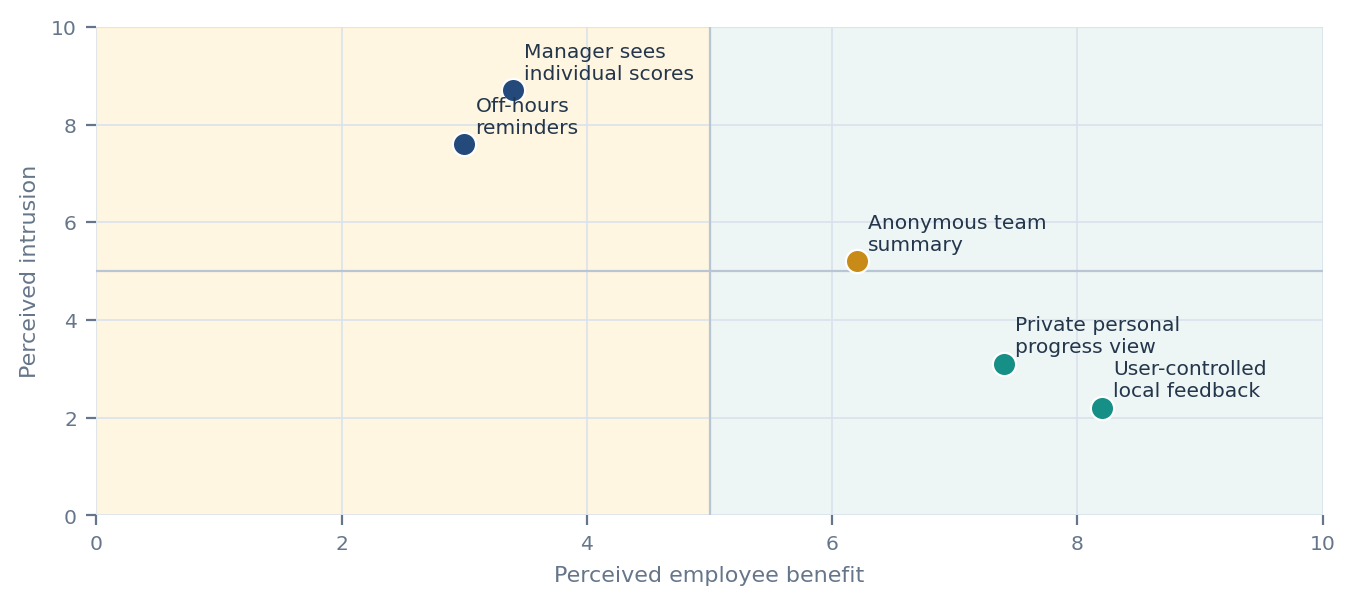
COMPARE How does a private history differ from an anonymous team summary or individual manager view?
ACT Which version would you adopt, decline, disable, return or recommend to colleagues?
Exhibit | Benefit versus intrusion
04 | DECISION OUTPUT
Design the programme around a trust-preserving boundary
Product perception changes when control, visibility and purpose change, even if the hardware remains identical.
Illustrative recommendation
DESIGN CHOICE | RECOMMENDED POSITION | PERCEPTION REASON |
|---|---|---|
Data ownership | Personal posture history stays with the employee | Preserves the meaning of self-support |
Employer reporting | Use voluntary, delayed and aggregate programme indicators only | Reduces fear of individual evaluation |
Prompt control | Employee controls intensity, schedule and off-hours use | Keeps feedback from feeling disciplinary |
Launch language | Lead with private feedback; explain sponsorship and limits separately | Avoids combining benefit and monitoring cues |
What the client would receive
BENEFIT-INTRUSION MATRIX
Meaning of each data choice
TRUST LANGUAGE GUIDE
Terms that reassure or trigger concern
ADOPTION CONDITIONS
Controls required by audience
PROGRAMME DECISION BRIEF
Recommended offer and reporting model
INDICATIVE DELIVERY Often 6 to 8 weeks, including recruitment, a three-day use period, programme sessions, analysis and readout.
STUDY BOUNDARIES This work evaluates product and programme perception. It does not validate clinical benefit, ergonomic effectiveness, privacy compliance, employment-law compliance or device safety.
Note: All counts, positions and findings are hypothetical and are included only to show the possible analysis.
Contact Us
DISCUSS YOUR PRODUCT PERCEPTION QUESTION
Tell us the device, use context, data choices, audiences and adoption decision. August Research will design the in-use fieldwork and meaning comparison around the trust boundary that matters.