Advanced Packaging Supply Continuity
Securing a Qualified Route for an Edge AI Module
ILLUSTRATIVE ENGAGEMENT | SUBJECT MATTER EXPERT INTERVIEWS
Illustrative note: This illustrative engagement shows a possible August Research approach. It does not describe an actual client assignment. Charts and scores labelled illustrative are working frameworks, not client findings.
Executive Summary
An industrial electronics company is developing an edge AI module whose performance and thermal targets require an advanced package configuration.
The work maps the product-specific interfaces that constrain supply, tests alternative sources for qualified usability, and defines triggers for action before an allocation or yield issue reaches the customer.
Client Background
The illustrative client is moving from prototype builds toward volume production. Its supply plan relies on a limited number of specialist packaging, substrate and test interfaces, and management needs a credible continuity plan before the next design freeze.
The Decision to Be Made
Which advanced packaging route should be qualified for production, and which supplier, design or inventory actions reduce exposure without delaying product release?
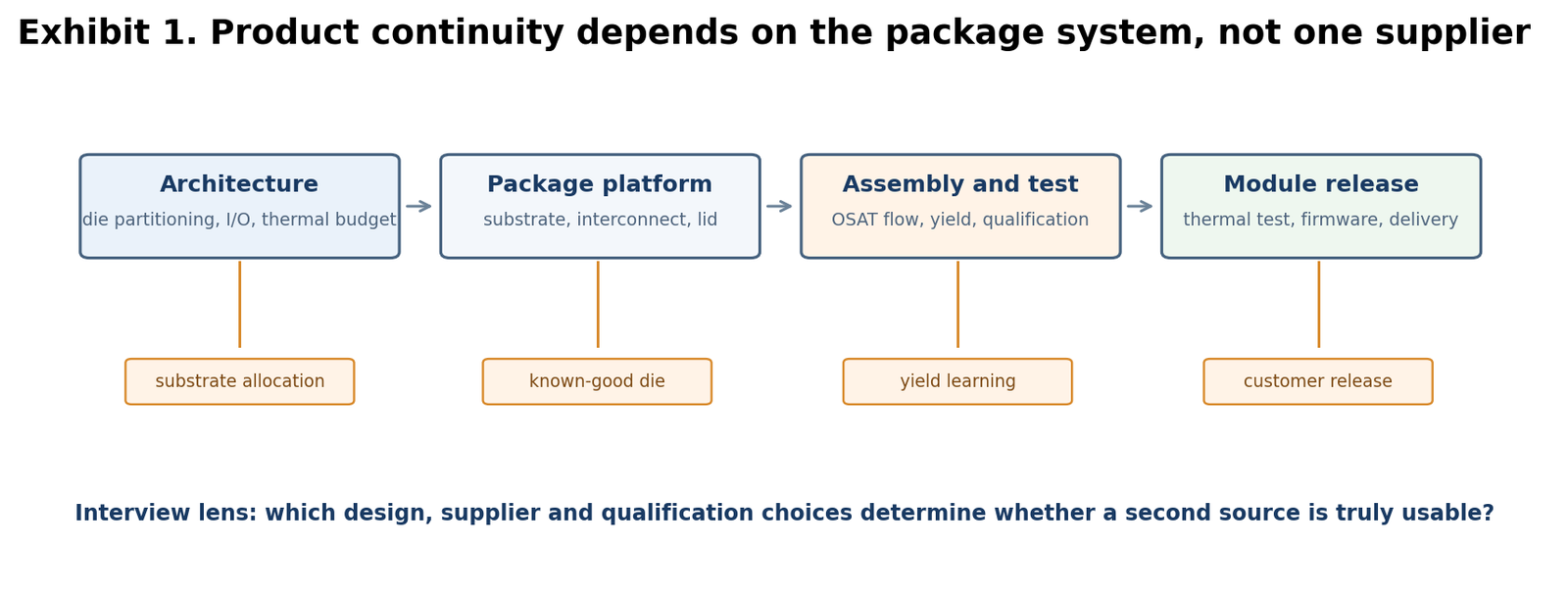
A Design-to-Qualified-Capacity Lens
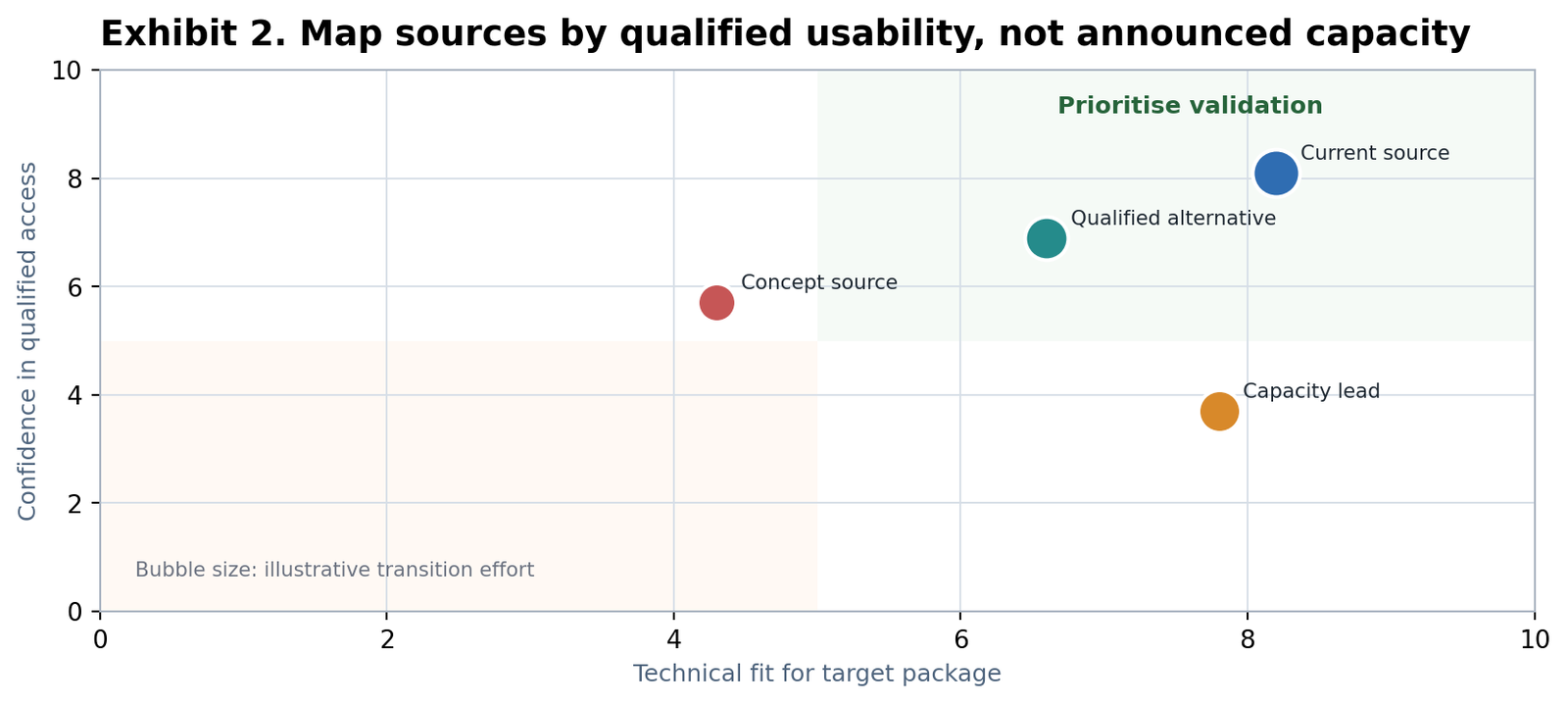
Announced manufacturing capacity does not create resilience for a finished module. An alternative only matters when it meets the design, qualification, yield, test and release requirements for this product.
Research Objectives
- Identify interfaces that can interrupt module availability.
- Assess which alternate sources are usable within the product qualification window.
- Test supplier capacity, yield-learning and allocation assumptions.
- Recommend a staged qualification and response plan.
Purpose-Built Interview Panel
The interview panel spans the interfaces where a packaging strategy can fail in transition.
- Package architects, SI/PI and thermal-design specialists.
- Substrate, assembly, test and reliability practitioners.
- OSAT and foundry supply-chain leaders.
- Component sourcing, manufacturing and quality leaders.
- Industrial electronics customers and field-reliability stakeholders.
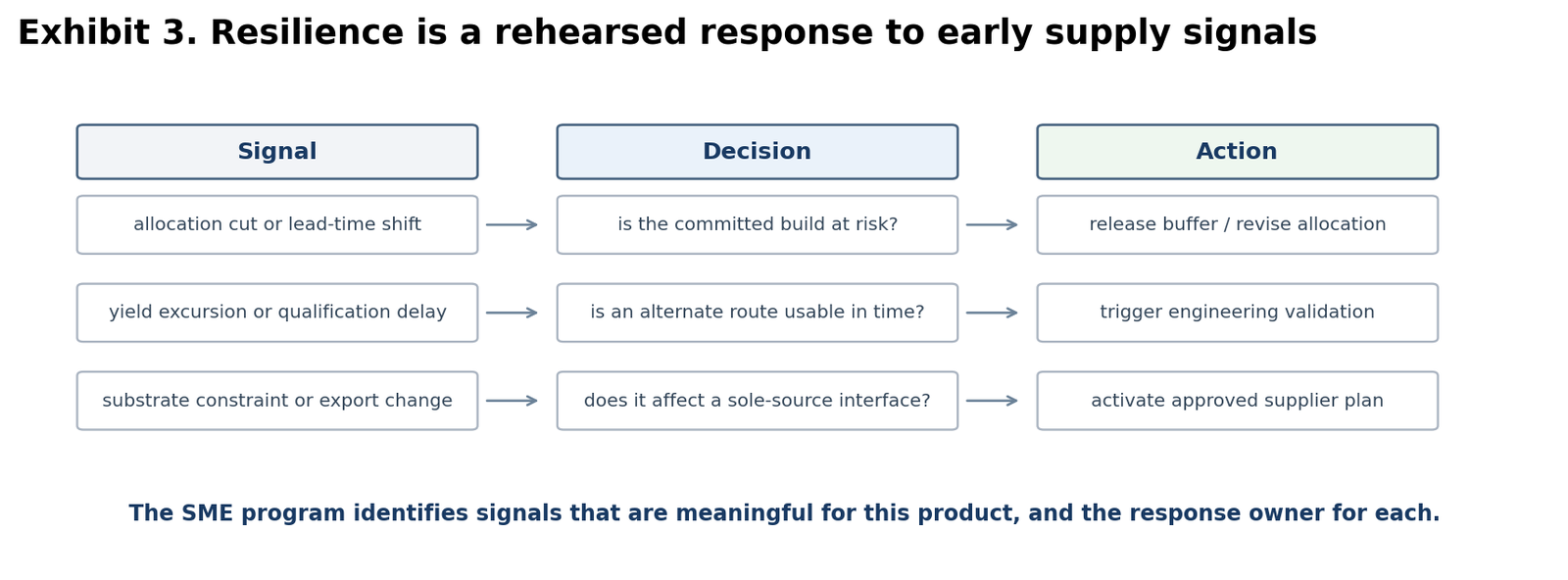
From Risk Signal to Product Response
Supply continuity is strongest when the company has already agreed what signals matter, who owns the response and what qualification work must begin before capacity becomes constrained.
How the Research is Conducted
Workstream | What it establishes | Output |
|---|---|---|
Interface mapping | Design, material, assembly and test dependencies. | Critical-interface register. |
Qualified source test | Technical fit, transition effort and available operating window. | Source-priority map. |
Supply signal review | Allocation, yield, lead-time and policy signals. | Early-warning indicators. |
Response design | Qualification, buffer and supplier actions by trigger. | Continuity playbook. |
Supporting Secondary Research
- Public semiconductor capacity and advanced-packaging investment announcements.
- Supplier technical documentation, package-roadmap signals and trade requirements.
- Comparable module qualification and reliability considerations.
Decision Synthesis
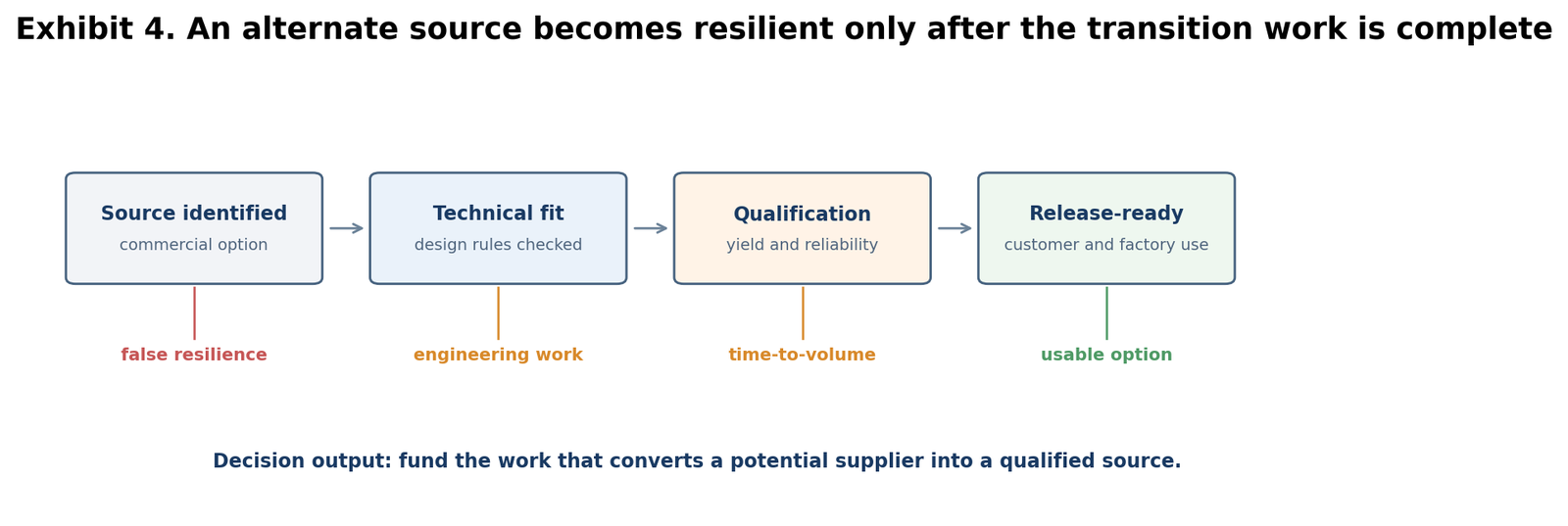
The recommendation distinguishes three very different things: a supplier that exists, a supplier that can build the package and a supplier that can support this module on the required timeline.
Project Outcomes & Outputs
Decision outcome | Client-ready output |
|---|---|
Packaging route | Recommended primary route and conditions for product release. |
Qualified alternative | Ranked second-source plan with validation gaps and timing. |
Continuity playbook | Signals, trigger thresholds, owners and response actions. |
Management decision | Investment, sourcing and design choices required before volume ramp. |
Why SME Interviews Matter
Advanced packaging connects architecture, materials, assembly, test, yield and customer qualification. SME Interviews make the interface risks visible early enough to protect the product schedule rather than merely document a supply-chain concern.
Research Sources for this Illustrative Engagement
The sources below inform the market context and research design. They are not presented as client findings.
1. U.S. Department of Commerce, CHIPS National Advanced Packaging Manufacturing Program announcements, 2024-2025.
2. Semiconductor Industry Association and Boston Consulting Group, Emerging Resilience in the Semiconductor Supply Chain, 2024.
3. Semiconductor Industry Association, Semiconductor Supply Chain Investments, accessed August 2026.
4. Semiconductor Industry Association, State of the U.S. Semiconductor Industry, 2026.
5. U.S. Department of Commerce, semiconductor-industry and CHIPS for America resources, accessed August 2026.
August Research Perspective
This case is not a generic semiconductor supply-chain review. It shows how packaging continuity is created by linking design choices to the sources that are qualified to deliver the finished module.
Let's Discuss Your Project
August Research can design a structured SME Interview program around the uncertainty that matters most to your next decision.