Sustainable Packaging Conversion
Proving a Circular Pack Before Market Launch
ILLUSTRATIVE ENGAGEMENT | SUBJECT MATTER EXPERT INTERVIEWS
Illustrative note: This illustrative engagement shows a possible August Research approach. It does not describe an actual client assignment. Charts and scores labelled illustrative are working frameworks, not client findings.
Executive Summary
A food brand is considering the conversion of a high-volume flexible food pack to a lower-impact format for selected European markets.
The work tests the full system behind the proposed claim: food-contact suitability, shelf-life, line performance, shopper use, collection and recovery. The decision is whether to pilot, redesign or defer the format.
Client Background
The illustrative client sells dry and ambient food products through grocery retail. Its existing multi-material laminate delivers reliable barrier performance, but the team needs a credible route to improve circularity without creating avoidable product, operational or claim risk.
The Decision to Be Made
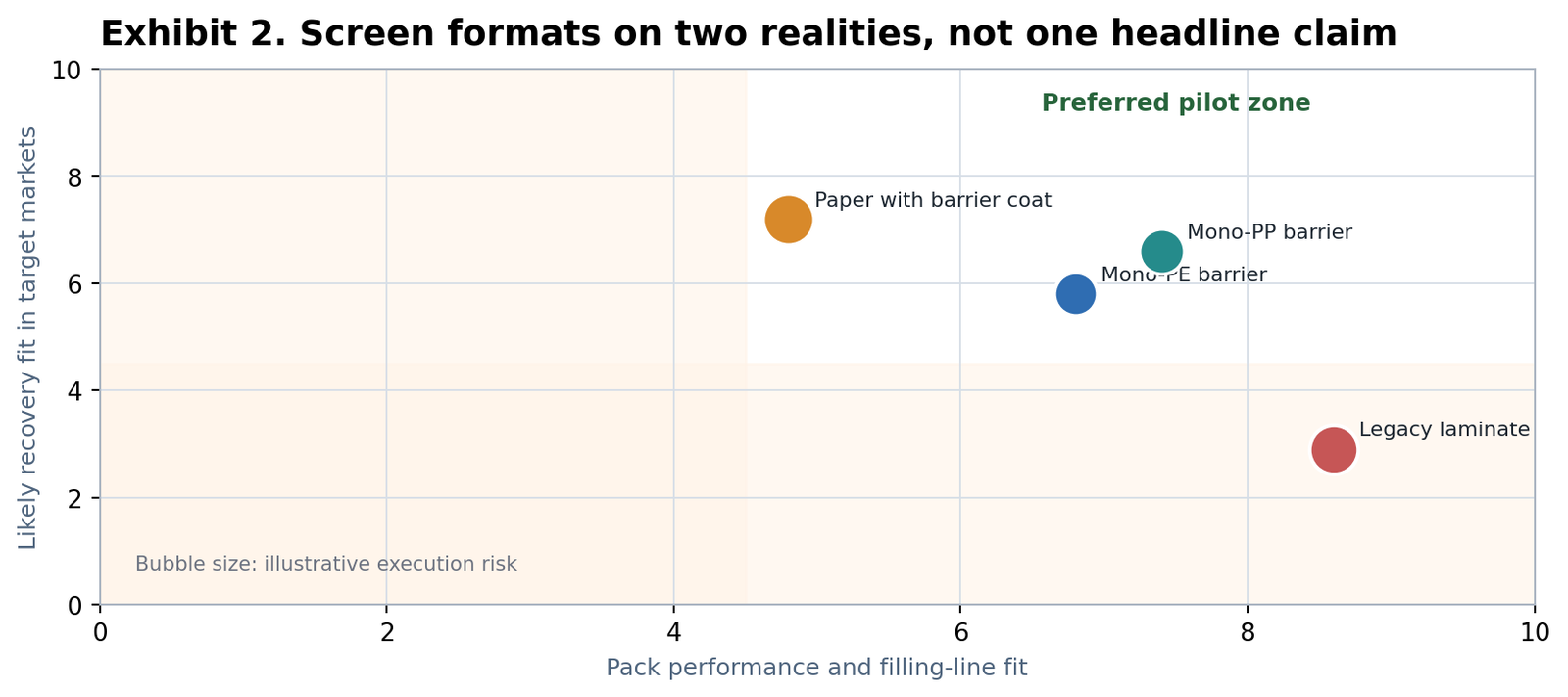
Which pack format should enter a market pilot, and what must be evidenced before the client makes a recyclable or lower-impact claim?
A Claim-to-Recovery Lens
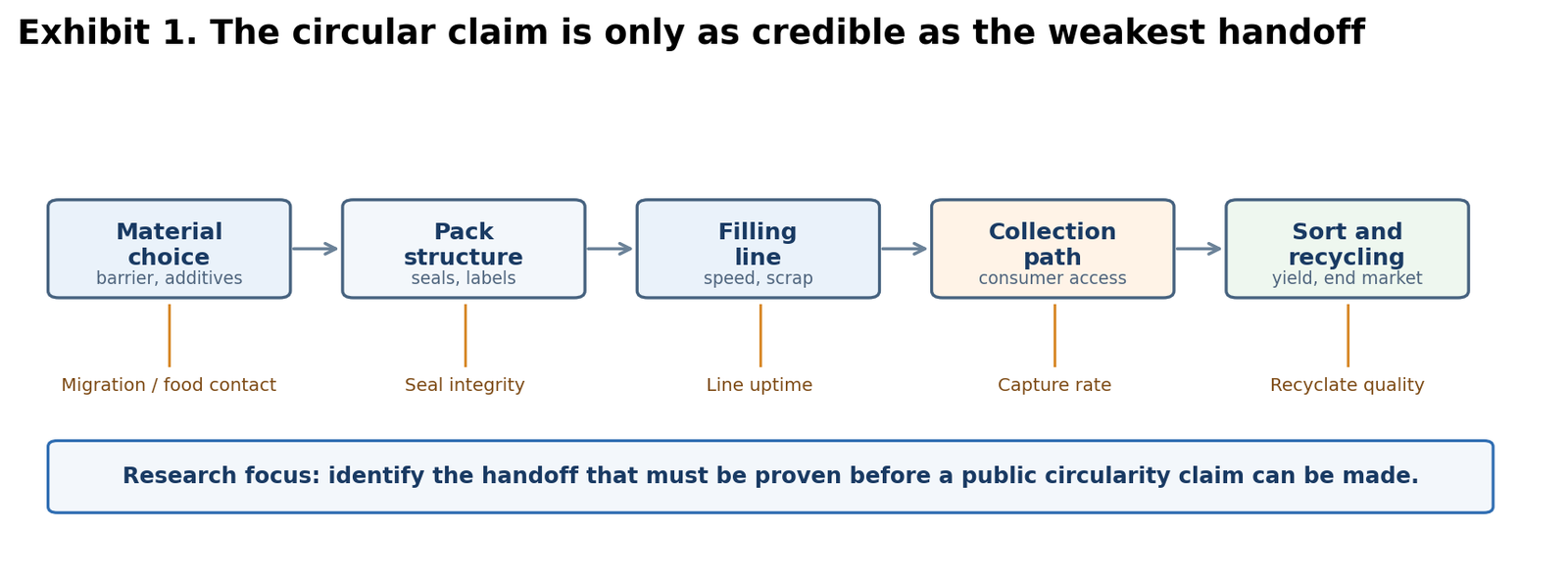
The preferred material is not automatically the preferred pack. The evaluation joins performance in use with how the pack is collected, sorted and turned into a usable output in each target market.
Research Objectives
- Identify candidate structures that preserve product protection and filling-line performance.
- Test which recovery assumptions are credible in the target markets.
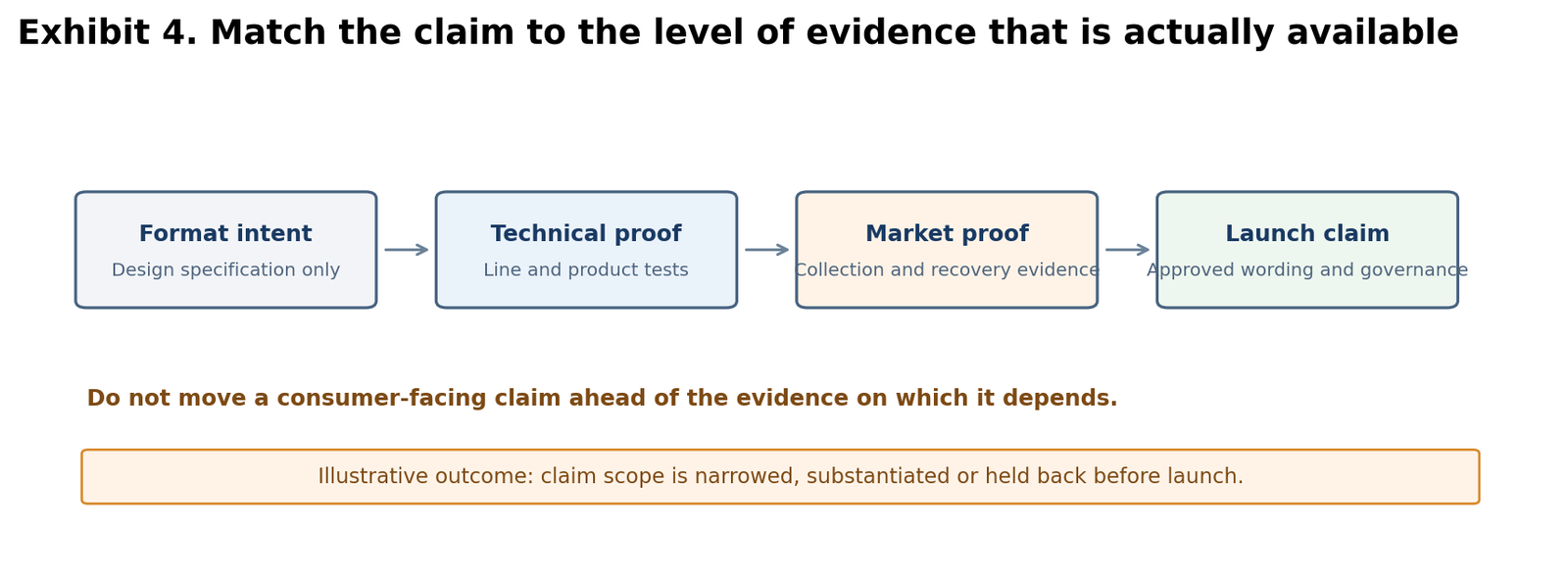
- Define the evidence required for consumer-facing and customer-facing claims.
- Recommend a pilot boundary, success criteria and stop conditions.
Purpose-Built Interview Panel
The interview panel follows the pack through its operating and recovery system.
- Flexible-packaging converters and material specialists.
- Food-contact, quality and shelf-life specialists.
- Packaging operations and co-packing leaders.
- Retail packaging and sustainability decision-makers.
- Collection, sorting and mechanical-recycling practitioners.
Pilot Evidence from Shelf to Recovery
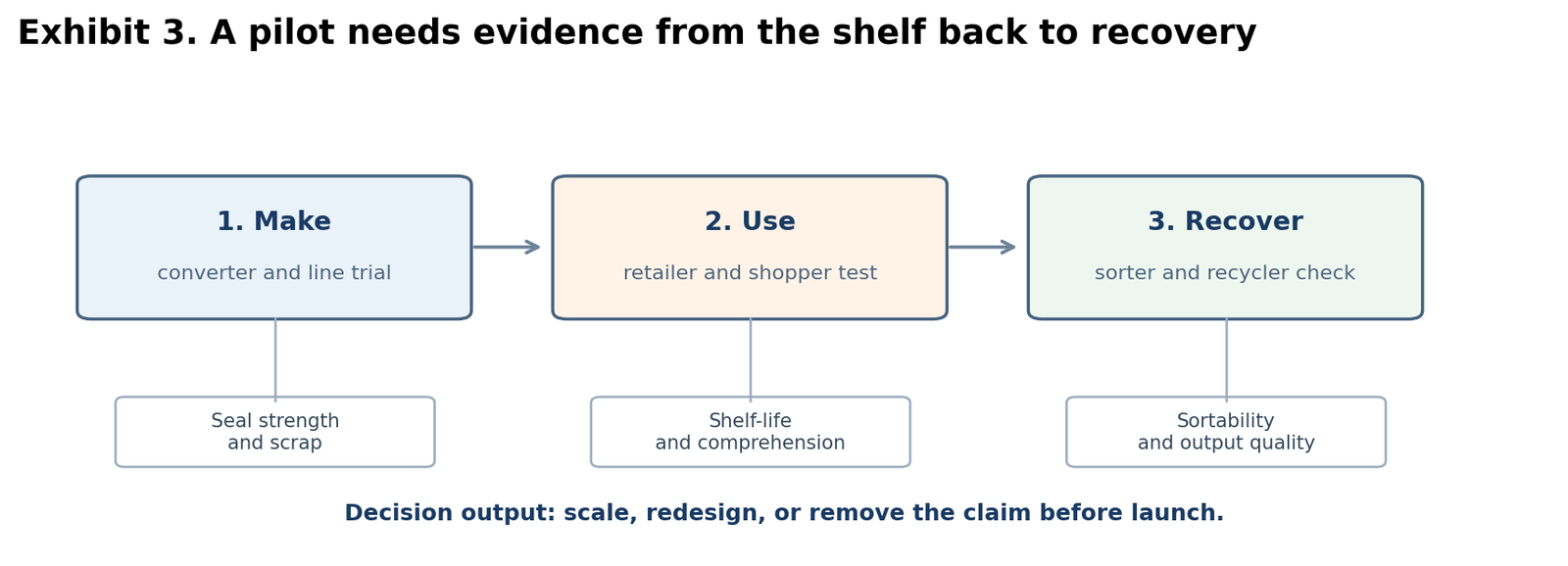
A desk assessment cannot establish whether the format works at commercial speed or whether recovered material has a real route to value. The pilot design brings both questions into the same test plan.
How the Research is Conducted
Workstream | What it establishes | Output |
|---|---|---|
Pack and product | Barrier, seal, migration and shelf-life limits. | Format shortlist and technical test criteria. |
Operations | Line speed, scrap, changeover and supplier readiness. | Manufacturing trial plan. |
Recovery reality | Collection access, sortability and recycler acceptance. | Market-specific recovery evidence. |
Claim review | What can be substantiated now and what needs proof. | Claim guardrails and decision memo. |
Supporting Secondary Research
- Relevant packaging and food-contact requirements.
- Format specifications, recycling guidance and infrastructure signals.
- Comparable pack launches and retail sustainability requirements.
Decision Synthesis
The recommendation is built from the point at which the pack, the operating line and the recovery system meet. That gives the client a controlled route to learn before a wider conversion.
Project Outcomes & Outputs
Decision outcome | Client-ready output |
|---|---|
Pilot selection | Recommended format, market scope and evidence still required. |
Claim readiness | Approved language boundaries and unanswered proof points. |
Scale decision | Scale, redesign or defer recommendation with supporting rationale. |
Risk ownership | Named owners for technical, operational, recovery and claim risks. |
Why SME Interviews Matter
Packaging conversion crosses material science, food safety, operations, retail expectations and local recovery realities. SME Interviews surface the constraints that are usually invisible in material data sheets and high-level recycling claims.
Research Sources for this Illustrative Engagement
The sources below inform the market context and research design. They are not presented as client findings.
1. European Commission, Packaging and Packaging Waste Regulation (EU) 2025/40, overview and timeline, accessed August 2026.
2. European Commission, Facts about the new EU rules on packaging and packaging waste, accessed August 2026.
3. European Commission, Regulation (EC) No 1935/2004 on materials and articles intended to come into contact with food.
4. European Commission, Circular Economy and packaging waste resources, accessed August 2026.
August Research Perspective
This case is not a general sustainable-packaging scan. It tests whether a particular pack can perform, be recovered and be claimed responsibly in the markets where it will be sold.
Let's Discuss Your Project
August Research can design a structured SME Interview program around the uncertainty that matters most to your next decision.