Evaluating Advanced Battery Technologies
for Electric Mobility
ILLUSTRATIVE ENGAGEMENT | SUBJECT MATTER EXPERT INTERVIEWS
RCD, Product Development C Innovation
Subject Matter Expert (SME) Interviews
Automotive C Electric Mobility
Primary research supported by secondary research
6-8 weeks
Disclaimer: This illustrative engagement demonstrates how August Research approaches complex technology and innovation challenges. It is for demonstration purposes and does not represent an actual client assignment. Visuals labelled illustrative are frameworks or source-informed hypotheses, not client findings.
Executive Summary
A global automotive Tier 1 supplier is evaluating next-generation battery technologies for integration into its future electric mobility platform. While several battery chemistries have demonstrated promising laboratory performance, uncertainty remains around manufacturing scalability, long-term safety, raw material availability, lifecycle performance, and commercial readiness.
The organization must determine which technologies warrant continued investment, which require further validation, and which present unacceptable technical or commercial risks. Published research provides valuable technical information; however, it rarely captures the practical engineering, manufacturing, supply-chain, and commercialization considerations that ultimately influence technology adoption.
August Research develops a structured Subject Matter Expert Interview program to obtain independent perspectives from professionals across the battery innovation ecosystem. Supported by focused secondary research, the engagement provides an evidence-based assessment that enables decision-makers to evaluate competing technologies with greater confidence.
Why This Engagement?
Technology investment decisions in the automotive sector are increasingly complex. Multiple battery chemistries continue to evolve simultaneously, each offering different performance characteristics, manufacturing requirements, raw-material dependencies, cost structures, and commercialization timelines.
Organizations often possess extensive technical information but lack independent validation from professionals who have direct experience developing, manufacturing, integrating, or commercializing these technologies. This engagement bridges that gap by combining structured expert perspectives with targeted secondary research.
Client Background
The transition toward electric mobility has transformed battery technology into one of the industry's most strategic innovation priorities. Although lithium-ion batteries remain the dominant commercial solution, advances in solid-state, sodium-ion, lithium-sulfur, silicon-anode, and lithium-metal systems continue to reshape the technology landscape.
The client is reviewing multiple technology pathways as part of its future product roadmap. Rather than selecting technologies based solely on published performance metrics or supplier claims, the organization seeks an independent evaluation of technical maturity, implementation feasibility, commercial readiness, and long-term strategic relevance.
The Decision to Be Made
The engagement supports a portfolio decision rather than a search for a single universally 'best' chemistry. The client must determine which technologies merit prototype investment, which should remain under observation, which align with future product and manufacturing strategy, and which external partners should be evaluated.
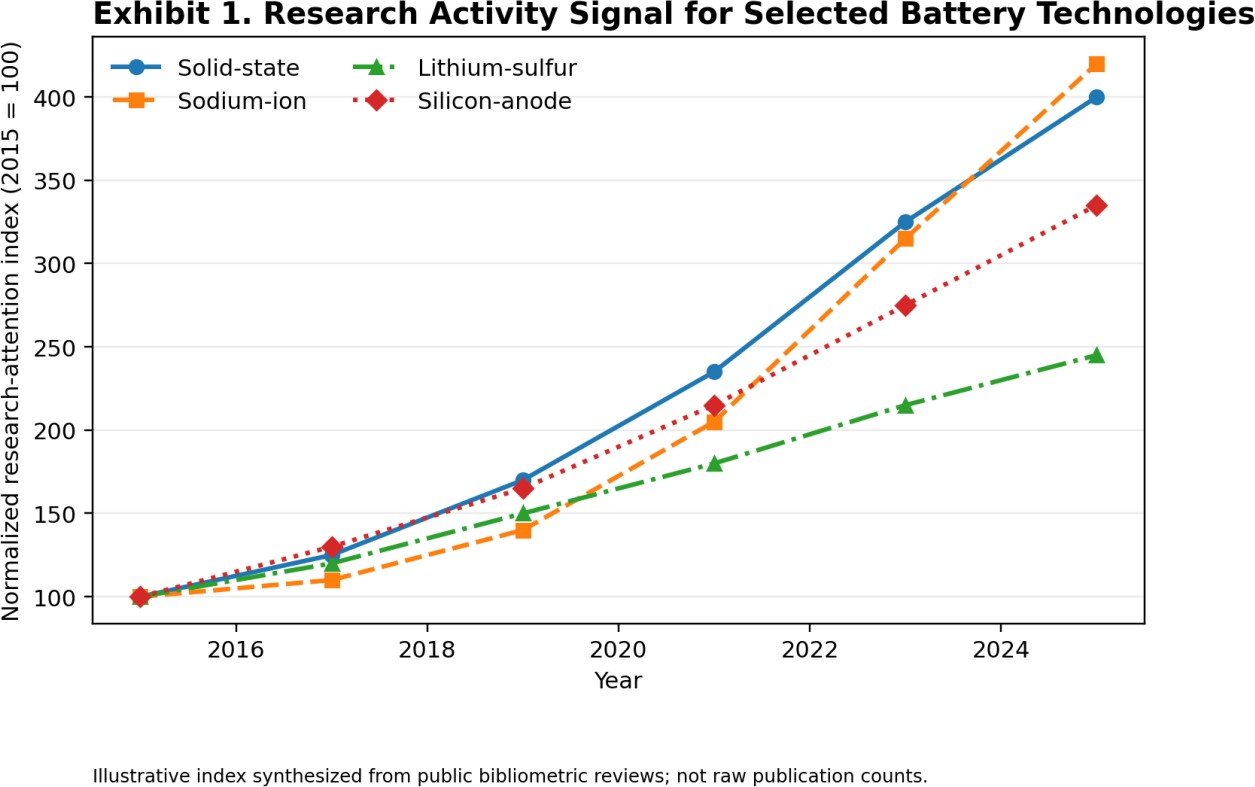
Source note: Directional index synthesized from public bibliometric studies reporting sustained growth in solid-state battery research, a notable rise in sodium-ion publications, and continuing research interest in lithium-sulfur and silicon-anode systems. The index is illustrative and is not a substitute for a database-specific bibliometric search strategy.
Research Objectives
Objective
Decision Supported
Evaluate technology maturity
Which technologies are ready for further
development?
Are current technical expectations realistic?
Can the technology be scaled and integrated?
Are critical materials and suppliers available?
Which options best fit the product roadmap?
Where should future RCD attention be directed?
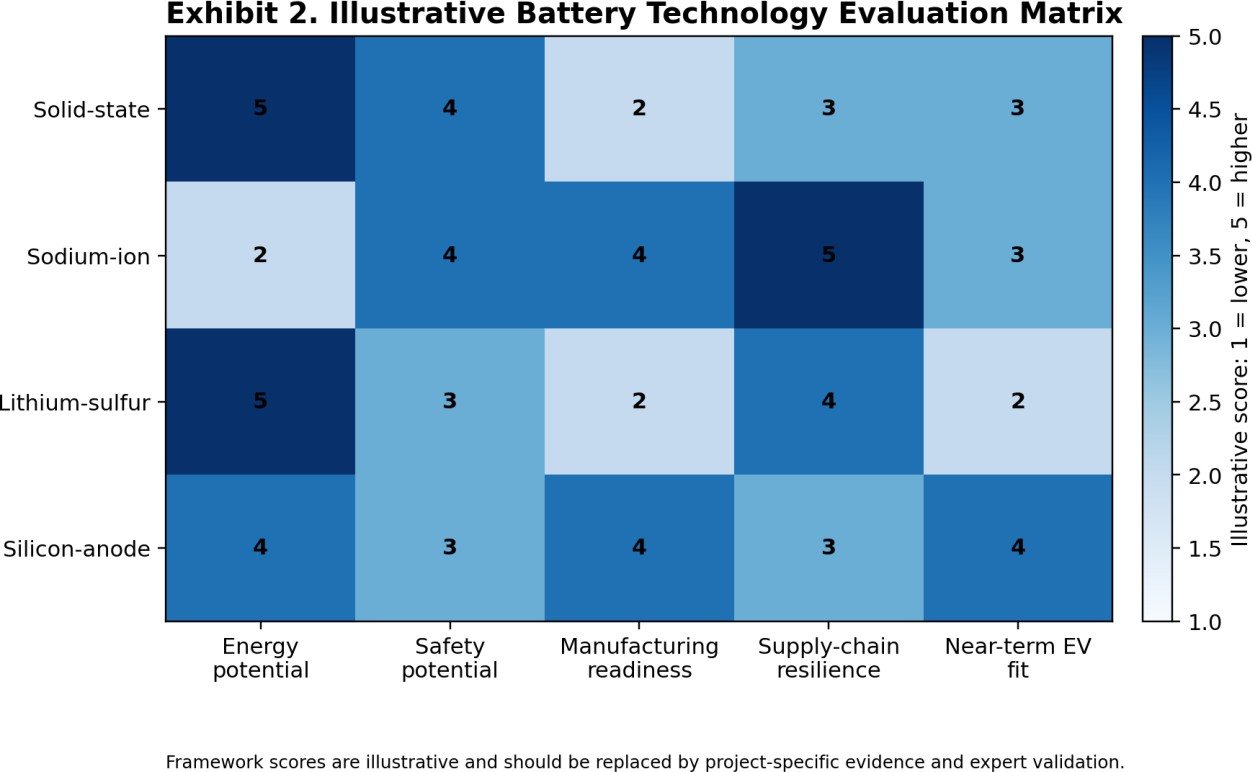
Source note: Dimensions reflect recurring considerations in DOE technology assessments and recent battery reviews, including safety, energy potential, manufacturability, supply-chain exposure, and commercialization readiness. Scores shown are illustrative placeholders for a client-specific assessment.
Scope of Research
Primary Research
A structured interview program is developed across research, engineering, manufacturing, commercialization, and supply-chain functions. The objective is to test assumptions from multiple perspectives rather than rely on one expert category or a fixed panel.
- Battery scientists and electrochemists
- Materials scientists and solid-electrolyte specialists
- Battery-pack and vehicle-integration engineers
- Thermal-management and safety specialists
- Cell-manufacturing and process engineers
- Raw-material, recycling, and supply-chain specialists
- Independent industry and commercialization experts
Supporting Secondary Research
- Scientific literature and bibliometric analysis
- Patent landscape and assignee activity
- Technology landscape and startup activity
- Competitive benchmarking
- Industry standards and regulatory developments
- Supply-chain intelligence
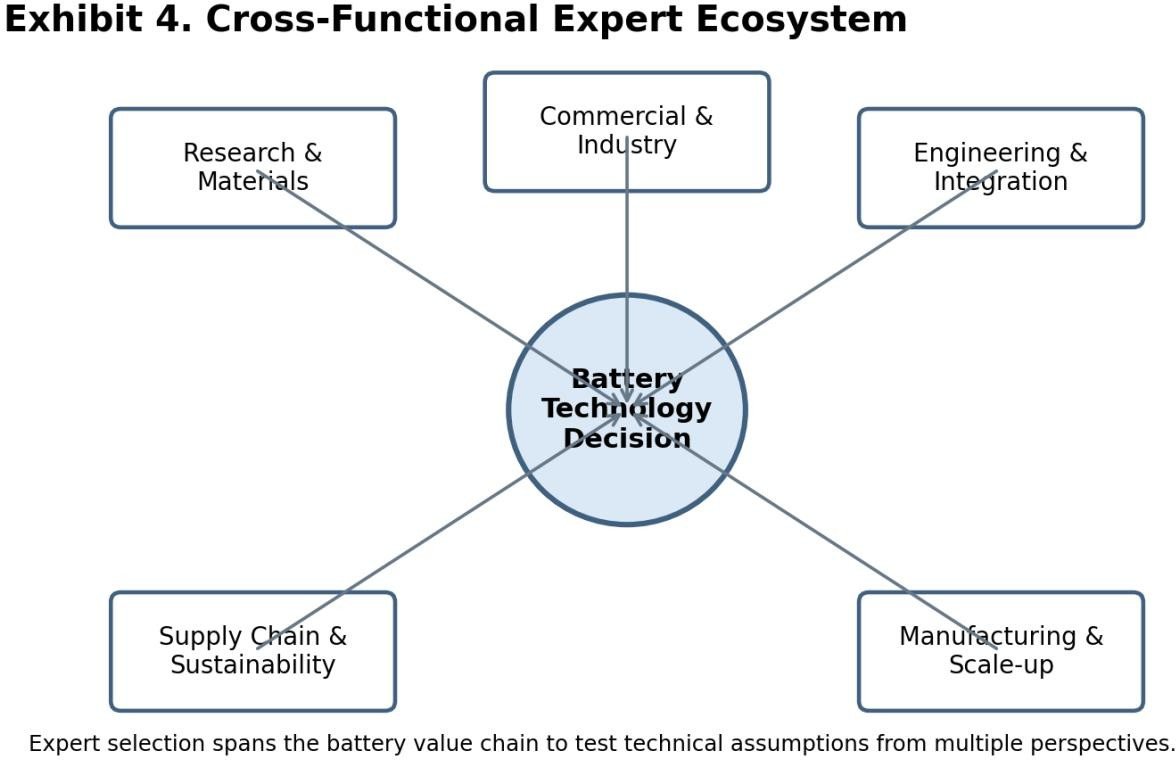
Exhibit interpretation: Expert selection is designed to capture the interdependence between materials science, engineering integration, manufacturability, commercial deployment, and supply-chain resilience.
August Research Approach
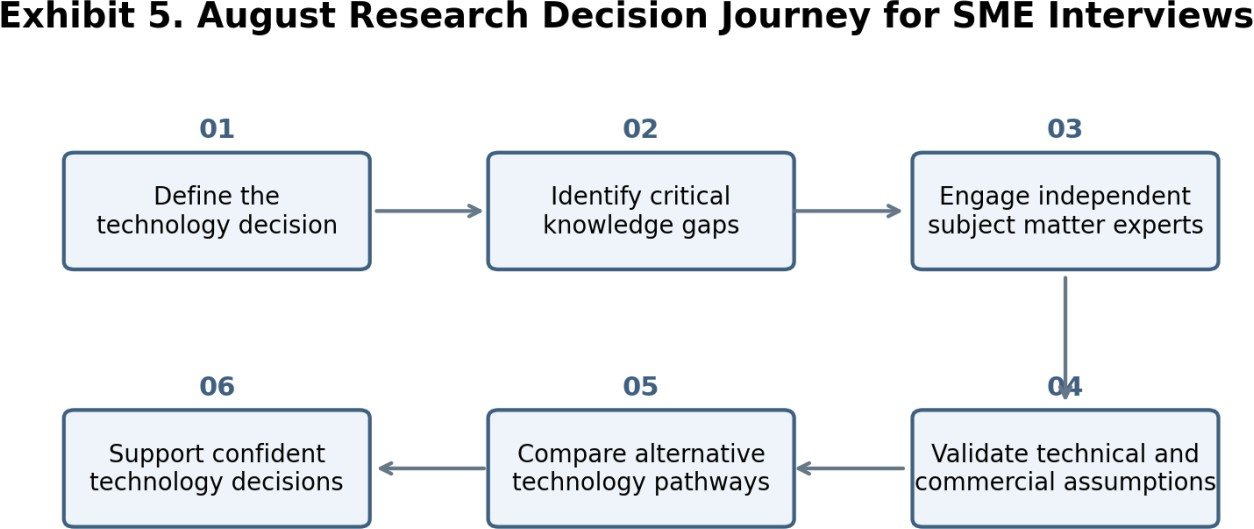
The methodology follows the client's decision journey. Each stage narrows uncertainty and converts expert knowledge into a comparative, decision-ready assessment.
Key Research Questions
- Which chemistries demonstrate the strongest evidence of technical maturity?
- Which technologies are most likely to achieve commercial scale within the relevant planning horizon?
- What engineering, interface, safety, and lifecycle challenges remain unresolved?
- Which manufacturing processes or equipment changes would be required?
- What raw-material and supplier dependencies could constrain commercialization?
- Which technology pathways best align with the client's vehicle, cost, and sustainability priorities?
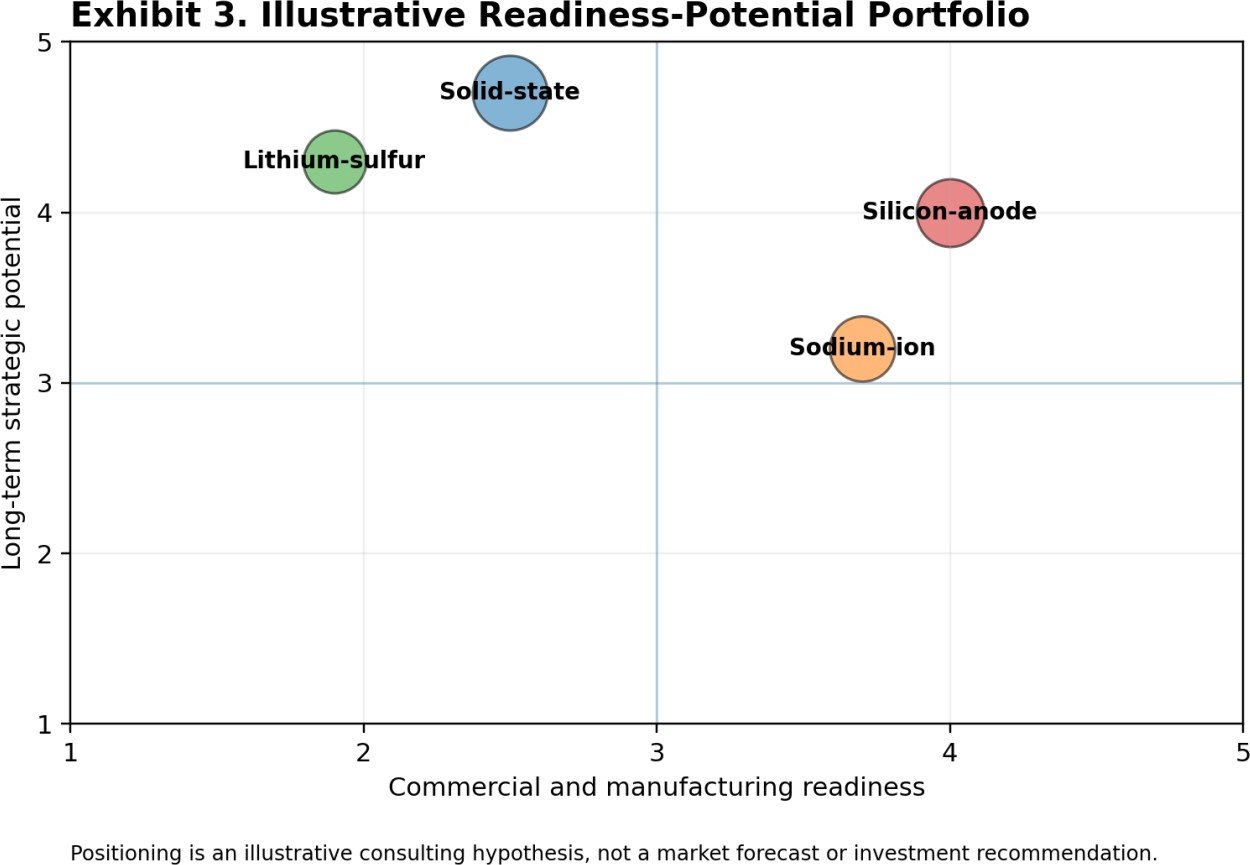
Source note: Portfolio positions are illustrative hypotheses informed by public technology assessments and reviews. A real engagement would establish criteria, weighting, evidence thresholds, and expert validation with the client before positioning technologies.
Project Outcomes & Outputs
Purpose
Key conclusions and strategic implications for senior
stakeholders.
Synthesized perspectives, including areas of
consensus and disagreement.
Evidence-based comparison across client-defined
criteria.
Assessment of maturity, manufacturing readiness,
and scale-up dependencies.
Technical, supply-chain, implementation, and
commercialization risks.
Prioritization, monitoring, partnership, and validation
actions.
Decision-focused presentation for stakeholder
alignment.
Decision Outcomes
The engagement is designed to help the client decide which battery technologies should advance to prototype development, which require additional validation, which partners or suppliers merit deeper evaluation, how RCD resources should be allocated, and which emerging pathways should remain on the long-term monitoring agenda.
Why SME Interviews Matter
Organizations making strategic RCD and innovation decisions often have access to extensive technical information through scientific publications, patents, conference proceedings, supplier documentation, and internal research. These sources are valuable, but they rarely capture the practical experience gained through technology development, manufacturing, commercialization, and real-world implementation.
Subject Matter Expert Interviews bridge this knowledge gap by providing direct access to professionals with first-hand experience across the technology lifecycle. These discussions help validate assumptions, challenge prevailing views, identify implementation risks, and understand practical trade-offs that are often unavailable through secondary research alone.
When combined with scientific literature, patent intelligence, technology landscape analysis, and competitive research, SME Interviews provide a more complete view of emerging technologies and their commercial potential. The result is decision-ready intelligence that supports more confident RCD, product-development, and investment decisions.
Research Sources for the Illustrative Exhibits
U.S. Department of Energy, "Breaking It Down: Next-Generation Batteries"
Summarizes benefits and manufacturing needs for solid-state and sodium-ion batteries, including safety, critical-material, scalability, and manufacturing considerations.
U.S. Department of Energy, "Sodium Batteries Technology Strategy Assessment" (2023)
Discusses sodium-ion maturity, commercial applications, solid-state sodium challenges, material interfaces, manufacturing scale-up, pilot demonstrations, and lifecycle needs.
Bridgelall, R., "Scientometric Insights into Rechargeable Solid-State Battery Developments," World Electric Vehicle Journal (2024)
Reports sustained publication growth in solid-state battery research from 2015-2024 and identifies electrolyte, electrode, architecture, and performance themes.
Özsin et al., "An overview of sodium-ion batteries as next-generation sustainable electrochemical energy storage systems" (2024)
Reports a notable rise in sodium-ion battery publications and reviews technology benefits and limitations.
Dörfler et al., "Recent Progress and Emerging Application Areas for Lithium-Sulfur Battery Technology" (2020)
Reviews performance benefits, limitations, and the path toward practical lithium-sulfur applications.
Thomas et al., "Technological Advances and Market Developments of Solid-State Batteries" (2024)
Reviews solid-state battery technology, commercialization challenges, and market development.
U.S. Department of Energy, Energy Storage Grand Challenge Roadmap
Provides a broader framework for technology performance, safety, manufacturing, supply-chain, and commercialization considerations.