Commercialising Green Hydrogen for an Existing Ammonia Asset
ILLUSTRATIVE ENGAGEMENT | SUBJECT MATTER EXPERT INTERVIEWS
R&D, Product Development & Innovation
Subject Matter Expert (SME) Interviews
Chemicals, Fertilisers & Clean Energy
Offtake-first primary research supported by secondary research
6-8 weeks
Disclaimer: This illustrative engagement demonstrates how August Research approaches complex technology and innovation challenges. It is for demonstration purposes and does not represent an actual client assignment. Visuals labelled illustrative are frameworks or source-informed hypotheses, not client findings.
Executive Summary
A regional fertiliser producer is assessing a first renewable-hydrogen tranche at an existing ammonia complex—lowering product carbon intensity while protecting plant reliability and commercial competitiveness.
The question is not simply which electrolyser to buy. August Research uses an offtake-first SME Interview program to test demand, delivery, certification and bankability, then recommends whether to go, hold or stage the transition.
Why This Engagement?
Hydrogen projects are moving from ambition to commercial discipline. Industrial demand is an early adoption route, but high costs, uncertain offtake, infrastructure and policy execution still constrain progress. An existing ammonia asset has a real use case; the test is whether it can become a bankable operating model.
Client Background
The illustrative client operates an established ammonia facility with internal hydrogen demand and industrial customers. Management is considering a first lower-carbon product tranche before any larger transition. Options include on-site production, grid-connected electrolysis or a contracted supply arrangement—each with different cost, integration, certification and risk implications.
The Decision to Be Made
The engagement supports a go / hold / stage decision: which pathway merits pre-FEED, and which conditions must be secured before capital is committed.
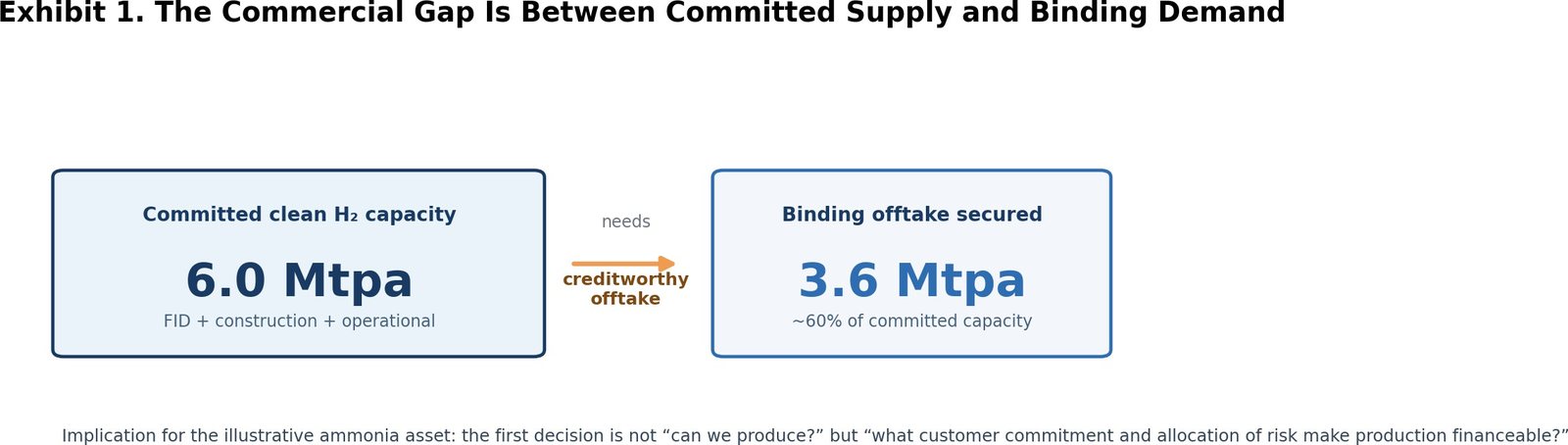
Source note: Hydrogen Council's Global Hydrogen Compass 2025 reports around 6 Mtpa of committed clean-hydrogen capacity and 3.6 Mtpa of binding offtake, covering roughly 60% of committed capacity. The quantities shown are sector context, not client data.
A Different Commercialisation Lens
Rather than starting with an electrolyser technology comparison, the work begins with the product and the customer. The framework below moves from a credible demand signal to delivery feasibility, financing logic and controlled scale-up.
1. DEMAND
Anchor a real hydrogen use case and offtake commitment.
2. DELIVERY
Validate power, water, equipment, integration and logistics.
3. BANKABILITY
Test cost, incentives, contracts and risk allocation.
4. SCALE
Stage investment around proven operating and commercial milestones.
Source note: The gate sequence is an August Research illustrative framework. It reflects the current market emphasis on firm offtake, infrastructure readiness, incentives and project bankability described by the IEA and Hydrogen Council.
Decision Criteria
Criterion | What the client needs to establish |
|---|---|
Customer value | Does the offer meet a defined procurement, compliance or decarbonisation need? |
Delivered economics | Can cost, incentives and premiums support the first tranche? |
Operating resilience | Can the pathway meet reliability, purity, storage and safety requirements? |
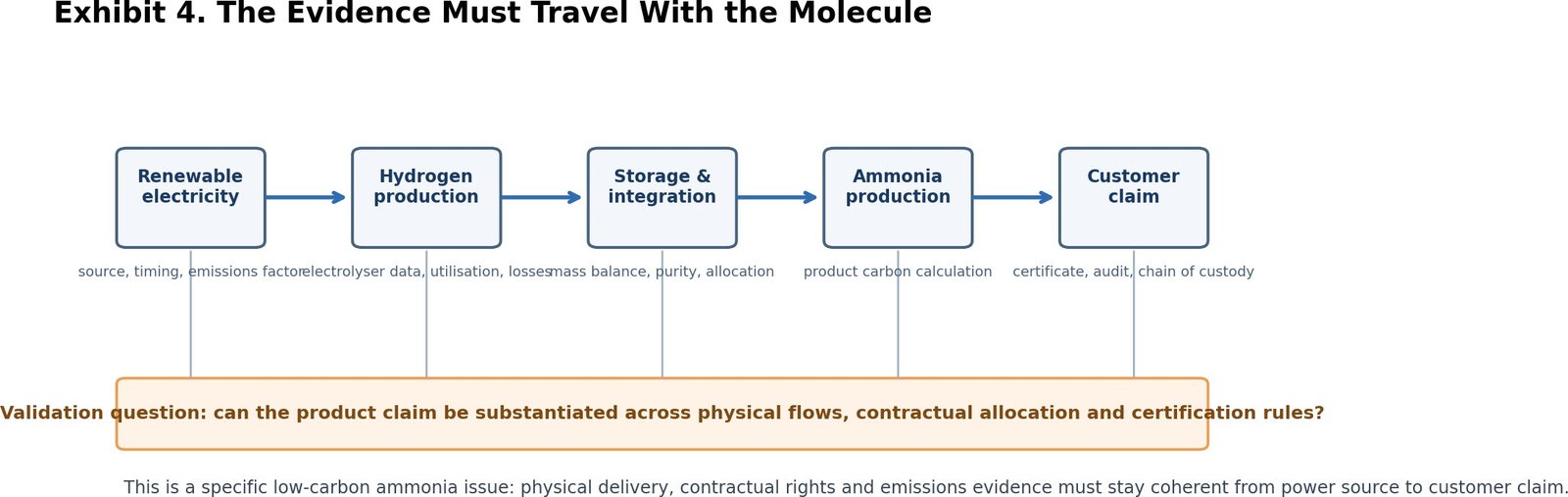
Certifiable claims | Can the product claim be audited for target markets? |
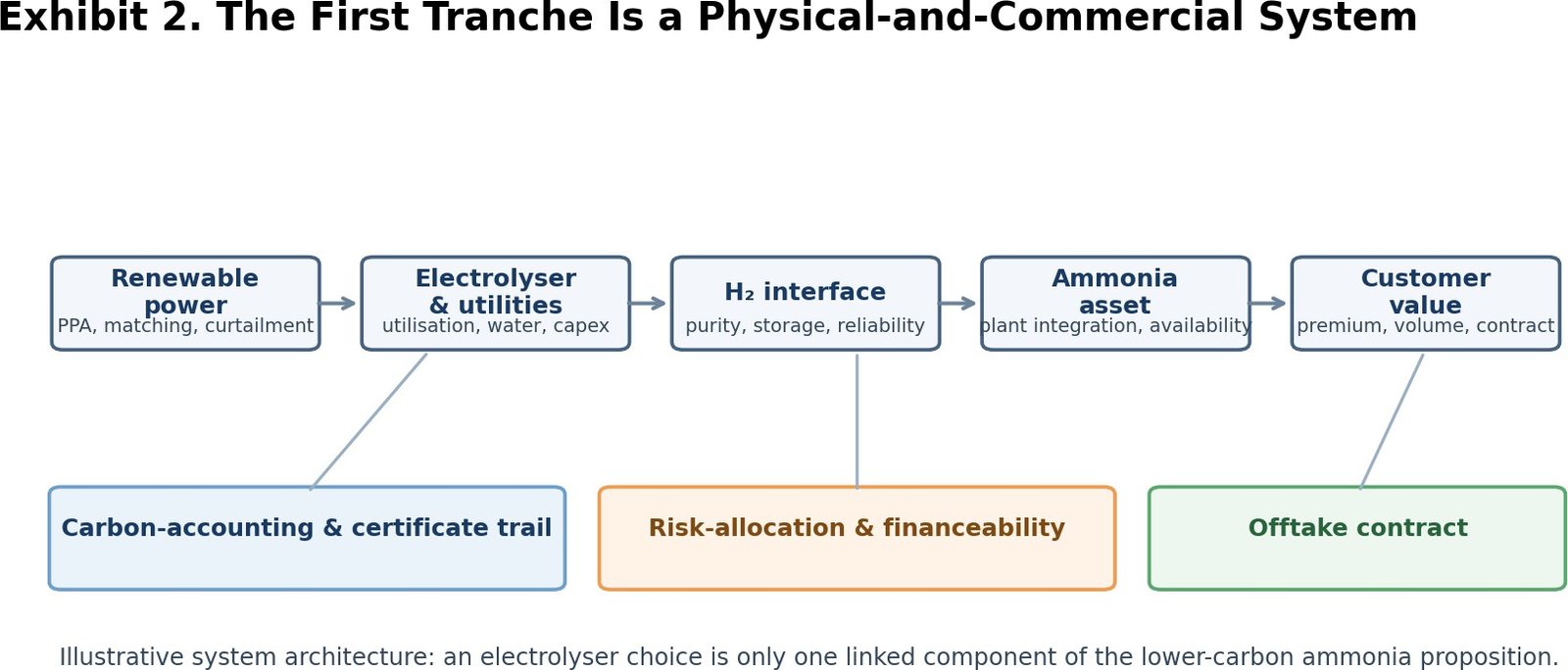
Source note: This is an August Research illustrative system map. It is designed to identify linked interfaces and proof requirements, not to prescribe a configuration before client-specific evidence has been tested.
Research Objectives
Objective | Decision supported |
|---|---|
Validate a marketable use case | Which customers can justify a first lower-carbon ammonia tranche? |
Test the operating model | Can supply meet integration, availability, purity and safety expectations? |
Compare pathways | Should the client produce, procure or blend hydrogen—and on what terms? |
Set bankability conditions | What commitments, incentives, risk allocation and evidence are required? |
Define the next gate | What must be proven before the client moves from tranche one to scale? |
Source note: The objectives deliberately address adoption and bankability as well as technology. IEA notes that firm low-emissions hydrogen offtake is still limited and that refining and chemicals are among the lead industrial adoption sectors.
Key Research Questions
- Which customers will value, procure or co-develop a lower-carbon product?
- What availability, purity, storage and safety constraints apply at the plant?
- Which supply pathway has the clearest first-tranche economics and risk profile?
- What offtake terms and evidence make the investment case credible?
Scope of Research
Primary Research
The interview panel is purpose-built to test assumptions across the value chain—not to create a generic expert panel.
- Ammonia operations, process engineering and maintenance leaders
- Electrolyser, power, storage, compression and safety specialists
- Hydrogen developers, commercial-structuring and project-finance specialists
- Fertiliser buyers and low-carbon procurement leaders
- Certification, lifecycle-assessment and regulatory specialists
Supporting Secondary Research
- Hydrogen projects, offtake, infrastructure and supply pathways
- Ammonia demand, customer needs and product positioning
- Incentives, certification, carbon accounting and trade requirements
- Comparable projects and supply-chain signals
Evidence Architecture
Evidence stream | Role in the decision |
|---|---|
Operators and engineers | Test what can be integrated and operated reliably. |
Commercial counterparties | Test whether buyers, suppliers and partners can support the risk allocation. |
Policy and certification specialists | Test claim eligibility, incentives and evidence requirements. |
Market evidence | Benchmark the pathway against current maturity and commercial signals. |
Source note: Expert perspectives are assessed as evidence, not treated as standalone fact. August Research validates areas of consensus, divergence and uncertainty against primary source material and client-specific assumptions.
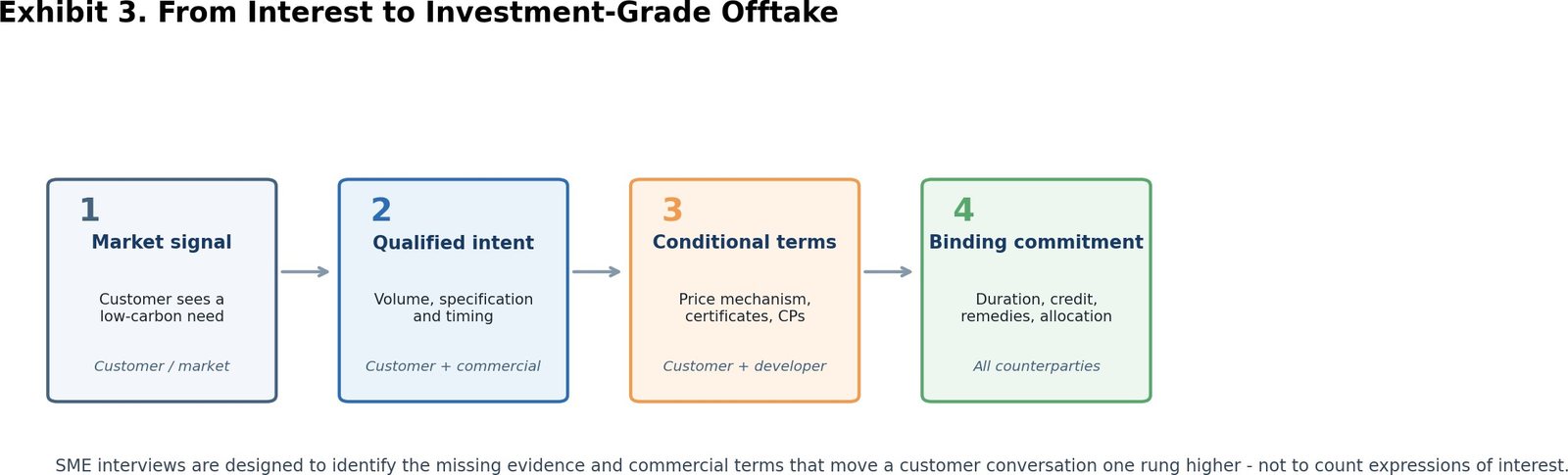
How Interviews Advance the Offtake Decision
Current conversation | What interviews are designed to test |
|---|---|
Product interest | Which application, claim and specification creates a buying reason. |
Qualified intent | What volume, timing, flexibility and premium logic matter. |
Conditional terms | Which price, certificate and risk-allocation terms are negotiable. |
Binding commitment | Which credit, duration and verification terms make offtake bankable. |
August Research Approach
Each gate creates the evidence needed for the next decision, beginning with the demand and contracting conditions that make a technical option investable.
Stage | How the work is applied | Decision output |
|---|---|---|
1. Frame the opportunity | Define the product, target customers, volume range and thresholds. | Commercialisation brief. |
2. Test demand | Interview buyers and partners; assess commitment, premium and volume. | Demand anchor and offtake requirements. |
3. Validate delivery | Test power, integration, storage, safety and operating assumptions. | Credible supply pathways. |
4. Stress-test bankability | Evaluate costs, incentives, contracts and risk allocation. | Progress / hold / redesign case. |
5. Set the next gate | Translate evidence into milestones and partner priorities. | Route to pre-FEED, pilot or deferral. |
Illustrative Scenario Lens
The project does not assume an owned electrolyser is the answer. It compares three pathways against the same decision criteria.
Pathway | Illustrative consideration |
|---|---|
On-site production | Greater control; depends on robust power, integration and utilisation assumptions. |
Contracted supply | Lower early capital exposure; depends on supply reliability and contracts. |
Phased hybrid | Validates product, certification and customer demand before scale. |
Source note: The pathway comparison is illustrative. A real engagement would model client-specific energy, plant, regulatory, location and contractual variables before reaching a recommendation.
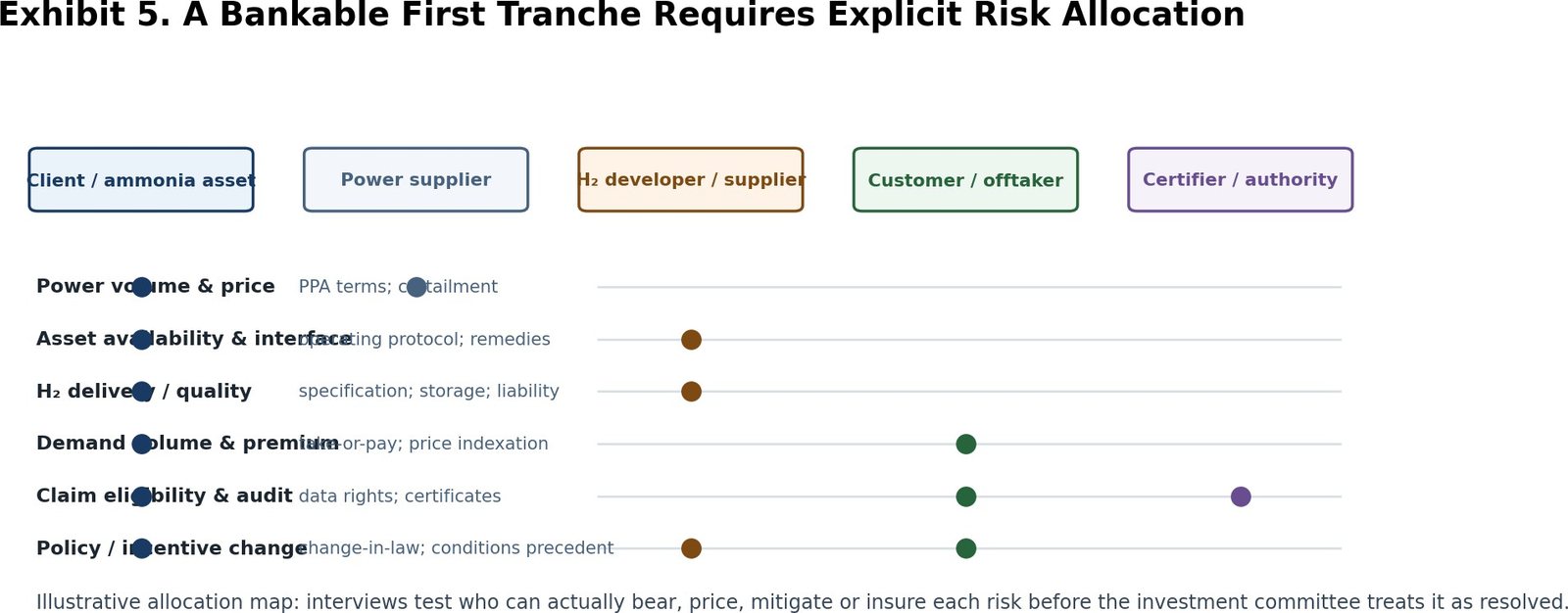
Source note: This allocation map is illustrative. It frames the contracting questions to test with counterparties; it is not a legal allocation of liability or an investment recommendation.
What the SME Program Must Establish
- Which risks remain with the ammonia asset and which need transfer, mitigation or insurance.
- Which performance obligations power suppliers, hydrogen suppliers and customers will accept.
- Where claim and certificate responsibilities must sit.
Project Outcomes & Outputs
Output | Purpose |
|---|---|
Commercialisation brief | Use case, decision thresholds, assumptions and evidence gaps. |
Expert insight report | Consensus, disagreement and practical implications. |
Offtake assessment | Demand anchors, commercial requirements and product-claim considerations. |
Supply-pathway assessment | Production, procurement and hybrid options. |
Bankability and risk register | Cost, policy, delivery, counterparty and certification risks. |
Decision-gated roadmap | Next actions, partner priorities and release conditions. |
Decision Outcomes
The engagement answers a more useful question than "Is green hydrogen attractive?": "What must be true for our first lower-carbon ammonia tranche to be worth advancing?"
- Whether to advance, pause or redesign the initial renewable-hydrogen tranche.
- Which supply configuration should move into pre-FEED or partner discussions.
- Which customer conversations and terms constitute a credible demand signal.
- Which operating and certification gaps must be resolved before capital is committed.
- What triggers the next scale decision.
Why SME Interviews Matter
Green-hydrogen commercialisation spans engineering, power, procurement, financing, certification and policy. Structured SME Interviews test the client’s assumptions with the people who build, operate, buy, certify and finance these systems—producing a decision-ready view of what is strong, uncertain and worth proving next.
Research Sources for the Illustrative Engagement
The engagement design and contextual statements are informed by the following public sources. These sources frame market conditions and decision considerations; they are not presented as client findings.
- International Energy Agency (IEA), Global Hydrogen Review 2025 — Executive Summary.
- IEA, Global Hydrogen Review 2025 — Demand.
- IEA, Hydrogen Production and Infrastructure Projects Database (updated June 2026).
- Hydrogen Council, Global Hydrogen Compass 2025.
- International Renewable Energy Agency (IRENA), Green Hydrogen for Industry: A Guide to Policy Making (2022).
- IRENA and UNIDO, Green Hydrogen for Sustainable Industrial Development (2024).
August Research Perspective
This engagement moves beyond a generic hydrogen opportunity scan. It begins with the demand anchor and tests commercial, operating and financing conditions together.
Let's Discuss Your Project
August Research can design a structured SME Interview program around the uncertainty that matters most to your investment decision.