Near-Patient Diagnostics Adoption
Making a Faster Molecular Result Usable in Care
ILLUSTRATIVE ENGAGEMENT | SUBJECT MATTER EXPERT INTERVIEWS
Illustrative note: This illustrative engagement shows a possible August Research approach. It does not describe an actual client assignment. Charts and scores labelled illustrative are working frameworks, not client findings.
Executive Summary
A diagnostic developer is preparing to introduce a near-patient molecular respiratory test into ambulatory and urgent-care settings.
The research asks where a rapid answer changes a clinical action, who must operate and trust the system, and what proof procurement needs to support a focused launch.
Client Background
The illustrative client has developed a cartridge-based molecular platform that can return a respiratory result closer to the point of care. It must choose a first use case and launch setting before investing in broad commercial rollout.
The Decision to Be Made
Which care settings and clinical use cases should be prioritised, and what clinical, operational and economic evidence is needed to support adoption?
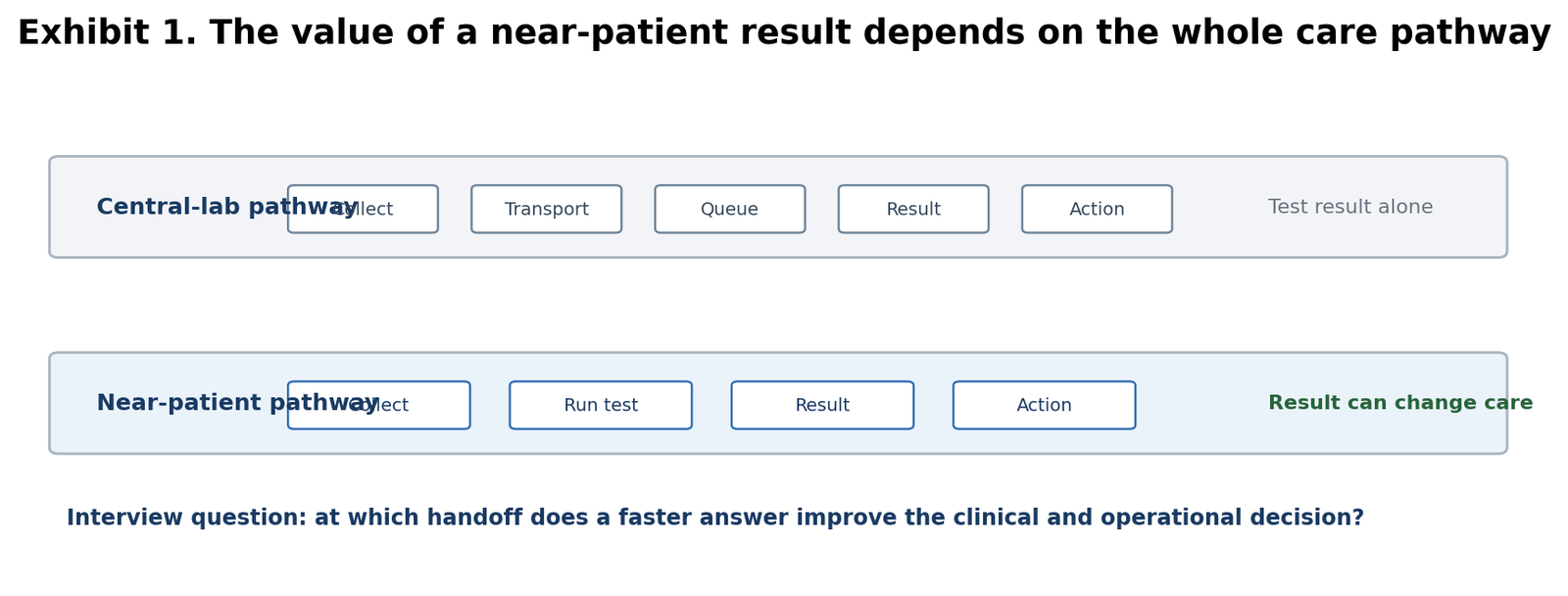
A Workflow-to-Adoption Lens
Test performance matters, but adoption depends on whether the result fits a real care workflow and has a clear owner. The work starts with the clinical decision, not the instrument specification.
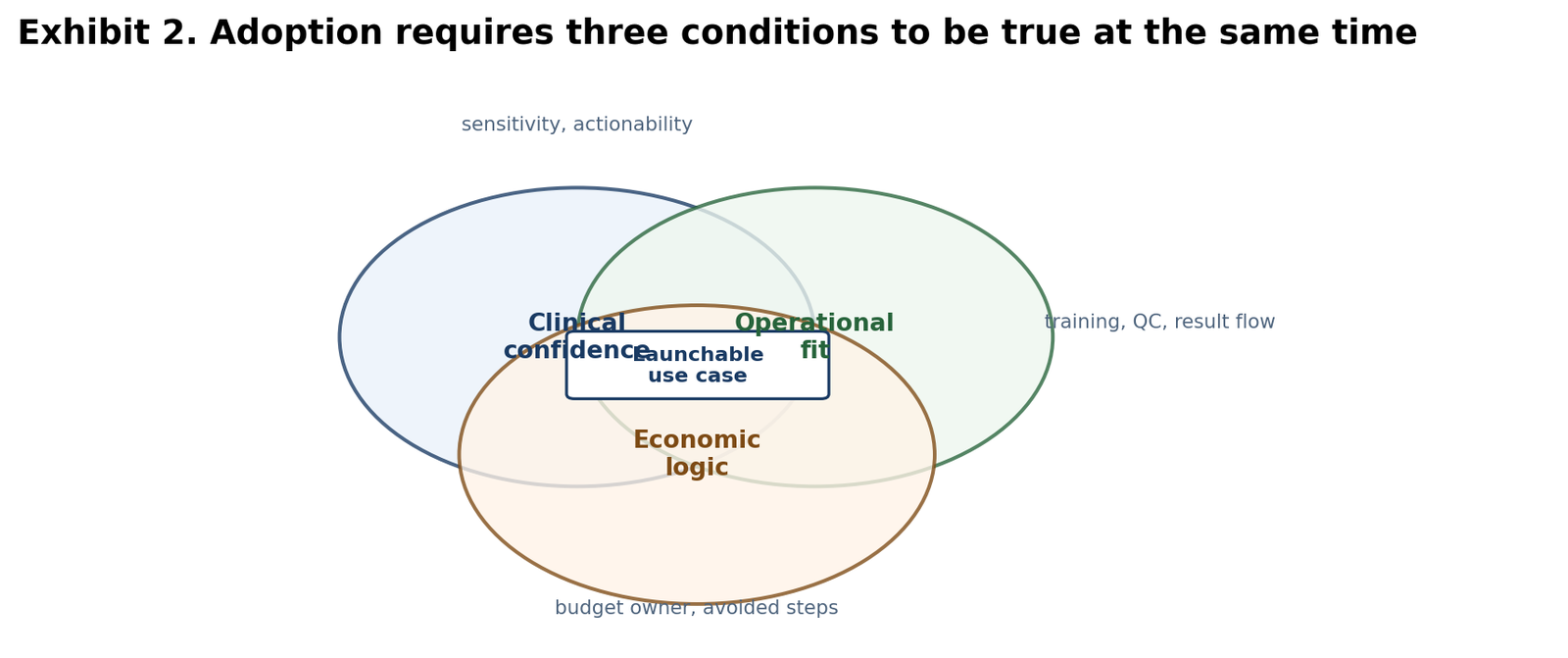
Research Objectives
- Identify the clinical decisions that benefit from a near-patient molecular result.
- Test operational fit across sampling, quality control, result routing and escalation.
- Clarify the economic story for the accountable buyer.
- Recommend a launch perimeter and evidence-development plan.
Purpose-Built Interview Panel
The interview panel is selected around the use case rather than around the device category alone.
- Urgent-care and primary-care clinicians.
- Laboratory medicine, quality and infection-control leaders.
- Practice operations, IT and connectivity specialists.
- Procurement, reimbursement and health-economics stakeholders.
- Implementation leaders from comparable diagnostic programs.
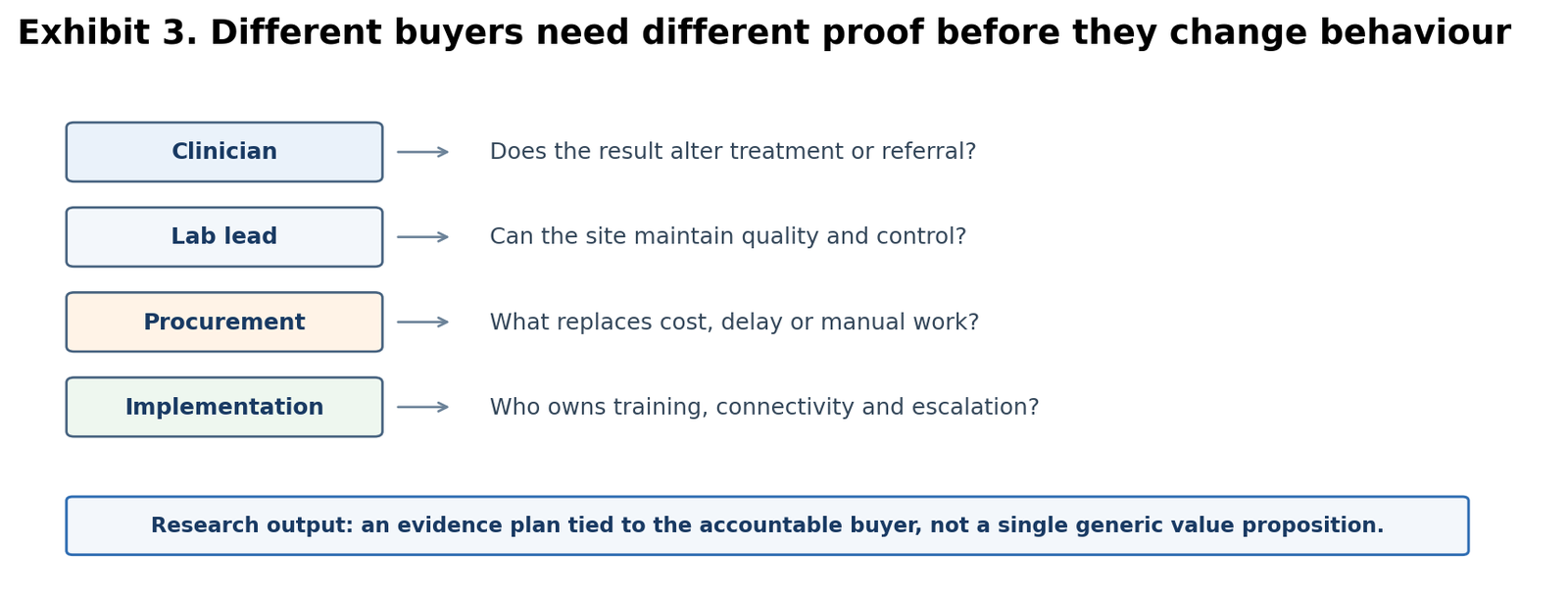
Evidence by Buyer, Not by Brochure
A product may be clinically credible yet still fail to scale if the laboratory, procurement and implementation questions remain unresolved. Interviews turn these different proof requirements into a practical launch plan.
How the Research is Conducted
Workstream | What it establishes | Output |
|---|---|---|
Clinical workflow | Where a result changes action and what turnaround time matters. | Prioritised use-case map. |
Site readiness | Training, quality control, connectivity and escalation needs. | Implementation requirements. |
Economic logic | Avoided handoffs, utilisation and budget ownership. | Buyer value hypothesis. |
Launch proof | Evidence gaps by clinician, laboratory and purchaser. | Focused evidence plan. |
Supporting Secondary Research
- WHO essential-diagnostics and diagnostic-capacity resources.
- Intended-use, quality and post-market monitoring requirements.
- Care-pathway and procurement models in selected launch markets.
Decision Synthesis
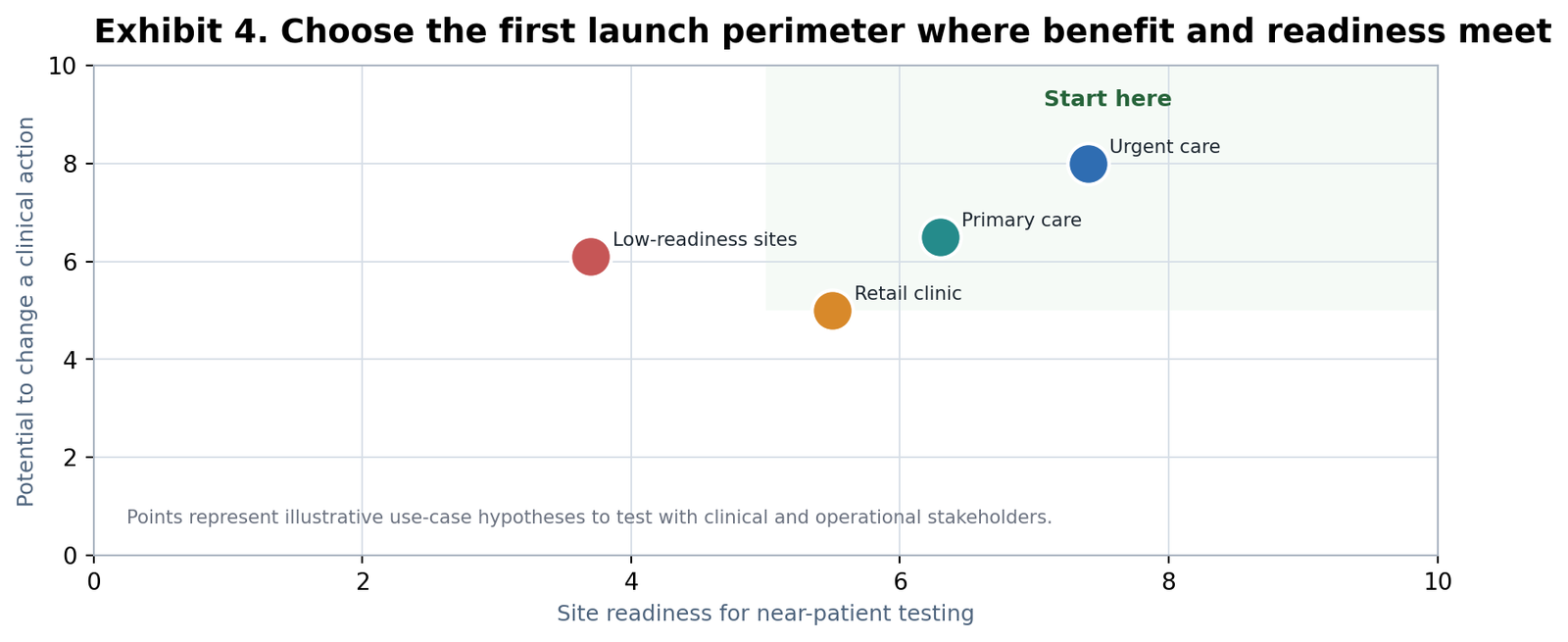
The outcome is not a broad statement that rapid testing is valuable. It is a practical answer to where this result changes care, who will adopt it first and what must be proven before wider launch.
Project Outcomes & Outputs
Decision outcome | Client-ready output |
|---|---|
Launch perimeter | Priority clinical use cases, sites and initial buyer groups. |
Adoption case | Clinical, operational and economic rationale for each priority setting. |
Evidence roadmap | Proof points, pilot measures and stakeholder owners. |
Commercial guidance | Positioning language that reflects the true workflow benefit. |
Why SME Interviews Matter
Diagnostic adoption involves more than a performance claim. SME Interviews bring together clinicians, laboratory leaders, operators and purchasers to test whether a faster result is genuinely usable in the setting where it is sold.
Research Sources for this Illustrative Engagement
The sources below inform the market context and research design. They are not presented as client findings.
1. World Health Organization, 2023 Essential Diagnostics List and supporting materials.
2. World Health Organization, Selection of Essential In Vitro Diagnostics at Country Level, 2021.
3. World Health Organization, Strengthening Diagnostics Capacity, accessed August 2026.
4. World Health Organization, Post-Market Surveillance of In Vitro Diagnostics.
5. World Health Organization, expansion of prequalification for in-vitro diagnostics, 2024.
August Research Perspective
This case frames diagnostics as a care-delivery decision. It identifies the narrow first setting where the technology is useful, operationally workable and commercially defensible.
Let's Discuss Your Project
August Research can design a structured SME Interview program around the uncertainty that matters most to your next decision.