STAKEHOLDER MAPPING | ILLUSTRATIVE ENGAGEMENT
What must change before recycled aggregate becomes routine?
A specification-to-use stakeholder study for transport and civil works in Victoria, Australia
THE BUSINESS DECISION A recycled-material producer wanted to understand why technically eligible aggregate remained inconsistently specified and procured for civil works. Before funding additional qualification and market development, the client needed to know which organisations interpreted, evidenced, purchased, installed and repeated the material's use.
39 ORGANISATIONS
Mapped decision system
12 INTERVIEWS
Contradiction-led selection
8 DOCUMENT CHECKS
Specifications and tenders
7 WEEKS
Illustrative delivery window
Why the setting mattered
The relevant decision system combined state-level specifications with project, council, contractor and supply conditions. The study therefore covered Victoria while distinguishing metropolitan and regional procurement, haulage and supply realities where they could alter adoption.
What the study needed to resolve
- Where does permitted specification wording still leave interpretation or liability uncertainty?
- Which evidence is accepted by specifiers, buyers, contractors and testing bodies?
- At what gate can procurement language or supply conditions reverse technical acceptance?
- What would allow successful project use to become repeatable rather than exceptional?
WHY INDEPENDENT RESEARCH MATTERED A supplier-led study could overemphasise product performance and understate procurement, risk allocation or contractor practice. Independent outreach allowed specifiers, buyers and users to explain why eligible material may still be excluded at a later decision gate.
All organisations, participant counts and findings in this example are hypothetical. They demonstrate a realistic research design and are not presented as market evidence.
02 | STAKEHOLDER UNIVERSE AND OUTREACH
Follow the material through five acceptance gates
The outreach began with documentary contradictions, then recruited practitioners able to explain why the same wording produced different project decisions.
Evidence before outreach
2 SPECIFICATIONS
Eligibility and evidence wording
3 TENDER PACKS
Procurement and approval clauses
2 ASSURANCE RECORDS
Testing and traceability requests
1 PROJECT CLOSEOUT
Evidence returned from field use
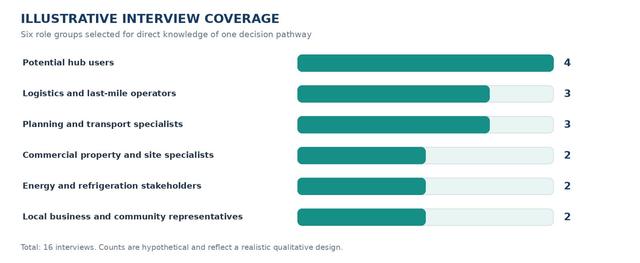
Who was interviewed
Specification and design | 3 interviews |
|---|---|
Public and private procurement | 2 interviews |
Civil contractors | 3 interviews |
Testing and assurance | 2 interviews |
Material production and logistics | 2 interviews |
What the outreach looked like
CONTRADICTION SAMPLING Recruit practitioners able to explain why similar material or wording produced different decisions.
DECISION-OWNER VERIFICATION Confirm the participant personally specified, approved, purchased, tested, supplied or installed the relevant material.
DOCUMENT-ANCHORED INTERVIEW Ask about a clause, evidence request or project event, not abstract support for recycled content.
SUPPLY REALITY CHECK Include metropolitan and regional conditions only where distance, volume or availability changes the gate.
RESEARCH SCALE Eight document checks narrowed the uncertainty before 12 interviews were conducted. The interview sample focused on decision points where similar technical inputs had produced different project outcomes.
03 | RESEARCH METHOD
Specification-to-Use Gate Mapping
The method traced the material through permission, evidence, procurement, installation and repeat-use gates rather than assigning stakeholders one generic influence score.
01 COMPARE
Review relevant wording, tender clauses and evidence requests.
02 LOCATE
Identify the owner and interpreter at each acceptance gate.
03 CONTRAST
Recruit cases where similar inputs led to different decisions.
04 RECONCILE
Test disputed evidence, risk and responsibility assumptions.
05 ENABLE
Define the actions required for repeatable project use.
Sample interview questions
SPECIFIER OR DESIGNER Assume the proposed aggregate meets the stated application limits. Which performance evidence, precedent or professional-liability concern would still influence whether you name or permit it in the project specification?
PUBLIC OR PRIVATE BUYER The tender could allow recycled material while leaving approval to the delivery team. Which procurement wording, assurance or supply commitment would make bids using the material genuinely comparable?
CONTRACTOR A compliant material may behave differently in storage, placement or quality control. Which site practices, programme risks or responsibility boundaries determine whether your team would price and use it?
TESTING OR ASSURANCE BODY The producer can provide routine test results and source records. Which variation, sampling, certification or traceability questions would need resolution before the evidence is relied upon?
MATERIAL PRODUCER Demand may arrive in irregular project volumes and locations. What inventory, haulage, production-control or notice conditions would determine whether the specification can be served reliably?
WHY THE OUTREACH STARTED WITH DOCUMENTS The decision was shaped by how written requirements were interpreted in practice. Document review located the points of ambiguity; interviews were then selected to explain contradictory decisions rather than to collect a general opinion sample.
04 | ILLUSTRATIVE FINDINGS
Technical permission did not guarantee procurement or repeat use
The hypothetical findings separated formal eligibility from the later decisions that determine actual demand.
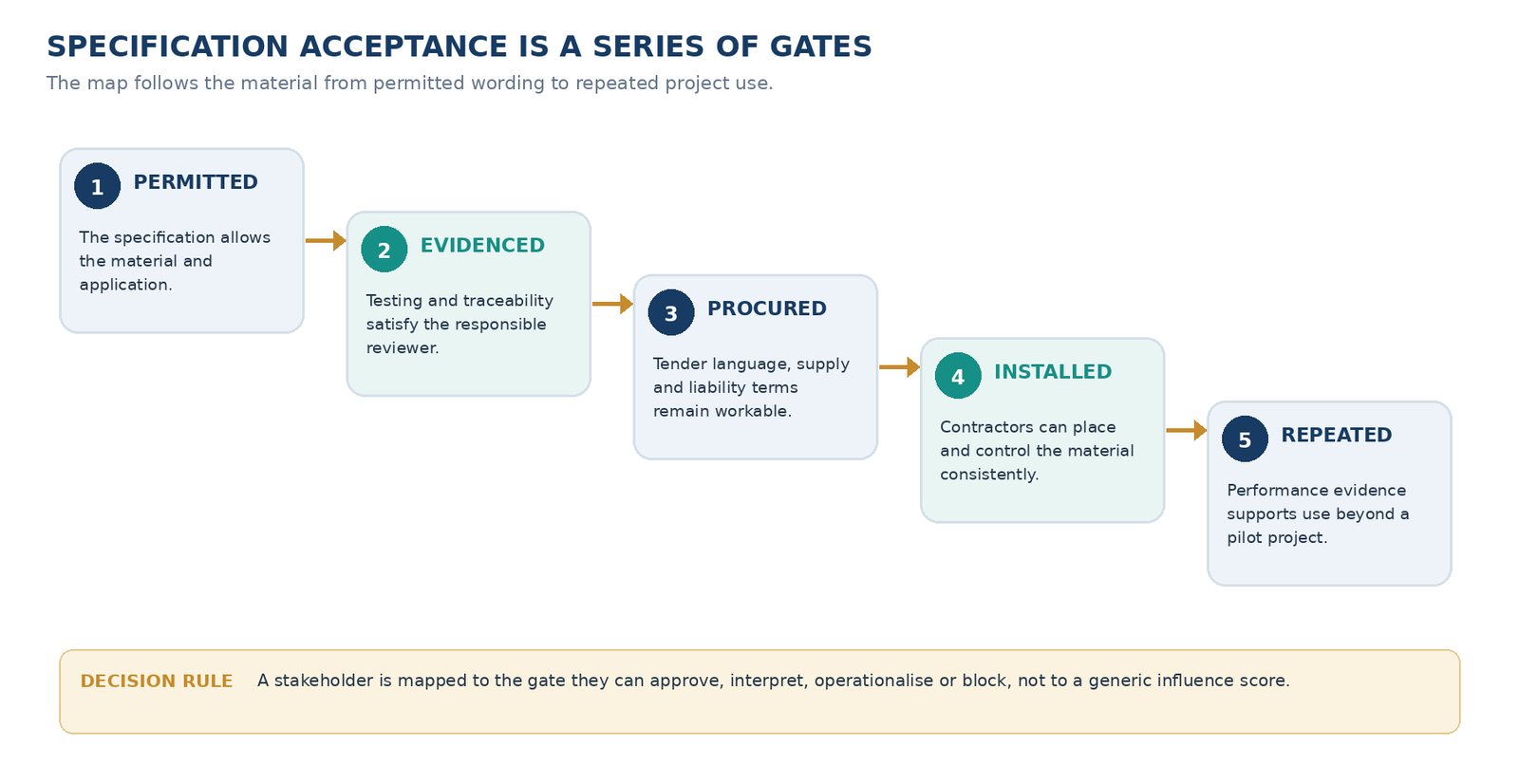
What the analysis indicated
WORDING LEFT DISCRETION
Permissive clauses still allowed project teams to require additional evidence or default to familiar material.
EVIDENCE NEEDED AN OWNER
Testing only resolved uncertainty when the responsible reviewer recognised the method, frequency and traceability.
PROCUREMENT COULD REVERSE ACCEPTANCE
Supply certainty, programme exposure and liability allocation could remove the material after technical approval.
REPEAT USE REQUIRED FEEDBACK
Performance from completed works needed a route back into specifications, tender templates and practitioner confidence.
DECISION PATTERN Prioritise the gate where the material is most often lost, then align evidence, commercial terms and field controls around the responsible decision owner.
05 | DECISION AND DELIVERY
Turn stakeholder evidence into an adoption workplan
The output showed which specification, assurance, procurement and delivery actions should be addressed before expanding capacity or market effort.
Recommended decision sequence
1 RESOLVE WORDING
Clarify the applications and discretion points that matter most.
2 ALIGN EVIDENCE
Match tests and traceability to the accountable reviewer.
3 REMOVE BID FRICTION
Address supply, liability and comparison conditions.
4 BUILD REPETITION
Return project evidence into future decisions.
What the client received
GATE-OWNER REGISTER
Organisations and roles classified by the decision they control or interpret.
SPECIFICATION PATHWAY
Written requirements linked to evidence, procurement and field-use gates.
CONTRADICTION LOG
Cases where similar technical inputs produced different commercial outcomes.
ADOPTION WORKPLAN
Priority wording, assurance, supply and feedback actions by gate.
Delivery
TIMING
Approximately seven weeks
WORKING OUTPUTS
Evidence-gap review after each decision gate
FINAL DELIVERY
Editable gate map, contradiction register and adoption readout
The timeline is illustrative and depends on stakeholder availability, access permissions, recruitment feasibility and client review time.
STUDY BOUNDARY The engagement would not certify the material, replace engineering judgement or guarantee acceptance in a tender. It would clarify how stakeholder decisions translate formal eligibility into project use.
Contact Us
MAP THE ROUTE FROM SPECIFICATION TO USE
Tell us the material, intended applications and decision geography. We will design the evidence review and outreach around the gates that shape adoption.