STAKEHOLDER MAPPING | ILLUSTRATIVE ENGAGEMENT
Which stakeholders must synchronise before a shore-power trial can run?
A berth-to-vessel readiness study for harbour-service vessels in Santos, Brazil
THE BUSINESS DECISION A marine-energy service provider was considering a shore-power trial for harbour-service vessels at two berth clusters. Before committing engineering and commercial resources, the client needed to know whether terminal, vessel, utility, service and oversight responsibilities could align within the same operating window.
27 ENTITIES
Mapped operating ecosystem
15 CONSULTATIONS
Berth and vessel roles
4 VESSEL PROFILES
Different connection needs
8 WEEKS
Illustrative delivery window
Why the setting mattered
Shore power is a location-bound service. Berth access, electrical infrastructure, vessel-call patterns, operating authority and local service capability had to be assessed around the proposed Santos trial area. The geography was therefore central to stakeholder selection rather than an optional market label.
What the study needed to resolve
- Which party controls each pre-clearance, connection, verification and exception decision?
- Which vessel profiles and berth windows offer a practical first trial?
- Where do technical readiness and commercial responsibility depend on different organisations?
- What evidence would be needed before repeating the service beyond one controlled call?
WHY INDEPENDENT RESEARCH MATTERED Each party could describe its own readiness without seeing the complete operational dependency. Independent consultations created a neutral view of conflicting assumptions about access, scheduling, cost, safety and incident responsibility before the client presented a fixed solution.
All organisations, participant counts and findings in this example are hypothetical. They demonstrate a realistic research design and are not presented as market evidence.
02 | STAKEHOLDER UNIVERSE AND OUTREACH
Recruit around the same vessel call and berth window
The outreach combined role-based consultations with four operating profiles so that participants responded to a shared trial condition rather than an abstract technology concept.
Four shared operating profiles
PROFILE A
Short call, lower hotel load
PROFILE B
Longer service window
PROFILE C
Restricted connection access
PROFILE D
Higher load and tighter schedule
Consultation architecture
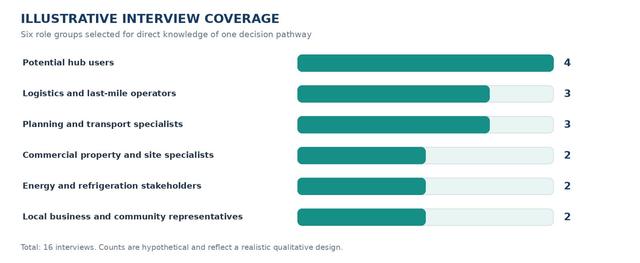
Terminal and berth operations | 3 consultations |
|---|---|
Vessel owners and operators | 4 consultations |
Utility and electrical stakeholders | 3 consultations |
Marine service providers | 2 consultations |
Oversight and local-impact roles | 3 consultations |
What the outreach looked like
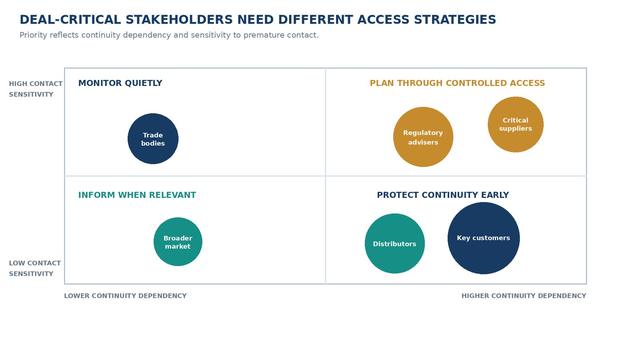
BERTH-SPECIFIC IDENTIFICATION Recruit roles connected to the proposed operating area, not a national port sample.
PROFILE BRIEFING Share only the vessel, load, window and responsibility assumptions needed for that participant.
BILINGUAL CONSULTATION Use Portuguese or English according to participant role and operating context.
SYNCHRONISATION REVIEW Return conflicts to the responsible role without disclosing another participant's identity.
CONSULTATION SCALE The 15 consultations covered four vessel profiles and two berth clusters that created distinct operating dependencies. The final mix would change with the selected trial configuration.
03 | RESEARCH METHOD
Berth-to-Vessel Synchronisation Mapping
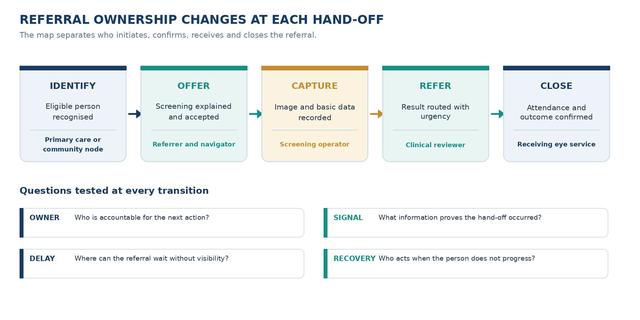
The method aligned responsibilities by operating moment: pre-clearance, berth preparation, connection, verification and repeat-service approval.
01 PROFILE
Define vessel, berth, power and timing conditions.
02 ASSIGN
Place an owner at each operating moment.
03 SIMULATE
Test a common trial call with each stakeholder group.
04 RECONCILE
Resolve assumption and responsibility conflicts.
05 GATE
Set evidence required to trial, repeat or expand.
Sample interview questions
TERMINAL OR BERTH OPERATOR Assume one harbour-service vessel would connect during a scheduled call without extending berth occupancy. Which access, cable-routing, operating-window and emergency conditions must be cleared before the trial is placed on the berth plan?
VESSEL OWNER OR OPERATOR The vessel would arrive with a defined connection interface and expected hotel load. What retrofit status, crew procedure, schedule certainty and commercial protection would be required before nominating a vessel?
UTILITY OR ELECTRICAL STAKEHOLDER The proposed trial has a bounded load and operating window. Which capacity, metering, energisation, power-quality and service-account questions must be confirmed before supply can be treated as available?
MARINE SERVICE PROVIDER Connection activity would occur within a live port environment. Which equipment checks, competent-person requirements, attendance and incident responsibilities would determine whether you could support the call?
OVERSIGHT OR LOCAL-IMPACT STAKEHOLDER The trial is intended to test one operating case rather than claim system-wide impact. What evidence and boundaries would be needed for the result to be interpreted responsibly?
WHY CONSULTATIONS USED OPERATING PROFILES General interviews could produce broad support without resolving one workable trial. Common vessel and berth profiles forced each participant to respond to the same timing, responsibility and evidence assumptions.
04 | ILLUSTRATIVE FINDINGS
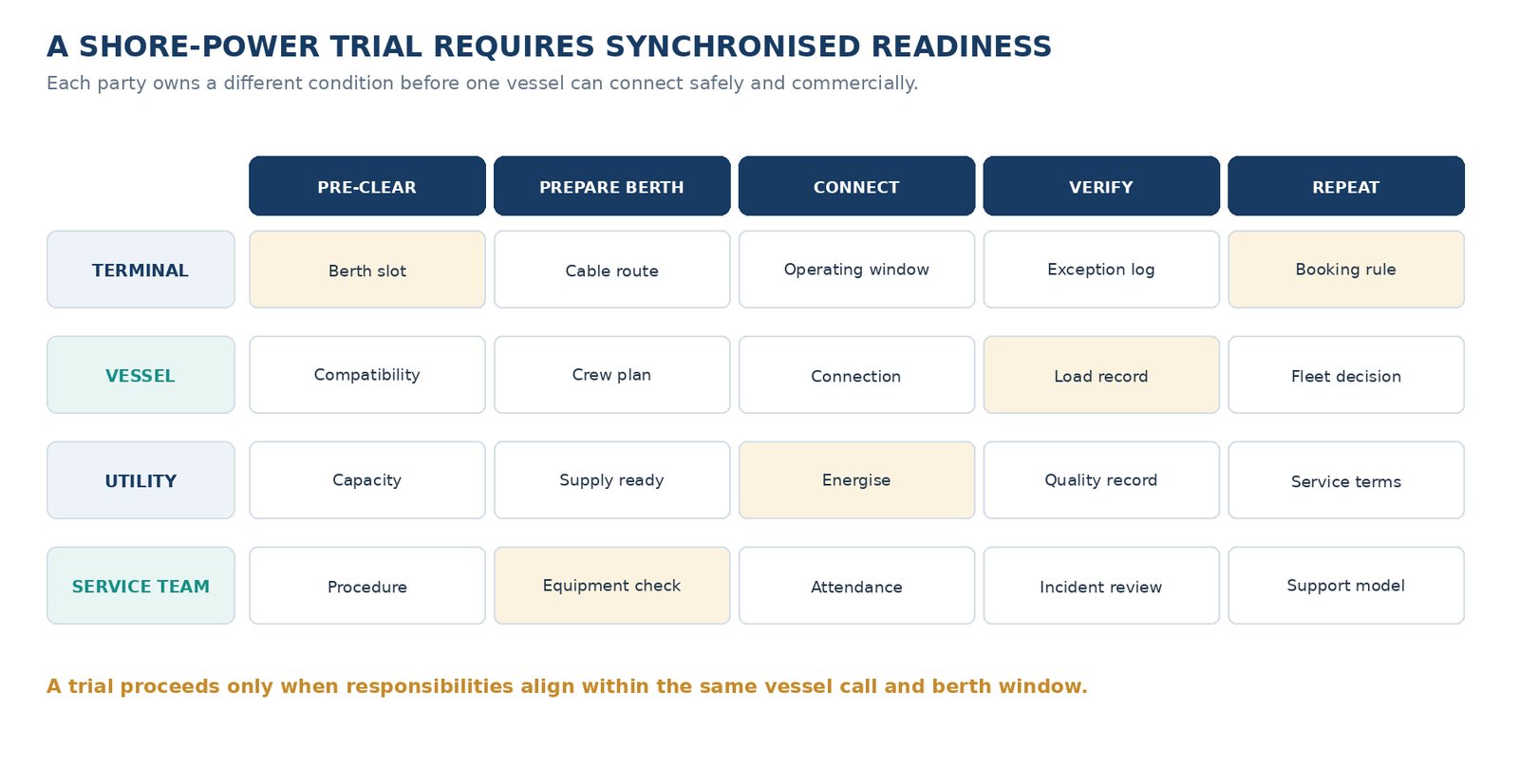
Readiness had to exist in the same operating window
The hypothetical analysis showed that individual willingness was insufficient when access, vessel, supply and service conditions matured at different times.
What the analysis indicated
BERTH ACCESS SET THE CLOCK
The trial needed a call where preparation, connection and verification could occur without disrupting terminal operations.
VESSEL COMPATIBILITY NEEDED PROOF
A nominated vessel required documented interface, load and crew readiness rather than fleet-level interest.
SUPPLY NEEDED SERVICE TERMS
Electrical availability was not complete until energisation, metering, quality and interruption responsibilities were defined.
REPEATABILITY NEEDED A RECORD
One successful connection needed an exception log and evidence package before it could support a repeat-service decision.
DECISION PATTERN Proceed only with a trial window where terminal, vessel, utility and service owners accept the same operating profile and evidence plan.
05 | DECISION AND DELIVERY
Turn the stakeholder map into a controlled trial gate
The output defined the minimum aligned condition for one trial and the evidence required before repetition or expansion.
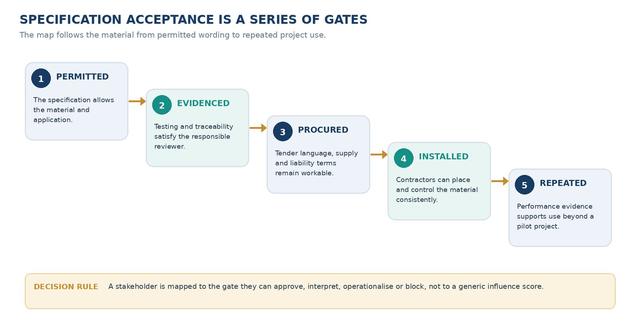
Recommended decision sequence
1 SELECT PROFILE
Choose the vessel and berth combination with the clearest fit.
2 CLEAR OWNERS
Assign access, connection, supply and incident responsibilities.
3 LOCK WINDOW
Confirm all readiness conditions against one call.
4 CAPTURE EVIDENCE
Record performance and exceptions for the repeat decision.
What the client received
OPERATING-ROLE REGISTER
Entities classified by berth, vessel, supply, service and oversight responsibility.
SYNCHRONISATION MAP
Owners and conditions aligned to each moment of the trial call.
TRIAL READINESS GATE
Minimum evidence and approvals required before scheduling.
REPEAT-SERVICE REGISTER
Performance, exceptions and unresolved actions for the next decision.
Delivery
TIMING
Approximately eight weeks
WORKING OUTPUTS
Readiness review by vessel and berth profile
FINAL DELIVERY
Editable role map, trial gate and management readout
The timeline is illustrative and depends on stakeholder availability, access permissions, recruitment feasibility and client review time.
STUDY BOUNDARY The engagement would not provide electrical design, maritime safety approval or regulatory advice. It would clarify stakeholder responsibilities, assumptions and evidence around the proposed operating decision.
Contact Us
ALIGN THE STAKEHOLDERS BEHIND YOUR FIELD TRIAL
Tell us the operating site, user profile and trial decision. We will map the organisations and responsibilities that must converge before resources are committed.