STAKEHOLDER MAPPING | ILLUSTRATIVE ENGAGEMENT
Which relationships could determine continuity after an acquisition?
A deal-continuity stakeholder study across the Benelux and Germany
THE BUSINESS DECISION A strategic buyer was assessing a specialty-ingredients acquisition with distributor-led routes to market and concentrated customer applications. Alongside commercial due diligence, the client needed to understand which external relationships could affect revenue continuity, supply resilience, regulatory confidence and integration sequencing after a transaction.
46 STAKEHOLDERS
Prioritised external universe
9 INTERNAL INTERVIEWS
Deal and operating teams
13 EXTERNAL INTERVIEWS
Controlled market outreach
6 WEEKS
Illustrative delivery window
Why the setting mattered
Customer qualification, distributor roles, supply relationships and regulatory expectations could operate differently across the Benelux and Germany. Geography was included where it changed relationship ownership, access or integration risk, not as a requirement to interview the same roles in every country.
What the study needed to resolve
- Which customer, distributor and supplier relationships are most dependent on individuals or informal routines?
- Which stakeholders could react negatively to premature or poorly sequenced contact?
- Where could integration change service, quality, regulatory or channel expectations?
- Which relationships require protection before close, at announcement or during the first 100 days?
WHY INDEPENDENT RESEARCH MATTERED Management interviews alone could overstate the portability of important relationships. Carefully controlled external research tested how customers, distributors, suppliers and advisers understood the relationship while protecting confidentiality and avoiding disclosure of a live transaction.
All organisations, participant counts and findings in this example are hypothetical. They demonstrate a realistic research design and are not presented as market evidence.
02 | STAKEHOLDER UNIVERSE AND OUTREACH
Separate relationship importance from contact permission
Forty-six hypothetical stakeholders were prioritised by continuity dependency, information sensitivity and the earliest safe route for evidence collection.
Two evidence streams
9 INTERNAL INTERVIEWS
Deal team, commercial, operations, quality, supply and integration roles reconstructed relationship ownership.
13 EXTERNAL INTERVIEWS
Selected customers, distributors, suppliers, market experts and advisers tested priority evidence gaps.
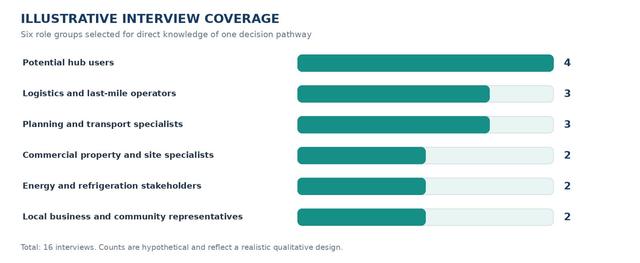
External coverage
CUSTOMERS
4 interviews
DISTRIBUTORS
3 interviews
CRITICAL SUPPLIERS
2 interviews
INDEPENDENT MARKET EXPERTS
2 interviews
REGULATORY OR QUALITY ADVISERS
2 interviews
What the outreach looked like
CODE-NAME PROTOCOL Use approved neutral language and disclose no transaction or target identity.
PERMISSION TIERS Separate blind research, approved direct contact, post-signing contact and post-close engagement.
ROLE-DEPENDENCY SELECTION Prioritise relationships tied to continuity, not merely the largest organisations.
GEOGRAPHIC TARGETING Include the Benelux or Germany only where channel, qualification, supply or regulatory ownership changes.
Confidentiality controls
- No restricted party would be contacted without written client approval.
- Responses would be aggregated and stripped of identifying commercial detail.
- The deal team would receive an evidence status, not unsupported attribution.
INTERVIEW ARCHITECTURE Nine internal interviews reconstructed relationship ownership before 13 external interviews tested priority evidence gaps. The final mix would be adapted to the confidentiality boundary and deal scope.
03 | RESEARCH METHOD
Deal-Continuity Stakeholder Mapping
The approach combined internal relationship reconstruction with controlled external validation and a contact-permission model tied to deal stage.
01 CODE
Define deal questions, confidentiality and permitted claims.
02 RECONSTRUCT
Map relationship ownership from internal evidence.
03 PRIORITISE
Rate continuity dependency and contact sensitivity.
04 VALIDATE
Use blind or approved outreach for selected gaps.
05 SEQUENCE
Set protection actions by signing, close and 100-day stage.
Sample interview questions
INTERNAL COMMERCIAL LEADER Without naming the transaction, consider the target's most important customer relationships. Which relationships rely on individual trust, application knowledge, service routines or exceptions that may not transfer automatically to a new owner?
CUSTOMER We are studying how specialty-ingredient suppliers maintain continuity during ownership or organisational change. Which technical-service, quality, supply and communication behaviours would determine whether your organisation continued or reconsidered the relationship?
DISTRIBUTOR Assume a principal changes ownership while retaining its product portfolio. Which territory, customer-ownership, inventory, margin or technical-support expectations would need early clarification to protect channel commitment?
CRITICAL SUPPLIER A buyer may preserve current production while changing governance and planning. Which forecast, specification, payment, capacity or change-control conditions would affect your ability to maintain supply?
REGULATORY OR QUALITY ADVISER The portfolio serves customers across the Benelux and Germany. Which ownership, documentation, notification or responsible-party changes could alter customer confidence or the sequence of integration?
WHY OUTREACH WAS STAGE-CONTROLLED The research question required external evidence, but not every stakeholder could be contacted safely before the transaction advanced. The design separated what could be learned blindly, what required approval and what should wait until signing or close.
04 | ILLUSTRATIVE FINDINGS
The highest-priority relationship was not always the earliest contact
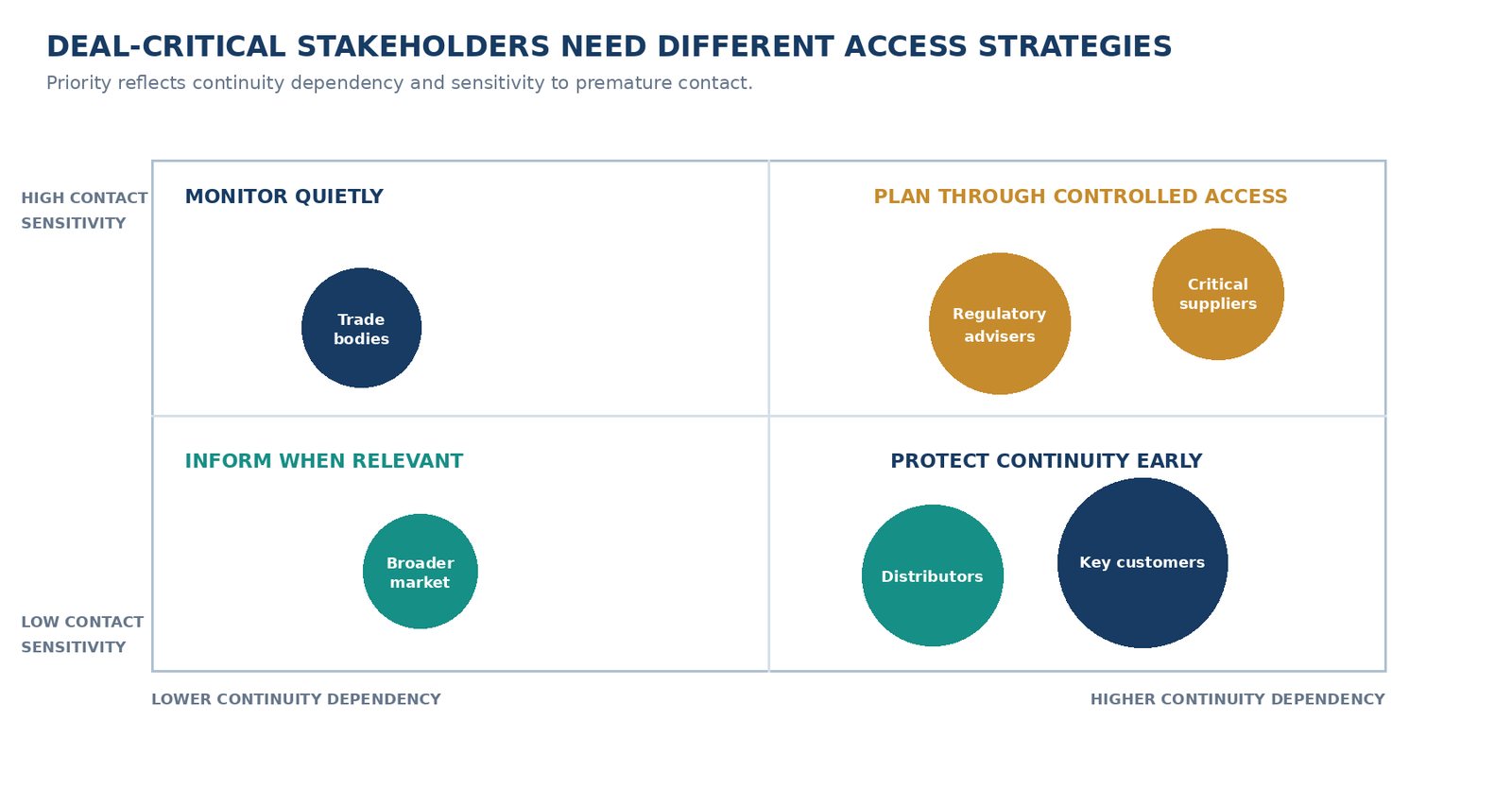
The hypothetical analysis separated continuity dependency from the risk of premature engagement.
What the analysis indicated
CUSTOMER CONTINUITY WAS PERSON-DEPENDENT
Several important relationships relied on application knowledge and informal problem-solving held by a small number of people.
DISTRIBUTOR RIGHTS NEEDED EARLY CLARITY
Uncertainty around territory, ownership and support could weaken commitment even where product demand remained stable.
SUPPLIER CHANGE CONTROL COULD DELAY INTEGRATION
Specification, forecast and approval routines limited how quickly procurement or production could be consolidated.
CONTACT TIMING WAS A DEAL CONTROL
Some high-dependency stakeholders required protection planning before direct outreach became permissible.
DECISION PATTERN Protect high-dependency relationships through internal ownership, approved evidence and stage-specific contact plans rather than contacting every influential stakeholder early.
05 | DECISION AND DELIVERY
Turn the stakeholder map into a continuity plan
The output connected diligence evidence to announcement, close and first-100-day relationship actions.
Recommended decision sequence
1 SECURE OWNERSHIP
Assign internal responsibility for each critical relationship.
2 CLOSE EVIDENCE GAPS
Use approved blind or direct validation where permitted.
3 PLAN ANNOUNCEMENT
Tailor message, owner and timing by stakeholder.
4 PROTECT 100 DAYS
Track continuity signals and escalation actions after close.
What the client received
DEAL STAKEHOLDER REGISTER
Relationships classified by dependency, sensitivity, access and evidence status.
CONTINUITY RISK MAP
Customer, distributor, supplier and oversight dependencies connected to value at risk.
CONTACT-PERMISSION PLAN
Blind, approved, post-signing and post-close outreach routes.
100-DAY RELATIONSHIP PLAN
Owners, messages, evidence, monitoring signals and escalation actions.
Delivery
TIMING
Approximately six weeks
WORKING OUTPUTS
Restricted weekly risk and evidence review
FINAL DELIVERY
Editable register, contact plan and deal-team readout
The timeline is illustrative and depends on stakeholder availability, access permissions, recruitment feasibility and client review time.
STUDY BOUNDARY The engagement would not provide legal, regulatory or financial due diligence, contact restricted parties without approval or guarantee stakeholder retention. It would make relationship dependencies and evidence gaps visible for the deal team.
Contact Us
MAP THE RELATIONSHIPS BEHIND DEAL VALUE
Tell us the transaction stage, markets and permitted outreach boundary. We will design the stakeholder universe and evidence plan around continuity risk and deal control.