STAKEHOLDER MAPPING | ILLUSTRATIVE ENGAGEMENT
Who must own each hand-off in a digital eye-screening referral service?
A referral-ownership study across three service districts in West Java, Indonesia
THE BUSINESS DECISION A healthcare-services company was considering a digitally supported eye-screening pathway linking community referral points, image capture, clinical review and receiving eye services. Before selecting operating partners, the client needed to understand who would initiate, accept, route, receive and close each referral.
24 ORGANISATIONS
Mapped referral ecosystem
18 INTERVIEWS
Six pathway roles
3 DISTRICTS
Different access conditions
6 WEEKS
Illustrative delivery window
Why the setting mattered
The service could not be designed as one national pathway. Referral habits, travel time, clinic capacity, connectivity and the availability of screening or specialist services could differ across districts. Geography therefore shaped which stakeholders were included and which hand-offs required local validation.
What the study needed to resolve
- Who can identify eligible people and offer screening without disrupting existing care?
- Which role owns consent, image capture, result communication and urgent escalation?
- How is referral acceptance confirmed between the digital service and receiving provider?
- Who follows up when a person does not attend or cannot be reached?
WHY INDEPENDENT RESEARCH MATTERED A vendor-led discussion could encourage participants to comment on the technology while avoiding unresolved ownership and workload questions. Independent interviews allowed each organisation to describe practical limits, incentives and hand-off failures without being asked to endorse a platform.
All organisations, participant counts and findings in this example are hypothetical. They demonstrate a realistic research design and are not presented as market evidence.
02 | STAKEHOLDER UNIVERSE AND OUTREACH
Map ownership around the referral, not around the platform
Twenty-four hypothetical organisations were classified by the action they could initiate, receive, verify or recover.
Interview coverage
PRIMARY AND COMMUNITY REFERRERS
4 interviews
EYE SERVICES AND CLINICAL REVIEW
3 interviews
SCREENING AND DIGITAL OPERATORS
3 interviews
PHARMACY OR COMMUNITY HEALTH NODES
3 interviews
HEALTH ADMINISTRATION OR PAYERS
2 interviews
NAVIGATION AND COMMUNITY ORGANISATIONS
3 interviews
How the outreach worked
DISTRICT CELLS Start with three contrasting service areas rather than recruit one undifferentiated provincial sample.
NODE RECRUITMENT Identify organisations that create, receive or recover a referral event, then verify direct operational knowledge.
SEQUENTIAL FOLLOW-UP Use one interview to locate the next hand-off only where the responsible organisation is unclear.
ROLE-SPECIFIC STIMULUS Present the same proposed service but change the operational detail shown to each role.
Access and inclusion controls
- No organisation was treated as representing an entire district or health system.
- Current role, service location and direct pathway knowledge were verified before interview.
- Patient experience was not inferred from provider interviews; a separate patient study would be required.
INTERVIEW SCALE The 18 interviews covered six ownership roles across three district cells. If the live pathway contained additional hand-offs or materially different service nodes, the coverage would be expanded.
03 | RESEARCH METHOD
Referral-Ownership Chain Mapping
The approach reconstructed the complete referral as linked ownership events, then tested where responsibility, information or recovery could disappear between organisations.
01 DEFINE
Specify the service promise and referral start and end points.
02 TRACE
Reconstruct the current hand-offs in each district.
03 ASSIGN
Identify the role expected to own each action and signal.
04 TEST
Interview contrasting nodes where ownership is unclear.
05 REPAIR
Design confirmation and recovery rules for priority gaps.
Sample interview questions
PRIMARY OR COMMUNITY REFERRER Assume eligible adults can be offered image-based eye screening through a local referral point. At what moment could your team introduce the service, and what information or authority would be required before a referral could be created?
SCREENING OPERATOR The service would capture images locally and route them for review. Which identity, consent, image-quality and connectivity conditions would determine whether a case could leave your site as a valid referral?
CLINICAL REVIEWER Results may range from routine follow-up to urgent referral. What clinical information, service directory and escalation route would you need before assigning a destination and urgency?
RECEIVING EYE SERVICE A digital referral may arrive from several community sources. What minimum information and booking confirmation would allow your service to accept responsibility rather than return or silently queue the case?
PATIENT NAVIGATION OR COMMUNITY ORGANISATION Some people may not complete the next step because of travel, cost, understanding or competing priorities. What signal should trigger follow-up, and which organisation could realistically act on it?
WHY NO GENERAL SATISFACTION SURVEY The client was designing a responsibility system, not measuring broad approval. Targeted interviews were needed to reconstruct ownership and hand-offs. Patient research could be commissioned separately if the decision expanded to message testing or service experience.
04 | ILLUSTRATIVE FINDINGS
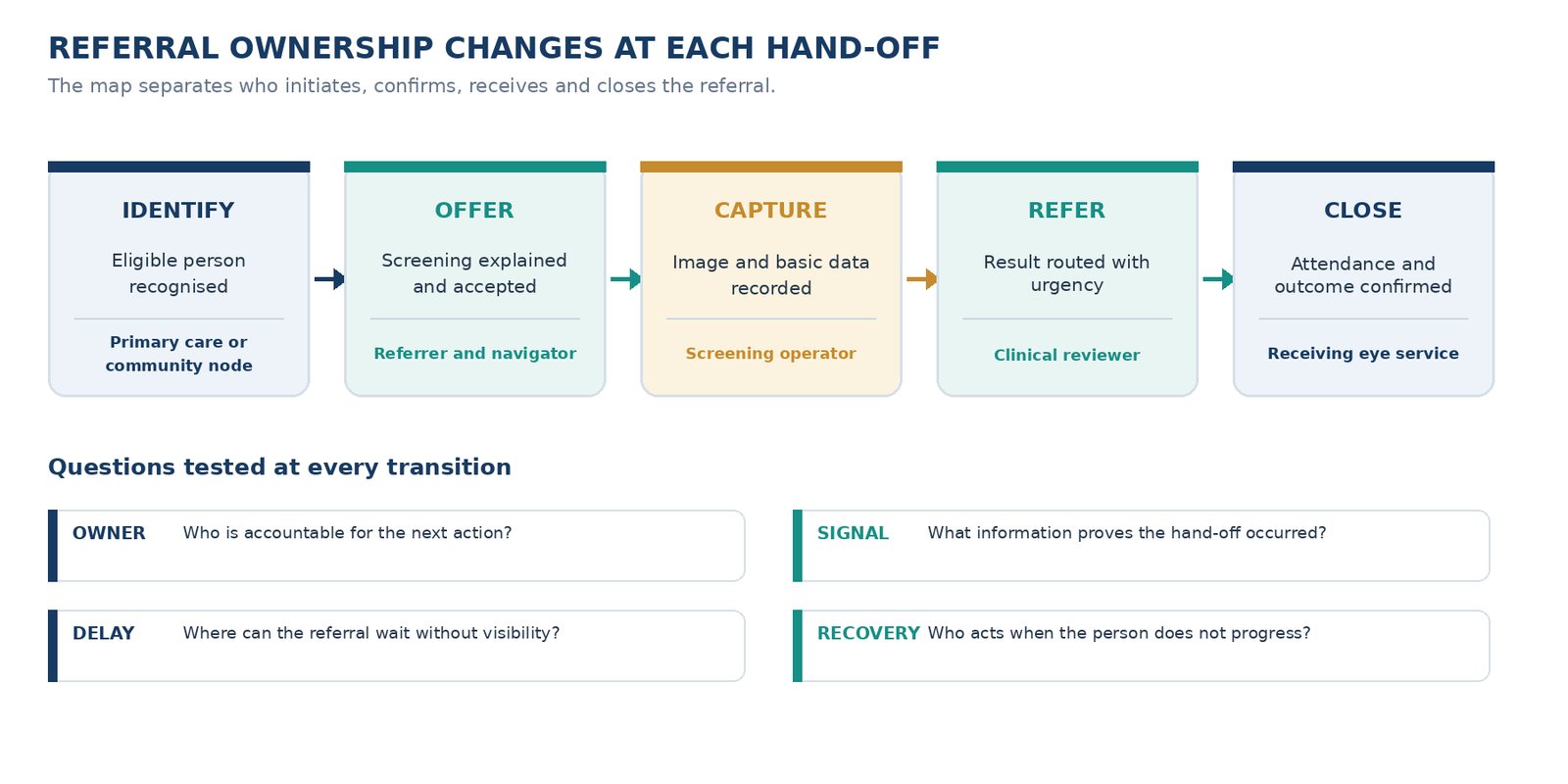
The weak point was not image capture but referral closure
The hypothetical analysis showed that technical completion and service completion were different events.
What the analysis indicated
INITIATION NEEDED A LOCAL OWNER
The pathway required a recognised referrer who could explain the service and create a traceable starting record.
ACCEPTANCE NEEDED CONFIRMATION
Sending a result did not transfer responsibility unless the receiving service acknowledged the referral and next action.
URGENCY NEEDED A ROUTE
Clinical urgency required a destination rule that matched local capacity rather than a generic escalation label.
NON-ATTENDANCE NEEDED RECOVERY
The model required a defined signal, permitted contact route and accountable follow-up role when progress stopped.
DECISION PATTERN Select partners only where initiation, acceptance, escalation and closure ownership can be demonstrated for the local referral pathway.
05 | DECISION AND DELIVERY
Turn the referral map into an operating-partner design
The output showed which responsibilities had to be contracted, integrated or locally adapted before launch.
Recommended decision sequence
1 VERIFY NODES
Confirm available referral, screening and receiving roles by district.
2 ASSIGN OWNERS
Place one accountable role at every hand-off.
3 TEST SIGNALS
Check that acceptance, urgency and non-attendance can be seen.
4 PILOT LOCALLY
Trial one complete pathway before broader replication.
What the client received
REFERRAL-ROLE REGISTER
Organisations classified by action, jurisdiction, access and current evidence.
HAND-OFF OWNERSHIP MAP
Initiation, transfer, acceptance, escalation and closure responsibilities.
PARTNER REQUIREMENTS
Minimum operating, information and response conditions for each node.
LOCAL ADAPTATION LOG
District differences requiring a changed route, message or recovery action.
Delivery
TIMING
Approximately six weeks
WORKING OUTPUTS
Weekly pathway review and recruitment-risk updates
FINAL DELIVERY
Editable maps, responsibility register and partner-design readout
The timeline is illustrative and depends on stakeholder availability, access permissions, recruitment feasibility and client review time.
STUDY BOUNDARY The engagement would not provide clinical advice, validate diagnostic performance or represent any authority's position. It would organise available evidence and stakeholder perspectives around the operating decision.
Contact Us
DESIGN THE OWNERSHIP BEHIND YOUR SERVICE
Tell us the intended pathway, locations and decision window. We will build the stakeholder universe and outreach around the hand-offs that determine whether the service can operate.