PHASE 2 ILLUSTRATION 3 AGRICULTURAL INPUTS
Strategic Business Intelligence Biological Crop Inputs
An illustrative decision case for a crop input company sequencing biological products across four European markets
DECISION
PORTFOLIO
PROGRAMME
HORIZON
Market sequence
8 candidates
EUR 12m
2026 to 2029
Decision question
Should the company accelerate eight biological fungicide and seed treatment candidates across Spain, Italy, France and Poland, or protect the conventional portfolio until registration, field performance and channel adoption are clearer?
Illustrative recommendation
Release a EUR 4 million first gate for two candidates in Spain and Italy, where the illustrative evidence combines a workable regulatory path, repeatable field performance, distributor sponsorship and acceptable grower economics. Continue targeted trials and registration work in France and Poland. Release the remaining EUR 8 million only when product and market evidence meet separate launch thresholds.
The hypothetical client is a European crop input company with a profitable conventional portfolio and eight biological candidates. The programme concerns crop protection and seed treatment rather than fertiliser claims. All client, product, trial, channel, farmer, competitor, financial and scoring values are illustrative.
Decision Evidence Lattice
A biological product can be technically promising and still fail commercially if the authorised use is narrow, performance varies by season, distributors do not support demonstrations or the grower cannot see a reliable return. The evidence ladder evaluates each product and market pair rather than treating biologicals as one category.
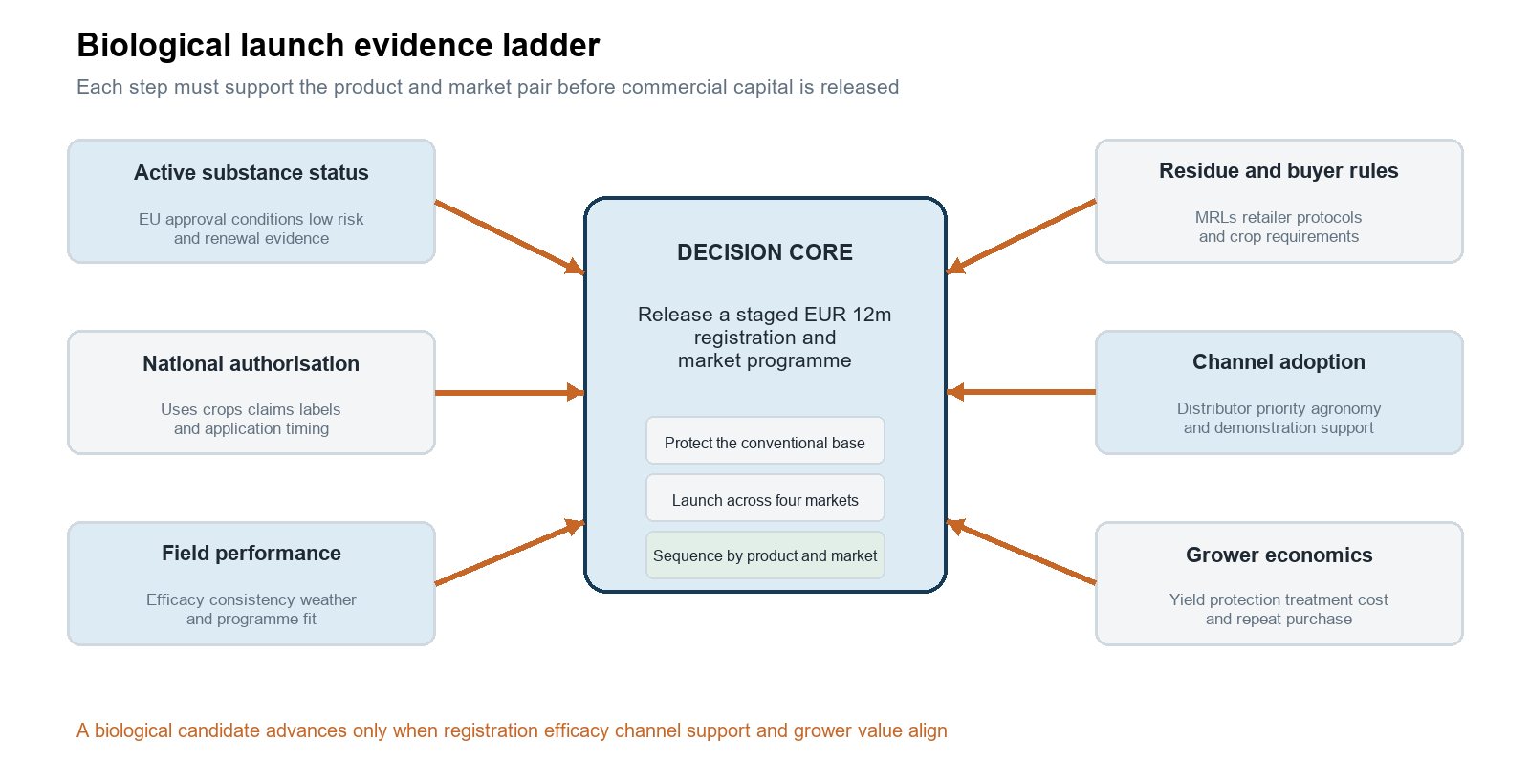
Decision condition | Illustrative interpretation | Effect on the route |
|---|---|---|
Regulatory path | Two candidates have an illustrative route that matches the intended crop and claim in Spain and Italy | Fund the dossiers and evidence gaps for those uses first |
Field consistency | Three seasons of trials show acceptable performance in the target programme for the two lead candidates | Move from exploratory trials to launch confirmation |
Channel sponsorship | Six distributors will support demonstrations, agronomist training and first season inventory | Concentrate commercial preparation where local support exists |
Grower value | The lead offers remain economic under the defined yield, disease pressure and treatment cost cases | Use a product and crop specific value claim rather than a broad sustainability claim |
Signal interpretation and source architecture
EU active substances, including micro-organisms, are assessed at Union level under Regulation EC 1107 2009, while plant protection products are authorised by Member States. The EU Pesticides Database, EFSA conclusions and national registers establish the regulatory evidence. Field and commercial readiness still have to be tested market by market.
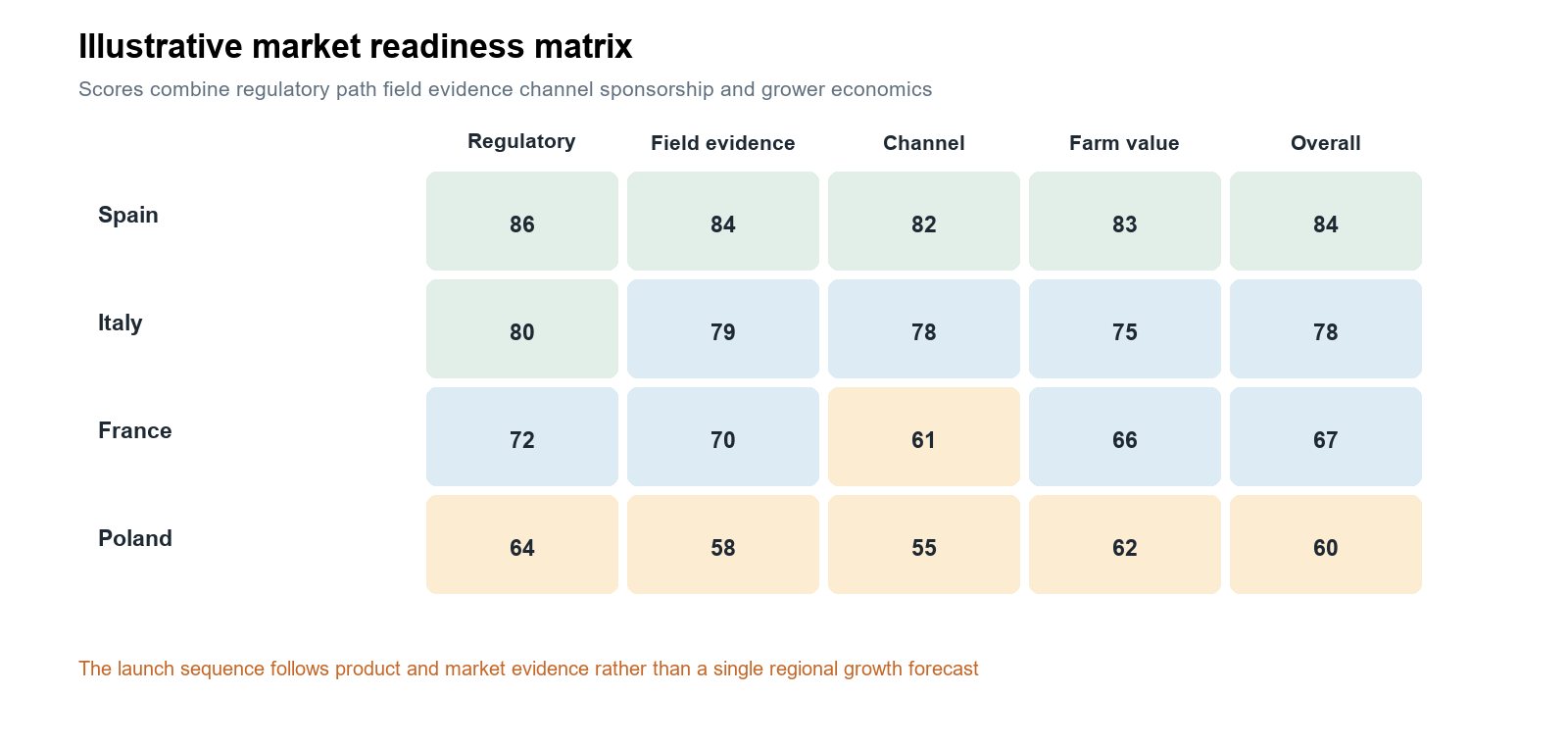
Evidence stream | Representative source route | Decision use |
|---|---|---|
Regulation | EU Pesticides Database, Official Journal, EFSA conclusions and national plant protection product registers | Confirm active substance status, authorised uses, conditions, MRLs and dossier timing |
Field performance | Official trial protocols, peer reviewed studies, extension services, client trials and weather records | Test consistency by crop, disease pressure, geography and application programme |
Channel and adoption | Distributor catalogues, agronomy programmes, demonstration events, tenders, product labels and client sell out records | Measure sponsorship, competing recommendations and repeat use |
Farmer economics | Eurostat agricultural input prices, crop prices and yields, national farm accounts and client treatment costs | Build product and crop level return cases under changing seasons and prices |
Portfolio allocation and transition sequence
The programme is split by product and market evidence. Registration status does not prove field consistency, and strong trials do not prove that a distributor or grower will adopt the offer. Each candidate moves only when the linked regulatory, agronomic and commercial case is sufficient.
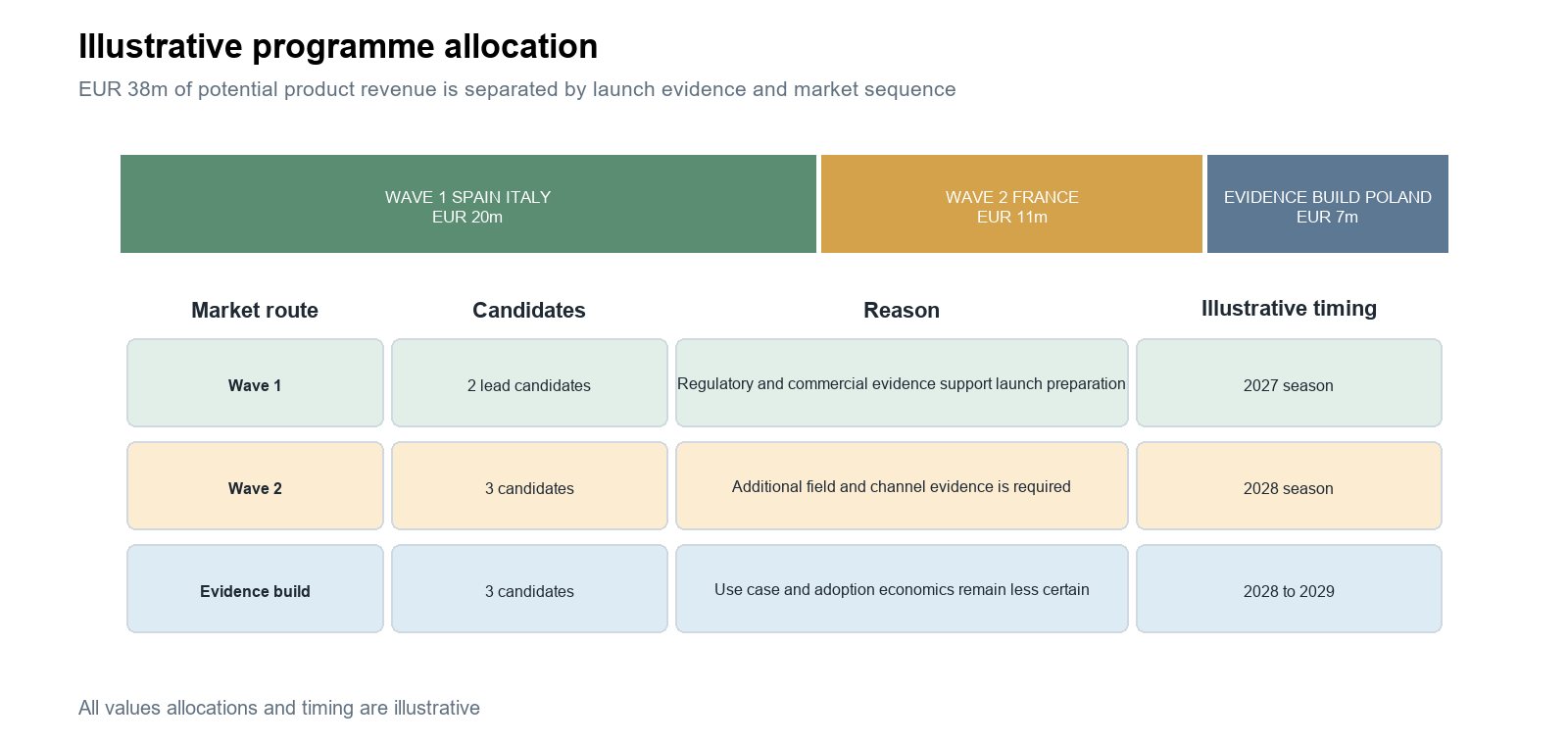
Market route | Evidence to confirm before release | Management treatment |
|---|---|---|
Wave 1 Spain and Italy | Authorised use path, repeatable efficacy, distributor plan, local crop economics and inventory assumptions | Fund dossier completion, demonstrations and a controlled first commercial season |
Wave 2 France | Additional local trials, buyer protocols, adviser support and price position | Continue evidence work without committing full launch spend |
Evidence build Poland | Use case priority, trial consistency, channel economics and fit with the conventional programme | Narrow candidates before market preparation |
The allocation remains provisional until the relevant evidence passes the stated decision threshold.
Decision routes and pressure cases
Protecting the conventional portfolio preserves earnings but can delay learning and channel access. Launching all candidates across four markets spends ahead of local evidence. A sequenced launch creates commercial evidence in the strongest product and market pairs while protecting the base business and the remaining development options.
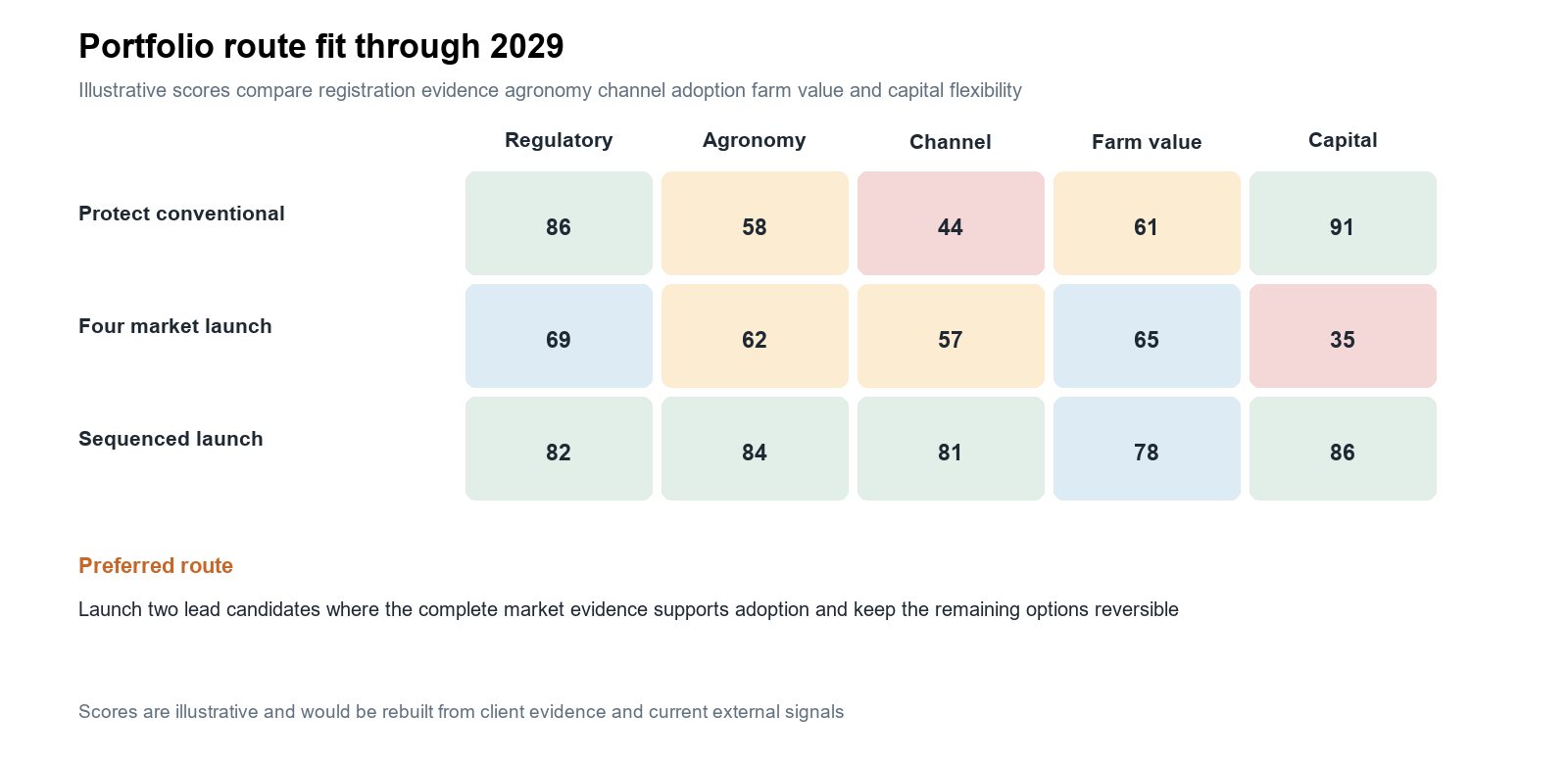
Pressure cases
- Approval timing moves by one season Shift launch spend to trials and channel preparation while avoiding inventory that depends on the delayed use.
- Disease pressure is unusually low Use multi season evidence and defined agronomic conditions rather than treating a weak season as a product failure.
- Distributor margin rises by six points Rebuild the farmer and company economics and narrow the channel plan if the launch cannot support both.
- A conventional active substance loses a key use Reassess the biological sequence where the gap is agronomically relevant and the authorised claim can serve it.
Recommended strategic decision
Approve the sequenced launch subject to six product and market gates. The first release funds two candidates in Spain and Italy and keeps the other six at defined evidence stages. A candidate cannot borrow readiness from another product or country.
Decision gate | Illustrative acceptance condition | Action if unmet |
|---|---|---|
Regulatory route | The intended substance, use, crop, claim and Member State path are documented | Do not set a launch date |
Field threshold | Local trials meet the minimum efficacy and consistency standard under the intended programme | Continue trials or narrow the claim |
Buyer acceptance | Residue, retailer and crop buyer requirements are compatible with the offer | Change the use case or market |
Channel commitment | Named distributors commit agronomy support, demonstrations and controlled inventory | Reduce geography or use direct support |
Grower economics | The return case remains acceptable across the agreed yield, price and disease pressure range | Reprice, reposition or stop |
Capital stage | The EUR 4 million gate produces evidence needed before the remaining EUR 8 million is released | Stop at the reversible gate |
What would change the recommendation
A weaker regulatory route, inconsistent local performance, limited distributor support or poor grower economics would delay a product and market pair. Earlier authorisation, strong repeat trial results and first season reorder evidence would support a faster second wave.
Decision control plan
Management would review substance and product decisions, dossier milestones, field performance by condition, retailer protocols, distributor activity, demo conversion, farmer economics, competitor labels, inventory and repeat orders. Triggers would be defined for each product and market.
First one hundred and twenty days
- Fix the product and market pairs Define the eight candidates, intended uses, crops, claims, countries and the conventional products affected by each decision.
- Build the regulatory path Reconcile EU active substance evidence with national product authorisations and dossier requirements.
- Normalise the field evidence Compare trials by protocol, location, disease pressure, treatment programme and statistical quality.
- Test the adoption system Map distributors, agronomists, buyer requirements, demonstration plans and farmer return cases.
- Issue the first launch decision Select the two lead pairs and define the evidence needed to release the second gate.
What August Research would deliver
- Product market evidence lattice A source linked view of regulation, field performance, channel readiness and grower economics.
- Readiness matrix Comparable product and country scores with evidence strength and unresolved gaps.
- Portfolio sequence Candidates assigned to launch, continue evidence or stop decisions.
- Adoption pressure test Weather, approval, channel and farm economy cases with decision breakpoints.
- Decision control plan Indicators and actions for accelerating, delaying, narrowing or stopping each candidate.
Scope boundary
This illustration demonstrates secondary research and strategic decision analysis. It does not replace regulatory advice, dossier preparation, efficacy trials, residue studies, product authorisation, agronomic recommendation, label approval, demand generation or inventory planning.
The client, products, customers, competitors, projects, assets, financial values, scores, thresholds and recommendation are hypothetical. Official sources are included to demonstrate the evidence routes an engagement would use.