PHARMACEUTICALS | INDIA
Protecting ophthalmic production from hidden input dependencies
A Batch Continuity Dependency Trace for three sterile manufacturing sites
CLIENT DECISION Which excipient and sterile-packaging dependencies could interrupt ophthalmic drug production, and which response should be activated first?
Background
An ophthalmic-drug manufacturer needed a defensible view of the inputs behind scheduled batches at facilities in Hyderabad, Ahmedabad and Goa. Direct supplier records did not show whether apparently separate sources shared a manufacturing plant, regulatory file or sterile-packaging dependency.
3
MANUFACTURING SITES
16
CRITICAL INPUT RELATIONSHIPS
9
SUPPLIER PLANTS
5–14
WEEKS OF OBSERVED COVER
ILLUSTRATIVE ENGAGEMENT | The organisation, scope, figures, findings and conclusion below show how the service can be applied. They do not describe an actual client engagement.
RESEARCH DESIGN
Batch Continuity Dependency Trace
The unit of analysis was not the supplier. It was the scheduled batch. Each required input was traced from specification and approved source to manufacturing site, documentation status, replenishment lead time and available substitute.
01
Define the batch
Link ophthalmic products, planned runs and bill-of-material requirements.
02
Resolve approved sources
Separate trading names from the legal entity and physical manufacturing plant.
03
Trace qualification
Connect specifications, quality documents and approved supplier status to each input.
04
Calculate time to impact
Compare inventory cover, replenishment lead time and the next affected batch.
05
Test the substitute path
Estimate the documentation, testing and change-control work required before use.
Evidence assembled
- regulatory and pharmacopoeial requirements
- trade and shipment evidence
- quality-event and change-control records
INDEPENDENT VALUE A common evidence structure reconciles internal records with external entity, facility, trade, capacity and event evidence. Assumptions that cannot be confirmed remain visible rather than being converted into false precision.
DEPENDENCY FINDING
One closure-system dependency reached the batch plan first
The critical exposure was not the input with the longest nominal lead time. It was a sterile bottle-and-dropper system used across two product families, with one approved plant and insufficient cover to complete an alternative qualification before the first affected batch.
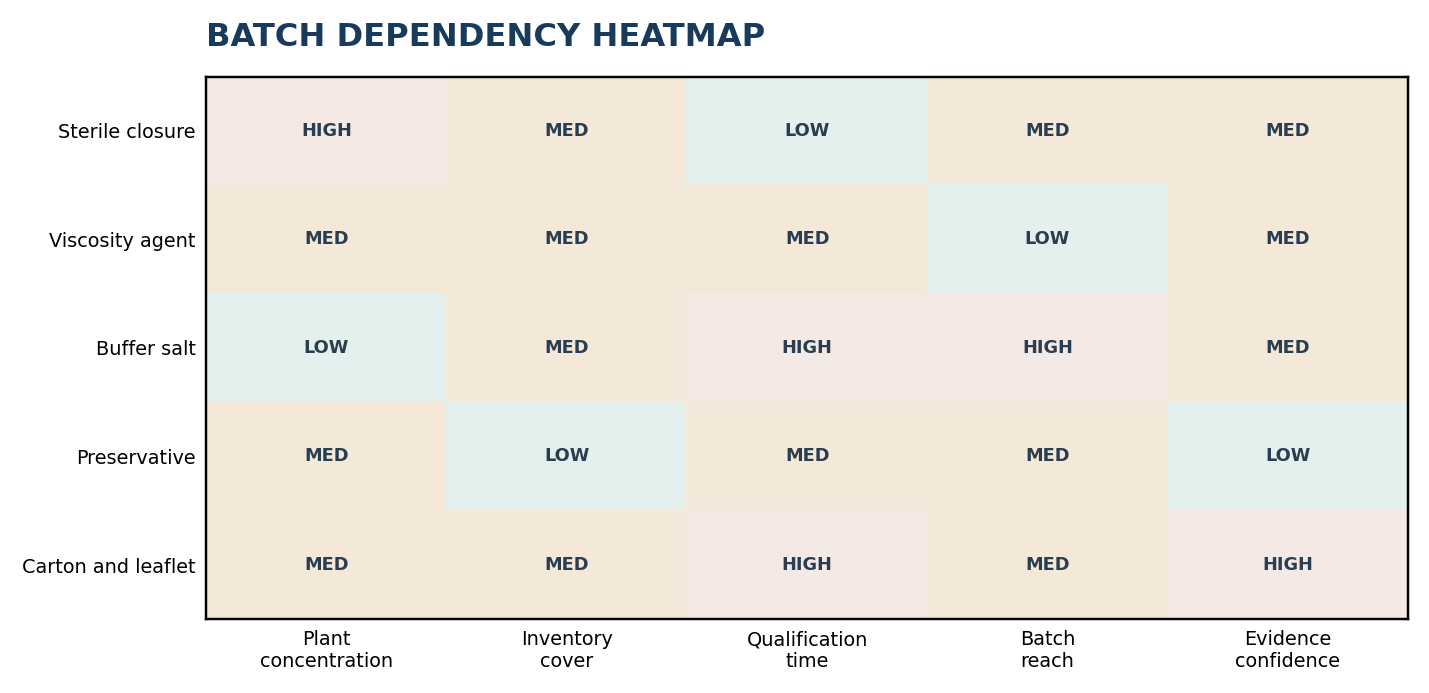
- The sterile closure reached two product families through one approved plant.
- Longer-lead excipients were less urgent because approved alternatives and inventory cover overlapped.
- Ownership resolution revealed two apparently separate sources with a shared upstream site.
All values shown are illustrative and would be rebuilt from the agreed product scope and available evidence.
STRESS AND RESPONSE
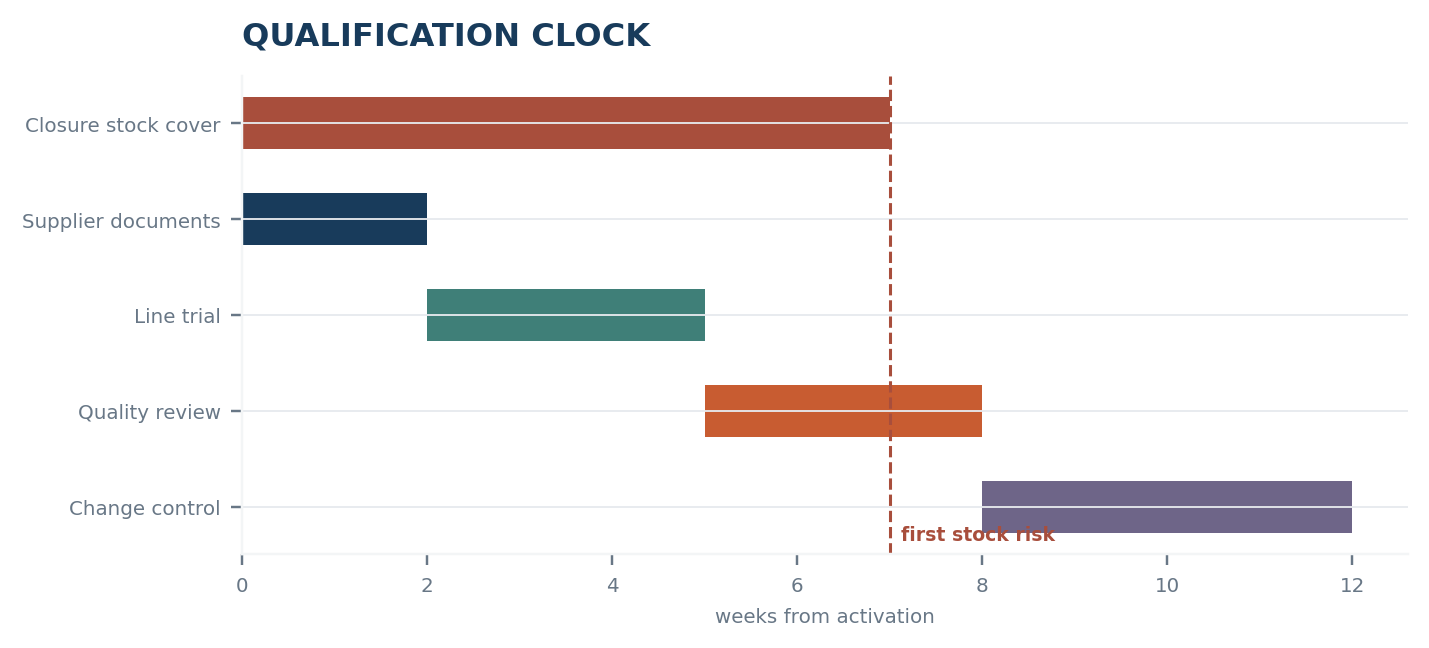
Response timing was tested against the qualification clock
The study compared the date at which stock would fall below the production requirement with the work needed to approve a replacement. A documentation-only response was separated from routes requiring extractables testing, line trials or regulatory change control.
Response logic
Decision point | Action |
|---|---|
Before the threshold | reserve stock by batch criticality and obtain the missing supplier file |
Qualification path | run closure testing and line trials in parallel where governance permits |
If disruption occurs | resequence batches to protect the lowest-cover product family |
DECISION OUTCOME
What the analysis would support
ILLUSTRATIVE CONCLUSION Begin second-source qualification for the closure system immediately, ring-fence existing inventory by batch criticality, and monitor two excipient relationships where shared manufacturing ownership could create correlated disruption.
What the client receives
batch-to-input dependency register | approved-source and plant map |
|---|---|
inventory-to-impact calendar | substitute qualification workplan |
evidence confidence log |
Delivery
Typical delivery: 6–8 weeks, depending on SKU breadth and access to client qualification records.
The final scope is set by the product, geography, tier depth, time horizon and decisions the study must support. Outputs can be supplied as an executive briefing, editable data model and monitoring specification.
Contact Us
DISCUSS YOUR SUPPLY CHAIN QUESTION Tell us which product, facility, sourcing decision or continuity concern you need to examine. August Research will define the dependency boundary, evidence plan and decision outputs around that question.