FOOD & BEVERAGES | WEST AFRICA TO EUROPE
Rebalancing cocoa exposure across origins, grinders and ports
An Origin-to-Grind Flow Balance for a European chocolate portfolio
CLIENT DECISION How exposed is the portfolio to cocoa-grinding capacity, port concentration and alternate-origin constraints?
Background
A European chocolate producer wanted to understand whether nominal origin diversification would still protect supply after quality, certification, grinding format and port-route constraints were applied. The decision concerned contracting for the next crop cycle, not a broad commodity outlook.
92 kt
ANNUAL COCOA-EQUIVALENT NEED
4
ORIGIN COUNTRIES
6
GRINDING LOCATIONS
5
PORT CORRIDORS
ILLUSTRATIVE ENGAGEMENT | The organisation, scope, figures, findings and conclusion below show how the service can be applied. They do not describe an actual client engagement.
RESEARCH DESIGN
Origin-to-Grind Flow Balance
The analysis converted beans, liquor, butter and powder into a comparable cocoa-equivalent balance. Volumes were then constrained by origin suitability, certified availability, grinder capability, port route and the portfolio's formulation requirements.
01
Normalise the requirement
Translate recipes and intermediate products into cocoa-equivalent demand.
02
Build origin flows
Reconcile production, exports, processor footprints and shipment routes.
03
Apply usability filters
Remove volume that does not meet quality, certification, format or timing needs.
04
Balance grind and route
Test whether processor and corridor capacity can carry the required mix.
05
Recontract the portfolio
Set origin, grinder and route ranges that remain workable under pressure.
Evidence assembled
- crop and grinding statistics
- trade and customs records
- processor and facility disclosures
- port and vessel-flow data
- certification and traceability requirements
- client recipes, contracts and inventory
INDEPENDENT VALUE A common evidence structure reconciles internal records with external entity, facility, trade, capacity and event evidence. Assumptions that cannot be confirmed remain visible rather than being converted into false precision.
DEPENDENCY FINDING
Diversified origins still converged on one operating corridor
Four origin countries created the appearance of diversification, yet 48% of usable cocoa-equivalent volume depended on one port-to-grinder corridor after certification and product-format constraints were applied.
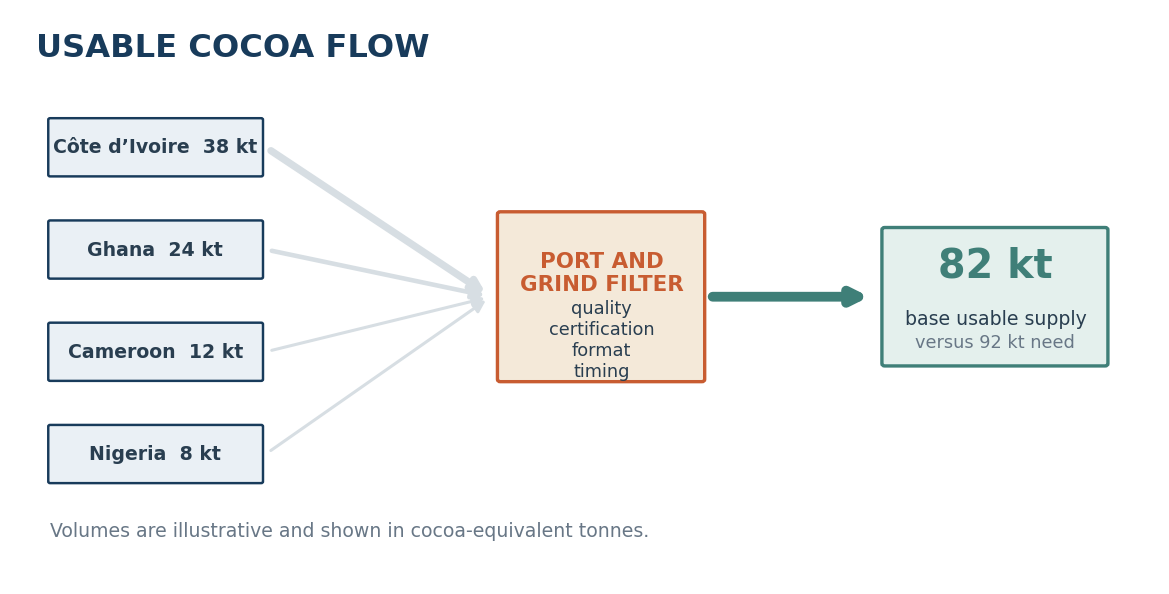
- Certification and format requirements removed part of the nominally available volume.
- Origin diversity did not remove corridor concentration after grinding and port routes were applied.
- The base balance remained below the full annual requirement before a compound disruption was tested.
All values shown are illustrative and would be rebuilt from the agreed product scope and available evidence.
STRESS AND RESPONSE
The portfolio was rebalanced under three linked shocks
The model combined an origin shortfall, a temporary port delay and reduced grinding availability. Alternative supply was counted only when it could arrive in the required format and satisfy the portfolio's traceability and quality conditions.
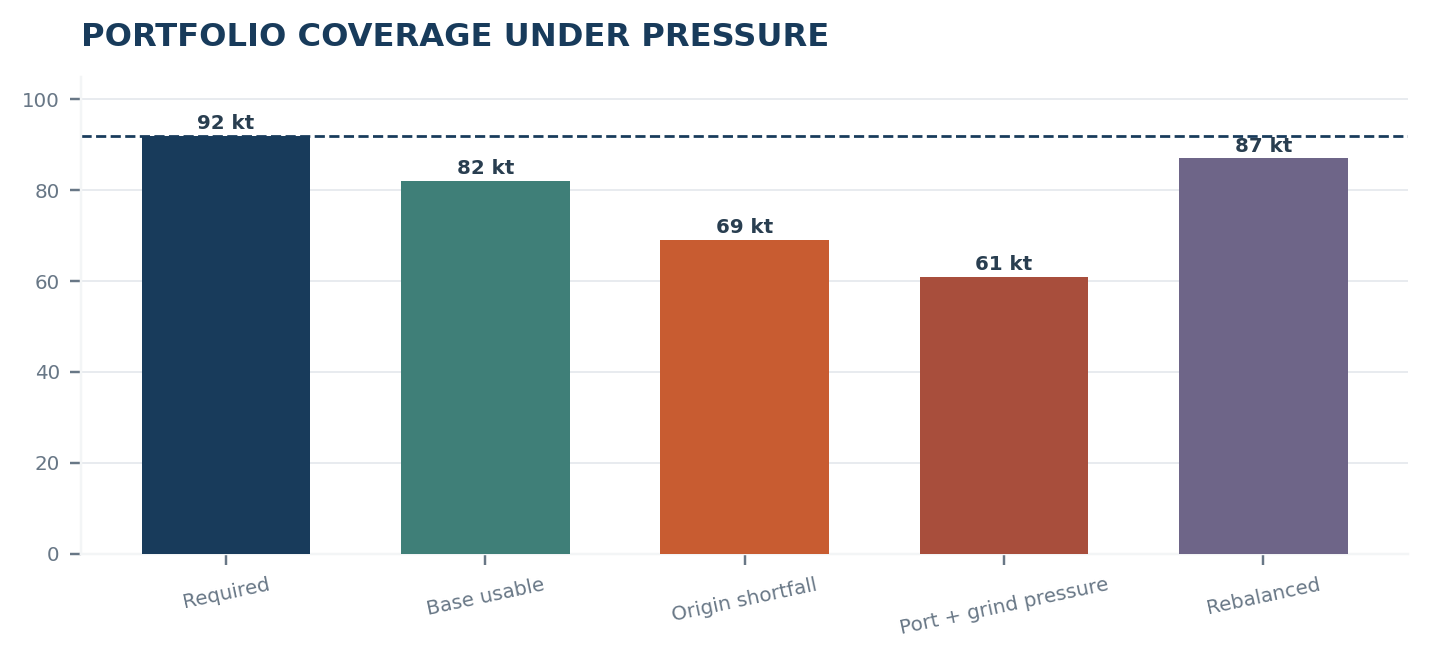
Response logic
Decision point | Action |
|---|---|
Contracting | set origin and grinder ranges instead of a fixed single-source allocation |
Logistics | reserve alternate port capacity before the main crop movement |
Under pressure | prioritise usable formats and recipes with the lowest conversion penalty |
DECISION OUTCOME
What the analysis would support
ILLUSTRATIVE CONCLUSION Shift part of the next contracting cycle to a second European grinding location, reserve alternate port capacity before the main crop movement and maintain an origin range rather than a single replacement country.
What the client receives
origin-to-product flow model | grinder and port corridor map |
|---|---|
usable-volume reconciliation | contracting range by origin |
scenario coverage dashboard |
Delivery
Typical delivery: 7–9 weeks, depending on product-format detail and access to contract volumes.
The final scope is set by the product, geography, tier depth, time horizon and decisions the study must support. Outputs can be supplied as an executive briefing, editable data model and monitoring specification.
Contact Us
DISCUSS YOUR SUPPLY CHAIN QUESTION Tell us which product, facility, sourcing decision or continuity concern you need to examine. August Research will define the dependency boundary, evidence plan and decision outputs around that question.